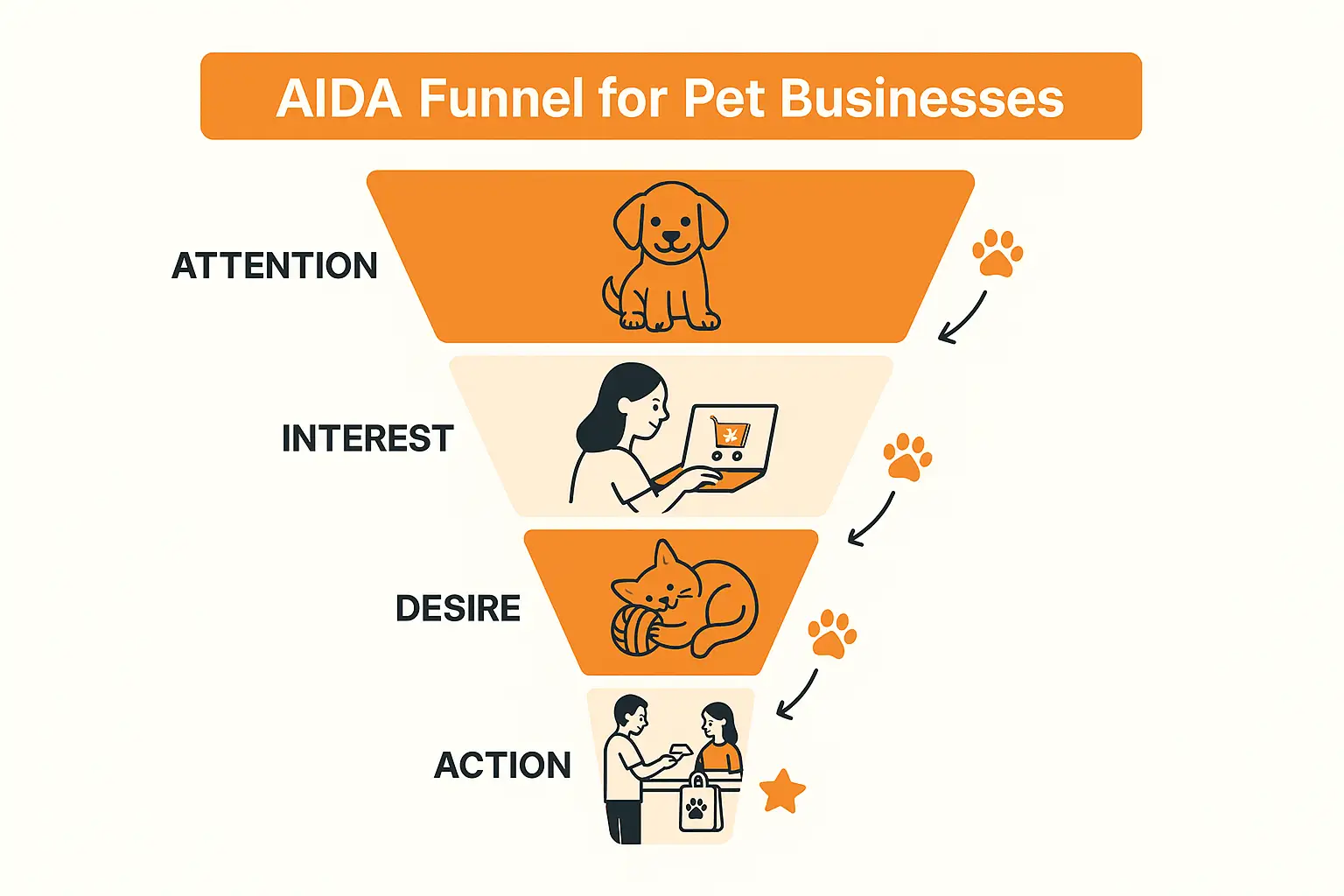
AIDA stands for Attention, Interest, Desire, and Action. It's a classic marketing model that maps out the psychological stages a customer goes through before making a purchase. First, you grab their Attention, then build their Interest, stir up Desire, and finally, drive them to take Action.
In the pet business, this model becomes incredibly powerful. Pet owners are emotionally attached to their animals. They don't just shop—they connect, research, compare, and want the best for their furry friends. Applying the AIDA model helps pet businesses communicate with customers in a way that feels personal, trustworthy, and value-driven.
Each stage of the funnel has a job:
Without AIDA, your marketing becomes scattered. But with it, you guide pet owners step by step—until they’re ready to click “Buy Now.”
The AIDA model has been around since the late 19th century, first introduced by American advertising and sales pioneer Elias St. Elmo Lewis. Over the decades, it's evolved and adapted to fit new marketing landscapes—from print ads to social media, from cold calling to TikTok videos.
Originally used in door-to-door sales, the model has expanded into virtually every digital marketing strategy we see today. In the pet industry, it’s particularly relevant. Why? Because it breaks down a complex, emotional buying decision into simple, repeatable steps.
In today’s digital-first world, the AIDA model has also grown more sophisticated. You can track each stage with tools like email analytics, ad retargeting, and behavior-based segmentation. It’s not just about selling—it’s about building relationships.
In a world flooded with ads and options, attention is the most valuable currency. You’re not just competing with other pet brands—you’re fighting for mental real estate against memes, DMs, and distractions.
The AIDA funnel gives your marketing clarity. It ensures you're not rushing customers or wasting money targeting the wrong people. Instead, you move them through a thoughtful journey that ends with a confident, happy purchase.
Especially in the pet niche, where emotional buying and loyalty are high, the AIDA model helps businesses speak to the heart of the customer. It’s not just a funnel—it’s a bridge between your brand and a pet owner who wants to do what’s best for their beloved companion.
Every pet business owner knows the theory: Attention, Interest, Desire, Action. But turning the AIDA funnel into real sales isn’t about guesswork—it’s about execution. That’s where Petbase.ai changes the game.
Unlike generic marketing tools, Petbase.ai is built specifically for the pet industry. It doesn’t just help you create content; it designs complete funnels that speak to the unique emotions and behaviors of pet owners. From eye-catching blog posts and social campaigns that grab attention, to educational authority clusters that spark interest, to emotionally driven product pages that build desire, all the way through seamless CTAs that drive action—Petbase.ai automates and aligns every step.
For pet shops, trainers, vets, and service providers, this means no more scattered marketing. With Petbase.ai, you get a funnel that reflects how pet owners actually think, research, and buy. The result? More trust, more conversions, and more wagging tails in your customer base.
Start posting content that attract pet owners and turns them into customers - today!
The pet industry is booming. According to recent market data, global spending on pets is projected to surpass $350 billion by 2027. More people are adopting pets, treating them as family, and spending on premium goods—from organic food to personalized accessories.
Here are some standout trends:
This booming industry is also highly competitive. If you're running a pet business, from eCommerce to grooming, you need more than just a cute logo. You need a strategy—and AIDA helps you map one.
Virtually every pet-related business can implement the AIDA funnel effectively. Here’s how different segments apply it:
In all cases, the funnel remains the same. Only the tools and messaging differ depending on your audience.
Pet owners are unique consumers. They’re emotionally driven, fiercely loyal, and willing to spend more for quality and trust.
Here’s what defines them:
If your funnel doesn’t address these behaviors—especially the emotional side—you’ll lose customers to more thoughtful competitors. AIDA ensures you’re checking every box along their journey.
A – Attention: Grabbing the Pet Lover’s Eye
Getting attention in the pet world means standing out—visually and emotionally. You’ve got milliseconds to stop a scroll, spark curiosity, or get a click.
Here’s what works:
Whether you’re using paid ads, social media, or content marketing, your goal is to stop the scroll. Make them feel something—then earn their next click.
These brands understand that attention isn’t about shouting the loudest. It’s about resonating deeply—and quickly—with the right audience.
The right tools can make a big difference at the attention stage:
A successful pet business grabs attention with authenticity, relevance, and cuteness—lots of cuteness.
Once you’ve captured their attention, the next step is keeping it. Interest is built through education, value, and emotional engagement. In the pet niche, this is your opportunity to show you care about their pet just as much as they do.
How to build interest:
People want to buy from businesses that feel human and helpful—not pushy or distant.
The pet industry is filled with emotion. The right message can instantly connect you with your audience.
Here are key emotional triggers:
Your content should speak to their hearts, not just their wallets.
Trust is everything in the interest phase. That’s where social proof comes in.
Use:
When pet parents see others raving about your brand, they’re more likely to stick around and explore further. Combine that with helpful blog content and they’ll start to see you as more than a seller—you become a trusted resource.
D – Desire: Creating a Craving for Your Product
Once you've grabbed their attention and held their interest, the next challenge is turning those warm feelings into a burning desire. In the pet business, this step is all about connecting emotionally and positioning your product as the ultimate solution to a pet owner’s problem—or the perfect treat for their furry friend.
To build desire, focus on the transformation. Show how your product enhances the pet’s life:
Use storytelling. Share how a rescue dog transformed after using your product, or how a picky eater now licks the bowl clean. When customers can see the change, they start to feel the need.
Another method? Show the exclusivity of your product. Make it feel special:
Humans want what they can’t always have. Use scarcity and social proof to your advantage. Show that your product is not just good—it’s in demand and loved.
Let’s look at real-life examples of pet brands who have turned interest into desire:
In every case, the focus is emotional value, not just product specs.
Creating desire isn’t just about being emotional—it’s also about being strategic. Scarcity and urgency drive people to act now rather than “later” (which often becomes never).
When these psychological triggers are combined with genuine storytelling and value, desire skyrockets—and the sale becomes inevitable.
Now comes the moment of truth—getting the customer to take action. After nurturing them through the funnel, your goal is to make the buying decision easy, quick, and trustworthy.
Here’s how:
It’s not enough to make people want your product. You have to guide them—gently but confidently—toward the finish line.
The real success of the AIDA funnel isn’t just in making a sale—it’s in turning that one-time buyer into a loyal, repeat customer. This is where the magic of customer retention begins.
Here’s how to loop them back into your funnel:
Keep providing value after the purchase, and you’ll not only retain a customer—you’ll gain a raving fan.
Every pet business—regardless of size—can build a winning strategy using the AIDA framework. But it’s not one-size-fits-all. You need to customize your approach based on your offerings.
Let’s break it down:
Audit your current strategy and ask: Where are you losing customers? Which stage of the funnel is leaking? Focus on tightening those gaps with AIDA.
Implementing the AIDA funnel successfully requires smart tools that align with each stage.
Bonus: Use analytics platforms like Google Analytics, Hotjar, or Crazy Egg to see how users flow through your funnel—and where they drop off.
BarkBox is the gold standard in applying AIDA in the pet business:
They make every stage delightful and emotion-packed. And it works—millions of pet parents subscribe.
You don’t need a giant marketing budget to win with AIDA. Small pet businesses are using local SEO, community events, and heartfelt social media to attract and convert loyal customers.
For example:
With AIDA, even the smallest fish can swim strong in a big pond.
The AIDA funnel isn’t just a marketing theory—it’s the heartbeat of a successful pet business. By guiding pet owners through a journey of attention, interest, desire, and action, you connect on a deeper level and build lasting relationships.
When applied thoughtfully, AIDA turns strangers into loyal buyers—and pet lovers into brand ambassadors. In a space as emotional, passionate, and competitive as the pet industry, it’s the one marketing framework you can’t afford to ignore.
So whether you're running a pet eCommerce brand, grooming service, or vet clinic, embrace the funnel—and watch your business grow, one tail wag at a time.
Try Petbase today and grow your pet business traffic on autopilot!
1. How does AIDA help increase customer loyalty in the pet business?
It builds trust through emotional connection and consistency. Once pet owners feel understood and valued, they return—and tell others.
2. Can the AIDA funnel work for pet service providers like vets or groomers?
Absolutely. From grabbing attention with pet tips to booking appointments online, AIDA works just as well for services.
3. What's the best way to get more repeat customers using AIDA?
Follow up after purchase, offer loyalty rewards, and keep providing value with newsletters, tips, and personalized offers.
4. Do I need paid ads to make AIDA work?
Not necessarily. Organic strategies like content marketing, email, and social media can effectively move users through the funnel.
5. How do I know which part of my AIDA funnel is weak?
Track analytics. High bounce rates = Attention issues. Low email opens = Interest issues. No conversions = Desire or Action gaps.