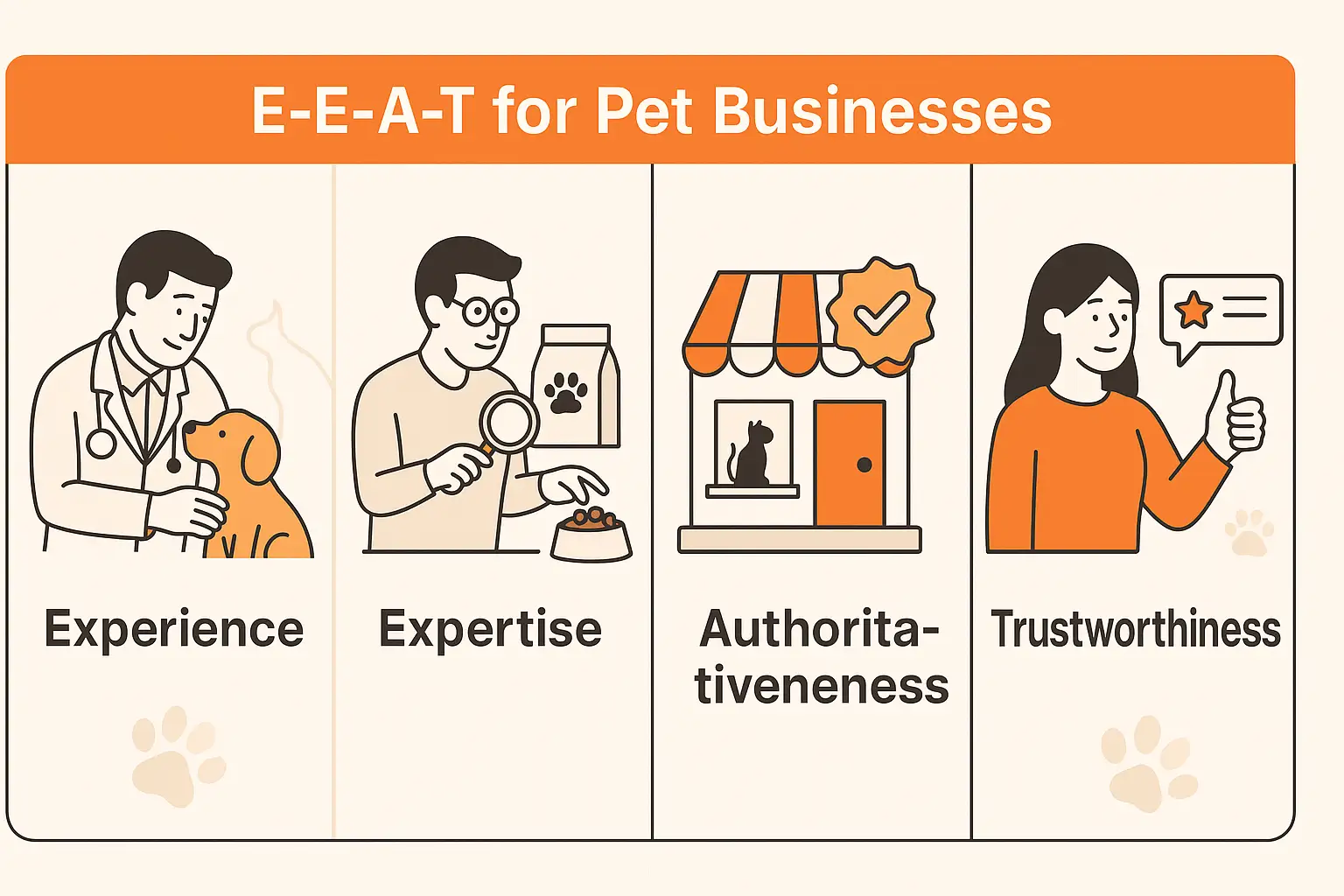
EEAT stands for Expertise, Authoritativeness, and Trustworthiness—a concept emphasized by Google’s Search Quality Evaluator Guidelines. It's not just a buzzword; it's a set of core principles used to assess the quality of content, particularly in niches where misinformation can cause real harm, such as health, finance, and yes—even pet care.
But EEAT isn’t limited to life-or-death topics. For the pet industry, it’s becoming increasingly important. Pet owners see their pets as family. So when they search for pet food recommendations, training advice, grooming services, or health-related tips, they want to hear from experts who actually know what they're talking about.
Google's algorithm is designed to reflect that. If your site lacks real expertise or signals of authority, you're unlikely to rank well—no matter how great your design looks.
Google's goal is simple: deliver the most accurate, reliable, and helpful information to users. When it comes to pets, poor advice can lead to serious health issues or behavioral problems. That’s why Google increasingly favors content backed by credentials, experience, and user trust.
For pet businesses, this means you must go beyond just writing blog posts or selling products. You need to demonstrate that you know your niche inside and out—whether it’s through staff qualifications, customer reviews, or consistently accurate content. It’s not enough to say you’re good at what you do. You need to prove it online.
Building EEAT—Expertise, Authoritativeness, and Trustworthiness—is no longer optional for pet businesses. It’s the standard Google uses to decide which websites deserve visibility and which ones get buried. And while many tools talk about “content,” only Petbase.ai is designed specifically for the pet industry to turn your website into a recognized authority.
Petbase.ai doesn’t just generate articles. It builds structured topical authority clusters, interlinks your content intelligently, and ensures every piece of information signals credibility to both Google and your audience. That means whether you’re selling organic dog food, running a grooming salon, or offering online pet training, your website positions you as the expert—not just another store or blog.
In a market where trust is everything and competition is fierce, Petbase.ai gives pet businesses a shortcut to what matters most: being seen as the go-to authority. By embedding EEAT principles directly into your content strategy, it helps you rank higher, earn customer trust faster, and stand out as a reliable source in the pet space.
Start publishing quality content that converts - today!
The pet business isn’t what it used to be. What started as a niche sector has exploded into a global, multi-billion-dollar industry. Pet owners today are willing to spend big on products and services—from luxury pet grooming to organic dog treats and high-tech pet gadgets. But with growth comes competition.
In this crowded space, customers are more selective. They want to trust the brands they buy from and the businesses they support. And guess what? They’re doing their research online. According to surveys, over 85% of pet parents look up businesses or products before making a purchase.
EEAT comes into play right here. If your website doesn't show expertise, isn’t cited by others, or lacks trust signals like testimonials and security, potential customers will bounce faster than a tennis ball at a dog park.
Running a pet business today is not just about loving animals. You have to be tech-savvy, marketing-smart, and reputation-conscious. Here are some common digital challenges:
These issues make EEAT essential. Without it, your site may look “okay,” but Google and your customers will see it as lacking credibility.
In the pet niche, expertise isn’t limited to holding a veterinary license (though that helps). It’s about demonstrating practical, in-depth knowledge about your specialty—whether you're a dog groomer, a cat behaviorist, or someone who formulates organic pet food.
Google distinguishes between formal and everyday expertise:
What matters is authenticity and relevance. If you sell dog treats, have you talked about how you sourced the ingredients, consulted animal nutritionists, or tested your products? These are signals of expertise.
Let’s consider a few examples of how pet brands show off their expertise:
In short, the more real, useful knowledge you share—and the more it's backed by credentials or proof—the more Google will see your brand as a trusted expert.
Authority doesn’t happen overnight. It’s built over time with consistent, valuable, and engaging content that gets noticed. That means you need a strong content strategy tailored to your niche and audience.
Pet businesses that dominate Google aren’t just lucky—they’re content machines. They publish:
All of this content positions your brand as a go-to resource. The more people trust and reference your content, the more authoritative your site becomes in Google's eyes.
Authoritativeness also comes from external validation. Here’s how you can build it:
When others vouch for your business—whether they’re customers or institutions—it strengthens your authority both with users and search engines.
Trust is the glue that holds everything together. Without it, even the most expert or authoritative content falls flat.
What do pet parents look for when evaluating a website or business?
These seemingly minor details can drastically improve conversion rates and bounce times. Why? Because people buy from businesses they feel safe with.
If you make a mistake or receive a bad review, don’t hide it. Address it publicly and professionally. Pet owners value honesty and accountability.
Share your sourcing practices, safety protocols, or behind-the-scenes looks into your business. When customers see you’ve got nothing to hide, trust increases—and so does loyalty.
Let’s face it—most people searching for pet services or products are doing it from their phones. Whether it’s a frantic search for “emergency vet near me” or a casual browse for a new dog toy, mobile is the name of the game. That’s why mobile optimization is non-negotiable for any pet business aiming to boost EEAT.
Google's algorithm prioritizes mobile-first indexing, which means the mobile version of your site is what Google looks at first. If it’s slow, hard to navigate, or broken on mobile devices, your site could be penalized—even if your content is gold.
Here’s what pet businesses need to do:
For example, a pet grooming salon with a one-click booking option that works flawlessly on mobile will always outperform a clunky site that forces users to pinch and zoom just to find the contact form.
Security is a huge part of EEAT, especially when you’re collecting user data or processing transactions. At a minimum, your website must use HTTPS. Without it, both Google and your users will see a “Not Secure” warning—definitely not a trust booster.
A secure site:
Also, showcase trust badges like “SSL Secured,” “Trusted Checkout,” or affiliations with known pet organizations to make your credibility even more visible.
Content marketing isn’t about pumping out articles for SEO’s sake—it’s about educating, engaging, and earning trust. Pet businesses should create content that reflects their daily interactions with animals, customers, and industry challenges.
Here are a few content types that scream expertise:
Consistency is key. Updating your blog weekly or bi-weekly tells both users and Google that your site is active and trustworthy.
Authority isn’t built in isolation. You need to network in your niche—digitally. Start by:
These efforts lead to natural backlinks, a critical SEO signal, and boost your EEAT score across all pillars—expertise, authority, and trust.
For local pet businesses like grooming salons, vet clinics, or training centers, Google Business Profile (GBP) is your digital front door. It’s often the first impression potential customers get—and it's packed with EEAT signals.
Your GBP should be:
Add your credentials, highlight if your staff includes certified trainers or licensed vets, and upload real pet photos from satisfied clients. These help build trust and credibility before a user even visits your website.
To further improve EEAT on a local level, aim for:
Google loves this kind of real-world validation. A well-optimized GBP with tons of 5-star reviews and accurate citations can help a local pet groomer outrank national chains in nearby searches.
You might think publishing lots of short, keyword-stuffed blogs will do the trick. Think again. Google’s EEAT framework penalizes thin, low-value, or duplicate content—especially in industries where incorrect info could harm users or their pets.
Common mistakes:
If your content doesn’t demonstrate deep knowledge, don’t publish it. Instead, focus on quality over quantity, even if that means fewer posts.
EEAT isn’t just about what’s on your website—it’s about the experience people have with your brand. If you advertise “same-day grooming appointments” but can’t actually deliver, customers will leave negative reviews. These can hurt your:
Be honest and accurate in your service descriptions. Overpromising might get clicks, but underdelivering destroys trust.
Each type of pet business can tailor EEAT differently:
Also, emphasize pet-specific knowledge. A daycare that knows how to manage both high-energy puppies and elderly dogs with mobility issues demonstrates well-rounded expertise.
If you're selling products online, your EEAT efforts should go into:
You can also include blog posts that support your products—for example, “Why hypoallergenic dog treats matter” linking back to your line of treats. It’s not just content; it’s contextual authority.
Social proof is one of the most powerful trust-building tools a pet business can use. Why? Because people trust people—especially when it comes to their furry family members. If potential customers see real people raving about your services, they’re far more likely to trust you.
Here’s how to integrate customer testimonials effectively:
Also, tap into user-generated content (UGC). Encourage customers to post on Instagram or TikTok using your branded hashtag, and share those posts (with permission) on your website or social media. These posts act as mini endorsements and are highly EEAT-friendly because they’re authentic and organic.
Social media isn’t just a marketing channel—it’s a credibility engine. Regularly posting pet tips, behind-the-scenes peeks, and engaging with followers shows you’re active, informed, and invested in your community.
Do this to build EEAT on social platforms:
The more social validation you have, the more credible your brand appears not just to customers—but also to Google.
You can’t improve what you don’t measure. If you’re investing in EEAT, you need to track how it’s affecting your site’s performance. Start with tools like:
Track KPIs like:
Also, look at behavioral signals—like more time spent on your pages or repeat visits. These show that users not only found your content, but trusted and engaged with it.
Let’s look at an example: A small online pet boutique in Portland was struggling to get traffic despite great products. They revamped their content to highlight:
Within 6 months, their organic traffic doubled, and their average conversion rate increased by 35%. That’s the power of aligning your site with EEAT principles.
Not all content is created equal. Hiring a generic freelancer to write “10 Tips for Training Your Puppy” might save money now, but it won’t deliver lasting value. Instead, invest in:
High-quality content is your most valuable digital asset—treat it that way.
Google loves fresh content. Make it a habit to:
Set a quarterly schedule to keep your content sharp and relevant. EEAT isn’t a one-time push—it’s a sustainable strategy.
Google is only getting smarter. Future algorithm updates are likely to emphasize:
That means pet businesses need to stay ahead. Embrace video content, interactive tools (like pet weight calculators), and conversational blog writing. The more value and experience you offer online, the more likely you are to stay relevant in SERPs.
The best part about EEAT? Most small pet businesses aren’t doing it yet. That gives you a huge advantage. While competitors churn out generic content or focus only on ads, you’ll be building lasting SEO equity and a trustworthy brand.
Think of EEAT as your digital reputation. Build it like you would build a relationship—with honesty, consistency, and authenticity.
Expertise in EEAT is no longer optional—it’s the backbone of digital success for modern pet businesses. Whether you're a local dog groomer, a nationwide pet supply retailer, or a niche cat behavior consultant, implementing EEAT principles will boost your credibility, visibility, and customer loyalty.
From showcasing real expertise and earning backlinks, to building trust through transparency and mobile optimization, EEAT is a holistic approach that drives both SEO performance and real-world business results.
Don’t wait until your competitors outrank you—start weaving EEAT into every aspect of your online presence now. The future of pet businesses is digital, and trust is the currency.
Start by publishing high-quality, experience-based content, collecting real customer reviews, and showcasing credentials like certifications or staff bios. Even local businesses can dominate with trust and authority.
No, EEAT benefits your entire brand reputation. It helps increase conversions, build customer loyalty, and reduce refund rates—because people are more confident in buying from trustworthy sources.
Aim for a quarterly content audit. Refresh stats, add new insights, update product pages, and delete or merge underperforming posts to keep your content relevant and trustworthy.
Absolutely. A certified vet adds instant credibility and expertise, especially for pet health-related content. Make sure to feature their name, bio, and contributions across your site.
Yes. Active, authentic engagement on platforms like Instagram or Facebook acts as social proof, which can indirectly boost trust signals and brand authority recognized by users and Google alike.