How Pet Brands Grow Visibility, Trust & Sales Through Search


Table of Contents +
- Why Pet Brands Need SEO More Than Ever
- The E-Commerce Shift: Why Online Visibility Is Non-Negotiable
- SEO Strategy by Pet Brand Type: A Comparison
- Understanding How Pet Owners Search for Products
- Product Page SEO - Where Brands Win or Lose Customers
- Category Page SEO - Your Brand's Biggest Untapped Ranking Opportunity
- Ingredient, Material & Safety Transparency - A Major SEO Advantage
- The Power of Educational Content for Pet Brands
- Backlinks & Pet Industry Partnerships - Long-Term Ranking Strength
- Competing With Big Brands - And Winning Through SEO
- Scaling Pet Product Brand SEO With Petbase
- Frequently Asked Questions About Pet Product Brand SEO
- References
- References
- Conclusion - SEO Is the Growth Engine for Modern Pet Brands
A complete SEO guide for pet brands. Learn how to rank pet products, optimize category pages, build authority, and grow revenue with data-backed strategies.
Pet product brands rank on Google by combining optimized product pages, structured category content, and educational blog posts that answer buyer questions at every stage of the purchase journey. Brands that publish detailed ingredient guides, safety transparency pages, and comparison content consistently outrank larger competitors who rely on generic listings. The key is matching your content to how pet owners actually search - by problem, ingredient, breed, or behavior - not just by product name.
The pet product industry is one of the fastest-growing consumer markets in the world. The global pet care market reached $273.42 billion in 2025.[1] New brands appear constantly, offering specialized feeds, enrichment toys, grooming tools, supplements, health products, training aids, wellness items, beds, and accessories. But with this rapid growth comes intense competition - especially online.
To stand out, pet product brands must become highly visible where pet owners make decisions: Google. And this is where pet product brand SEO becomes the strategic engine of long-term success.
Pet parents rarely purchase without research. 97% of U.S. pet owners consider their pets family members[2] - and they shop accordingly. They compare ingredients, materials, sizes, certifications, reviews, and product performance. When they search "best dog food for allergies," "safe chew toys for aggressive chewers," or "pet calming supplements review" - Google determines which brands they discover first.
Let's explore how pet brands can stand out, attract loyal customers, and build authority through SEO.
Why Pet Brands Need SEO More Than Ever
The pet market is saturated, but the growth is real. The U.S. pet industry was valued at $152 billion in 2024.[3] Whether you sell DTC, through retailers, Amazon, Chewy, or boutique shops, the digital competition is relentless.
Organic search drives 53% of all website traffic.[4] For pet brands, SEO is the great equalizer - allowing small, specialized brands to outrank larger corporations simply by producing better content.
Pet product brand SEO helps brands:
- appear for high-intent product searches
- build authority in niche categories
- differentiate from generic products
- increase organic traffic without paying per click
- reduce dependency on ads
- grow conversion rates
- educate pet owners at scale
SEO is especially valuable for brands offering specialized products, such as limited-ingredient food, single-protein treats, calming supplements, orthopedic dog beds, interactive enrichment toys, grooming tools, and eco-friendly pet products. Each product type has distinct search patterns, and SEO makes your brand discoverable to the right buyers.
This aligns with the broader strategy outlined in the Pet Blog SEO Guide, where content helps build long-term organic visibility.
Petbase builds this SEO foundation automatically for pet businesses - 10 optimized articles published every month - start your free trial.
The E-Commerce Shift: Why Online Visibility Is Non-Negotiable
The numbers tell a clear story. Pet care e-commerce hit $94.89 billion in 2024 and is growing at 7.8% CAGR.[5] In the same year, e-commerce sales rose 9% while brick-and-mortar grew less than 1%.
Direct-to-consumer brands face an even bigger opportunity. The DTC pet food market is projected to grow from $3.1 billion in 2024 to $19.5 billion by 2034 - a 20.1% CAGR.[6] If you sell pet products online, your search visibility directly determines how much of that growth you capture.
And with e-commerce averaging a 2.3% conversion rate[7], every additional organic visitor counts. You need volume, and organic search is the most cost-effective way to get it.
SEO Strategy by Pet Brand Type: A Comparison
Not all pet product brands face the same SEO challenges. A manufacturer selling direct to consumers has different priorities than a reseller stocking third-party brands, and a direct-to-consumer startup competes very differently from a marketplace seller. The table below maps out where each brand type should focus its SEO effort for maximum impact.
| Brand Type | Primary SEO Focus | Key Content Assets | Biggest SEO Challenge | Where They Win |
|---|---|---|---|---|
| Manufacturer (own brand) | Product page depth, ingredient transparency, educational content | Ingredient guides, safety pages, vet endorsements, how-it-works content | Building brand recognition from scratch in competitive categories | Niche authority - deep expertise signals differentiate from generic brands |
| Reseller / Retailer | Category pages, comparison content, buying guides | Brand comparison posts, best-X-for-Y guides, curated category introductions | Competing with official brand sites on branded keyword searches | Aggregation value - helping buyers compare and choose across multiple brands |
| Direct-to-Consumer (D2C) | Educational blog content, email capture, trust signals | Founder story, sourcing transparency, subscription value content, reviews | High customer acquisition cost without brand recognition | Storytelling and community - authentic brand voice builds loyal audiences |
| Marketplace Seller (Amazon, Chewy) | Product listing optimization, off-site content to drive external traffic | Blog posts linking to listings, review-focused content, social proof pages | Limited control over page design and internal linking | Volume - marketplace traffic is high if listings are well-optimized |
Use this table as a starting point for prioritizing where to invest your content budget. If you are a D2C brand, educational content and trust-building will make a bigger difference than technical listing optimization. If you are a reseller, category pages and buying guides are your highest-impact asset. For practical implementation, see our guide on writing pet product descriptions that rank and sell.
Understanding How Pet Owners Search for Products
Pet owners search with specific intentions, often researching deeply before they buy.
Common behaviors include:
- comparing brands ("Brand A vs Brand B dog food")
- researching ingredients ("is glucosamine safe for dogs?")
- reviewing materials ("non-toxic dog chew toy?")
- exploring product features ("no-pull dog harness with padding")
- reading reviews ("best cat litter for odor control")
- checking safety ("is rawhide safe?")
These are not casual searches - these are highly motivated buyers. Remember, 97% of pet owners view their pets as family. They apply the same care to choosing a dog supplement as they would to choosing a vitamin for themselves.
By creating content that answers these questions, pet brands build trust early in the buying journey. This is also where internal linking to supporting business guides such as the Pet Store SEO Strategy provides additional context for buyers exploring where to purchase.
Search intent is the heart of SEO. Brands that understand it win.
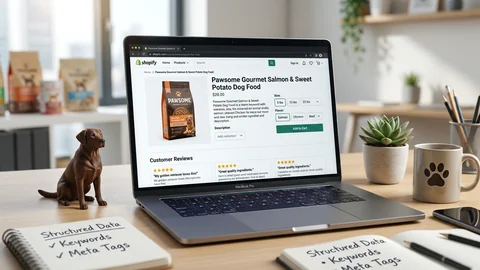
Product Page SEO - Where Brands Win or Lose Customers
A product page is not just an online listing - it's a sales conversation. But too many brands rely on minimal descriptions that fail to communicate value, safety, or differentiation.
Mobile-friendly websites see 32% higher conversion rates.[8] For pet brands, this means product pages must be fast, readable on any device, and rich with detail.
Effective product pages include:
- a strong product title with the primary keyword
- a clear description that explains benefits, not just features
- nutritional or material information
- recommended use cases
- size or breed compatibility
- safety guidelines
- certifications (OFA, vet recommended, eco-friendly, hypoallergenic, etc.)
- customer testimonials
For example, instead of writing:
"Safe dog chew toy made of rubber."
Write:
"A durable, non-toxic rubber chew toy designed for power chewers, ideal for reducing anxiety, preventing destructive behavior, and supporting dental health."
This aligns with behavior-related content from the Dog Training SEO Guide, which helps contextualize behavioral benefits behind product design. For a step-by-step framework, read our post on how to optimize pet product pages for search and conversions.
Add internal links from product pages to educational content.
Example: a hip supplement page linking to a blog article on "Joint Support for Senior Dogs," which links back to the Veterinary SEO Structure.
This triangle (product - blog - authority page) is extremely powerful for SEO.
Category Page SEO - Your Brand's Biggest Untapped Ranking Opportunity
Most pet brands overlook category pages, but they are among the highest-ranking pages on large retail sites. Pet brands must build these categories strategically, not just list products.
Each category page should introduce:
- what the category is
- which pets it's for
- how owners should choose between options
- what problems the category solves
- how your products differ
- internal links to relevant blogs
For example, a "Dog Enrichment Toys" category page could discuss mental stimulation, boredom reduction, and problem-solving skills - and link to internal resources such as the Pet Groomer SEO Guide, especially when discussing coat- or grooming-related enrichment needs.
This page should also link to relevant product pages, as well as educational content explaining use cases. This creates a strong internal structure Google can follow. For a detailed walkthrough, see our guide on optimizing pet store category pages.
Category pages often outrank product pages, making them crucial for visibility.
Ingredient, Material & Safety Transparency - A Major SEO Advantage
Pet owners trust brands that communicate clearly. Transparency directly impacts SEO because it builds:
- longer page engagement
- higher trust signals
- more shares and backlinks
- improved E-E-A-T (Experience, Expertise, Authoritativeness, Trustworthiness)
Examples:
Food & Treat Brands
Explain each ingredient's purpose. Link to sourcing information and nutritional research.
Toy Brands
Discuss durability, chewing levels, and non-toxic materials. Include testing certifications.
Supplement Brands
Include detailed safety guidelines, dosage information, and vet references.
Grooming Product Brands
Discuss coat types, skin sensitivity, and active ingredients. Reference breed-specific needs.
This educational layer can link to blogs enhanced by the Pet Blog SEO Guide, which reinforces your internal topic authority.
The Power of Educational Content for Pet Brands
Educational content is not optional - it is essential. With organic search delivering 53% of all website traffic[4], educational blog posts are the primary vehicle for capturing top-of-funnel visitors.
Pet brands that publish authoritative content:
- build trust with pet parents
- answer common questions before the sale
- reduce customer support burden
- improve organic ranking across entire topic clusters
- strengthen expertise signals for Google's E-E-A-T
- outperform generic competitors on long-tail queries
- support product discovery through internal linking
Examples of high-performing content:
- "How to Choose the Right Food for Allergic Dogs"
- "Safe Chew Toys for Heavy Chewers Explained"
- "What to Look for in a Cat Litter for Odor Control"
- "Puppy Enrichment Toys Recommended by Experts"
Internal linking should reference broader SEO pillars like the Pet Business SEO Strategy, as well as content strategy topics like the content clustering guide when you build topic authority across multiple posts.
Educational content fuels SEO - and SEO fuels sales.
Backlinks & Pet Industry Partnerships - Long-Term Ranking Strength
Backlinks are essential for product brand SEO. They signal trust, relevance, and authority to Google.
Pet brands gain backlinks from:
- veterinarians and veterinary associations
- dog trainers and training schools
- groomers and grooming blogs
- breeders and breed clubs
- pet influencers and content creators
- comparison and review blogs
- pet stores and online retailers
- animal shelters and rescues
- pet industry magazines and publications
For example:
- A veterinarian links to your supplement guide from their resource page
- A breeder links to your puppy essentials checklist
- A groomer links to your coat-care product guides
These relationships support internal connections such as the Pet Influencer SEO Guide and our guide on how to build backlinks for pet stores, strengthening your brand's authority across the ecosystem.
Competing With Big Brands - And Winning Through SEO
Large companies often rely on generic descriptions, minimal transparency, slow content updates, and mass-market messaging. They rank for broad category terms, but they rarely produce deep educational content on niche topics.
Smaller pet brands win by:
- being specialized in specific product categories
- offering deep education on ingredients, safety, and use cases
- building authentic trust through transparency
- expressing unique brand values and founder stories
- responding faster to trends and seasonal demand
- creating detailed product pages that answer every buyer question
- optimizing SEO consistently with a topical authority strategy
- using tools to scale content production without sacrificing quality
A small brand selling single-protein rabbit treats can rank above Amazon for queries like "best rabbit treat for cats with chicken allergies" simply by publishing a thorough, expert-written guide on the topic. Learn more about how independent pet stores close the gap with large retailers in our guide on how pet stores compete with Amazon through content and SEO.
Scaling Pet Product Brand SEO With Petbase
Petbase helps pet brands automate and scale their SEO strategy. For USD 199/mo, you get 10 blog posts per month - each strategically planned around topical authority clusters, not random keywords.
Petbase handles:
- keyword research and content planning
- blog posts tailored to your product niche
- category page content
- ingredient and buying guides
- FAQ sections
- internal linking strategy
- metadata optimization
- auto-publishing to your CMS
Unlike generic content tools, Petbase understands the pet industry: nutrition, enrichment concepts, behavioral benefits, coat types, allergy triggers, safety standards, breed differences, and veterinary terminology. This contextual depth creates content that earns E-E-A-T signals and builds domain authority faster than generic alternatives.
For comparison: a single freelance article costs USD 200-500. Petbase delivers 10 strategically connected articles for USD 199/mo - each one strengthening the next through topical clustering.
Frequently Asked Questions About Pet Product Brand SEO
How do pet product brands rank on Google?
Pet product brands rank by combining three things: well-optimized product and category pages, educational blog content that answers buyer questions, and trust signals like reviews, author credentials, and ingredient transparency. Brands that publish detailed comparison guides, safety pages, and how-to-choose content consistently outrank larger competitors who rely solely on product listings. Google rewards sites that help users make informed decisions - not just sites that sell. Start with your top 5 product categories, write a dedicated educational post for each, and link them to the corresponding product pages.
Should pet brands focus on product pages or blog content?
Both, but the priority depends on where you are in your SEO journey. If your product pages are thin or unoptimized, fix those first - they are the highest commercial-intent pages on your site and every visitor who finds them is already close to buying. Once product pages are strong, invest in educational blog content that targets research-phase queries. Blog posts bring in top-of-funnel traffic, build topical authority, and earn backlinks that eventually lift your product pages in rankings. The ideal ratio for most pet brands is 60% product/category page work and 40% blog content in the first year, shifting to roughly 30/70 once the commercial pages are solid. See our guide on optimizing pet product pages for a complete framework.
How long does SEO take for a pet brand?
Most pet brands see meaningful organic traffic growth within 4 to 6 months of consistent publishing and on-page optimization. Reaching competitive rankings for high-volume keywords like "best dog food for allergies" or "cat calming supplement" typically takes 8 to 14 months, depending on domain age, backlink profile, and publishing frequency. Niche sub-categories with lower competition - "freeze-dried rabbit treats for ferrets" or "orthopedic bed for large breed seniors" - can rank in 6 to 10 weeks. The fastest path is to identify 10 to 20 low-competition, high-intent keywords specific to your product range and build a dedicated page or post for each before tackling broader terms.
How can small pet brands compete with established retailers on Google?
Small pet brands win on specificity. Large retailers and marketplaces like Amazon or Chewy rank for broad category terms, but they rarely produce deep educational content on niche topics. A small brand selling single-protein rabbit treats can rank above Amazon for queries like "best rabbit treat for cats with chicken allergies" simply by publishing a thorough, expert-written guide on the topic. Focus on the long-tail searches that big retailers ignore: ingredient-specific queries, breed-specific recommendations, behavioral use cases, and comparison content. Build 30 to 50 posts in your niche before competing on broad terms. Read our breakdown of how pet stores compete with Amazon through content for specific tactics.
References
- Fortune Business Insights (2025). Pet Care Market Size, Share & Industry Analysis. fortunebusinessinsights.com
- Grand View Research (2025). Pet Grooming Services Market Analysis. grandviewresearch.com
- American Pet Products Association (2024). Industry Trends and Stats. americanpetproducts.org
- BrightEdge (2025). How Much Traffic Comes From Organic Search. seoinc.com
- Grand View Research (2024). Pet Care E-Commerce Market Analysis. grandviewresearch.com
- InsightAce Analytic (2024). Direct-to-Consumer (DTC) Pet Food Market. insightaceanalytic.com
- International Outsourcing Group (2025). SEO Benchmarks by Industry. internationaloutsourcinggroup.com
- Clutch (2025). SEO Statistics. clutch.co
References
- Fortune Business Insights (2025). Pet Care Market Size, Share & Industry Analysis. fortunebusinessinsights.com
- Grand View Research (2025). Pet Grooming Services Market Analysis. grandviewresearch.com
- American Pet Products Association (2024). Industry Trends and Stats. americanpetproducts.org
- BrightEdge (2025). How Much Traffic Comes From Organic Search. seoinc.com
- Grand View Research (2024). Pet Care E-Commerce Market Analysis. grandviewresearch.com
- InsightAce Analytic (2024). Direct-to-Consumer (DTC) Pet Food Market. insightaceanalytic.com
- International Outsourcing Group (2025). SEO Benchmarks by Industry. internationaloutsourcinggroup.com
- Clutch (2025). SEO Statistics. clutch.co
Conclusion - SEO Is the Growth Engine for Modern Pet Brands
The pet industry is a $273 billion market growing fast - and e-commerce is where the growth concentrates. In an industry where trust, transparency, and product quality drive consumer decisions, SEO is the most effective long-term growth channel for pet brands.
By combining optimized product pages, strategic category pages, educational content, backlinks, transparency, and consistent publishing, pet brands can outperform bigger competitors and earn the loyalty of modern pet parents.
SEO builds visibility.
Visibility builds trust.
Trust builds lifelong customers.