Duplicate, Thin, and Out-of-Stock Pet Product Pages: A Cleanup Workflow


Table of Contents +
- Scenario: One pet catalog, scattered SKUs - how to cleanly recover SEO value
- Step-by-step cleanup: from inventory snapshot to stable URLs
- Quick decision guide
- Practical safety boundaries
- Monitoring and validation
- Evidence status and known caveats
- Appendix: Consolidation and canonicalization rules you can copy
- Further reading
- Frequently Asked Questions
- Conclusion
- References
A practical workflow to fix duplicate SKUs, thin content, and out-of-stock pet product pages with rules for canonicalization, consolidation, and scaled rewrites
Your catalog may be bigger than your visibility. Duplicate SKUs, thin pages, and out-of-stock URLs quietly dilute rankings and squander crawl budget. Search engines see noise, not clear choices.
This matters because wasted signals reduce discoverability and conversion. A structured cleanup restores authority to the right URLs. You will learn how to classify inventory, consolidate duplicates, handle OOS scenarios, and standardize canonicals. You will also see how to scale rewrites safely and monitor impact.
Scenario: One pet catalog, scattered SKUs - how to cleanly recover SEO value
What this workflow solves (signal confusion, crawl waste, cannibalization)
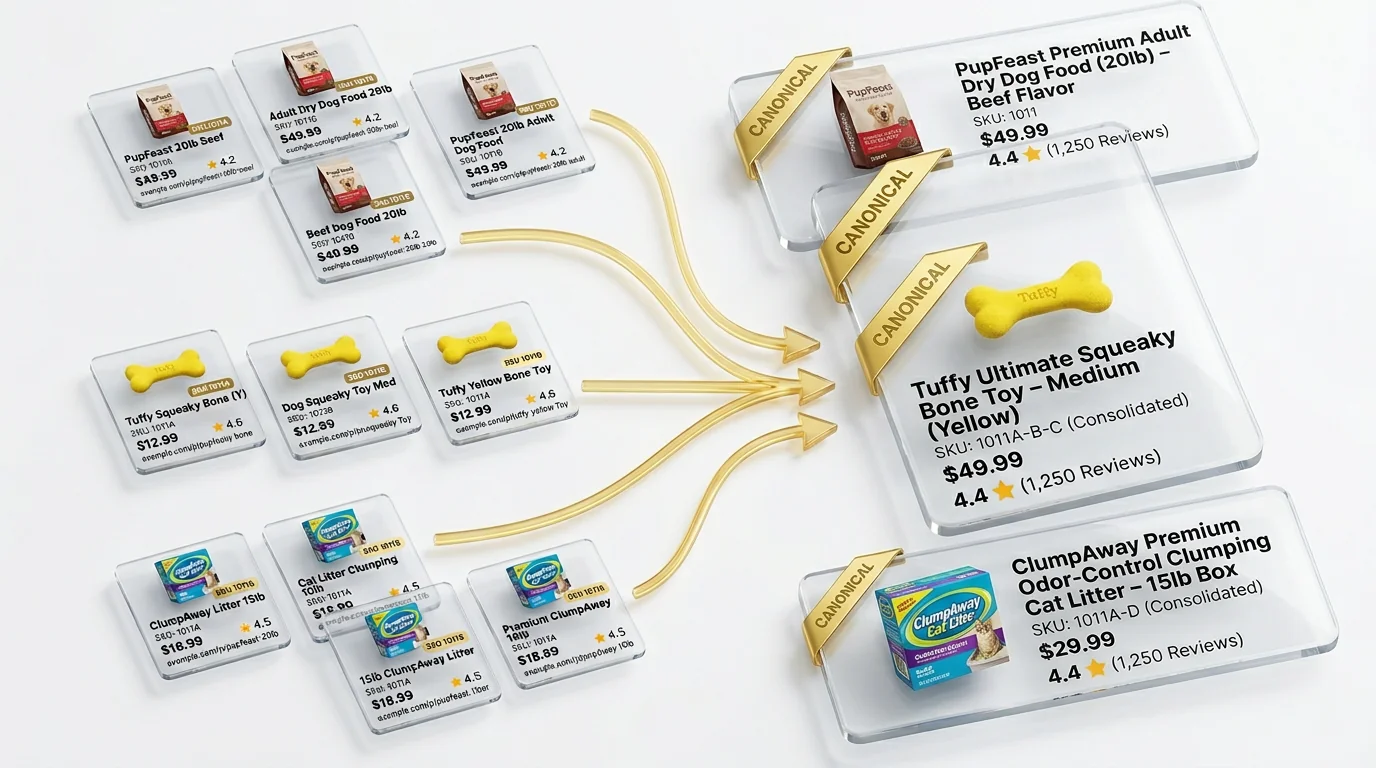
Duplicate product pages SEO issues emerge when the same product appears under multiple URLs or titles. Search engines receive mixed signals and may rank the wrong page. Catalog sprawl also drives crawl waste and cannibalization.
Detecting duplicates is challenging because titles, attributes, and images differ by channel and vendor. Research shows duplicate detection requires robust attribute matching and modeling, not simple string comparison[1]. Data quality inconsistencies across feeds further complicate reconciliation and exchange[4].
Inputs you need (feed, inventory, URL map, search data)
Prepare a clean product feed with normalized identifiers. Include GTINs, MPNs, SKUs, brand, and variant attributes. Export an inventory status snapshot and a full URL map with last crawl dates and canonical tags.
Pull search data: impressions, clicks, queries, and landing pages. Add on-site signals like add-to-cart rate and stock availability. With these in hand, you can plan product page consolidation and prioritize fixes.
Petbase automates SEO content for pet stores - publishing 10 optimized articles monthly so you can focus on running your shop - start your free trial.
Step-by-step cleanup: from inventory snapshot to stable URLs
Use this workflow to stabilize rankings and reclaim crawl efficiency while avoiding risky bulk changes.
1) Inventory snapshot: classify by status (In-Stock, OOS-Temporary, OOS-Permanent, Discontinued)
Take a point-in-time export. Assign every SKU one of four statuses: In-Stock, Out-of-Stock Temporary, Out-of-Stock Permanent, or Discontinued. Maintain a reason code and expected replenishment date for OOS-Temporary.
Freeze the URL list connected to each SKU. This protects decisions as inventory moves. Reconcile any SKUs missing a status and investigate misaligned variants before proceeding.
2) Deduplicate SKUs: variant vs. duplicate rules and canonical targets
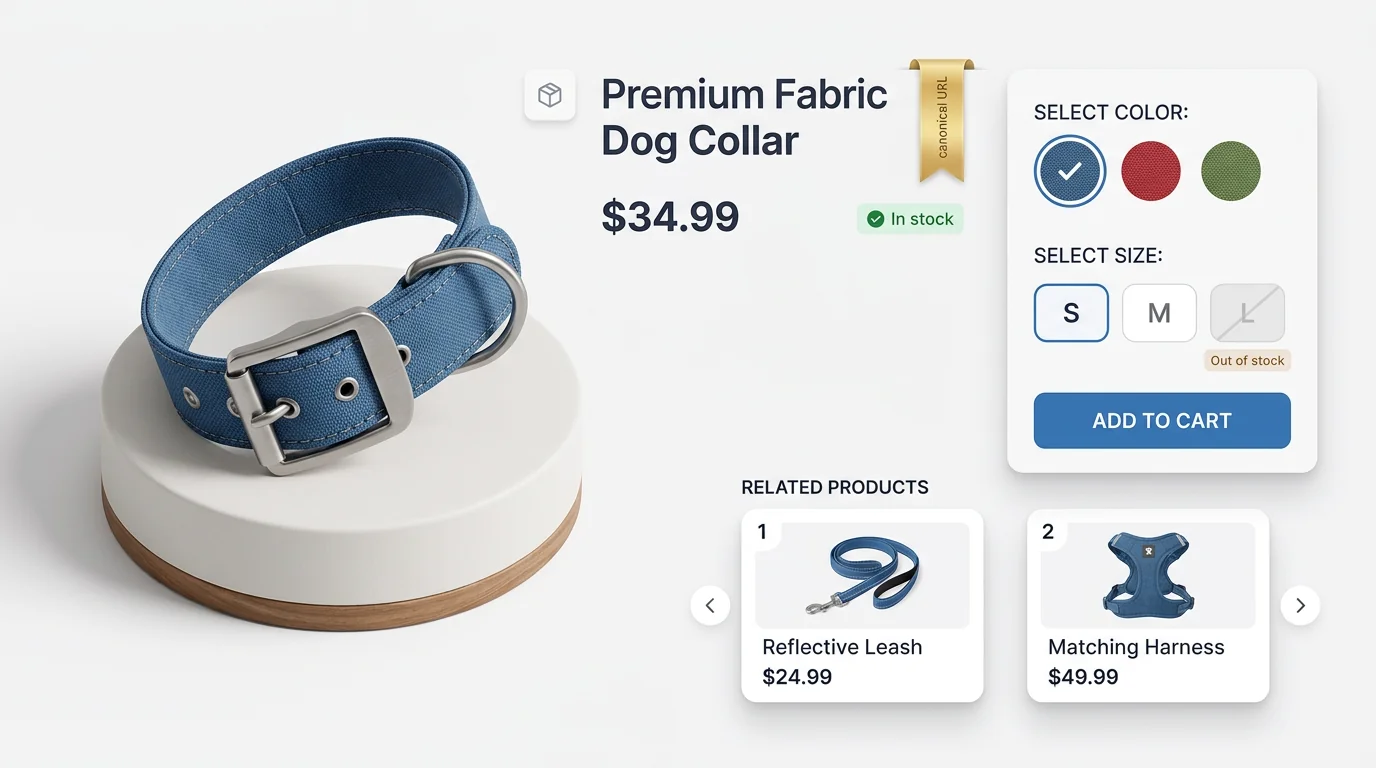
Define a single canonical parent for each logical product. Treat size and color as selectable variants under one stable URL. Apply SKU canonicalization rules: parameters and alternate paths must canonicalize to the parent.
Flag true duplicates using title normalization, attribute matching, and image similarity. Studies show advanced matching and vision models can improve duplicate detection where textual signals diverge[2][1]. Redirect obsolete duplicates to the canonical target.
3) Consolidate thin pages: merge, expand, or retire
Thin content pet products often stem from feed-only pages with minimal text. Set thresholds. Pages under roughly 150 words without unique specs, media, or FAQs enter remediation.
Options: merge into the closest rich parent, expand with care guidance and usage notes, or retire with a redirect if redundant. Choose based on search intent, impressions, and internal demand.
4) Out-of-stock handling: temporary vs. permanent playbook
For temporary OOS, keep the page indexable, show clear availability, and promote alternatives. For permanent OOS, use a 301 to the most relevant substitute or the parent category. Avoid soft 404 patterns.
Review product structured data to align availability and pricing signals. An out of stock SEO strategy should maintain helpful content and internal links, preventing orphaned demand and preserving historical equity.
5) Petbase at scale: rewrite + mapping workflow for large catalogs
When hundreds of SKUs need enrichment, batching matters. Map each SKU to a canonical parent, then queue rewrites for uniform titles, descriptions, and FAQs. Preserve variant attributes consistently.
For high-volume brands, consider using Petbase AI to generate standardized descriptions, harmonize variant phrasing, and publish updates against your mapping file while retaining your approved canonicals.
Quick decision guide
If X then Y: 6 fast rules you can apply today
- If two URLs sell the identical product with minor title differences, 301 the weaker URL to the stronger canonical.
- If variants differ only by size or color, use one parent URL with variant selectors and canonicalize siblings to the parent.
- If a page is thin and has no unique demand, merge into the canonical parent and transfer reviews and media.
- If an OOS page will restock within 30-60 days, keep it indexable and suggest in-stock alternatives prominently.
- If an OOS is permanent, redirect to the closest substitute product or, secondarily, the most relevant category.
- If UTM or filter parameters create crawlable duplicates, block via robots rules or parameter handling and consolidate with rel=canonical.
Practical safety boundaries
Guardrails for redirects, canonicals, structured data, and inventory timing
Limit redirect batches to 500-2,000 URLs per release to control crawl volatility. Validate each mapping with SKU-to-URL parity before deploy. Avoid redirect chains; go direct to the final canonical target.
Use self-referencing canonicals on canonical pages and one-way canonicals from siblings to parents. Do not cross-canonicalize between siblings. Keep schema aligned with visible content and inventory state to reduce trust erosions.
Time major changes just after crawl peaks. Freeze large-scale merges during high-demand periods. Update XML sitemaps on release day, and re-submit after QA to encourage fresh crawls.
Monitoring and validation
What to check after 7-14 days
Spot-check cache dates and indexed variants. Confirm that retired URLs resolve with 301s to final destinations. Compare impressions and clicks for canonical parents versus prior siblings to detect cannibalization recovery.
In Search Console coverage and canonical reports, review submitted versus selected canonicals. Look for reduced Duplicate, submitted URL warnings. Crawl a sample with parameters to ensure rel=canonical and noindex directives match expectations.
What to check after 4-8 weeks
Evaluate aggregate non-brand clicks to canonical parents, aiming for uplift where duplicates were merged. Track crawl stats for reduced discovered but not indexed pages as a proxy for improved efficiency.
Assess conversion impacts on enriched pages. Evidence suggests better product content may support engagement increases. Validate that out-of-stock alternatives drive add-to-cart behavior without suppressing the main canonical’s rankings.

Evidence status and known caveats
What industry data suggests vs. where you should test
Studies indicate that robust attribute matching engines and multimodal approaches improve duplicate detection in e-commerce catalogs, particularly where text alone is inconsistent[1][2]. Data exchange and quality gaps are a recurring source of SKU sprawl and misclassification[4].
Emerging work on multimodal embeddings may further enhance deduplication at marketplace scale, though results will vary by catalog and image consistency[3]. Because catalogs and demand patterns differ, A/B test threshold choices, redirect scopes, and enrichment templates before wide deployment.
Appendix: Consolidation and canonicalization rules you can copy
Patterns for color/size variants, bundles, region-specific SKUs
Color and size: one parent URL with variant selectors. Parent holds reviews, FAQs, and media. Variant swatches reflect selected attribute values. Canonical from each variant URL points to the parent.
Bundles: if the bundle has distinct search demand, give it a dedicated canonical URL. If not, consolidate into the primary product’s page with a bundle option. Avoid duplicate review blocks across bundle and parent.
Region-specific SKUs: use a shared parent when the product is identical and only pricing or regulatory notes differ. Surface region selection in the interface. If content diverges materially, localize on separate URLs with hreflang.
Duplicate to parent redirects: always 301 directly to the canonical, preserving UTM stripping. Keep parameters non-indexable. Document SKU mappings and store them beside release notes for rollback clarity.
For deeper alignment, review your variant consolidation rules against your taxonomy and URL structure guidance to ensure consistent internal linking and crawl paths.
Further reading
Reconnect to pet eCommerce SEO foundations
Align cleanup with your broader roadmap. Revisit pet eCommerce SEO foundations for prioritization principles, category architecture, and intent mapping. For cross-category linking improvements, see Internal Linking and Measurement for Pet Stores to route authority into your most valuable product parents.
Frequently Asked Questions
Should out-of-stock pet products be noindexed or kept live?
If the item will return, keep the page indexed with clear availability, related alternatives, and structured data adjusted. If it will not return, consider a 301 to the closest relevant substitute or parent category.
What is the best way to handle duplicate SKUs across variants?
Use one canonical parent URL and treat size or color as selectable variants. Only split URLs when search behavior and unique intent differ materially, and avoid cross-canonicals between siblings.
How thin is too thin for a pet product page?
Pages under ~120-200 words with limited specs, no unique media, and no FAQs may underperform. Evidence suggests expanded descriptions, care guidance, and UGC can support improved engagement.
When should I use a 301 vs. a canonical for duplicates?
Use a 301 when the duplicate URL should no longer exist. Use a canonical when multiple accessible URLs must remain (e.g., tracking parameters or variant URLs) but one should consolidate ranking signals.
Do discontinued products harm SEO if left up?
If they attract search demand, keep them with clear messaging and strong internal links to alternatives. Otherwise, consider a 301 to the closest match to preserve any residual equity.
Conclusion
A disciplined pet eCommerce SEO cleanup workflow restores clarity to your catalog. Start with a status snapshot, de-duplicate to one canonical parent, and enrich thin pages. Apply careful OOS decisions, aligned schema, and measured redirects.
Evidence suggests that consistent SKU canonicalization rules and structured consolidation may support better crawl efficiency and rankings. Validate changes over 4-8 weeks, then scale the pattern across categories. Sustainable gains come from stable URLs, useful content, and disciplined monitoring.
References
- OS Albayrak et al. (2022). Duplicate product record detection engine for e-commerce platforms. Expert Systems with Applications. View article
- E Teper et al. (2024). Detecting duplicate products in e-commerce images using siamese networks. 2024 9th International …. View article
- A Kulunk et al. (2025). Optimizing Product Deduplication in E-Commerce with Multimodal Embeddings. arXiv preprint arXiv …. View article
- M Niemir et al. (2021). Basic product data in e-commerce: specifications and problems of data exchange. 2021 - um.edu.mt. View article