Programmatic Pet SEO: Safe Templates for Breeds, Sizes, and Life Stages


Table of Contents +
- Scope one scenario: building a safe template for “grain-free puppy food for large breeds”
- Quick decision guide
- Content architecture and data model
- Monitoring guidance
- Practical safety boundaries
- Evidence status: what we know and where caution is needed
- Implementation checklist
- Cross-linking within the cluster
- Frequently Asked Questions
- Conclusion
- References
Design safe programmatic templates for pet SEO across breeds, sizes, and life stages-avoid duplication, thinness, and risky claims while scaling.
Scaling pages like “grain-free puppy food for large breeds” sounds simple. It is not. The risks include duplication, thinness, and unsafe medical phrasing. These can quietly erode organic performance.
This guide shows a template-driven method that protects quality while scaling. You will learn attribute modeling, modular blocks, and governance rules. You will also get decision trees, monitoring steps, and safety boundaries to keep programmatic pet SEO responsible.
Scope one scenario: building a safe template for “grain-free puppy food for large breeds”
Use this scenario to standardize your approach for breed-specific SEO, life stage content templates, and size-based product pages. Keep the focus on clarity, evidence, and user needs.
Define the entity set: breeds, sizes, life stages, diet attributes
Model four controlled dimensions: Breed group or exemplar breeds, Size band, Life stage, and Diet attribute. Canonicalize synonyms, for example “grain free” and “grain-free.” For this node, bind: Large size, Puppy life stage, and Grain-free diet.
Template skeleton: modular blocks to prevent thinness and duplication
Assemble modules: intent summary, nutrition guidance with disclaimers, feeding guidelines by size, product ItemList, comparison table, FAQs, and store availability. Add constraints for word count and SKU minimums. For efficient orchestration, many teams use Petbase AI during planning and publishing.
Guardrail logic: constraints, exclusions, and medical disclaimers
Apply rule sets: minimum three relevant SKUs, 180-260 words of unique guidance, and three FAQs. Exclude disease language. Use “may support” phrasing for benefits. Trigger canonicalization when overlap exceeds set thresholds.

Petbase builds this SEO foundation automatically for pet businesses - 10 optimized articles published every month - start your free trial.
Quick decision guide
Turn ambiguous situations into clear actions. Use these if-then rules to maintain quality under programmatic scale.
If data coverage is sparse, then narrow the attribute stack
Remove the least critical modifier first, usually the diet attribute. Pivot “grain-free puppy food for large breeds” to “puppy food for large breeds” until coverage and uniqueness thresholds are satisfied.
If duplication risk rises, then swap to comparison or FAQ block
Replace repetitive guidance with a “Top three differences” comparison or an FAQ module. This changes the information gain profile and can reduce similarity across near-duplicate size-based product pages.
If medical terms appear, then pivot to vet-reviewed phrasing
Rewrite outcomes as general support claims. Add a “care disclaimer” and consider expert review markup. Avoid mentioning or implying disease prevention, diagnosis, or treatment without licensed review.
If SKUs < 3 in category, then switch to guidance-first layout
Prioritize buyer guidance, feeding tips, and comparison criteria. Include a short ItemList of alternative diets. Flag the node for re-enrichment when inventory improves beyond the defined threshold.
If query has local intent, then attach store availability schema
Add LocalBusiness or Store information and location-based availability where policy allows. Surface pickup options and inventory freshness. Keep hours and stock timestamps updated to avoid user frustration.
If SERP shows YMYL dominance, then add expert review markup
Increase transparency signals with author credentials, reviewedBy, and timestamping. Elevate sourcing and disclaimers. In YMYL-like queries, trust features may improve eligibility and user confidence.
Content architecture and data model
A stable taxonomy, precise mappings, and uniqueness heuristics are the backbone of programmatic SEO templates that withstand scale.
Canonical attribute taxonomy and synonyms
Create a canonical taxonomy covering sizes, life stages, diets, and representative breeds. Maintain a synonym table and normalization rules. Research indicates that automated taxonomy methods can reduce drift and improve hierarchical consistency[1][3].
Product-to-attribute mapping and evidence notes
Map SKUs to attributes through structured fields and verified labels. Use a lightweight evidence note for each mapping, such as ingredient panels or brand claims. Hybrid NER and relation extraction pipelines can support consistent tagging at scale[4].
Unique value per node: heuristics to avoid thinness
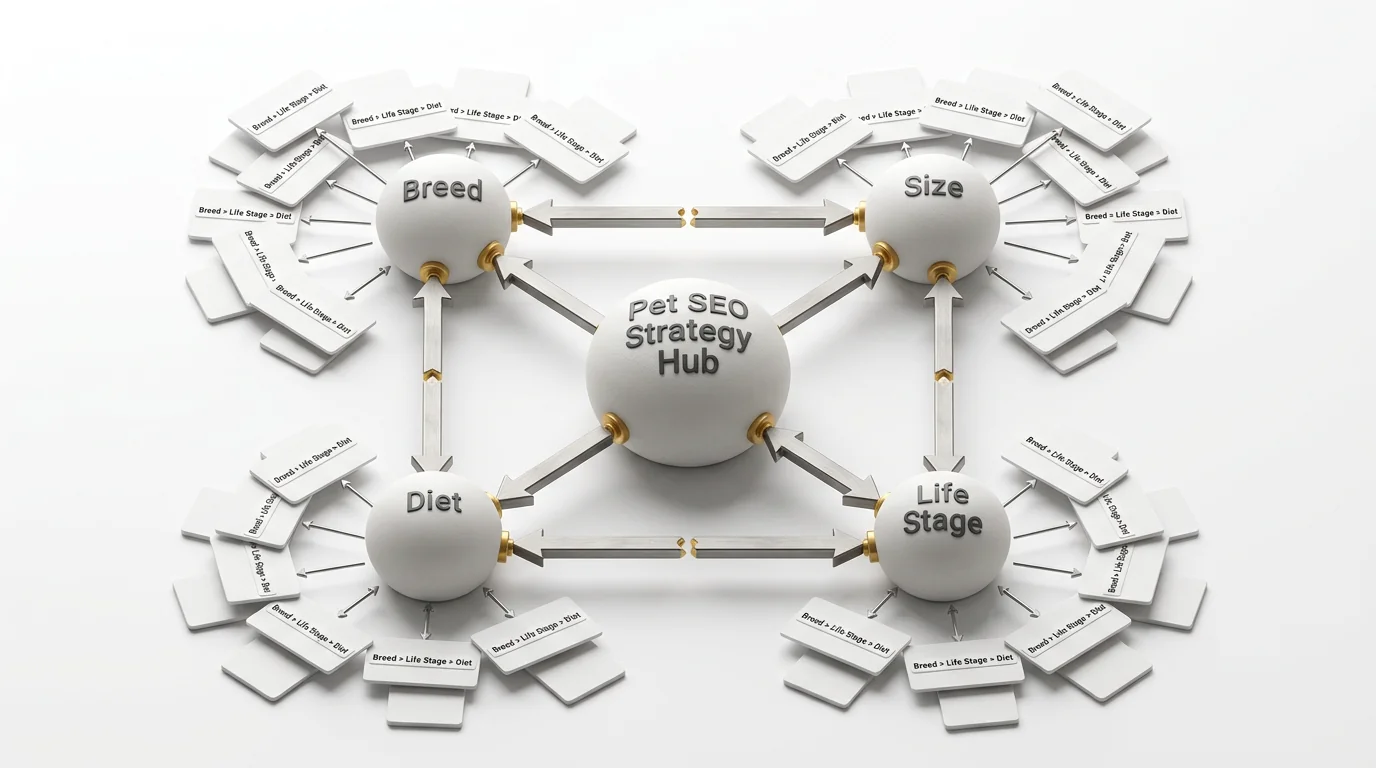
Set explicit uniqueness thresholds: minimum 40% varied sentences in guidance, three SKU differentials, and at least one module swap versus sibling nodes. Alignment methods help prevent taxonomy collisions that cause near-duplicates[2]. Link to your pet SEO strategy hub for governance oversight.
Monitoring guidance
Monitor early technical signals and mid-term behavior shifts. Iterate thresholds and modules to maintain quality and growth.
7-14 days: crawl health, duplication, and indexation checks
Verify discoverability, status codes, canonical tags, and noindex rules. Evaluate similarity clusters and soft-duplicate detection. Confirm schema validity using your QA routines and this reference on product and review markup implementation (schema QA for pet catalogs).
4-8 weeks: query mix shift, cannibalization, and engagement
Inspect Search Console for emerging modifiers and long-tail variants. Check click distribution across breed-specific SEO nodes to spot cannibalization. Review dwell, scroll, and CTR. Align internal links using guidance in internal linking and measurement for pet stores.
Iterative adjustments: threshold tuning and module swaps
Raise uniqueness thresholds if nodes cluster tightly. Swap a guidance module for comparison where engagement lags. Adjust FAQ depth when intent diversifies. Rebalance SKUs as inventory shifts.

Practical safety boundaries
Set non-negotiable boundaries to safeguard users and your brand while advancing pet ecommerce SEO objectives.
Medical and nutrition claim boundaries
Do not assert disease treatment, prevention, or cure. Use cautious language like “may support” and “can help.” Include a care disclaimer, author credentials, and last-reviewed date for transparency.
Breed stereotypes and bias avoidance
Avoid generic temperament claims and unverified breed generalizations. Focus on measurable needs such as size, activity, and life stage. Keep recommendations neutral, respectful, and sourced where appropriate.
Price, availability, and freshness rules
Show observed price ranges only when auto-updated. Timestamp availability and limit stale cache windows. If stock is volatile, pivot to guidance-first layouts to avoid frustration and maintain trust.
Evidence status: what we know and where caution is needed
Phrase claims to match evidence strength. Use schema and notes to reinforce transparency where uncertainty exists.
Nutritional claims: consensus vs. contested areas
Consensus exists for fundamentals like complete-and-balanced labeling. More specific benefits may vary by formulation. Prefer conditional phrasing and cite brand-provided documentation in evidence notes, avoiding medical language in text.
Behavioral claims: toy durability and training aids
Durability varies by material and dog behavior. Replace absolutes with ranges and context. Provide selection criteria and disclaimers, not guarantees. Encourage supervised use and safe disposal guidance.
Mapping evidence to on-page phrasing and schema
Align each claim to a structured evidence note and optional Review schema. Keep on-page phrasing conditional and attribute-scoped. Structured pipelines help maintain consistent claim-to-evidence mapping across templates[4].
Implementation checklist
Launch with a controlled sample, validate signals, then expand. Programmatic SEO templates benefit from disciplined rollout and rollback plans.
Pre-launch QA for 25-node sample
Generate 25 nodes across sizes and life stages. Validate canonical tags, schema, internal links, and uniqueness thresholds. Manually spot-check for medical language and breed bias. Fix observed issues before scaling.
Schema, internal links, and canonicalization
Apply Product, ItemList, and FAQ schema where relevant. Use on-page breadcrumbs and clean parent links. Canonicalize near-overlaps to the strongest node. Ensure consistent brand and author fields across pages.
Rollback and de-duplication procedures
Create a versioned content index. If soft-duplicate clusters emerge, consolidate nodes, update canonicals, and submit recrawls. Retain winning URL patterns. Redirect deprecated paths to preserve equity.
Cross-linking within the cluster
Smart cross-linking distributes context and authority. It also reduces cannibalization by signaling relationships among attributes.
Linking to the pet SEO strategy hub
From each node, link once to the pet SEO strategy hub for governance and education. Use breadcrumb schema (Breed > Life Stage > Diet) to clarify hierarchy and improve navigability.
Bridging to product categories and buyer guides
Contextually link to parent category guides and comparison pages to support deeper evaluation. See patterns in information architecture for pet stores for managing filters, facets, and intent without fragmentation.
Frequently Asked Questions
How do I prevent duplicate content across breed and size pages?
Use a canonical attribute taxonomy, enforce minimum unique value per page, and implement canonicals when overlap is unavoidable. Module-swapping based on data density reduces similarity and protects distinct user value across related nodes.
Can I mention health benefits without medical liability?
Use cautious language such as “may support,” cite general guidance when appropriate, and avoid disease claims. Include care disclaimers. For sensitive topics, add expert review markup and timestamps to reinforce transparency and responsible communication.
What minimum data do I need to launch a template node?
Secure at least three relevant SKUs, 150-250 words of unique guidance, three to five FAQs, and a comparison or checklist module. If these thresholds are unmet, route traffic to a consolidated page until requirements are satisfied.
How should I monitor performance after launch?
Within 7-14 days, confirm crawl, indexation, and duplication signals. Within 4-8 weeks, analyze impressions, query grouping, engagement, and cannibalization. Adjust thresholds and module selection based on observed shifts in user intent and inventory.
Which schema types are suitable for these pages?
Consider Product, ItemList, FAQPage, and Review schema where applicable. For expert-reviewed advice, use Author and reviewedBy with dates. Validate regularly to maintain eligibility and accurate rich result rendering across pages.
Conclusion
Scaling “grain-free puppy food for large breeds” and similar nodes demands rigor. A canonical taxonomy, modular templates, and strict guardrails help you avoid duplication, thinness, and risky claims. Start with a small, high-quality sample. Monitor early signals, then tune thresholds and swap modules where needed. Keep evidence structured, language cautious, and transparency high. With disciplined governance, programmatic pet SEO can deliver dependable gains in pet ecommerce SEO while protecting users and brand trust. When your data, templates, and review loops align, every new node adds measurable value rather than noise.
References
- B Vu et al. (2025). Automated taxonomy construction using large language models: A comparative study of fine-tuning and prompt engineering. Eng. View article
- A Lahiri et al. (2025). TaxoAlign: Scholarly Taxonomy Generation Using Language Models. … of the 2025 Conference on Empirical …. View article
- S Iloga et al. (2021). An efficient generic approach for automatic taxonomy generation using HMMs. Pattern Analysis and Applications. View article
- LJ Gonzalez-Gomez et al. (2025). Dynamic taxonomy generation for future skills identification using a named entity recognition and relation extraction pipeline. Frontiers in Artificial …. View article