Commercial content that converts: ‘best for’ and comparison pages in pet retail


Table of Contents +
- The single decision: When to use ‘best for’ vs. comparison pages
- A quick decision guide
- Template: ‘Best for [breed/need]’ page
- Template: Head-to-head and roundup comparisons
- Monitoring guidance
- Practical safety boundaries
- Evidence status and where claims may be strong
- Implementation workflow with automation
- Frequently Asked Questions
- Conclusion
- References
Use ‘best for’ and comparison pages to guide pet shoppers. Framework covers page templates, pros/cons, CTAs, and compliant linking to products.
Shoppers want clear answers, not guesswork. Your content should guide them to the right product with confidence and care. That is how commercial pages earn trust.
This matters because search intent can shift quickly in pet retail. A precise page may turn curiosity into a cart. You will learn when to choose a ‘best for’ or comparison page, how to structure each, and how to measure results.
The single decision: When to use ‘best for’ vs. comparison pages
Signals in queries and catalog that suggest each format
Use a ‘best for’ page when search terms include qualifiers like “for seniors,” “for allergies,” or “for heavy chewers.” This implies a need state and a filtered list. Choose comparisons when queries include brand or product names, “vs,” or “compare.” Catalog depth also matters. If you have 5-12 viable options for a need, ‘best for’ fits. If buyers weigh 2-5 specific SKUs, a head-to-head or roundup works. Evidence suggests intent-based SEO aligns with stronger visibility in pet categories[1].
Examples from common pet categories (food, toys, grooming)
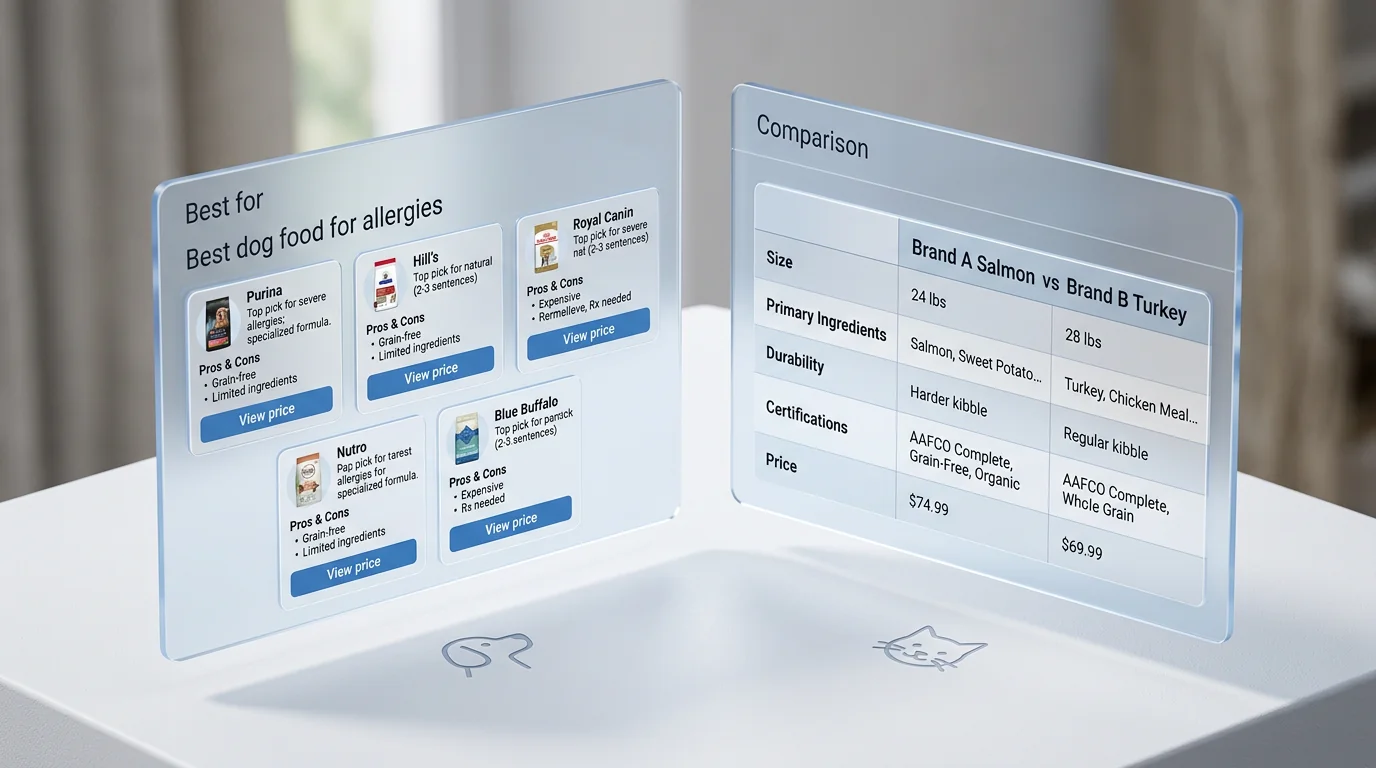
Food: “grain-free for sensitivities” favors a ‘best for’ list, while “Brand A salmon vs Brand B turkey” needs a comparison. Toys: “tough chew toys for aggressive chewers” suits ‘best for.’ “Kong vs West Paw durability” demands head-to-head. Grooming: “shed control shampoo for double coats” fits ‘best for,’ while “Brush A vs Brush B for thick coats” asks for a comparison. For broader architecture context, see the pet eCommerce SEO guide.
Petbase automates SEO content for pet stores - publishing 10 optimized articles monthly so you can focus on running your shop - start your free trial.
A quick decision guide
If X situation, then Y action (6 common scenarios)
- If search includes “best for [breed/need],” then publish a ‘best for’ page with 3-7 curated products.
- If users search “[Brand A] vs [Brand B],” then create a head-to-head with a concise result and a feature matrix.
- If queries list features without brands, then build a roundup comparison across 4-6 leading options.
- If catalog is shallow (≤3 items), then integrate a mini-comparison inside a product page.
- If seasonality drives need (e.g., shedding), then launch a time-bound ‘best for’ hub with clear CTAs.
- If paid search highlights undecided users, then pair a comparison with remarketing and structured data. SEO and SEM may reinforce product discovery when coordinated thoughtfully[2].
Template: ‘Best for [breed/need]’ page
On-page structure and product tie-ins
Open with a one-paragraph overview of the need state. Add a scannable shortlist of 3-7 products, each with a 2-3 sentence rationale. Place “View price” and “See full details” CTAs above the fold and after each card. Include contextual anchors to product pages using descriptive text such as “grain-free salmon dog food for sensitivities,” “low-fat weight management formula,” and “hypoallergenic limited-ingredient treats.” Add a short Q&A at the end and a breadcrumb to your category. For scalable patterns, consider programmatic templates for breeds and life stages.
Pros/cons blocks and compliance notes
Each product card should include a bulleted pros/cons block. Use neutral, evidence-leaning statements like “may reduce shedding” or “may support digestive health.” Add a short compliance note under supplements and medical-adjacent items: “This information is not a substitute for veterinary advice.” Include clear sourcing of key facts, and avoid disease claims. Encourage users to compare alternatives via a subtle “see full comparison of [Brand A vs Brand B] for large breeds.”
Template: Head-to-head and roundup comparisons
Feature matrix and decision criteria
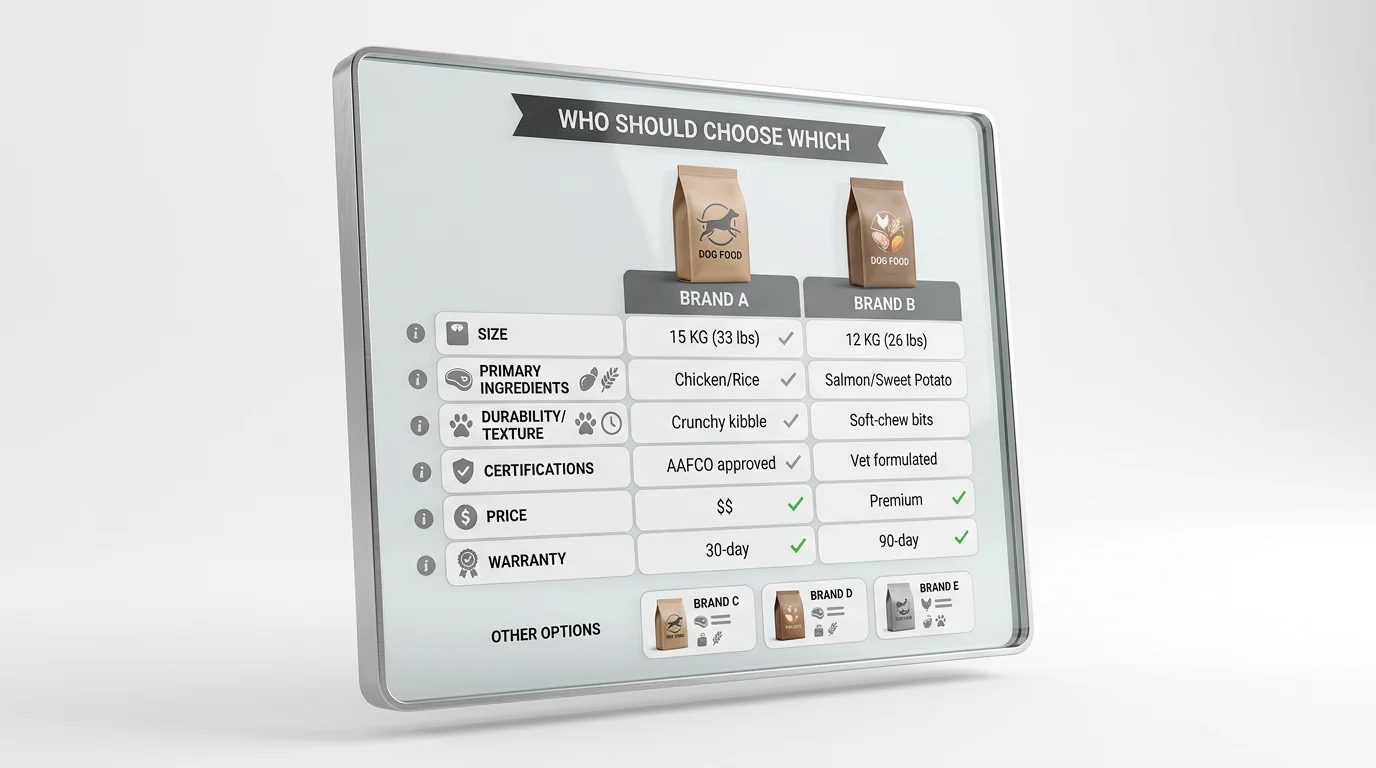
Create a top summary that states who should choose which option. Under it, add a comparison table covering size, ingredients, durability, certifications, price-per-unit, and return policy. Use a decision checklist: budget, sensitivity, life stage, activity level, and handling preferences. Sample feature matrix:
| Criteria | Product A | Product B |
|---|---|---|
| Main protein/material | Salmon | Turkey |
| Key benefit | May support skin health | May aid digestion |
| Certifications | AAFCO-compliant | AAFCO-compliant |
| Durability/Hardness | Moderate | Firm |
| Price per unit | $$ | $ |
Enhance eligibility with structured data; see Product and Review Schema for Pet Catalogs.
Neutral language and evidence cues
Use balanced phrasing such as “stronger on X,” “trade-off,” or “best when.” Cite ingredients from labels and link to official brand pages for verification. Avoid superlatives without sources. Note limitations transparently: “Lab testing not independently verified.” Evidence-informed copy, paired with clear matrices, may improve scannability and decision-making in pet ecommerce content[1].
Monitoring guidance
What to check after 7-14 days
Review indexation, core keyword coverage, and SERP appearance. Check click-through on “View price” and “See full details.” Inspect scroll depth to the matrix and pros/cons. Measure product clicks per session and time to product views. Validate internal links and breadcrumb paths. Benchmark non-branded impressions to ensure visibility is growing. If spending on SEM, coordinate messages; aligned SEO and paid signals may enhance relevance[2]. For setup, see content-to-product tracking setup.
What to assess after 4-8 weeks
Evaluate ranked keywords, assisted conversions, and add-to-cart rate from these pages. Compare bounce rate versus informational pages. Analyze engagement with tables and pros/cons. Confirm schema is error-free. Validate price accuracy and stock status consistency. Consider architecture refinements that reflect intent clustering; see Information Architecture for Pet Stores. Mature content often benefits from iterative pruning and consolidation guided by performance.
Practical safety boundaries
Health, efficacy, and claims sensitivity
Prioritize cautious phrasing for supplements and medical-adjacent items. Use “may support,” “may help maintain,” or “designed for,” not disease or cure claims. Always include a veterinarian disclaimer when benefits refer to health outcomes. Standardize claims review with checklists and sign-off. Structured governance may contribute to durable retail value creation and trust preservation over time[4].
Data sources and stock/price accuracy
Reference product labels, brand datasheets, and certifications as primary facts. Automate price and stock checks hourly to daily, depending on volatility. Add a timestamp: “Prices and availability updated [date/time].” Use canonical links and noindex for out-of-stock variants; see Duplicate, Thin, and Out-of-Stock Pet Product Pages for cleanup patterns.
Evidence status and where claims may be strong
What current evidence suggests for typical pet categories
Ingredient-function claims often rely on general nutrition principles and brand data. Evidence suggests SEO is foundational for discoverability in pet retail, especially for food and consumables[1]. Cross-channel reinforcement can help sustain visibility and conversion. Balanced resource allocation between content and promotion may improve e-commerce ranking opportunities when executed thoughtfully[2].
How to phrase benefits with uncertainty language
For foods and treats, prefer “may support healthy skin,” “formulated to help maintain weight,” or “designed for sensitive digestion.” For toys and gear, use “built for durability,” “suited for heavy chewers,” or “may reduce boredom.” Social proof and inbound content can correlate with sales lift in pet categories when responsibly integrated[3]. Always include a vet disclaimer where relevant.
Implementation workflow with automation
Keyword discovery to publish in one loop
Start with intent clustering: “best for [need],” “vs,” and “compare.” Map categories with 3-7 viable products to ‘best for.’ Assign brand pairs and top sellers to comparisons. Draft outlines with consistent CTAs, pros/cons, and a matrix. Add a breadcrumb like: Home › Category › ‘Best for [need]’. Ensure internal links route from the new pages to specific SKUs and back to the parent category. For automation and scheduling at scale, many teams use Petbase AI.
Internal linking rules and schema setup
From each ‘best for’ or comparison card, link directly to the product detail page and to one related alternative. Add a “Top pick” anchor to the first product. Include organization, product, and review schema; test in Search Console. For sprint planning, see The First 90 Days: Pet eCommerce SEO Sprint Plan. For markup QA, use Product and Review Schema for Pet Catalogs: Implementation and QA. Consider sitewide breadcrumbs that point back to your store category and to the pillar hub for context.
Breadcrumb example: Home › Pet eCommerce SEO › Dog Food › Best for Sensitive Digestion

Frequently Asked Questions
When should I choose a ‘best for [breed/need]’ page over a comparison?
Use ‘best for’ when intent narrows to a specific pet profile (breed, life stage, constraint). Use comparisons when shoppers weigh 2-5 named products or brands.
How long should pet product comparisons be?
Many pages perform well at 900-1,800 words. Evidence suggests clarity and scannability matter more than length; include a concise summary and a feature matrix.
What metrics indicate these pages may be working?
Watch ranked keywords, non-branded clicks, product page clicks, and assisted conversions. Rising scroll depth and table interactions can also signal relevance.
Can I include health claims for pet supplements?
Use cautious wording and cite reputable sources. Avoid disease treatment claims; prefer phrasing like “may support” and include a veterinarian disclaimer where relevant.
How many products should a ‘best for’ list include?
3-7 items often balance choice and clarity. Group by need states and add pros/cons so readers can compare quickly without decision fatigue.
Conclusion
Winning commercial content aligns format with intent. ‘Best for’ pages guide niche needs. Comparisons resolve close calls. Use neutral language, clear CTAs, and evidence cues. Measure early indicators, then optimize structure, links, and schema. Govern health claims carefully. Standardize your product comparison template and breadcrumbing to keep journeys smooth. With disciplined execution, pet retail comparison pages and best for pages SEO may elevate visibility, trust, and revenue while protecting compliance and user experience.
References
- S Xu (2024). Research on marketing strategies in the pet food industry: A case study based on existing brands. SHS Web of Conferences. View article
- H Ibrahim et al. (2024). A Dual-Focused Approach to E-Commerce Product Ranking: Leveraging Search Engine Optimization and Search Engine Marketing.. Library of Progress ….
- BJ Vasquez-Reyes et al. (2024). Inbound social media marketing and increased sales in SMEs: a correlational study in the pet food industry. Innovative Marketing. View article
- RA Stein (2025). THE EFFECT OF RESOURCE INVESTMENT STRATEGY AND BUSINESS MODEL STRUCTURE ON VALUE CREATION IN RETAIL COMPANIES. 2025 - repository.arizona.edu. View article