Product and Review Schema for Pet Catalogs: Implementation and QA


Table of Contents +
- Why this matters now for pet catalogs
- Scope: one clear decision-how to model variants vs. parent SKU
- Implementation checklist: Product, Review, AggregateRating, Breadcrumb
- Quick decision guide
- Common pitfalls for pet variants and marketplace feeds
- QA workflow: validate, test, and monitor
- Monitoring guidance: what to observe after 7-14 days and 4-8 weeks
- Practical safety boundaries
- Evidence status and limitations
- Validation checklist and next steps
- Frequently Asked Questions
- Conclusion
- References
Implement Product, Review, AggregateRating, and Breadcrumb schema for pet SKUs. Avoid variant pitfalls and marketplace issues with a step-by-step QA plan.
Rich results influence how shoppers scan, compare, and buy. Clear product markup helps surface price, availability, and ratings where they matter most. Small schema gaps may cause big visibility losses.
This guide focuses on deploying Product, Review, AggregateRating, and Breadcrumb schema for pet SKUs. You will learn variant modeling logic, a precise implementation checklist, and a QA workflow for marketplace parity. You will also see monitoring steps and safety boundaries.
Why this matters now for pet catalogs
Search intent and SERP features impacted
Product rich results, ratings, and Breadcrumbs shape scanning behavior. Accurate schema may help surfaces like price, availability, and review stars appear consistently. Evidence from e-commerce projects indicates structured data enhances snippet quality and clarity.[2]
Where schema may support conversion and CTR
Shoppers compare quickly when ratings, prices, and stock are visible. Product, Review, AggregateRating schema and Breadcrumb schema may reduce friction. They also align landing pages to intent, supporting higher CTR and fewer pogo-sticks.

Petbase automates SEO content for pet stores - publishing 10 optimized articles monthly so you can focus on running your shop - start your free trial.
Scope: one clear decision-how to model variants vs. parent SKU
When to use a parent Product with variants
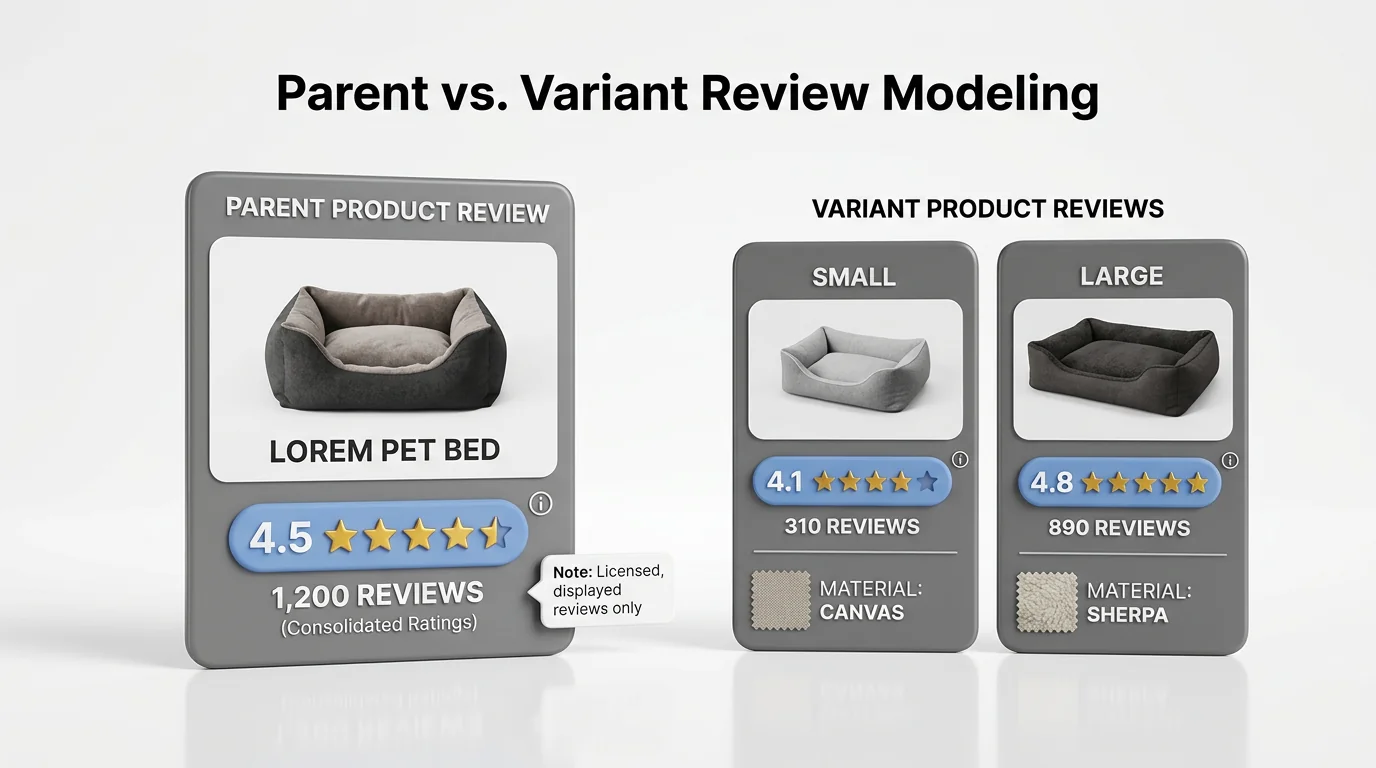
Use a single parent Product when differences are minor, such as size, color, or pack count. Map variant-level price, SKU, GTIN, and availability. Display consolidated reviews if experience is materially identical.
When to split into separate Product entities
Split Products when variants change performance or use case. Distinct formulations, materials, or functionality justify separate Product entities. In those cases, model independent Review and AggregateRating objects per item.
Implementation checklist: Product, Review, AggregateRating, Breadcrumb
Product essentials (name, brand, GTIN, SKU, image, description)
Include name, brand, SKU, and a unique description aligned to visible content. Add GTIN (gtin8/12/13/14) when available. Provide at least one 1200px image. Ensure all values shown on-page match your markup for eligibility.[4]
Offer and availability (price, currency, condition, availability)
Use Offer with price, priceCurrency, itemCondition, and availability per variant. Update availability at render time. If pricing changes often, schedule nightly schema refreshes to prevent desynchronization.
Review and AggregateRating (sources, recency, counts)
Only include reviews that appear on the page and you are licensed to display. Provide reviewCount and ratingValue that match the UI. Stabilize rounding. Refresh AggregateRating when counts or averages change meaningfully.
Breadcrumb alignment with site navigation
Implement BreadcrumbList reflecting your primary navigation path. Use canonical category names and URLs consistently. Align with your information architecture and avoid mixing filter paths to reduce duplication risk.
Quick decision guide
If X situation, then Y action (5-7 scenarios)
- If variants differ only by size or color, use one parent Product with variant-level Offers and availability.
- If formulation or performance changes, split into separate Products with distinct reviews and AggregateRating.
- If you have no GTINs, still publish SKU and brand. Add GTIN later without changing identifiers.
- If marketplace ratings are displayed on-page with permission, include them and label the source.
- If price/availability updates hourly, render schema server-side and cache for 15-30 minutes.
- If using Shopify product schema defaults, extend templates to include variant-level availability.
- If breadcrumbs differ from navigation, standardize to the canonical category chain.
Common pitfalls for pet variants and marketplace feeds
Mismatched price/availability across variants
Shoppers may see inaccurate stock if variant data is flattened. Ensure variant-level price and availability populate Offers accurately. For Shopify product schema, validate Liquid logic to prevent defaulting to the first variant.
Double-counted or ineligible reviews
Avoid mixing syndicated reviews that are not displayed or licensed. Do not sum marketplace and onsite reviews without clear disclosure. Stabilize ratingValue across decimal places to match visible UI and schema equally.
Conflicting GTIN/SKU and duplicate content
Do not reuse GTIN across distinct items. If variants are split into Products, rewrite titles and descriptions to avoid duplication. See programmatic patterns in programmatic SEO templates and strengthen paths with internal linking blueprints.
QA workflow: validate, test, and monitor
Pre-release validation steps
Run JSON-LD through schema validators and structured data testing. Cross-check UI against schema for price, stock, and ratings. Confirm Breadcrumbs follow the canonical path and exclude querystring parameters and tracking codes.[4]
Live testing and Search Console checks
Deploy to a small percentage of PDPs first. Inspect URLs with the URL inspection tool and Rich Results report. Review warnings for deprecated fields or missing recommended attributes before scaling.
Marketplace feed parity checks
Compare feed attributes (GTIN, price, availability) to structured data nightly. Alert on >2% mismatches by attribute. Evidence suggests disciplined micro-markup improves e-commerce data consistency and visibility.[2]

Monitoring guidance: what to observe after 7-14 days and 4-8 weeks
CTR and rich result coverage trends
Track Product-result coverage and CTR by category. Look for uplift where stars and price render. Evaluate differences between parent-with-variants vs. split Products to refine your modeling approach by segment.
Error/warning patterns in Search Console
Watch for priceCurrency, availability, or AggregateRating warnings. Investigate status changes after re-crawls. Fix template-level issues first to resolve at scale. Revalidate affected URLs and annotate your analytics timeline.
Review volume, recency, and moderation signals
Aim for steady review inflow from verified buyers. Refresh AggregateRating when new reviews shift the average. Moderate outliers transparently. Automated schema generation may assist but requires human review for quality.[1]
Practical safety boundaries
Eligibility, authenticity, and moderation standards
Only mark up products that are purchasable or clearly listed with price and availability. Show reviews you actually display. Disclose sources for syndicated ratings. Avoid gating rating visibility behind interactions or tabs.
Rate limits and rollout gates
Release schema changes incrementally. Start with 5-10% of PDPs, then 25-50%, then full rollout. Rebuild sitemaps to encourage re-crawl. Cap schema regeneration jobs to avoid cache thrashing and inconsistent snapshots.
Evidence status and limitations
What evidence suggests about CTR and visibility
Research indicates accurate, consistent micro-markup contributes to richer snippets and improved clarity for shoppers. Gains vary by query class and competition, so treat improvements as directional rather than guaranteed.[2]
Areas where results may vary
Eligibility policies, re-crawl timing, and site authority influence outcomes. Schema must match visible content precisely for sustained benefits. Validation and periodic audits remain necessary as templates and catalogs evolve.[4]
Validation checklist and next steps
Final pre-production checks
Confirm Product essentials, Offers per variant, and accurate AggregateRating. Validate Breadcrumb schema and URL canonicals. Ensure Shopify product schema extensions handle variant availability. Snapshot before-and-after SERP features for matched cohorts.
Link to the core SEO roadmap
Connect schema deployment to your broader content, IA, and measurement plans. See the core SEO roadmap for aligning category architecture, internal links, and commercial content sequencing across rollouts.
Frequently Asked Questions
Should reviews live on the parent product or each variant?
Evidence suggests consolidating reviews at the parent Product when variants differ only by size or color. If variants materially change performance (e.g., chew strength), variant-level reviews may be more accurate.
Can I include third-party marketplace reviews in my schema?
You may reference reviews you are licensed to display and that appear on the page. Avoid aggregating off-site ratings not shown to users or mixing sources without disclosure.
Do I need GTINs for pet products in schema?
GTINs are not mandatory but may support disambiguation and merchant features. Use gtin8/12/13/14 when available; otherwise ensure SKU and brand are consistent.
How often should AggregateRating be updated?
Update when review count or average meaningfully changes. Many teams refresh nightly; ensure the on-page rating matches the structured data at render time.
Why are my product rich results not appearing?
Eligibility is not guaranteed. Check for policy issues, missing required fields, mismatched on-page content, or delayed recrawl. Search Console’s Rich Results report may highlight specific warnings.
Conclusion
Product, Review, AggregateRating, and Breadcrumb schema help buyers qualify choices quickly. Model variants thoughtfully, synchronize marketplace feeds, and validate meticulously. For at-scale updates across pet ecommerce schema, teams often automate content and markup generation with careful human QA-platforms such as Petbase AI can assist while you preserve strict review and eligibility standards.[1]
References
- BUD Abbasi et al. (2022). Autonomous schema markups based on intelligent computing for search engine optimization. PeerJ Computer ….
- O Belz (2022). Use of Schema. org micro-markup in e-commerce projects. Three Seas Economic Journal. View article
- MH Dang et al. (2025). LLM4Schema. org: Generating Schema. org Markups with Large Language Models. … Web. View article
- M Edgar (2023). Schema and structured data markup. Tech SEO Guide: A Reference Guide for Developers …. View article