Local Pet Services SEO for Groomers, Trainers, and Vets with Online Stores

Table of Contents +
- The one decision to get right: a safe hybrid for service + store
- Quick decision guide
- Google Business Profile setup for service-eCommerce hybrids
- Service pages that convert and support local rankings
- Product pages with a local lens
- Practical safety boundaries
- Monitoring guidance
- Evidence status: what the data and guidelines suggest
- Implementation worksheet (outline)
- Frequently Asked Questions
- Conclusion
- References
How groomers, trainers, and vets can align local SEO and online store. GBP, service pages, product tie-ins, and safe hybrid site structure.
Local pet providers now mix appointments with retail. Searchers also mix local intent with product demand. The result is opportunity and risk for visibility and conversions across both tracks.
This guide shows a safe hybrid for service areas and eCommerce. You will learn how to structure pages, configure Google Business Profile, and tie products to local intent without cannibalizing rankings. Expect practical steps for groomer SEO, dog trainer SEO, and veterinary SEO.
The one decision to get right: a safe hybrid for service + store
Your domain structure sets the ceiling for performance. Unclear intent confuses crawlers and users. A dual-track model distinguishes local service discovery from transactional product buying, then connects them with purposeful internal links.
When to keep services and products on one domain vs. subdomain
Use one domain when brand, NAP, and teams are shared. Add a /services/ hub and a /shop/ hub. Choose a subdomain only when operations, inventory, or branding differ significantly across teams or regions.
Mapping local intent pages vs. transactional product pages
Local intent lives in service landing pages and city child pages. Transactional intent lives in product detail pages and collections. Use distinct templates, breadcrumbs, and schema to reduce ambiguity between these intents.
Avoiding cannibalization between service queries and retail SKUs
Separate keywords by intent in titles and H1s. Link service pages to relevant SKUs via modules, not broad lists. Consolidate overlapping SKUs into collections. See our pet eCommerce strategy overview for the broader model.

Petbase automates SEO content for veterinary clinics - so you can focus on patients, not blog posts - start your free trial.
Quick decision guide
Use these fast rules to resolve intent conflicts. They help groomers, trainers, and clinics decide where a query should land and what to feature next on the path to purchase or booking.
If searches are “near me” or include city names → prioritize service pages
Route these queries to service templates with location signals, testimonials, hours, and booking. Attach a concise “Recommended products” module that reinforces the service outcome without diluting the primary local intent.
If searches are product + size/breed → prioritize product pages
Send these users to SKUs or collections. Include fitment, size charts, and care guidance. Add a subtle link back to the most relevant service page for expert support, not as the main call to action.
If a product aids a service outcome → add contextual blocks on service pages
Use small narrative blocks: “Maintain results at home.” Link two or three SKUs and one collection. Place near outcomes or aftercare sections. Avoid repeating full product descriptions on service pages.
If pages target the same keyword → separate intents and adjust titles
Refactor titles: “Teeth cleaning in [city]” for service; “Enzymatic dental gel” for product. Differentiate FAQs and visuals. Monitor Google Search Console queries per URL to confirm reduced overlap.
If GBP posts trend on a SKU → create a local promo collection
When a product draws engagement in GBP, build a themed collection for local pickup. Feature inventory status and short care notes. Promote it in Posts and on the related service page sidebar.
If multi-location → use location child pages, not duplicate products
Create unique city pages under each core service. Keep one canonical product URL. Add local pickup availability and store inventory badges that change by location. Avoid product duplication across cities.
Google Business Profile setup for service-eCommerce hybrids
Google Business Profile for pet services is the local discovery gateway. Configure properly to surface services and eligible products without cloaking or mixed signals that might limit visibility or trust.
Primary/secondary categories for groomers, trainers, vets
Choose the core category for your main service. Add secondaries that match offerings, not every product line. Categories help map intent for local SEO for pet services and reduce mismatched impressions.
Services, booking links, and product highlights without cloaking
List services with concise descriptions and pricing ranges. Add the booking URL consistently. Highlight care adjuncts as “Products,” described factually. Keep destination URLs canonical, not UTMed copies or short-links.
Using Products and Posts features to surface local-lens SKUs
Promote SKUs tied to common appointments. Stress pickup and suitability paragraphs. Evidence suggests organized digital presence improves performance for veterinary practices and related services.[1]
Service pages that convert and support local rankings
Service templates should answer local questions, inspire booking, and connect to the right products. Build for clarity first, then add structured data and restrained commerce tie-ins to support both paths.
Outline: problem, process, outcomes, proof, local signals
Lead with the problem clients face. Explain your process with timelines. Share outcomes, before-after proof, and reviews. Reinforce local signals: service area, hours, parking, and neighborhood references where appropriate.
Entity and location markup that may support visibility
Add LocalBusiness subtype markup on service templates. Include NAP, geo coordinates, and sameAs profiles. Strong ICT adoption correlates with discoverability and operational efficiency improvements.[2]
Where to place retail tie-ins without over-optimizing
Place “Maintain results at home” near outcomes or aftercare sections. Limit to two or three SKUs and a collection. Use internal links, not embedded carts, to keep service primary and reduce clutter.
Product pages with a local lens
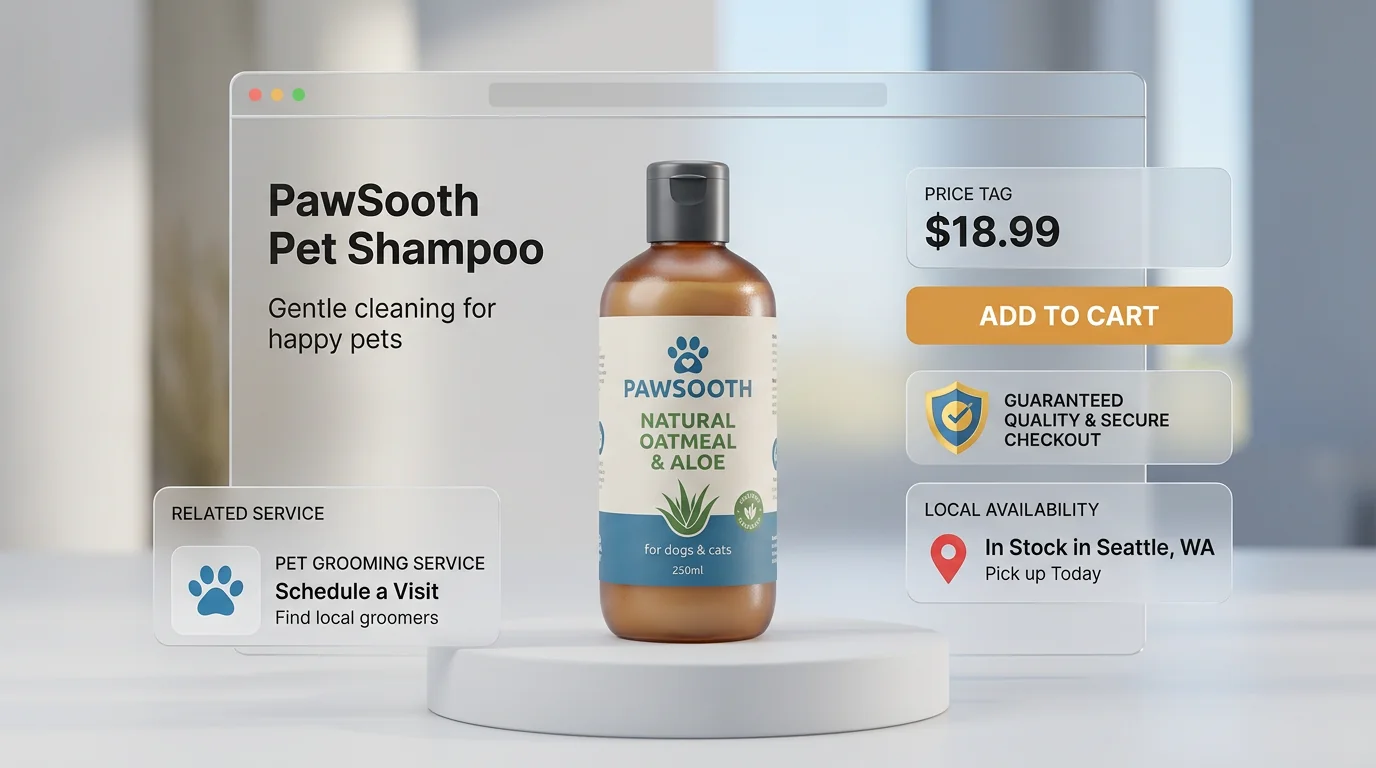
SKU templates can acknowledge your professional expertise without overshadowing purchase intent. Bring local credibility forward while emphasizing inventory, pickup options, and related appointments as supportive next steps.
On-page blocks: “Recommended by our clinic/groomer/trainer”
Add a small trust block. Include the credential, why it fits, and a privacy-safe testimonial. Keep the tone factual. Link back to the relevant service page for deeper professional guidance where appropriate.
Local pickup, inventory, and appointment-linked upsells
Display live inventory and pickup windows. Offer gentle appointment upsells when relevant. Personalization and convenience may improve loyalty in pet eCommerce contexts when executed responsibly.[4]
Collections for conditions, coat types, and training goals
Group SKUs by use case, not brand alone. Use intent-led filters and canonicalization. For structure fundamentals, see information architecture for pet stores to avoid fragmentation and duplicated paths.
Practical safety boundaries
Protect trust and compliance as you merge services with retail. Keep claims cautious, avoid doorway tactics, and ensure clean, unmixed structured data signals across templates and feeds.
Medical and behavioral claims: cautious wording and citations
Avoid promises or guarantees. Use phrasing like “may support” and cite authoritative sources when making health-adjacent statements. Responsible ICT usage aligns with professional standards and risk management.[2]
Avoid doorway pages and thin city duplicates
Build unique city pages with substantive content, staff profiles, and context. Do not replicate product pages per city. Centralize SKUs and vary pickup badges, hours, and store selectors instead.
SKU-schema and LocalBusiness-schema separation
Use Product schema on SKU templates and LocalBusiness (e.g., VeterinaryCare) on service pages. Do not mix on a single template. For practical QA, review Product and Review Schema QA guidance.
Monitoring guidance
Watch early signals in GBP and Search Console, then iterate titles, modules, and linking. Confirm that service pages capture local queries while product pages hold transactional phrases without overlap.
7-14 days: GBP insights, impressions, and query shifts
Check Views, Searches, and Actions. Note which products get clicks from Posts or Products. Validate category alignment. ICT presence often correlates with better discovery and booking efficiency.[1]
4-8 weeks: GSC by page type, cannibalization checks, assisted conversions
Filter GSC by URL folder: /services/ vs. /shop/. Compare queries, CTR, and positions. Track assisted conversions in analytics. See our internal linking and measurement for pet stores workflow for filters.
Diagnostics: location SERP spot-checks and log sampling
Search incognito across key cities and categories. Sample logs for bot behavior on service and product templates. Confirm crawl paths are clean and titles reflect separated intents at scale.
Evidence status: what the data and guidelines suggest
Guidelines emphasize accurate representation and clear intent. Practitioner experience indicates dual-track setups often reduce conflicts and improve engagement when implemented with disciplined templates and conservative claims.
What guidelines state vs. common practitioner outcomes
Guidelines reward clarity, proximity, and relevance. Practitioners often observe stronger lead quality when services and SKUs are separated by templates yet linked contextually to satisfy blended shopper behavior patterns.
Signals that may correlate with improvements
Consistent NAP, category accuracy, structured data integrity, and responsive content updates correlate with visibility. AI-supported operations may enhance speed and consistency in clinics and service providers.[3]
Areas where testing is recommended
Test positions of product tie-ins on service pages, collection faceting depth, and GBP Product card copy length. Split-test title formats for intent clarity. Track both booked appointments and SKU conversion lift.
Implementation worksheet (outline)
Formalize your plan before building. Use a lightweight spreadsheet to map URLs, templates, and schema. Align GBP content with promotions and seasonality to keep the hybrid model coherent and measurable.
URL map and canonical plan
Define /services/ and city children, plus /shop/ collections and SKUs. Set self-canonicals on SKUs and avoid parameter indexation. Map internal links between intent pairs with anchor text clarifying user goals.
Template modules for service and product pages
Service: hero with booking, outcomes, proof, FAQs, and “Recommended products.” Product: trust block, inventory, pickup, and related service link. For automation at scale, many teams use Petbase AI to maintain templates.
GBP content calendar integrating seasonal SKUs
Plan two Posts weekly: one service tip, one product highlight with local pickup. Rotate collections by season and conditions. Cross-link to service pages and collections to reinforce intent without duplication.

Frequently Asked Questions
Should I separate my online store from my service site?
Evidence suggests many pet providers benefit from one domain with clear intent separation. Use dedicated service pages for local queries and product pages for transactions, supported by internal links.
Can I list products in Google Business Profile for a clinic or groomer?
Yes, GBP Products and Posts may surface local-friendly SKUs. Keep descriptions factual, avoid medical guarantees, and link to canonical product URLs.
How do I avoid keyword cannibalization between services and products?
Differentiate titles and H1s by intent, use unique FAQs per page type, and add internal links clarifying next steps. Monitor GSC queries per URL to catch overlaps.
What schema should I use for a vet with a store?
Use LocalBusiness (e.g., VeterinaryCare) for service pages and Product schema for SKUs. Keep them on relevant templates to avoid mixed signals.
How long until local changes may show results?
GBP edits may reflect within days, while organic local rankings often take several weeks. Track impressions, calls, and assisted conversions over 4-8 weeks.
Conclusion
A dual-track approach aligns service discovery with product transactions without tripping search engines or confusing customers. Keep templates distinct, titles precise, and links purposeful. Optimize GBP to surface both services and local-friendly SKUs responsibly.
Use disciplined monitoring to validate separation and detect early conflicts. When sustained, this framework supports groomer SEO, dog trainer SEO, and veterinary SEO together, delivering measurable local visibility and revenue lift with prudent technical safeguards.
References
- N Fejzić et al. (2023). The impact of digital presence and use of information technology on business performance of veterinary practices: a case study of Bosnia and Herzegovina. Frontiers in Veterinary …. View article
- B Karolina (2023). Unlocking the potential of ICT innovation in veterinary healthcare: The pathway to improve practices and business model. Procedia Computer Science. View article
- K Beyer et al. (2025). THE ROLE OF ARTIFICIAL INTELLIGENCE AND ICT IN VETERINARY BUSINESS: A LITERATURE REVIEW. Intelligent Management and …. View article
- YH Lee et al. (2025). Primary Determinants and Strategic Implications for Customer Loyalty in Pet-Related Vertical E-Commerce: A Machine Learning Approach. Systems. View article