Multilingual Pet SEO: US, UK, and DACH Rollouts Without Content Drift

Table of Contents +
- Context: One catalog, three regions, zero drift
- Quick decision guide: if this, then do that
- Hreflang and canonical architecture
- Localization without drift: currency, units, and pet terms
- Product mapping and taxonomy control
- Schema, feeds, and storefront signals
- Monitoring: what to check after 7-14 days and 4-8 weeks
- Practical safety boundaries
- Evidence status and assumptions
- Frequently Asked Questions
- Conclusion: sequence your rollout and avoid drift
- References
Hreflang, localization, and pet terminology mapping for US, UK, and DACH rollouts that keep product pages aligned and avoid content drift.
Expanding into US, UK, and DACH promises growth, but it also invites content drift. Regional variants can collide, confuse search engines, and fragment equity. You need structure.
This guide shows how to align hreflang for ecommerce, currency and measurement SEO, and pet terminology localization. You will learn a repeatable framework that preserves product mapping, avoids duplication, and maintains performance as you scale.
Context: One catalog, three regions, zero drift
Scope of this deep dive: US, UK, DACH for pet ecommerce
This article focuses on a single global catalog with regional storefronts for the US, UK, and DACH. The emphasis is strict mapping between locales. We prioritize implementation detail over theory.
Risks to control: duplicate intent, cannibalization, mis-mapped products
Key risks are duplicated search intent across English variants, cross-locale cannibalization, and product-to-URL misalignment. Secondary risks include schema drift, translation errors, and pricing desynchronization that mislead search engines.

Petbase handles this entire content workflow automatically - 10 SEO articles published to your blog every month - start your free trial.
Quick decision guide: if this, then do that
5-7 situational rules that keep rollouts aligned
- If US and UK target the same query, then localize spellings, units, and price formats, and keep self-referencing canonicals.
- If a product is unavailable in DACH, then publish a soft-404 template with alternates and keep hreflang pairs consistent.
- If US and UK share identical copy, then add a 10-15% localization delta and update structured data priceCurrency.
- If filters differ by market, then align facet semantics and preserve URL patterns; avoid orphan parameters.
- If translation introduces new terms, then validate taxonomy tags against the canonical product ID.
- If shipping or regulations vary, then localize Offer markup and shipping badges to avoid snippet mismatches.
- If you deploy programmatic content, then template locale tokens and constrain term variants for consistency across catalogs. See safe programmatic content patterns.
Hreflang and canonical architecture
Language-region pairs and x-default
Use ISO pairs: en-us, en-gb, de-de, de-at, and de-ch for DACH SEO best practices. Set an x-default to the global chooser or primary market homepage. Structured alternates must fully reciprocate across all pairs. Multilingual systems commonly support hreflang management and may reduce implementation errors.[1] Consider standardizing templates for multi-language content creation and ensure internal linking automation preserves alternate chains.
Canonical rules to prevent cross-locale duplication
Keep self-referencing canonicals per locale. Do not canonicalize UK pages to US, or vice versa. If a product is temporarily unified across locales, enforce uniques via hreflang and localized schema values instead of cross-canonicals.
Sitemaps and alternates consistency checklist
Provide locale-dedicated sitemaps. Ensure each URL lists every valid alternate and matches on-path endpoints. Avoid trailing slash mismatch. Rebuild sitemaps on SKU or availability changes to keep alternates synchronized for crawlers.
Localization without drift: currency, units, and pet terms
Currency, pricing, and availability signals
Render prices in USD, GBP, and EUR respectively, with priceCurrency in markup and visible UI. Localize thousand and decimal separators. Maintain synchronized availability states to avoid snippet confusion. Automation may improve consistency across large catalogs.[2]
Measurements: lb/oz vs kg/g; size charts and filters
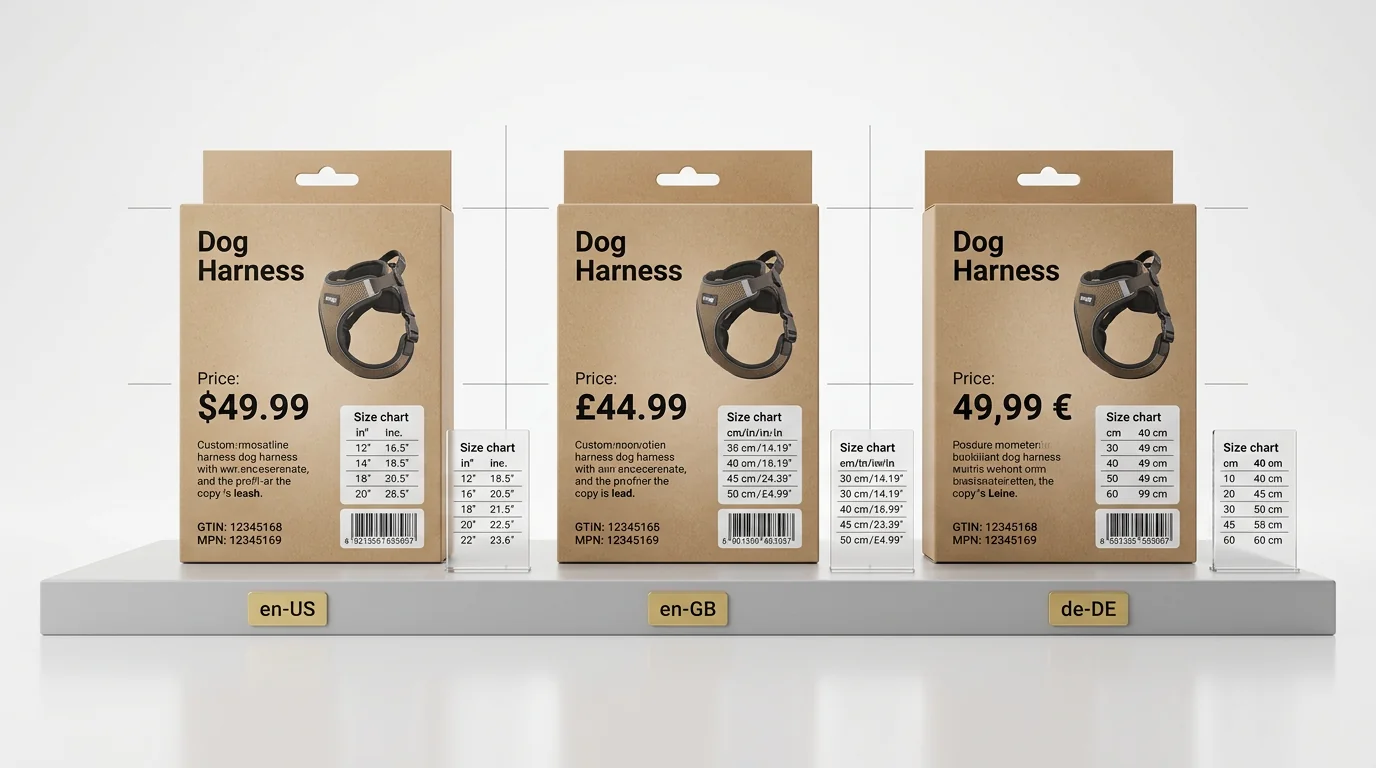
Show imperial in US and metric in UK and DACH, with optional dual display in UK. Provide parallel size charts. Map filter values to canonical attributes and local labels, not new attribute IDs.
Terminology map: US/UK English and German (DACH) examples
Standardize a terminology register that informs titles, facets, and on-page UX. This supports relevance without fragmenting taxonomy. Evidence indicates multilingual normalization may assist discoverability and quality control.[1]
| Concept | US | UK | German (DACH) |
|---|---|---|---|
| Lead/Leash | Leash | Lead | Leine |
| Waste bags | Waste bags | Poo bags | Kotbeutel |
| Shipping | Shipping | Delivery | Versand |
| Sales tax/VAT | Sales tax | VAT | MwSt. |
| Returns | Returns | Returns | Rückgabe |
Product mapping and taxonomy control
Stable product IDs with locale variants
Maintain one global product ID with locale-specific slugs and attributes. Keep GTIN/MPN static. Feed titles and descriptions localize, but SKU-to-ID relationships must not change. This preserves reviews, offers, and ranking continuity.
Facet parity and filter semantics per market
Align core facets across markets: size, material, age range, and certifications. Translate labels, not underlying attribute keys. Review parity with a checklist and align IA with category and filter intent patterns to avoid crawl traps.
SKU bundling and region-specific compliance notes
Some bundles are regional. Use child SKUs tied to the global parent to keep alternates intact. Store compliance text per locale and reference Product and Offer markup to ensure correct disclosures in structured data and UI.
Schema, feeds, and storefront signals
Product and Offer markup per locale
Render Product with inLanguage, name, description, GTIN/MPN constant, and Offer per locale with priceCurrency, price, availability, shippingDetails, and country restrictions. Keep URL in markup matching the locale URL. Validate with Search Console.
Merchant center feeds and GTIN/MPN consistency
Use separate feeds per country with identical IDs, constant GTIN/MPN, and localized titles, links, prices, and availability. Ensure tax and shipping fields reflect market rules. This alignment may stabilize Shopping visibility.
Breadcrumb and organization markup alignment
Localize BreadcrumbList text while preserving consistent item URLs per locale. Keep Organization markup stable with sameAs links. Localize image alt text and captions, which AI-driven models may help scale responsibly.[4]
Monitoring: what to check after 7-14 days and 4-8 weeks
Early signals (indexation and hreflang coverage)
Within 7-14 days, confirm coverage for priority SKUs. Inspect server logs for alternating bot requests across locales. Audit indexation and hreflang coverage for reciprocity, x-default presence, and sitemap freshness.
Mid-term signals (cannibalization and conversion parity)
At 4-8 weeks, compare query clusters for US vs UK overlap. Watch unintended ranking switches and anomalous CTR gaps. Automating comparisons may reduce noise and speed corrections across routine checks.[2] For scaled catalogs, teams often adopt Petbase AI to coordinate updates.

Practical safety boundaries
Change windows, rollout gates, and rollback criteria
Batch deployments in 300-1,000 URL cohorts per locale. Gate releases on hreflang reciprocity above 98% and sitemap parity above 99%. Define rollback triggers for sudden cross-locale ranking swaps or markup validation failures.
Content and pricing variance thresholds
Target 10-20% copy delta between US and UK pages via spelling, terminology, and unit differences. For DACH, require full native copy. Keep price deltas within real exchange variation, not cosmetic differences that confuse users.
Evidence status and assumptions
What evidence suggests for hreflang and localization
Research indicates multilingual tooling and structured processes can standardize alternates and reduce errors, supporting discoverability at scale.[1] AI-assisted monitoring may streamline repetitive SEO tasks that underpin stable international deployments.[2]
Where data is limited and how to test safely
Evidence is thinner on the optimal localization delta for English variants and template-level term choices. Run 50-200 URL experiments per locale and iterate. Emerging methods for multilingual generation warrant cautious A/B testing.[3]
Frequently Asked Questions
Should I use separate domains, subdomains, or folders for US, UK, and DACH?
Evidence suggests subfolders can consolidate authority while supporting clean hreflang. Separate ccTLDs may help local trust but add maintenance. Choose the model that best fits your engineering and link equity strategy.
How do I prevent duplicate content across US and UK pages?
Use hreflang with region-specific content deltas (spelling, currency, units, and terms). Keep self-referencing canonicals per locale and ensure each page has a direct alternate for the others.
What’s the minimum localization needed for DACH?
Native German copy, EUR pricing, metric units, and localized pet terms may support relevance. Also adapt legal/compliance text (e.g., returns) and shipping badges that reflect local expectations.
How should I localize size guides for pet apparel and harnesses?
Offer parallel charts in imperial and metric with breed examples known in that region. Maintain one product ID with locale-specific attributes to keep reviews and offers consistent.
Do I need separate product schema per locale?
Yes, render Product and Offer data with localized priceCurrency, availability, and inLanguage. Keep GTIN/MPN constant to signal the same item across locales.
Conclusion: sequence your rollout and avoid drift
US → UK → DACH sequencing and the handoff checklist
Sequence US first to anchor taxonomy and product IDs. Localize UK with spelling, GBP, and refined terminology. Hand off to DACH with native copy, metric units, EUR pricing, and compliance text. Validate hreflang, schema, and feeds before scaling.
Link back to the global pet SEO roadmap for context
Adopt disciplined gates, monitor alternates, and keep product mapping stable to prevent drift. For broader orchestration across architecture, content, and measurement, see the global pet SEO roadmap for sequencing and cross-team alignment.
References
- A Vasiļjevs et al. (2024). Advancing Digital Language Equality in Europe: A Market Study and Open-Source Solutions for Multilingual Websites. Proceedings of the 25th …. View article
- MC Pereira et al. (2025). AI in Search-Redefining SEO in Digital Marketing Strategy and Practices. International Conference on Business …. View article
- A Singh et al. (2025). Enhancing Large Language Models for Real-Time, SEO-Optimized Article Generation. Intelligent Systems Conference. View article
- Z Ayaz (2024). AI-driven automation in SEO: Enhancing image descriptions with BLIP-processor models. International Journal on Technical and Physical …. View article