From Blog to Basket: Internal Linking and Measurement for Pet Stores

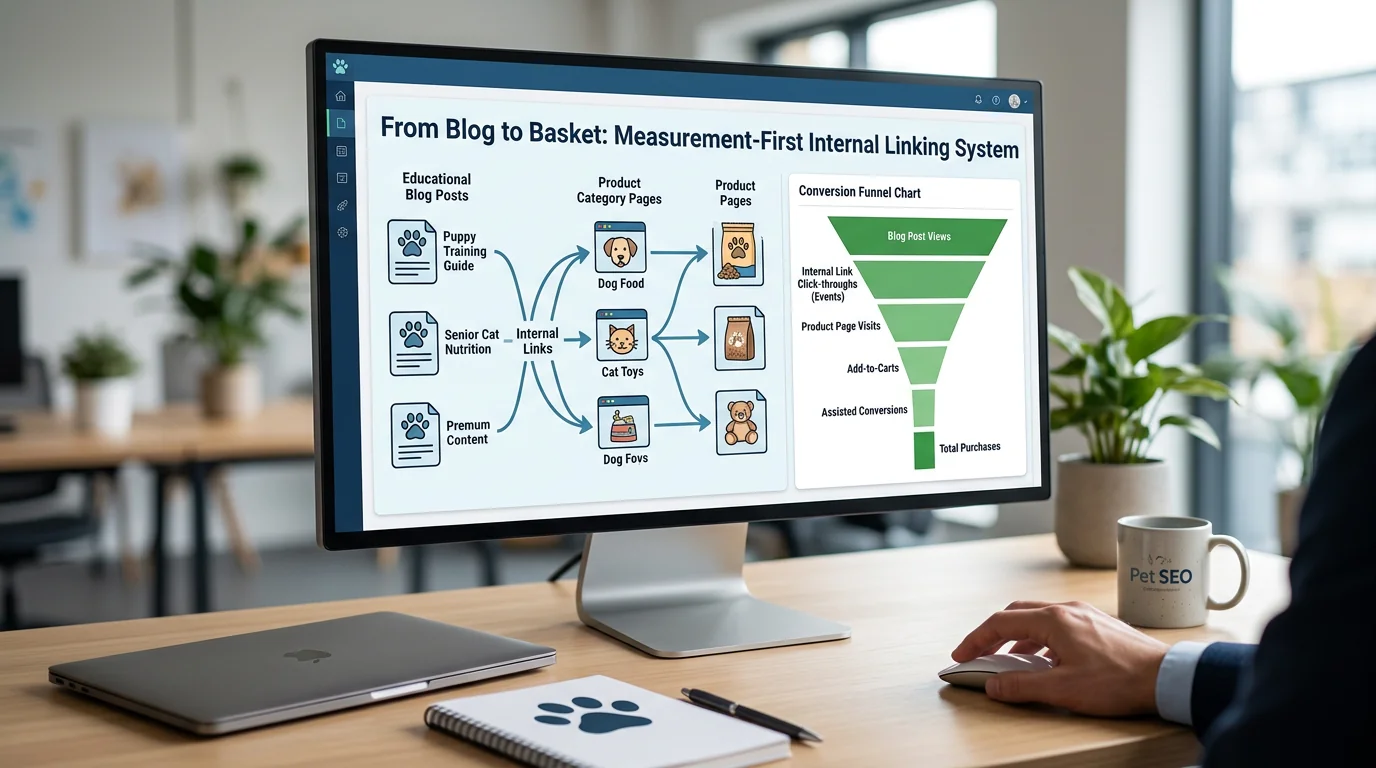
Table of Contents +
- Scenario: Educational blog posts aren’t driving add-to-carts
- Quick decision guide
- Link architecture that moves readers to baskets
- Event setup: GA4 + consent-safe add-to-cart measurement
- KPI framework and diagnostics
- Practical safety boundaries
- Evidence status and assumptions
- Monitoring guidance and action windows
- Glossary and implementation checklist
- Further reading and cluster navigation
- Frequently Asked Questions
- References
A measurement-first system to connect blogs to product pages, set events, and track add-to-cart and assisted conversions for pet eCommerce.
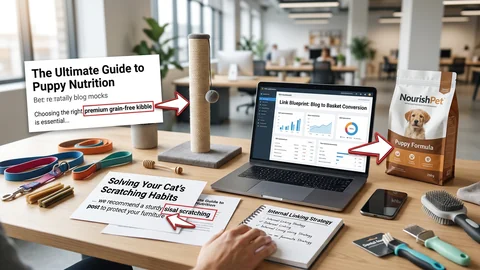
Educational content should earn baskets, not just pageviews. Many teams publish strong guides, yet see little movement in carts. The gap is usually measurement and link architecture.
This matters because pet ecommerce SEO succeeds when readers find relevant products quickly. A measurement-first approach clarifies where content supports revenue. In this article, you will map intent to shoppable paths, instrument GA4 events, and monitor assisted conversions with clear thresholds.
Scenario: Educational blog posts aren’t driving add-to-carts
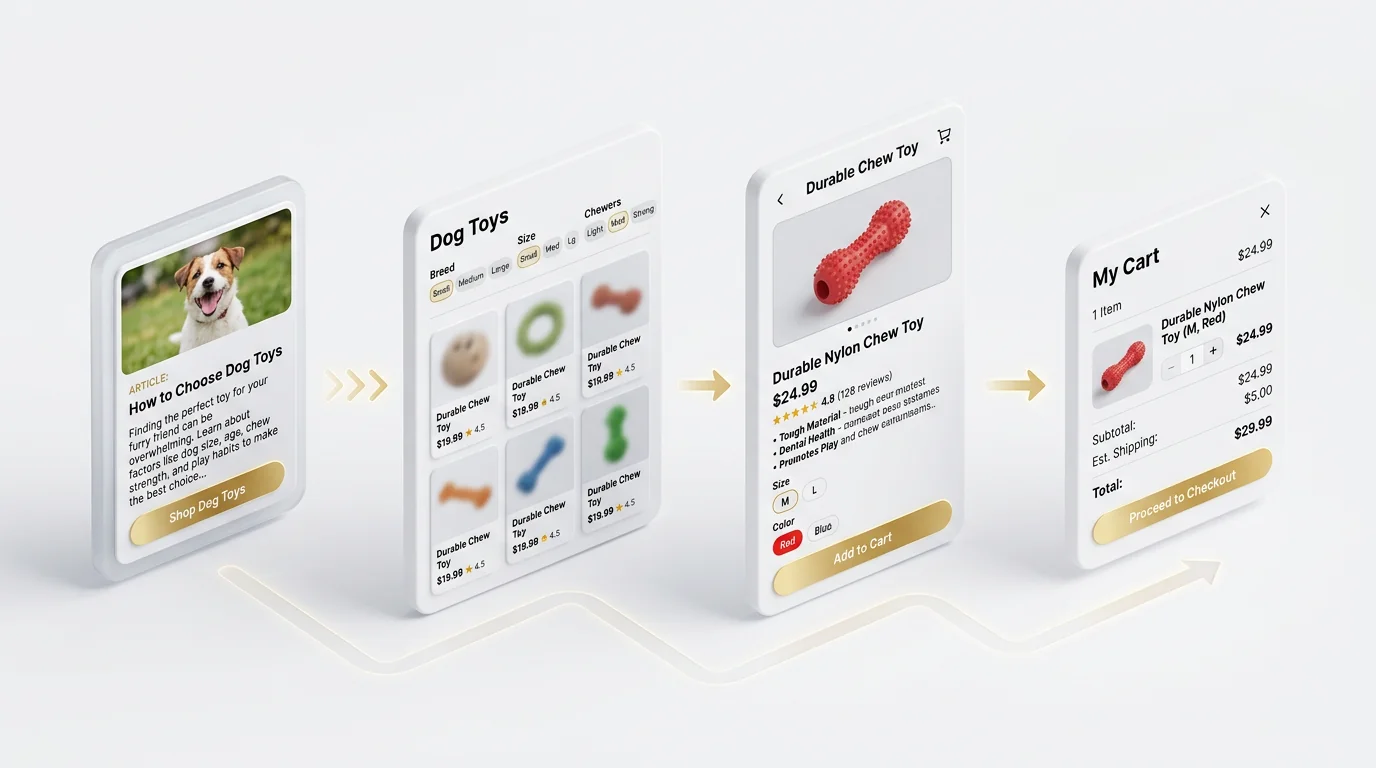
Define one conversion path per post (blog → category → product → cart)
Assign a single, primary path per post to limit cognitive load. Guide readers from education to a relevant category, then to products, then to cart. Avoid competing paths that fragment attention.
Map intent to link targets: care guides → categories; breed queries → filtered PLPs
Intent should determine destination depth. Care and how-to content typically points to categories first. Breed, size, or life stage topics often perform better with pre-filtered product listing pages.
Instrument GA4 events and parameters before scaling links
Do not scale internal linking without verified measurement. Establish GA4 event hygiene and consent handling. Confirm add to cart tracking, list interactions, and parameters resolve to datasets you trust.
Petbase automates SEO content for pet stores - publishing 10 optimized articles monthly so you can focus on running your shop - start your free trial.
Quick decision guide
If the post is care/“how-to”, link first to the most relevant category (1-2 anchors)
Begin with a single, high-visibility category link, then a secondary mention later. Keep anchors natural, intent-matched, and placed where motivation peaks near problem-solution transitions.
If the post targets breed/size/life stage, link to a pre-filtered PLP
Use focused PLPs with filters applied for breed, size, or age. Illustrate with examples like pre-filtered dog toys for chewers. Maintain readable, benefit-led anchor text that signals specificity.
If the post compares products, link directly to 2-3 top SKUs with pros/cons
Comparison content implies shopping mode. Feature two or three best-fit SKUs with short pros and cons. Keep links adjacent to verdicts, and reiterate one SKU near the conclusion.
If the post addresses a problem symptom, link to solution bundles or kits
Bundles reduce friction for readers unsure about components. Link to curated kits that address the exact symptom. Reinforce value with clear naming, concise benefits, and social proof.
If the post has high scroll depth but low ATC, add sticky ‘shop this topic’ links
Introduce a persistent, minimal sticky module. Use neutral styling and non-intrusive motion. Emphasize relevance over urgency. Measure if scroll engagement translates to product list interactions.
If the post has high ATC but low checkout, add cart value boosters (free-ship thresholds)
Surface shipping thresholds and compatible add-ons. Include messages near cart triggers and product links. Emphasize complementary, low-consideration items that raise AOV without derailing intent.
If the post gets mobile traffic >70%, move product links above first H2
Prioritize early, scannable links on small screens. Place a concise utility module before the first H2. Test sticky anchors against inline links to maintain readability and speed.
Link architecture that moves readers to baskets
Primary path links: one contextual anchor per 250-300 words
Adopt a predictable cadence. One strong, context-aligned anchor every 250-300 words keeps readers oriented without clutter. Use verb-led anchors and avoid repetitive phrasing across a post.
Utility modules: ‘Shop this topic’ box with 3 dynamic targets
Insert a small box featuring a category, a filtered PLP, and one top SKU. Position near the first scroll checkpoint. Align with merchandising logic to optimize pet category pages.
Breadcrumb and related content loops to reinforce relevance
Render breadcrumbs that mirror taxonomy. Add related content loops beneath the fold, prioritizing guides that ladder up to the same category. Keep loops secondary to shoppable paths.
Event setup: GA4 + consent-safe add-to-cart measurement
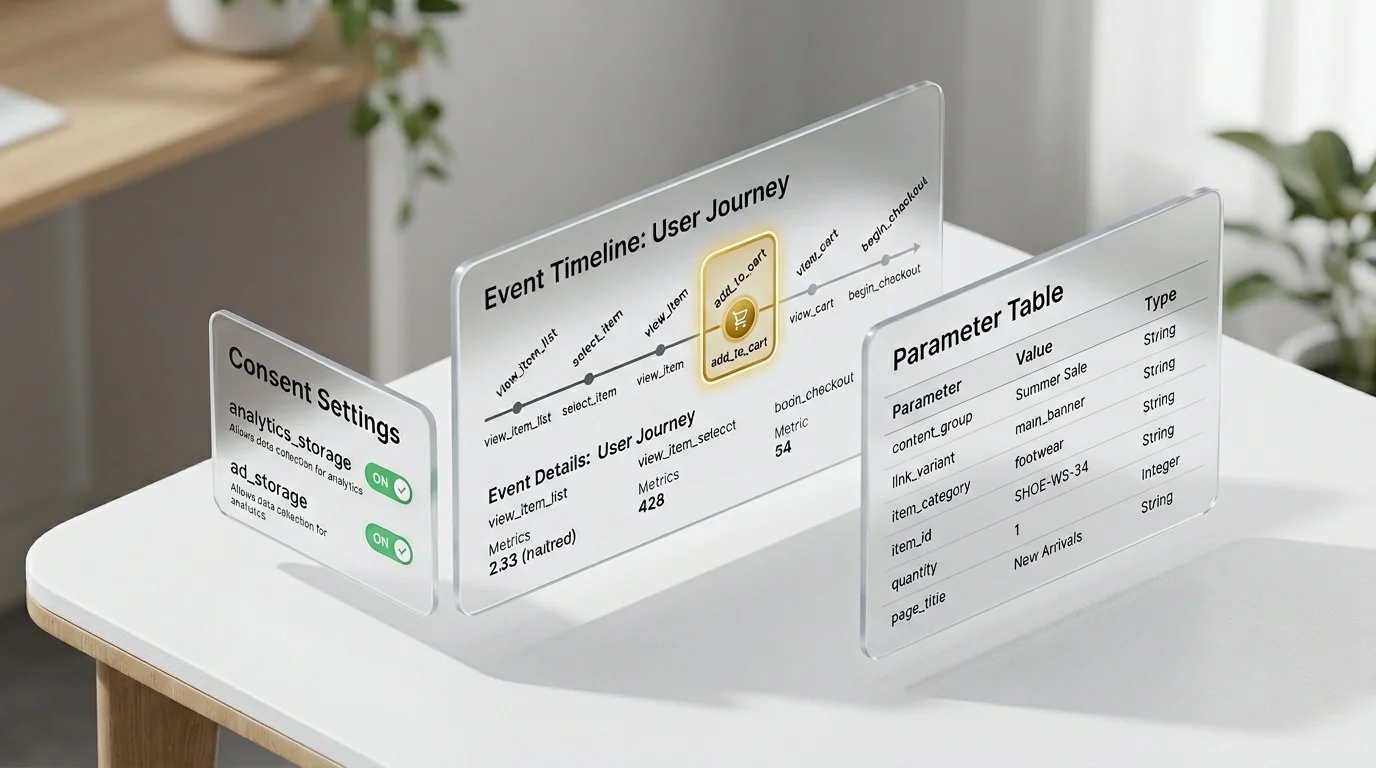
Standardize events: view_item_list, select_item, view_item, add_to_cart
Adopt GA4’s retail events for comparability across channels. Align event names to Google’s recommendation and your consent framework. This consistency may improve attribution fidelity and diagnostics quality.[2]
Pass item_category, breed/size tags, price, list_position
Attach parameters to analyze which content and filters drive progression. Include content_group for blog sections and link_variant for anchor position. Document Shopify GA4 events and server-side mappings for reliability.
Track assisted conversions with content_group and link_variant
Configure assisted conversions using session scopes and exploration reports. Distinguish list clicks from PDP views and add to cart tracking. See GA4 event setup for pet stores to align definitions across teams.
KPI framework and diagnostics
7-14 day checks: click-through to PLP/PDP, ATC rate, bounce back to blog
Use early checks to validate link clarity and event quality. Focus on PLP/PDP clicks, ATC rate, and returns to content. Big data pipelines may refine directionality at this stage.[1]
4-8 week checks: assisted conversions, RPV from content sessions, SKU coverage
Evaluate assisted conversions, revenue per visit from content sessions, and SKU exposure distribution. Expect variability due to consent rates and attribution windows. Complex systems thinking may clarify path interactions.[3]
Thresholds to iterate: link CTR <3%, ATC <4%, RPV delta <10%
Use pragmatic thresholds, not absolutes. Raise link prominence or specificity if CTR underperforms. Tighten product relevance if ATC lags. Consult your eCommerce measurement glossary for consistent definitions.
Practical safety boundaries
Limit links per post section and avoid keyword-stuffed anchors
Overlinking can dilute attention and reduce trust. Cap contextual anchors to one every few paragraphs. Keep anchors descriptive yet concise. Avoid repetitive exact-match phrasing.
Use nofollow on manufacturer outbound links where necessary
When linking to manufacturers or non-commercial resources, apply nofollow as appropriate. Preserve crawl equity for internal destinations. Ensure external links genuinely assist readers.
Respect consent for event tracking and avoid PII in parameters
Implement consent mode before firing marketing events. Do not pass PII in GA4 parameters. Keep item tags limited to taxonomy, price, and merchandising attributes rather than user identifiers.
Evidence status and assumptions
What industry data suggests about internal links and ATC lift
Research on e-commerce analytics indicates structured data collection enables meaningful optimization, which may support improved add-to-cart outcomes through clearer customer journeys.[1] Evidence remains directional and context-dependent.
Measurement caveats: attribution windows and consent rates
Attribution windows, channel composition, and consent rates influence assisted conversion visibility. E-commerce technology stacks vary, shaping data coverage and reliability across sessions and devices.[2]
Where results may vary: assortment depth and merchandising
Assortment breadth, stock availability, and merchandising quality affect click-through and ATC. AI-assisted content operations may reduce variance by standardizing taxonomy and link hygiene across posts.[4]
Monitoring guidance and action windows
7-14 days: validate event quality and link engagement
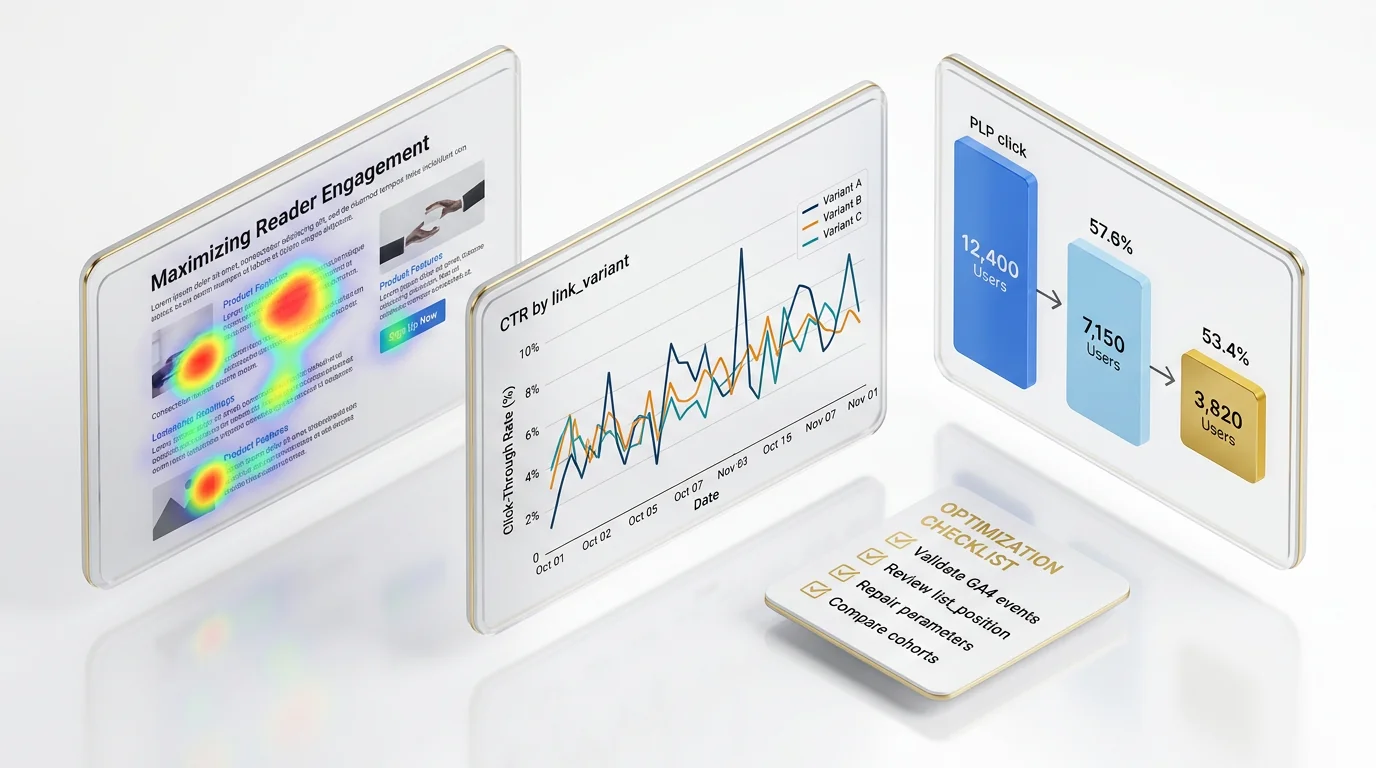
Confirm GA4 events trigger correctly across templates. Validate list positions and content_group. Review link heatmaps and CTR. Repair broken parameters before scaling internal linking or merchandising tests.
4-8 weeks: evaluate assisted revenue and path length changes
Analyze assisted conversions, AOV from content-origin sessions, and path length. Compare cohorts exposed to utility modules versus only contextual anchors. Look for stable RPV lifts rather than single-session spikes.
Roll-forward plan: expand to top 20 posts by traffic
Once instrumentation holds, replicate the model across top-traffic posts. Maintain a cadence of weekly audits. Where resourcing is limited, consider workflow automation with Petbase AI for consistent mapping.
Glossary and implementation checklist
Key terms: PLP, PDP, ATC, RPV, assisted conversion
PLP: product listing page. PDP: product detail page. ATC: add to cart. RPV: revenue per visit. Assisted conversion: a conversion where content was an earlier touchpoint within the attribution window.
Pre-publish and post-publish checks
- Pre-publish: confirm one primary path, anchors per 250-300 words, utility module placement, breadcrumb accuracy, and consent-safe events.
- Post-publish: verify Shopify GA4 events, validate parameters, review CTR and ATC in 7-14 days, and assess assisted conversions by 4-8 weeks.
Further reading and cluster navigation
For orientation across strategy, taxonomy, and templates, explore the pet eCommerce SEO hub. It provides a cohesive view of category structures, content frameworks, and roadmap priorities that support blog to product linking.
Frequently Asked Questions
How many product links should a blog post include?
Evidence suggests 3-5 well-placed links may support engagement without overwhelming readers. Aim for one contextual link per 250-300 words and a single utility module.
Should I link to categories or products from educational posts?
Start with categories for broad intent and pre-filtered PLPs for breed/size/life stage. Link to specific products when the post includes comparisons or clear buyer intent.
What GA4 events are essential for tracking blog-to-basket impact?
Use view_item_list, select_item, view_item, and add_to_cart. Include parameters like item_category, breed/size, list_position, and content_group to analyze assisted conversions.
How long until I can evaluate assisted conversions from content?
A 4-8 week window may provide a more stable view, depending on consent rates and attribution settings. Early directional signals can appear within 7-14 days.
Will adding more internal links always increase conversions?
Not necessarily. Overlinking may dilute attention. Balanced, intent-matched links with clear modules and measurement may support better outcomes.
A measurement-first internal linking system aligns education with commerce. Define one path per post, instrument consistent events, and iterate with disciplined thresholds. Over time, these practices may lift assisted conversions while strengthening customer experience in pet ecommerce SEO.
References
- AA Alsmadi et al. (2023). Big data analytics and innovation in e-commerce: current insights and future directions. Journal of Financial …. View article
- S Kaabi et al. (2019). Overview of E-commerce technologies, data analysis capabilities and marketing knowledge. International Conference on Digital Economy. View article
- M Madanchian (2024). The role of complex systems in predictive analytics for e-commerce innovations in business management. Systems. View article
- X He et al. (2024). Knowledge evolutionary process of Artificial intelligence in E-commerce: Main path analysis and science mapping analysis. Expert Systems with Applications. View article