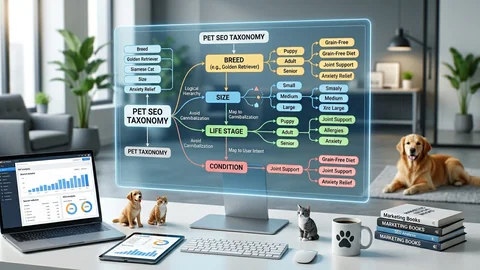
Pet Keyword Research: Turn Breeds, Life Stages, and Problems into an SEO Map


Table of Contents +
- Scenario focus: Convert breed, life stage, and problem modifiers into a shoppable SEO map
- Quick decision guide
- Keyword harvesting and clustering workflow
- Information architecture and URL patterns
- On-page templates for pet modifiers
- Monitoring: what to check after 7-14 days and 4-8 weeks
- Practical safety boundaries
- Evidence status: what is established vs. emerging
- Worked example: From raw terms to a publish plan
- Frequently Asked Questions
- Conclusion
- References
Learn how to map pet keywords by breed, size, age, and problems to structure categories and content. Includes decision guide, safeguards, and monitoring.
Shoppers do not search generically. They search with breed, size, and problem details. Your pet ecommerce SEO should reflect those modifiers across categories, guides, and product pages.
This matters because structured intent capture increases relevance and conversion opportunities. You will learn a practical framework for mapping breed modifiers SEO, life stage keywords, and pet problem keywords into a scalable content and category system.
Scenario focus: Convert breed, life stage, and problem modifiers into a shoppable SEO map
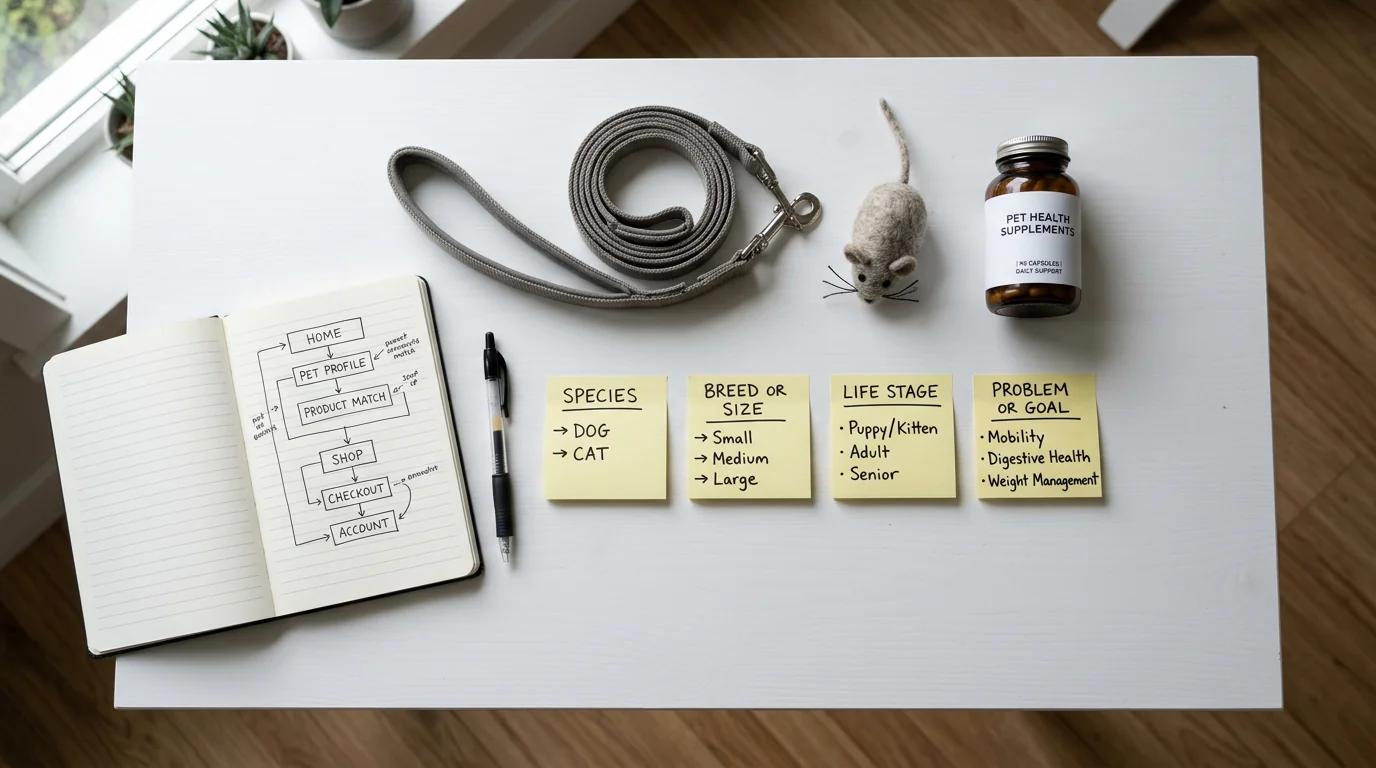
Define the core entity stack: species → breed/size → life stage → problem/goal
Start with a consistent entity stack. Use species first, then breed or size, then life stage, then problem or goal. This order mirrors shopper mental models and keeps pet category mapping predictable.
Decide page types: category vs. guide vs. FAQ vs. PDP enhancer
Assign one intent per page type. Use categories for commercial aggregation, guides for how-to intent, FAQs for objections, and PDP enhancements for SKU-specific advice. Avoid mixing intents on a single page.
Set a canonical modifier order for titles, H1s, and URLs
Adopt a consistent pattern. Example: “Breed/Size + Problem/Goal + Product Type.” Reflect it in URLs, Title, and H1. Consistency simplifies internal linking and reduces cannibalization risk across variants.
Petbase builds this SEO foundation automatically for pet businesses - 10 optimized articles published every month - start your free trial.
Quick decision guide
If query has commercial intent + broad volume, create a category
When volume is high and SERP shows shopping blocks or category pages, build a dedicated category. Add filters for breed, size, and life stage to capture long-tail without generating thin duplicates.
If query is specific + informational, publish a guide and link to category
When intent is how-to, publish a concise guide. Include shoppable sections and link prominently to the closest category. Reinforce problem/goal terms in H2s with life stage keywords for clarity.
If query is ultra-niche but repeats across breeds, use a template collection
Recurring micro-intents across many breeds suggest template collections. Use a uniform layout, with breed-specific blocks. Roll out in batches to test demand before scaling site-wide.
If query maps to care advice for one SKU, enhance PDP with sections/FAQ
When search aligns with a single product solution, add PDP sections: sizing, safety, life-stage suitability, and FAQs. Keep copy concise. Link to related guides for added context and depth.
If modifiers clash (breed vs. size), prioritize data-backed demand
Compare search volume and SERP intent to decide hierarchy. If size leads, make it primary and integrate breed as on-page references. Reassess quarterly as demand and SERPs evolve.
If seasonality spikes, schedule content 6-8 weeks ahead
Identify seasonal patterns. Publish relevant categories and refresh guides before peaks. For planning heuristics and timelines, see seasonal and trend calendars for pet eCommerce to align production with demand.
Keyword harvesting and clustering workflow
Collect modifiers: breeds, sizes, life stages, problems/goals
Harvest terms from keyword tools, your store search logs, and marketplace autosuggest. Capture full modifier sets: breed, size, age group, and problem or goal. Name clusters precisely for repeatability and reporting.
Expand with SERP features: People Also Ask, related searches, forums
Scan People Also Ask, related searches, Reddit, and specialty forums. These sources may surface phrasing and objections tools miss. Taxonomies improve consistent labeling and strengthen clustering logic.[2]
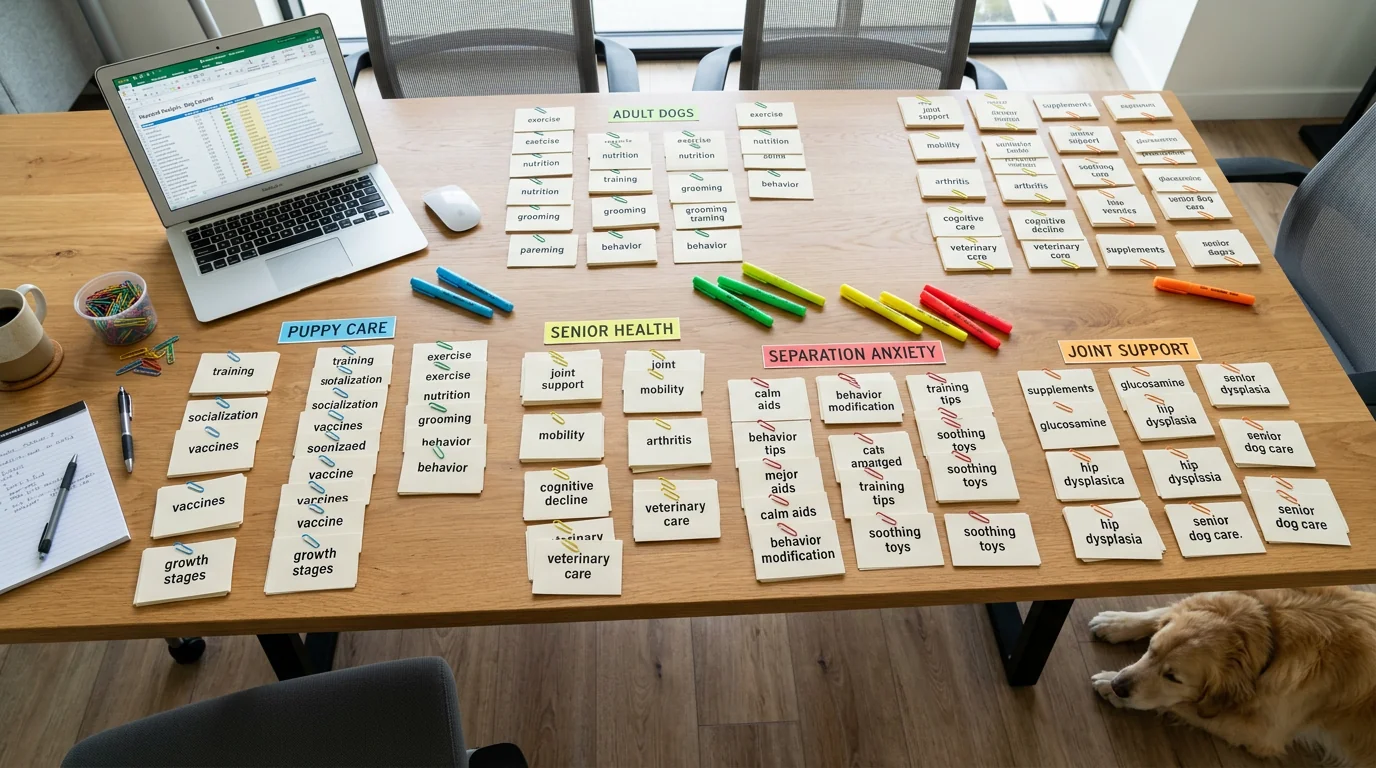
Cluster by intent and modifier depth; label page type and template
Group terms by commercial versus informational intent. Then sort by modifier depth: species, breed or size, life stage, and problem. Assign a page template per cluster to reduce ambiguity.
Score by demand, competition, and product availability
Use a balanced score: demand (volume), difficulty (competition), and readiness (inventory, margins). Prioritize clusters where product availability is solid and informational support may assist conversions.
For workflow acceleration, some teams use Petbase AI to automate pet keyword research and publish mapped pages at scale.
Information architecture and URL patterns
Recommended URL syntax and parameter hygiene
Favor short, descriptive slugs: /species/breed-or-size/problem-product-type/. Avoid stacking parameters that create duplicates. Canonicalize equivalent filters. Keep depth shallow for crawl efficiency and clarity.
Title/H1 patterns that stack modifiers naturally
Use human-first phrasing. Examples: “Large Breed Joint Support Supplements,” or “Puppy Separation Anxiety Training Guide.” Keep Titles under 60 characters when possible. Test CTR for truncation sensitivity and clarity over time.
Facet rules to prevent thin/duplicate pages
Define which facets are indexable: size and life stage may be indexable, color often not. Noindex low-demand combinations. For markup best practices, review our schema for pet eCommerce resource.
On-page templates for pet modifiers
Category template: breed + problem (e.g., /dogs/pitbulls/toys-durable/)
Lead with a concise intro explaining breed-specific needs. Add curated filters and top picks. Include a comparison row and featured guides. Link upward to your pet eCommerce content strategy hub for structural alignment.
Guide template: life stage + goal (e.g., puppy crate training)
Structure in steps: assess, choose, fit, maintain. Insert contextual product blocks and “Shop the category” links. Cross-link to two sibling guides sharing the same problem for depth, supported by internal linking blueprints.
PDP enhancements: size tables, life-stage suitability, vet notes
Add size charts, life stage suitability tags, and care disclaimers. Surface breed-specific tips and safety notes. For deeper PDP architecture, see breed-, size-, and life-stage-aware product page templates.
FAQ block: risks, sizing, durability, transitions
Address common concerns clearly. Use concise questions and evidence-aware language. Provide links to related guides and categories. Include care warnings where appropriate, avoiding medical claims or definitive treatment language.

Monitoring: what to check after 7-14 days and 4-8 weeks
7-14 days: indexing status, coverage, and cannibalization checks
Confirm indexing via coverage reports. Inspect for duplicate titles or URLs. Review internal anchor distribution for consistency. When analyzing store logs, consider privacy-preserving techniques for sensitive text.[1]
4-8 weeks: query mix shift, CTR by modifier, assisted conversions
Track query composition by breed, size, life stage, and problem. Compare CTR by Title patterns. Attribute assisted conversions to guides and categories. Use segment filters to isolate variant performance cleanly over time.
4-8 weeks: internal linking and hub alignment reviews
Audit guide-to-category and category-to-PDP links. Ensure hubs anchor the structure. If gaps surface, adjust the map for clarity. For comprehensive approaches, revisit the pet eCommerce content strategy hub.
Practical safety boundaries
Avoid medical claims; use cautious language and cite sources
Steer clear of diagnosing or prescribing. Prefer phrasing such as “may support” or “can help.” Health-sensitive content benefits from conservative claims and trustworthy review practices aligned with responsible AI norms.[3]
Limit page generation to demand-backed clusters
Do not auto-generate every breed-size-lifestage combination. Require threshold signals: minimum search volume, relevant SKUs, and identifiable SERP intent. Expand only after early performance validates interest.
Guardrails for duplicate facets and crawl budget
Lock indexing to named, high-intent facets. Apply canonical tags to equivalents. Disallow crawl for sort parameters. Keep facet combinations manageable to preserve equity and simplify reporting.
Sizing and safety guidance for toys, chews, and supplements
Use measured sizing tables and life-stage suitability. Warn against unsupervised use where relevant. Reference manufacturer specs. When in doubt, recommend consulting a professional for individualized guidance.
Evidence status: what is established vs. emerging
Evidence suggests modifier stacking can improve relevance
Consistent taxonomies help systems interpret intent and relevance. Structured modifier stacking aligns with classification principles that often enhance retrieval and matching quality in practice.[2]
Breed interest may fluctuate; verify with trend data
Breed-level demand changes by season and pop culture. Re-check volume quarterly and during seasonal peaks. Adjust the hierarchy when SERP intent or trend data signals a shift worth prioritizing.
User testing may support better conversion with life-stage copy
Copy tuned to life stage can clarify suitability and reduce returns. Test these blocks against generic copy. Prioritize clarity, concise scannability, and benefit-led sections near calls to action.
Structured data may aid discovery but does not ensure rankings
Product, FAQ, and ItemList markup may improve enrichment and eligibility. Rankings depend on multiple signals. Focus on intent fit, quality content, and robust IA before markup enhancements.
Worked example: From raw terms to a publish plan
Seed list → clusters → IA → 6-week rollout
Start with seeds for size, life stage keywords, and pet problem keywords. Cluster by intent and depth. Build IA: categories, guides, PDP enhancements. Schedule a six-week rollout, prioritizing stock-backed, high-intent clusters.
Internal linking from guides to categories and PDPs
Each guide links to its parent category and two sibling guides targeting the same problem across life stages. Categories link to best-selling PDPs. See From Blog to Basket internal linking frameworks for anchor strategies.
Measurement plan and iteration loop
Weekly: index and coverage. Biweekly: query mix by modifier. Monthly: CTR by Title pattern, assisted conversions. Iterate templates and Titles. For structured data specifics, reference schema implementation guidance.
Frequently Asked Questions
How do I choose between a breed page and a size page for similar queries?
Compare demand and SERP intent. Evidence suggests you should prioritize the modifier with higher search volume and clearer commercial intent, then reference the secondary modifier within on-page filters or copy.
Should every breed get its own category?
Not necessarily. Start with breeds showing consistent demand and distinct intent. For low-volume breeds, use guide pages or fold them into size-based categories to avoid thin pages.
How many modifiers can I include in a title?
Two to three is usually readable. A common pattern is Breed/Size + Problem/Goal + Product Type. Test CTR and adjust if truncation reduces clarity.
What data sources are best for pet keyword modifiers?
Combine keyword tools with SERP features, marketplace autosuggest, social/Reddit threads, and your store search logs. This mix may reveal real phrasing and gaps tools miss.
How do I prevent keyword cannibalization in pet clusters?
Assign one primary page per intent and modifier depth, set internal link hierarchies, and use canonical tags where necessary. Review queries in Search Console to spot overlaps.
Conclusion
Pet keyword research gains power when you transform breed, size, life stage, and problem modifiers into an intentional map. Use consistent taxonomies, clear page roles, and cautious language. Roll out demand-backed clusters, monitor query shifts, and iterate templates. Internal linking should guide shoppers from education to purchase without friction. For seasonality, plan ahead. For technical robustness, keep facets under control and schema accurate. This focused, evidence-aware approach may strengthen relevance and conversion while supporting sustainable organic growth across your catalog.
References
- S Sousa et al. (2023). How to keep text private? A systematic review of deep learning methods for privacy-preserving natural language processing. Artificial Intelligence Review. View article
- A Welivita et al. (2020). A taxonomy of empathetic response intents in human social conversations. … 28th International Conference on Computational …. View article
- K Sedghighadikolaei et al. (2024). Privacy-preserving and trustworthy deep learning for medical imaging. arXiv preprint arXiv:2407.00538. View article
- OAMF Alnaggar et al. (2024). Efficient artificial intelligence approaches for medical image processing in healthcare: comprehensive review, taxonomy, and analysis. Artificial Intelligence …. View article