Product Page SEO for Pet Stores: Breed-, Size-, and Life-Stage-Aware Templates


Table of Contents +
- Why breed-, size-, and life-stage signals matter at decision time
- Template blueprint: map intent to on-page elements
- Quick decision guide: if X situation, then Y action
- Monitoring: what to check after 7-14 days and 4-8 weeks
- Practical safety boundaries
- Evidence status and uncertainty notes
- Implementation checklist for your next 10 SKUs
- Frequently Asked Questions
- Conclusion
- References
A focused template to align pet product pages with breed, size, and life stage. Includes on-page copy blocks, FAQs, media, and monitoring tips.
Pet shoppers type with intent. They ask for items that fit a breed, size, and life stage. Generic pages often miss those signals and lose conversions.
When pages resolve fit and risk, trust improves. Returns may fall, and add-to-cart rates can rise. This guide shows a practical product template that maps breed, size, and life stage to on-page copy, FAQs, media, and schema.
Why breed-, size-, and life-stage signals matter at decision time
Search intent patterns: from generic to purchase-ready
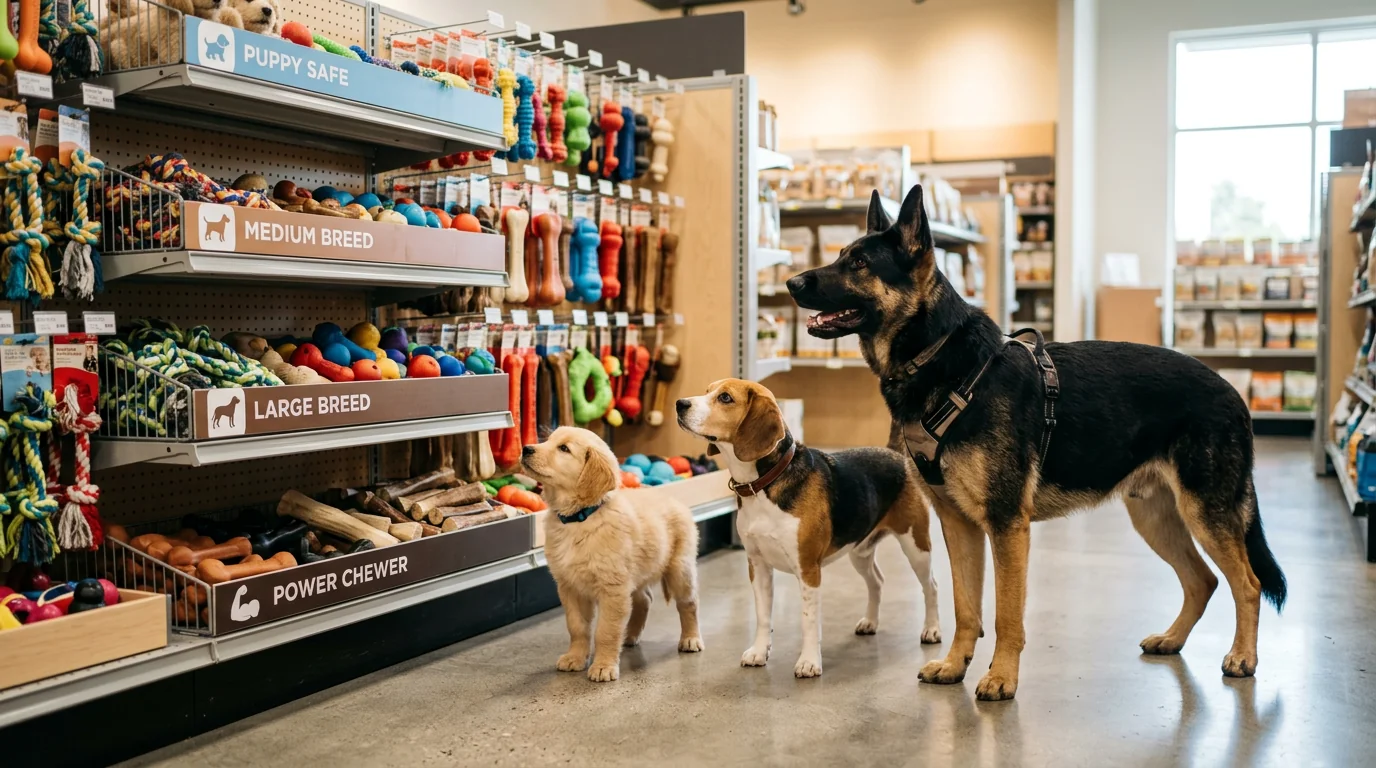
Query qualifiers like “large breed,” “puppy-safe,” or “for power chewers” indicate purchase intent and risk sensitivity. E-commerce query taxonomies show users move from broad discovery to precise, attribute-rich searches as they near purchase decisions.[3]
Risk and fit: how constraints shape copy and filters
Poor attribute matching may cause misclassification, underserving fit-critical queries and increasing returns. Clear mapping of breed, size, and age attributes helps users filter effectively and trust recommendations. Reliable category matching frameworks support consistent attribute display across catalogs.[4]
Petbase automates SEO content for pet stores - publishing 10 optimized articles monthly so you can focus on running your shop - start your free trial.
Template blueprint: map intent to on-page elements
Above-the-fold: title, variant logic, and trust cues
Use a concise title with one or two qualifiers: “Chew Toy - Large Breeds, Puppy Safe.” Surface variant buttons by size and life stage. Add micro-trust cues: material highlights, chew-strength scale, and quick-fit guidance. Keep shipping and returns visible.
Body modules: fit guide, benefits, risks, and comparisons
Include a fit guide mapping weight and jaw strength to sizes. Clarify benefits and known risks, with supervision notes. Add comparison tiles to similar SKUs. Cross-link terms like “large breed puppies” to relevant hubs or selectors and your internal linking blueprints (Internal linking templates).
Media plan: imagery and short video formats by segment
Provide images of scale next to a hand and a ruler. Add short video loops showing chew resistance and cleanup. Include variant-specific photos when color or size changes. Keep alt text descriptive with breed-, size-, and age-relevant cues.
Structured data: Product, FAQ, and variant attributes
Use Product schema with offers, review snippets, and key attributes (size, age range, material). Add FAQPage for safety and fit questions. Consistent attribute tagging helps large catalogs scale classification and reduce ambiguity across variants.[2] See examples in schema patterns for pet eCommerce.
Quick decision guide: if X situation, then Y action
Match query qualifiers to template switches
- If the query includes “large breed” and “puppy,” enable life stage copy, supervision notes, and size gating by weight range.
- If it includes “power chewer,” elevate chew-strength scale, material testing notes, and durability disclaimers.
- If color or pattern drives selection, surface swatches first and keep size secondary but persistent.
- If price-sensitive terms appear, show unit economics and bundle value without overshadowing fit messaging.
- If “indoor-only” or “apartment” appears, prioritize noise level, mess control, and cleaning instructions.
- If medical or dietary claims surface, pivot to disclaimers and general guidance, avoiding diagnostic language.
Automated attribute detection may assist template switching by extracting qualifiers and mapping them to flags, building consistency across breed specific product pages and size based product SEO at scale.[1]
Examples for dogs, cats, and small animals
- “Best chew toy for large breed puppies” → Default to XL/XXL, jaw-strength scale, puppy-safe materials, and teething tips.
- “Quiet interactive toy for indoor cats” → Emphasize noise rating, motion type, and enrichment benefits.
- “Chew-safe hideout for dwarf hamsters” → Focus on aperture size, chew-resistance, and nesting safety.
For mapping qualifiers to content patterns, align with your keyword research process in breed and life stage SEO mapping.

Monitoring: what to check after 7-14 days and 4-8 weeks
Early signals: crawl, indexing, and CTR deltas
Within 7-14 days, confirm crawling and indexing of updated variants. Track impressions for qualified terms and measure CTR changes. Improved snippet relevance may support click-through as titles and FAQs align with intent-rich phrases.[3]
Later signals: add-to-cart rate and assisted revenue
Across 4-8 weeks, evaluate add-to-cart rates for primary segments, and assisted revenue from comparison clicks. Monitor return reasons for misfit declines. Attribute mapping quality influences merchandising accuracy and can reduce mismatch-driven returns.[4]
Practical safety boundaries
Medical and nutrition disclaimers
Avoid diagnostic or treatment claims on product pages. Use general guidance and encourage consultation with a qualified professional for specific conditions. Keep wording cautious and consistent. Document your claim standards and moderation approach to support trust signals and E-E-A-T (schema and review guidance).
Age/size suitability and supervision guidance
State recommended weight ranges and life stages clearly. Note that supervision may be required, especially for strong chewers or teething stages. Provide clear retirement cues for damaged items to reduce ingestion risks and accidental injuries.
Material and durability claims
Use measured language such as “designed for strong chewers.” Provide testing contexts, like duration ranges and observed failure modes. Avoid absolute promises. Offer care instructions and disposal guidance to manage expectation and reduce misuse.
Evidence status and uncertainty notes
What industry data suggests
Query taxonomies indicate users add modifiers as they narrow intent. That behavior can inform titles, FAQs, and faceted navigation. Classification research supports consistent attribute mapping across catalogs, reducing ambiguity and improving discovery at scale.[3][2]
Where evidence is limited or context-dependent
Durability outcomes vary by chewing style and supervision. CTR changes may depend on snippet competition and pricing. Structured data benefits fluctuate with platform policies. Treat improvements as indicative, not definitive, and test changes incrementally.
Implementation checklist for your next 10 SKUs
Data inputs to collect
- Attributes: breed suitability notes, weight ranges, life stage, materials, chew-strength scale.
- Assets: scale photos per size, 10-20 second demo videos, variant-specific images.
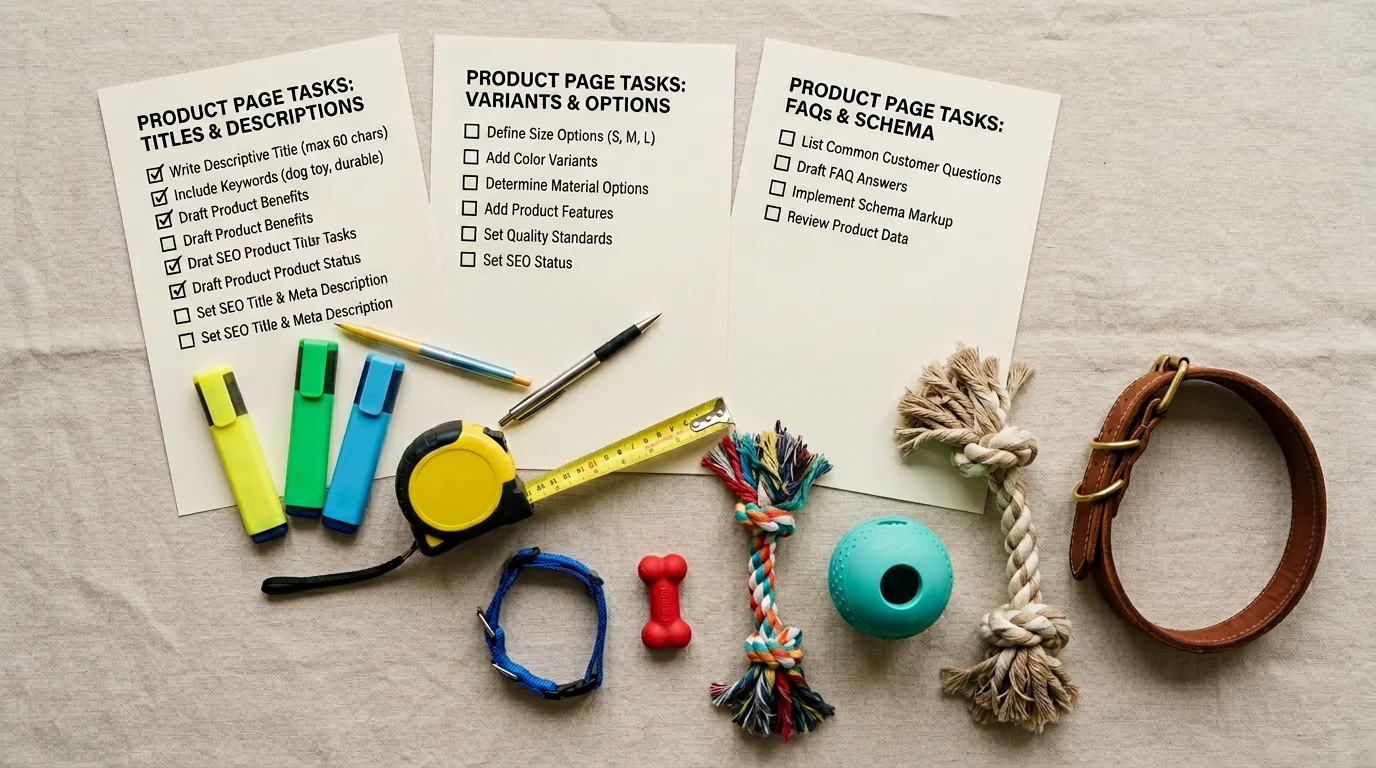
- Copy blocks: concise titles, fit guide, benefits, risk notes, FAQs, and comparison snippets.
- Schema: Product, Offer, Review, and FAQPage aligned with visible content and variants.
To operationalize pet product page optimization faster, many teams use automation to draft variants, FAQs, and schema at scale. For best results, consider using Petbase AI which is designed for this purpose.
Rollout plan and QA steps
- Prioritize high-intent SKUs where misfit risk is highest and returns are common.
- Apply life stage product templates and breed specific product pages with variant logic.
- Run QA for titles, images per variant, size charts, and FAQ accuracy.
- Validate structured data using a testing tool; confirm no hidden or conflicting fields.
- Publish in batches of 5-10 SKUs and monitor early signals. Document changes and learnings.
- Cross-link fit guides to size charts and life-stage education. Reference internal linking blueprints for navigation patterns.
Frequently Asked Questions
How do I structure product titles for breed or size without keyword stuffing?
Use a base product name plus one to two qualifiers that mirror user language, such as “Chew Toy - Large Breeds, Puppy Safe.” Evidence suggests concise, readable titles may support CTR without over-optimization. Keep intent first.
Should I create separate pages or variants for different sizes and life stages?
If materials, pricing, or images differ meaningfully, variants may work well under one canonical page with structured attributes. Separate pages can help when intent and content differ substantially. Validate with crawl, ranking, and returns data.
What schema helps pet product pages appear richer in search?
Product with offers, reviews, and attribute properties may help, along with FAQPage for common fit and safety questions. Ensure data matches visible content. Keep variant attributes explicit, and avoid hidden or misleading structured fields.
How can I avoid overpromising durability for power chewers?
Use cautious phrasing like “designed for strong chewers” and include supervision notes. Provide a material breakdown and testing context instead of absolute guarantees. Offer guidance on wear indicators and replacement timing to reduce risk.
What KPIs indicate the template is working?
Look for improved query matching (impressions for qualified terms), higher CTR, better add-to-cart rates on targeted segments, and reduced returns for misfit reasons. Track variant-specific performance and assisted revenue from comparison modules.
Conclusion
Templates that encode breed, size, and life-stage context help resolve safety and fit questions before purchase. Align on-page copy, media, and schema to the user’s qualifiers. Monitor crawl, CTR, and add-to-cart rates to confirm traction. For broader planning, align category and navigation decisions with our main pet eCommerce content guide. Then apply this checklist to the next ten SKUs, measure, and iterate confidently.
References
- M Pawłowski (2022). Machine learning based product classification for ecommerce. Journal of Computer Information Systems. View article
- L Tan et al. (2020). E-commerce product categorization via machine translation. ACM Transactions on Management Information …. View article
- P Sondhi et al. (2018). A taxonomy of queries for e-commerce search. The 41st International ACM …. View article
- M Kejriwal et al. (2021). An evaluation and annotation methodology for product category matching in e-commerce. Computers in Industry. View article