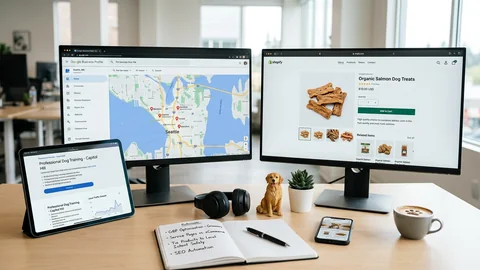
Local + eCommerce SEO for Vets, Groomers, and Trainers with Online Shops

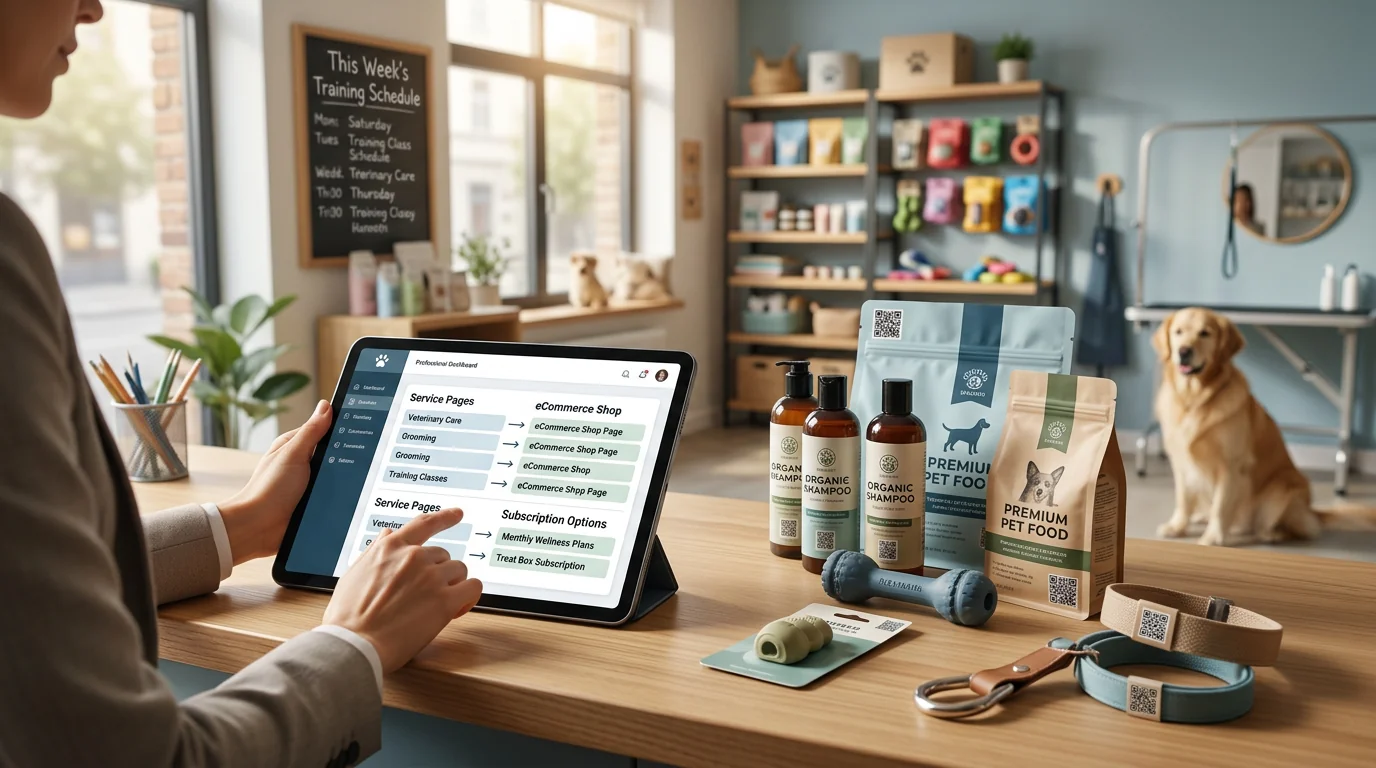
Table of Contents +
- The specific decision: how to connect service pages to products without cannibalizing local rankings
- On-page blueprint for hybrid service + shop experiences
- Quick decision guide
- Technical SEO and schema setup
- Monitoring guidance
- Practical safety boundaries
- Evidence status
- Implementation checklist (compact)
- Frequently Asked Questions
- References
A focused framework to integrate local service pages with shoppable product and subscription content for vets, groomers, and trainers.
Customers search “near me,” then expect to buy or book seamlessly. Service pages and shop pages must work together. They should not compete for local visibility or dilute relevance.
This matters because hybrid pet businesses risk cannibalizing map pack rankings. They also risk missing high-intent product revenue. You will learn a practical framework to connect local service pages with shoppable products and subscriptions, using cautious signals, schema, and measurable internal linking.
The specific decision: how to connect service pages to products without cannibalizing local rankings
The central question is structural. Decide which pages own local intent and which pages convert product interest. Then design internal links that move users forward without splitting local relevance.
User journey mapping: from “near me” to basket
Map the flow from location discovery to purchase. Start with a location or service page that answers intent fast, then recommend contextually relevant products. Evidence in veterinary markets links stronger digital presence with better business results, underscoring this pathway’s value.[1]
URL and template choices: location pages vs. product/category pages
Let location and service pages target local modifiers and NAP data. Reserve shoppable intent for product and category URLs. Avoid mixing Product markup on core location pages to preserve clarity for crawlers and the map pack.
Internal link patterns that support both map pack and sales
Use short, descriptive product cards within service pages. Link to 3-5 items or a focused collection. On product pages, add a subtle “Available at [Location]” link back to the relevant location page to reinforce local eligibility without re-targeting local intent.

Petbase automates SEO content for veterinary clinics - so you can focus on patients, not blog posts - start your free trial.
On-page blueprint for hybrid service + shop experiences
Build modular pages that satisfy intent and nudge logical next steps. Use consistent blocks for contact, services, reviews, and commercial highlights to reduce friction and improve clarity for users and crawlers.
Location page modules: NAP, services, reviews, inventory highlights
Feature complete NAP, hours, parking, and service summaries. Add review excerpts with clear provenance. Include an “Available this week” inventory highlight from your feed. Content strategy in veterinary e-commerce indicates SEO-backed content modules increase trust and conversion potential.[2]
Service detail pages: procedures, FAQs, and recommended products
Explain procedures, risks, timing, and prep steps. Include concise FAQs. Surface 3-5 recommended products per service, grouped by immediate need and aftercare. Keep benefit language cautious. This pattern fits veterinary SEO, groomer SEO, and dog trainer SEO use cases.
Product and subscription pages: local availability and pickup signals
Highlight local pickup, same-day options, and inventory counts where feasible. Add store selection near price to anchor local relevance. For feed-driven modules and on-page consistency, consider using Petbase AI which is designed for this purpose.
Quick decision guide
Use these rules to pick templates and linking patterns without overhauling your entire site. Adjust for your demand mix and testing velocity.
If your GMB drives most bookings, then prioritize location pages and link to 3-5 relevant products per service.
Let location and service pages own “near me” terms. Add compact product cards tied to the service’s immediate needs. Keep local keywords and NAP prominent. This maintains relevance while enabling commerce without overwhelming intent.
If online sales outpace bookings, then prioritize category pages and link back to service explainers with local proof.
Let categories capture non-local product queries. Embed a block that links to related service explainers. Add local proof, such as staff credentials and reviews, to build trust without retargeting the location keyword set.
If you have multiple locations, then create location-specific shop collections with unique stock/rules.
Build store collections per branch, using inventory feeds and pickup eligibility. Link each collection from the associated location page. This may strengthen local relevance and prevent duplicate content across branches by differentiating stock and policies.
If you run subscriptions (food, meds, grooming plans), then surface them on service pages with cautious benefit language.
Subscriptions may lift lifetime value and predictability. Place them under service details with measured, non-medical phrasing. Emphasize convenience and reminders. This supports conversion without overstating outcomes or confusing service intent.
If blog traffic is high but conversions are low, then add product cards and local pickup schema to top posts.
Identify top posts by sessions and engagement. Insert tightly relevant product cards. Add local pickup signals on linked product pages. Annotate the change to measure assisted conversions and session depth improvements over time.
If inventory changes weekly, then automate ‘Available this week’ modules on location pages from your feed.
Use a feed-based widget that updates automatically. Limit to five items. Tie each item to product pages with pickup availability. This can refresh crawl interest and support local relevance while managing editorial overhead.
Technical SEO and schema setup
Separate entity types by page purpose. Align schema with visible content. Keep markup clean, consistent, and free from conflicting signals.
Service schema + LocalBusiness on location pages
Implement LocalBusiness with accurate NAP, hours, geo, and sameAs where applicable. Add Service for core offerings with brief descriptions. Keep markup mirrored by on-page content to avoid confusion. This aligns with structured content guidance for pet ecommerce SEO.[2]
Product + Offer + AggregateRating on shoppable pages
On product pages, use Product, Offer, and AggregateRating. Surface price, availability, SKU, and pickup options. For deeper patterns, review Schema for Pet eCommerce: Product, FAQ, Review, Vet Service, and HowTo and the broader Pet eCommerce Content strategy hub for structural consistency.
How to avoid conflicting markup and duplication
Do not place Product on core location pages. Avoid duplicate LocalBusiness markup on product URLs. For multi-location product availability, reflect pickup in Product. Then link back to the relevant location page, keeping entities distinct but connected.
Monitoring guidance
Measure early signals and sustained trends. Annotate all template releases. Compare local versus product queries and assisted paths.
After 7-14 days: map pack visibility, CTR shifts, product clicks from service pages
Watch map pack ranks and CTR for location and service pages. Track click events on product cards from service URLs. Log changes in Search Console impressions for local modifiers and in-session transitions to product views.
After 4-8 weeks: non-brand impressions, category lifts, assisted conversions
Evaluate non-brand growth by service and category. Review category entrances and revenue per session. Monitor assisted conversions driven by service pages. For instrumentation practices, explore Content Operations and Automation for Pet Stores Using Petbase for tracking and workflow alignment.

Practical safety boundaries
Maintain local relevance and regulatory caution while enabling commerce. Use conservative language, keep structure clean, and respect the user’s primary intent at each step.
Avoid medical claims on product tiles; use cautious phrasing
Do not imply diagnosis, cure, or guaranteed outcomes on product cards. Use benefit framing like “supports,” “may help,” or “for comfort.” Reserve clinical statements for veterinarian guidance within appropriate service content.
Do not replace core NAP or services with commercial blocks
Ensure NAP, hours, and service descriptions remain above the fold on location pages. Keep product blocks secondary. This preserves the page’s purpose for local queries and helps guard against intent dilution.
Cap on-page product links to maintain service relevance
Limit to 3-5 tightly related items per service. Use a single “View all recommendations” link if more depth is required. Excessive product linking may weaken local relevance and confuse crawlers.
Keep location content unique across branches
Write distinct service highlights, staff bios, and localized tips per branch. Use location-specific collections and stock rules. Unique content reduces duplication risk and can support stronger local discovery per market.
Evidence status
Available research indicates digital maturity correlates with performance in veterinary contexts. Evidence also discusses content strategies that enhance trust and conversion in online veterinary commerce.
What case studies in local commerce suggest
Veterinary practices with robust digital presence may experience improved performance, supporting the case for integrated local and shoppable experiences when executed carefully and measured rigorously.[1] Content-led approaches in veterinary e-commerce highlight SEO’s role in building trust at each touchpoint.[2]
Signals that may support rankings vs. what remains uncertain
Local content uniqueness, clear entity markup, and consistent NAP likely support visibility. Profitability differences in clinics with retail extensions appear context-dependent, and exact SEO causality remains uncertain.[3] Integrated marketing planning suggests benefits but acknowledges market variability.[4]
Implementation checklist (compact)
Align templates, feeds, schema, and tracking. Launch changes incrementally. Annotate each deployment to preserve causal clarity in your reports.
Templates, feeds, schema, and tracking parameters to configure
- Templates: Location, Service, Category, Product, Subscription, and Location-specific Collections.
- Feeds: Inventory availability, pickup eligibility, and pricing synced daily or near-real-time.
- Schema: LocalBusiness + Service on location/service; Product + Offer + AggregateRating on shoppable URLs.
- Internal links: 3-5 product cards per service; “Available at [Location]” links on product pages. See From Blog to Basket internal linking blueprints.
- Tracking: Click events on product cards, UTM on collection links, GA4 assisted conversions, and Search Console local vs. product query filters.
- Content ops: Weekly review of inventory highlights and rotating service FAQs to maintain freshness.

Frequently Asked Questions
Should service pages or product pages target local keywords?
Evidence suggests service and location pages should own local intent, while product pages focus on inventory and conversion. Link products contextually from service pages to connect journeys.
How many products should I feature on a service page?
Many teams see stable relevance by limiting to 3-5 highly related products or a single curated collection. This may preserve local focus while enabling commerce.
Can subscriptions help local rankings for vets and groomers?
Subscriptions may support engagement and retention, but their impact on local rankings is unclear. They can improve conversion when placed near relevant services.
What schema is recommended for hybrid pages?
Use LocalBusiness and Service on location/service pages. Use Product, Offer, and AggregateRating on product pages. Avoid mixing Product on core location pages.
How do I track if internal links are helping?
Set click events on product cards from service pages, annotate changes, and review assisted conversions and category/session depth after 4-8 weeks.
Conclusion
Vets, groomers, and trainers can integrate local and eCommerce SEO without cannibalization by separating intent, aligning schema, and using conservative internal links. Start with measured modules on location and service pages. Then add pickup signals on products. Monitor early and long-range metrics to validate impact. This framework respects veterinary SEO, groomer SEO, and dog trainer SEO constraints while advancing pet ecommerce SEO outcomes. Keep language cautious, content unique by location, and instrumentation airtight. Iterate quarterly, informed by performance and customer feedback.
References
- N Fejzić et al. (2023). The impact of digital presence and use of information technology on business performance of veterinary practices: a case study of Bosnia and Herzegovina. Frontiers in Veterinary …. View article
- Т Устік et al. (2025). КОНТЕНТ-СТРАТЕГІЯ ЯК МАРКЕТИНГОВИЙ ІНСТРУМЕНТ ФОРМУВАННЯ ДОВІРИ ДО ВЕТЕРИНАРНИХ ОНЛАЙН-МАГАЗИНІВ. Економіка та суспільство. View article
- VM Tamás et al. (2026). Kisállateledel és-felszerelésbolttal rendelkező állatorvosi rendelők jövedelmezőségének összehasonlító elemzése Magyarországon.. Magyar Állatorvosok Lapja.
- JI Caballero (2026). Plan de Marketing para eVet, el sistema integral de gestión veterinaria y de e-commerce. repositorio.udesa.edu.ar. View article