Schema for Pet eCommerce: Product, FAQ, Review, Vet Service, and HowTo


Table of Contents +
- The single decision: Which schema types to implement first on a pet store or vet site
- Quick decision guide
- Implementation details that reduce warnings and volatility
- Monitoring and validation
- Practical safety boundaries
- Evidence status: What current guidance and tests suggest
- Schema snippets: Minimal, copy-safe examples
- Connect schema to internal linking and topical authority
- Frequently Asked Questions
- References
Learn which schema to add for pet products and services-Product, FAQ, Review, HowTo, and Vet Service-to earn rich results and strengthen discovery.
Rich results are competitive edges you can earn, not buy. Structured data is how you qualify. Most pet stores and veterinary clinics underuse it or implement it inconsistently.
This matters because product and service discovery increasingly depends on machine-readable context. Implement the right schema, in the right order, to improve eligibility across SERPs and AI experiences. You will learn which schema to deploy first, the minimum fields to avoid volatility, how to monitor, and safe, copy-ready snippets.
The single decision: Which schema types to implement first on a pet store or vet site
Prioritized order: Product, Review, FAQ, HowTo, LocalBusiness/VeterinaryCare
Start with Product for all sellable SKUs. Pair Review when authentic ratings exist, then layer FAQ for buyer-helpful answers. Add HowTo for care tasks tied to products. Finally, implement LocalBusiness or VeterinaryCare for clinics and mobile services.
This prioritization reflects how platforms interpret entities and relationships defined by ontologies. Structured markup formalizes meaning, which may improve alignment between your pages and user intents across systems that parse structured data.[2][3]
Mapping by template: PDPs, PLPs, blog, service pages
On product detail pages (PDPs), use Product with Offer and optionally AggregateRating or Review. On listing pages (PLPs), avoid Product per item; use ItemList with ListItem metadata. On blog posts, add FAQ and relevant HowTo. On veterinary service pages, add LocalBusiness or VeterinaryCare with Services detail. This approach aligns product schema for pet stores with navigational intent and template purpose.

Petbase automates SEO content for veterinary clinics - so you can focus on patients, not blog posts - start your free trial.
Quick decision guide
If X situation, then Y schema action (5-7 scenarios)
- If a product has price and stock, add Product with Offer, priceCurrency, price, and availability.
- If a product has 10+ genuine ratings, add AggregateRating within Product; otherwise omit ratings to avoid warnings.
- If shoppers ask repeat pre-purchase questions, add FAQ with buyer-helpful entries; avoid policy duplicates to keep faq schema pets clean.
- If a care process uses your SKU, add HowTo; reference the product as a tool and show step images for howto schema pet care.
- If you run a clinic, add VeterinaryCare with NAP, geo, hours, and acceptedInsurance as applicable to strengthen veterinary service schema.
- If variants differ in price or size, model each Offer; consider AggregateOffer for ranges on parent PDPs.
- If you publish expert editorial reviews, add Review with author and reviewRating; do not mix user and expert context in review schema pet products.
Implementation details that reduce warnings and volatility
Required vs recommended fields by schema
For Product, include name, description, image, sku or mpn, brand, and url. For Offer, include price, priceCurrency, itemCondition, availability, and url. AggregateRating should include ratingValue and ratingCount with visible alignment. Review requires reviewRating, author, and datePublished. FAQ requires mainEntity with unique Question and acceptedAnswer pairs. HowTo benefits from totalTime, estimatedCost, step with images, and tool or supply when a product is used.
Using consistent identifiers and property ranges improves data interpretability across systems that map relational content into ontologies.[3]
Handling out-of-stock, variants, and aggregate ratings
When out of stock, keep Product but set Offer availability to OutOfStock. For variants, attach multiple Offers or link to variant URLs, ensuring prices and availability render on-page. Use AggregateOffer where parent pages show ranges. For AggregateRating, match ratingValue precision to visible stars, and update ratingCount or reviewCount only when reviews change. Avoid hardcoding inflated numbers to maintain trust and eligibility.
Monitoring and validation
What to check after 7-14 days
Validate with Google’s Rich Results Test and confirm enhancements in Search Console. Check for warnings on priceCurrency, availability, images, and mismatch between schema and rendered content. Track impression growth on product queries and confirm that core templates are indexed. Compare average position for PDP queries where markup was added versus control groups.
What to assess after 4-8 weeks
Assess stability of rich result impressions, CTR deltas, and proportion of PDPs with enhancements. For clinics, watch local panels and direction requests alongside branded queries. Compare volatility before and after variant modeling. Automation can reduce drift; consider using Petbase AI to publish schema consistently across catalogs and keep prices, availability, and ratings synchronized during updates.

Practical safety boundaries
Data sources, moderation, and policy alignment
Only mark up information users can see. Source ratings from authentic buyers or verified experts and disclose collection methods. Moderate submissions to remove offensive content and unverifiable claims. Align medical content with local advertising and health policies. For clinics, avoid implying guaranteed outcomes and keep emergency and telehealth details current.
Avoiding spam signals in FAQs and reviews
Reserve FAQ for unique, buyer-helpful content such as sizing, materials, or returns. Do not copy storewide policy pages or user questions already present in reviews. Keep answers concise, factual, and non-promotional. In reviews, avoid keyword stuffing, repetitive templates, or undisclosed incentives. These practices maintain faq schema pets integrity and reduce risk of suppressed enhancements.
Evidence status: What current guidance and tests suggest
Rich result eligibility and limits
Structured data helps systems interpret entities and relations, which may support eligibility for rich results; visibility is not guaranteed. Ontology-based approaches show how formal schemas enable consistent, query-time reasoning over heterogeneous sources, suggesting why coherent markup reduces ambiguity.[3][2]
AI Overviews, EEAT signals, and local discovery
Generative systems leverage structured inputs to assemble coherent, context-aware responses; research on data-to-text generation indicates benefits when inputs are well-structured and ontology-aligned.[1] Context-explication principles further suggest that precise definitions and constraints reduce misinterpretation, which may contribute to clearer entity understanding in AI Overviews and local panels.[4]
Schema snippets: Minimal, copy-safe examples
Product + AggregateRating + Offer (pet SKU)
Use minimal properties consistently visible on the PDP. For sizing and returns layout best practices, see product page templates for size and life-stage clarity and internal linking patterns that surface policies contextually.
{
  "@context": "https://schema.org",
  "@type": "Product",
  "name": "Adjustable No-Pull Harness",
  "description": "Adjustable harness with padded straps and reflective stitching.",
  "image": ["https://example.com/images/harness.jpg"],
  "sku": "HAR-001",
  "brand": {"@type": "Brand", "name": "Petbase Essentials"},
  "url": "https://example.com/products/adjustable-harness",
  "aggregateRating": {
    "@type": "AggregateRating",
    "ratingValue": "4.6",
    "ratingCount": "128"
  },
  "offers": {
    "@type": "Offer",
    "price": "29.99",
    "priceCurrency": "USD",
    "availability": "https://schema.org/InStock",
    "itemCondition": "https://schema.org/NewCondition",
    "url": "https://example.com/products/adjustable-harness"
  }
}
FAQ (product or care page)
{
  "@context": "https://schema.org",
  "@type": "FAQPage",
  "mainEntity": [{
    "@type": "Question",
    "name": "How do I choose the right harness size?",
    "acceptedAnswer": {
      "@type": "Answer",
      "text": "Measure chest girth and compare to the size chart on the page. If between sizes, choose the larger and adjust for a secure fit."
    }
  },{
    "@type": "Question",
    "name": "What is your returns policy?",
    "acceptedAnswer": {
      "@type": "Answer",
      "text": "Unworn items in original packaging are eligible for returns within 30 days. Initiate a request from your order history."
    }
  }]
}
HowTo (care routine tied to product)
Ensure steps truly form a sequence and include images. Reference the product as a tool to align howto schema pet care with your PDP.
{
  "@context": "https://schema.org",
  "@type": "HowTo",
  "name": "How to Fit an Adjustable Harness",
  "description": "Step-by-step guide to achieve a comfortable, secure fit.",
  "totalTime": "PT10M",
  "tool": {
    "@type": "Product",
    "name": "Adjustable No-Pull Harness",
    "url": "https://example.com/products/adjustable-harness"
  },
  "step": [{
    "@type": "HowToStep",
    "name": "Measure chest",
    "text": "Measure the widest part of the chest with a soft tape.",
    "image": "https://example.com/images/measure.jpg"
  },{
    "@type": "HowToStep",
    "name": "Adjust straps",
    "text": "Loosen straps, place harness, then tighten evenly until snug.",
    "image": "https://example.com/images/adjust.jpg"
  }]
}
LocalBusiness/VeterinaryCare (clinic page)
Use VeterinaryCare for clinics. Add geo, hours, and acceptedInsurance when applicable. For combined store-plus-clinic strategies, see local and eCommerce SEO tactics for service retailers.
{
  "@context": "https://schema.org",
  "@type": "VeterinaryCare",
  "name": "City Center Veterinary Clinic",
  "image": "https://example.com/images/clinic.jpg",
  "url": "https://example.com/clinic",
  "telephone": "+1-555-0100",
  "address": {
    "@type": "PostalAddress",
    "streetAddress": "100 Main St",
    "addressLocality": "Springfield",
    "addressRegion": "IL",
    "postalCode": "62701",
    "addressCountry": "US"
  },
  "geo": {"@type": "GeoCoordinates", "latitude": 39.8017, "longitude": -89.6436},
  "openingHours": "Mo-Fr 08:00-18:00",
  "acceptedInsurance": "ABC Pet Insurance"
}
Connect schema to internal linking and topical authority
Breadcrumbs, ItemList, and sameAs for brand graphs
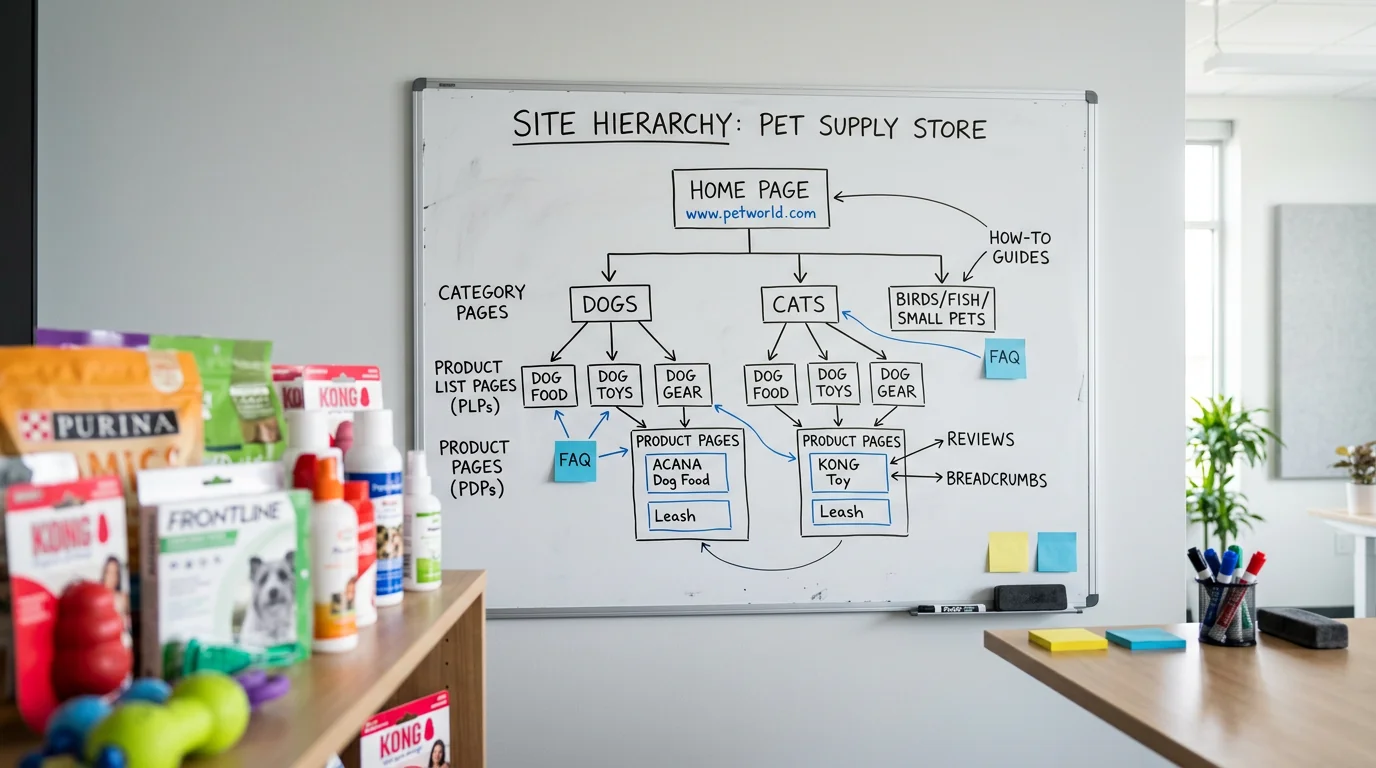
BreadcrumbList clarifies hierarchy and helps disambiguate categories. Use ItemList on PLPs to indicate order and relevance. Add sameAs to connect your brand to authoritative profiles. Internally, link PDPs to care guides and comparison pages to reinforce relationships. For navigation blueprints, review internal linking patterns for pet retailers and buyer’s guide structures that convert.
Link to the pet eCommerce SEO hub for context
Clustered content improves crawl paths and semantic cohesion. From care articles and PDP FAQs, reference your strategic hub to signal scope and authority. Start with the pet eCommerce SEO hub, then extend to templates in product page SEO for pet stores and research in pet keyword mapping.
Frequently Asked Questions
Should pet product pages use both Product and Review schema?
Yes, when you have authentic customer ratings or expert reviews. Nest AggregateRating or Review within Product. If no reviews exist, omit rating fields to avoid warnings.
Can I use FAQ schema on product pages?
Yes, if the questions are unique and buyer-helpful (e.g., sizing, materials, returns). Avoid duplicating Q&A that appears as user reviews or generic store policies.
When is HowTo schema suitable for pet sites?
Use for step-based care tasks that pair with products (e.g., how to fit a harness). Include images per step and ensure the article truly follows a sequence.
What schema should veterinary clinics add?
Use LocalBusiness or VeterinaryCare with NAP, geo, openingHours, and acceptedInsurance if applicable. Add Service subpages with MedicalEntity where relevant.
How long until rich results may appear?
Indexing and eligibility vary. Early signals may appear within 1-2 weeks, while stable visibility often requires several crawl cycles over 4-8 weeks.
Conclusion
Schema does not guarantee rich results, but strategic, consistent implementation improves eligibility and clarity. Prioritize Product and Review, add FAQ and HowTo where truly helpful, and mark up veterinary services comprehensively. Validate early, monitor steadily, and iterate prudently. Keep content, data, and policies synchronized to sustain trust and visibility across search and emerging AI experiences. Pair strong markup with purposeful internal linking and category architecture to compound results over time.
Helpful links for deeper context:
References
- L Nan et al. (2021). Dart: Open-domain structured data record to text generation. Proceedings of the …. View article
- MN Asim et al. (2018). A survey of ontology learning techniques and applications. Database. View article
- G Xiao et al. (2018). Ontology-based data access: A survey. 2018 - eprints.bbk.ac.uk. View article
- G Pierra (2026). Context-explication in conceptual ontologies: The plib approach. Concurrent Engineering, Volume 1: Enhanced …. View article