Turn Pet Blogs Into Revenue With Automated, Product-Aware Internal Linking

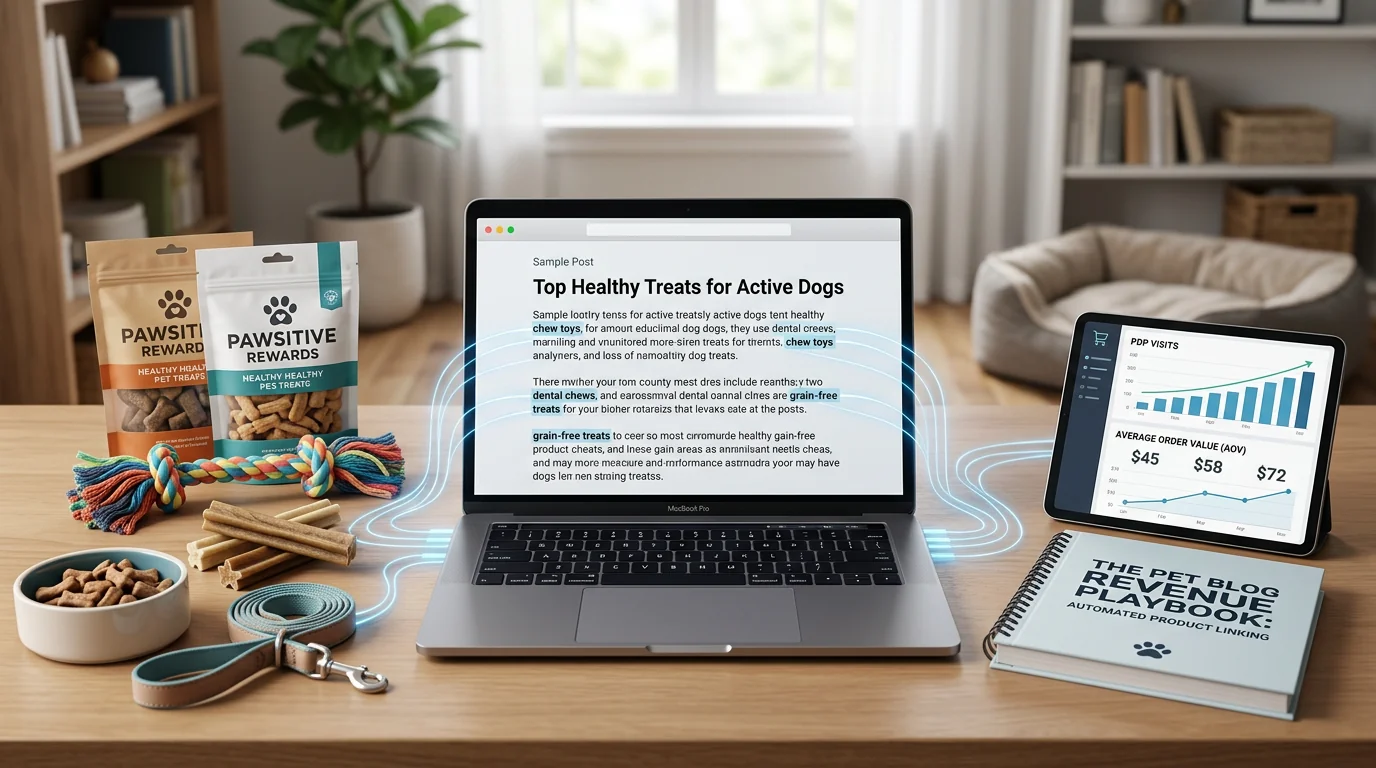
Table of Contents +
- The scenario: you publish pet education, but PDP views lag
- Quick decision guide: if this, then link that
- Implementation playbook: set up automated, product-aware links
- Safety boundaries: keep links helpful, compliant, and brand-safe
- Monitoring: what to check at 7-14 days and 4-8 weeks
- Evidence status: what current data suggests
- Align with your broader automation strategy
- Frequently Asked Questions
- References
A focused playbook to insert contextual links from pet blogs to relevant products, categories, and bundles to lift PDP visits and AOV.
Your educational posts attract searchers, but product page views remain flat. That gap wastes intent and budget. It also hides quick wins your competitors may capture.
Automated, product-aware internal linking routes readers to the right items at the right moment. This guide shows a focused playbook. You will learn how to map intent, set anchor guardrails, automate insertion, and monitor impact without harming user experience.
The scenario: you publish pet education, but PDP views lag
Why manual linking misses intent (and seasonal demand)
Manual internal linking is slow, inconsistent, and hard to maintain across a growing library. Editors often guess which items fit each paragraph, then forget to revisit as demand shifts. Seasonal peaks around health, travel, or holidays require rapid, site-wide adjustments. Ad hoc updates struggle to reflect real search intent, stock changes, and promotional priorities. Product-aware internal linking centralizes rules so educational content can surface relevant product pages, categories, or bundles as conditions evolve.
What “product-aware” linking means in practice
Product-aware linking ties contextual cues in a paragraph to a defined destination hierarchy: specific PDPs, categories, and bundles. It uses rules, attributes, and thresholds to avoid irrelevant suggestions. The system reads intent signals, such as size, life stage, or problem framing, and ranks link candidates accordingly. It also respects exclusions where commercial links would be inappropriate. Done well, it becomes a reliable bridge from learning to purchasing without disrupting editorial integrity.
Petbase automates SEO content for pet stores - publishing 10 optimized articles monthly so you can focus on running your shop - start your free trial.
Quick decision guide: if this, then link that
5-7 rules that route readers from intent to product, category, or bundle
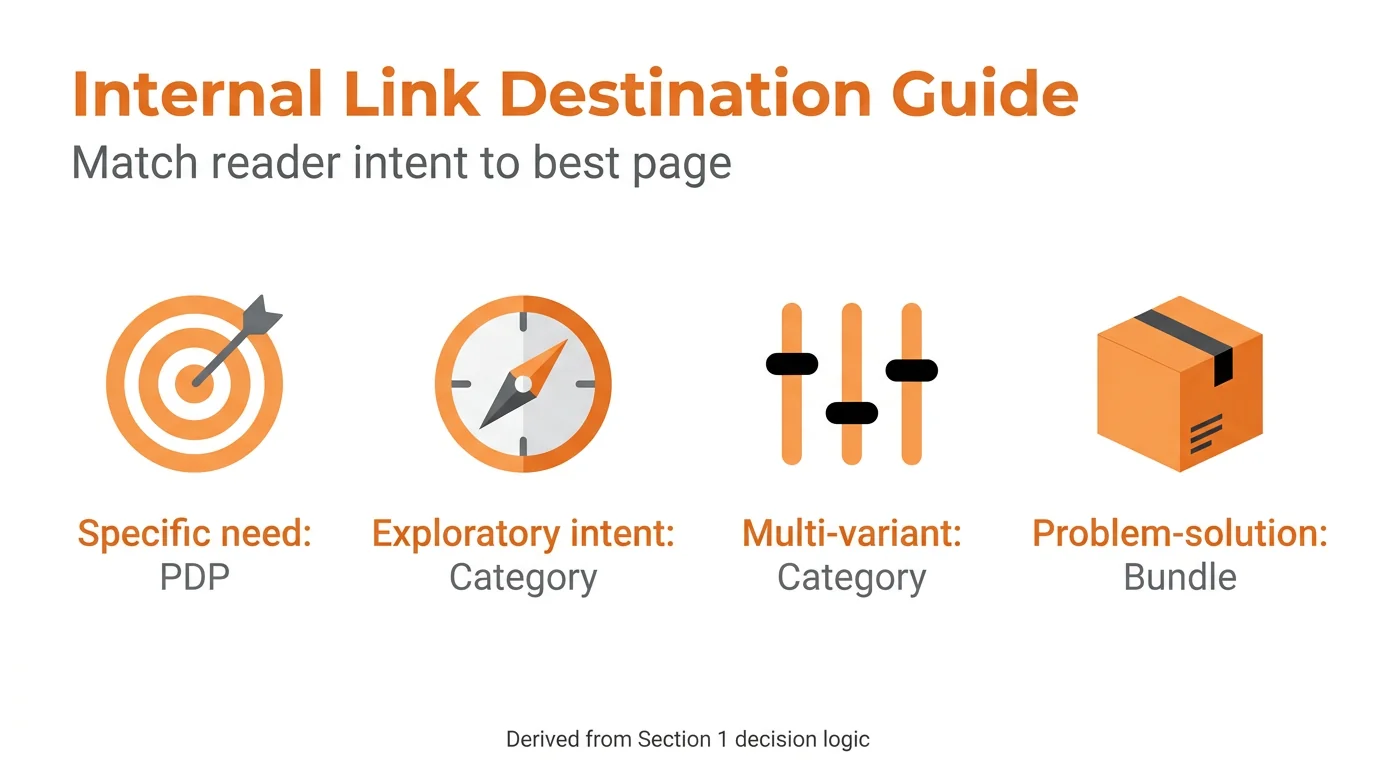
- If the paragraph expresses a precise problem with a clear single-item solution, route to the most relevant PDP. Prefer models with strong stock, ratings, and clear sizing guidance.
- If the text compares options or highlights attributes (material, size, or price tiers), route to the matching category. Let filters or facets refine choice within pet eCommerce SEO standards.
- If the content frames a multi-step routine or kit-based solution, route to a curated bundle. Bundles can simplify decisions and may raise AOV for the pet store.
- If the paragraph is early-stage and informational without purchasing signals, link to an in-depth guide. Keep commerce out until readers demonstrate intent.
- If seasonal timing is explicit, route to a seasonal category or bundle variant. Expire or swap the link after the campaign window closes.
- If the article mentions constraints like budget or subscription, route to categories with price filters or subscription-enabled PDPs to reduce friction.
Implementation playbook: set up automated, product-aware links
Map intents to destinations (PDP vs. category vs. bundle vs. guide)
Start with a taxonomy of intents grounded in real queries and on-site behavior. Define which intents deserve PDPs, which require comparison at the category level, and which are best solved with bundles. Incorporate merchandising signals: margin, inventory, variants, and ratings. Build fallbacks for out-of-stock or restricted items. A lightweight matrix keeps linking decisions consistent during contextual linking automation.
Define anchor taxonomies and guardrails
Create anchor groups that reflect natural phrasing and modifiers. Include synonyms, attribute variants, and long-tail patterns. Use negative lists to block anchors in sensitive contexts. Evidence suggests phrase mining can discover high-quality anchor candidates when tuned for precision over recall[1]. Document frequency caps per article, per section, and per paragraph to preserve readability.
Automation workflow: detect, match, insert, measure
Detect: Parse each paragraph to extract entities, attributes, and intent cues. Match: Score candidate PDPs, categories, or bundles using relevance, availability, and business priority. Insert: Place one contextual link per qualifying paragraph with descriptive anchors. Measure: Track CTR, PDP sessions per 1,000 views, assisted revenue, and AOV deltas. Teams may use tools like Petbase AI to unify topic research, product-aware internal linking, and measurement without heavy engineering. For discovery, a topical explorer can reveal new intent clusters for mapping.
Safety boundaries: keep links helpful, compliant, and brand-safe
Relevance, medical/legal caution, and frequency caps
Hold links to a strict relevance threshold and suppress when confidence is low. Avoid prescriptive claims; instead, offer options and direct readers to professional advice where appropriate. For clarity, link “medical/legal caution” resources near sensitive guidance. Cap links at 2-4 per 1,000 words to limit clutter and reduce cognitive load. Research on automated methods stresses the importance of conservative thresholds and human oversight to maintain trust[2].
De-duplication, no-link zones, and accessibility
Deduplicate anchors within the same section to avoid spammy repetition. Declare no-link zones in introductions, summaries, and legal disclaimers. Ensure anchors are descriptive, not “click here,” and maintain sufficient contrast. Automated systems can inherit biases from training data; explicit rules and audits help sustain fairness and clarity in link placement[4].
Monitoring: what to check at 7-14 days and 4-8 weeks
Early signals of fit and friction
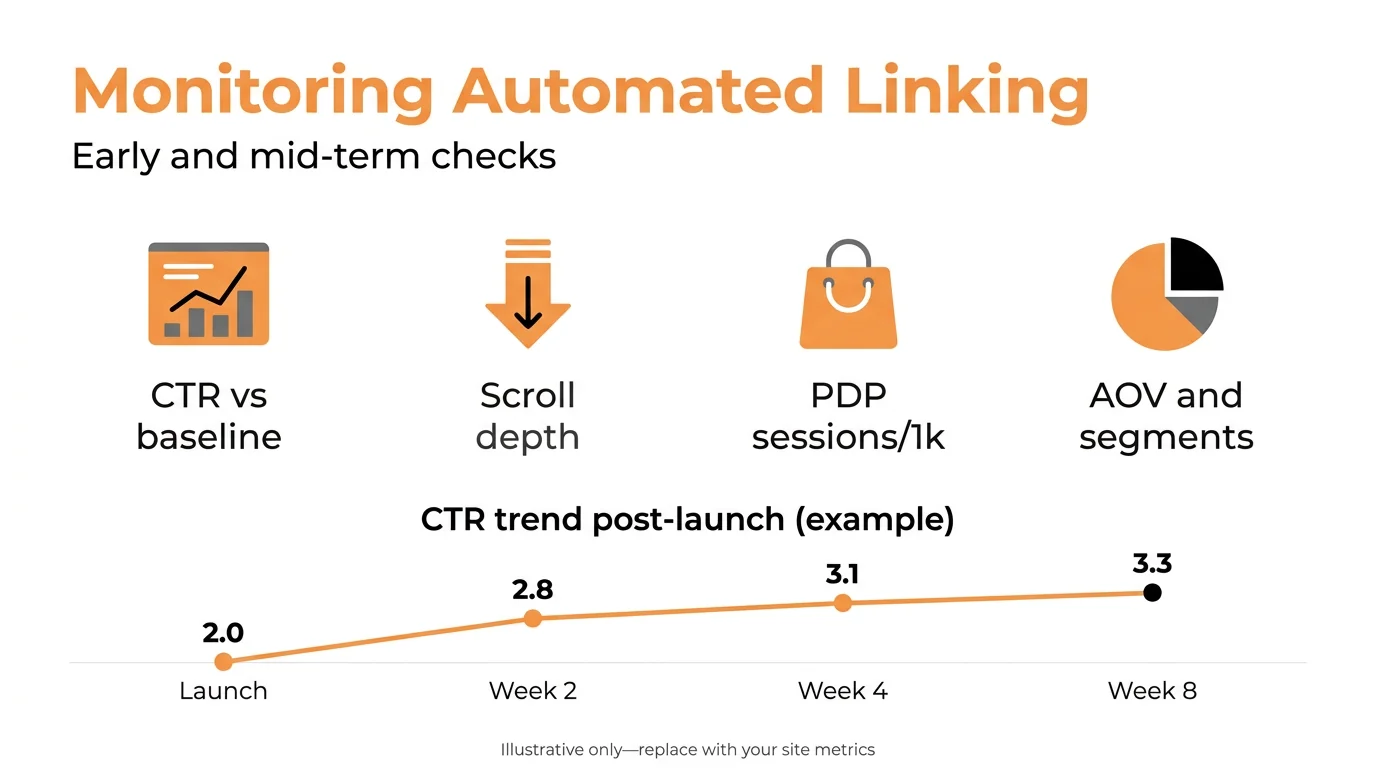
After 7-14 days, compare CTR on new links versus site baselines. Review scroll depth to confirm links appear before disengagement points. Investigate dwell time and exit rates on linked PDPs. If friction appears, refine anchors, reposition links, or optimize or rewrite existing pages for clarity. Early sampling may reveal mismatched intents or ineffective anchor variants.
Mid-term metrics to validate revenue impact
Across 4-8 weeks, analyze PDP sessions per 1,000 article views, assisted conversion share, and AOV on sessions that include link clicks. Segment by destination type to understand whether PDPs or categories drive better outcomes. Studies comparing automated linking to human baselines suggest performance can approach human quality when thresholds are tuned conservatively[3]. Reallocate link rules toward the highest-yield destinations.
Evidence status: what current data suggests
Observed lifts in PDP visits and AOV
In practice, teams report measurable increases in PDP sessions when contextual rules route precise intents to specific items. AOV may improve when bundles surface during routine-based education. While results vary, aligning destinations with clear intent helps reduce choice overload. Literature on automated matching indicates that careful calibration and validation against human judgments supports higher-precision outcomes[3].
Limitations and variables that may affect results
Catalog depth, inventory volatility, merchandising strategy, and content quality can all influence outcomes. Human oversight remains important to correct ambiguous cases and prevent drift. Combining algorithmic rules with editorial reviews can improve trust and reduce errors in sensitive contexts[2]. Anchor discovery benefits from phrase mining, but site-specific language still needs curation[1].
Align with your broader automation strategy
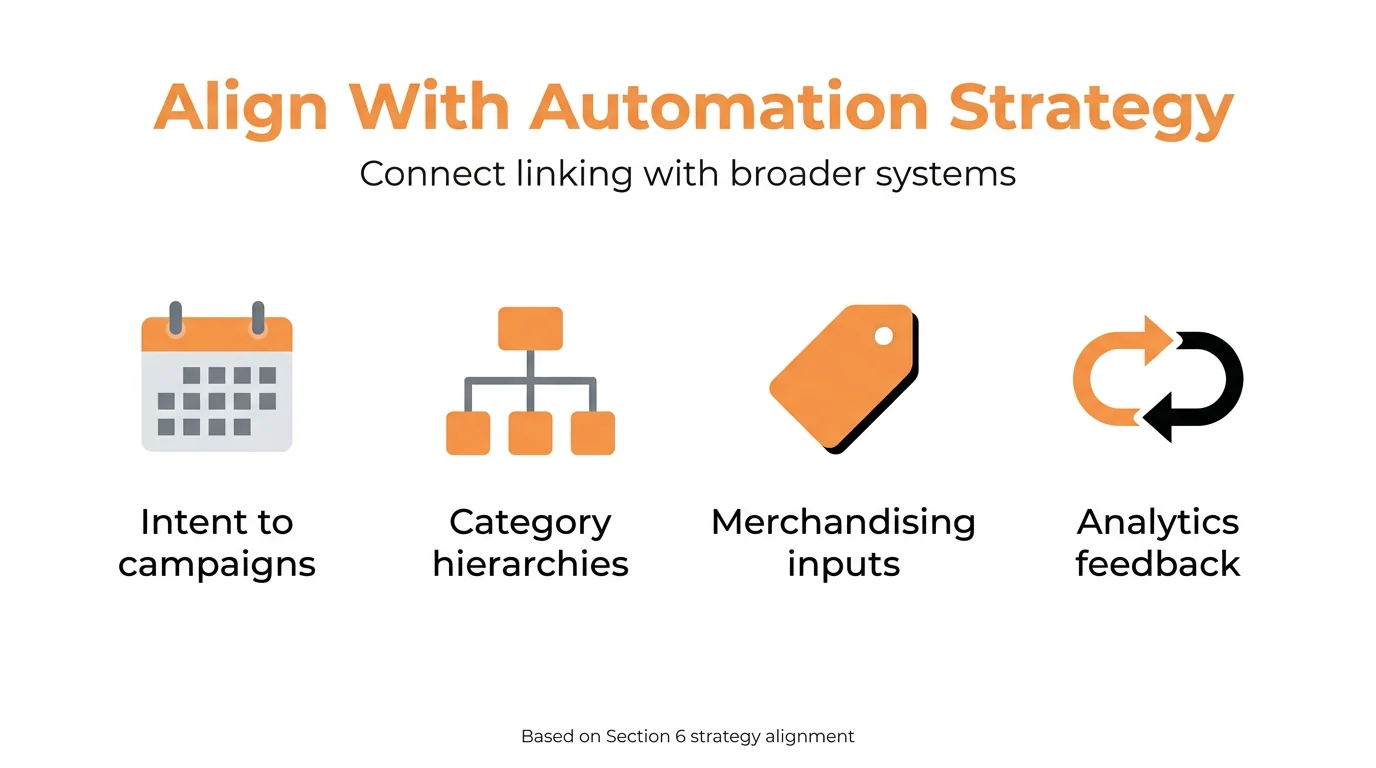
Product-aware internal linking should reinforce your broader content and commerce automation. Connect intent mapping with campaign calendars, category merchandising, and post-purchase journeys. Coordinate rules with structured data on PDPs to strengthen relevance and tracking. Align link placements with ongoing content QA and compliance guidelines to protect brand voice. For strategic context, see our central guide on pet content automation, then operationalize the playbook through iterative testing, safe guardrails, and revenue-focused measurement.
Frequently Asked Questions
How many automated internal links per article are reasonable?
Evidence suggests 2-4 high-relevance links per 1,000 words may balance discoverability with readability. Cap per-section links to avoid clutter and track user engagement.
Should I link to product pages or categories?
Route by intent. Specific need or breed/size often suits PDPs; exploratory or multi-variant needs may fit categories; bundled solutions can serve problem-solution posts. Test and compare click-through and conversion.
Will automated links hurt SEO if overused?
Excessive or irrelevant linking may dilute value. Apply frequency caps, deduplicate anchors, and prioritize topical relevance to support a positive user experience.
How do I choose anchor text for pet products?
Use natural, descriptive anchors that reflect user intent, such as breed, life stage, size, and problem. Avoid repetitive exact-match patterns across the site.
What metrics indicate success?
Track CTR from posts to PDPs/categories, PDP sessions per 1,000 views, assisted revenue, AOV on linked sessions, and bounce/scroll depth to ensure links remain helpful.
References
- J Shang et al. (2018). Automated phrase mining from massive text corpora. IEEE Transactions on …. View article
- R Abramitzky et al. (2021). Automated linking of historical data. Journal of Economic …. View article
- MJ Bailey et al. (2020). How well do automated linking methods perform? Lessons from US historical data. Journal of economic …. View article
- F Hamborg et al. (2019). Automated identification of media bias in news articles: an interdisciplinary literature review. International Journal on Digital Libraries. View article