Pet-Specific Keyword Gap Analysis on Autopilot: Find What Your Catalog Misses


Table of Contents +
- The scenario: Your pet catalog ranks for generic terms but misses breed, use-case, and life-stage demand
- How automated pet-specific gap analysis works from import to prioritized topics
- Quick decision guide: If this is your situation, take this action
- Prioritization rubric for pet brands and retailers
- Monitoring guidance: What to observe after 7-14 days and 4-8 weeks
- Practical safety boundaries for automated gap filling
- Evidence status: What current data suggests and where uncertainty remains
- Bring it together: Output checklist you should see after one automated run
- Frequently Asked Questions
- References
Learn how to auto-discover pet keyword gaps by species, breed, use case, and life stage, then prioritize topics competitors rank for to grow relevant traffic.
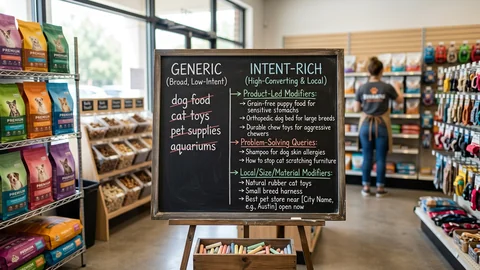
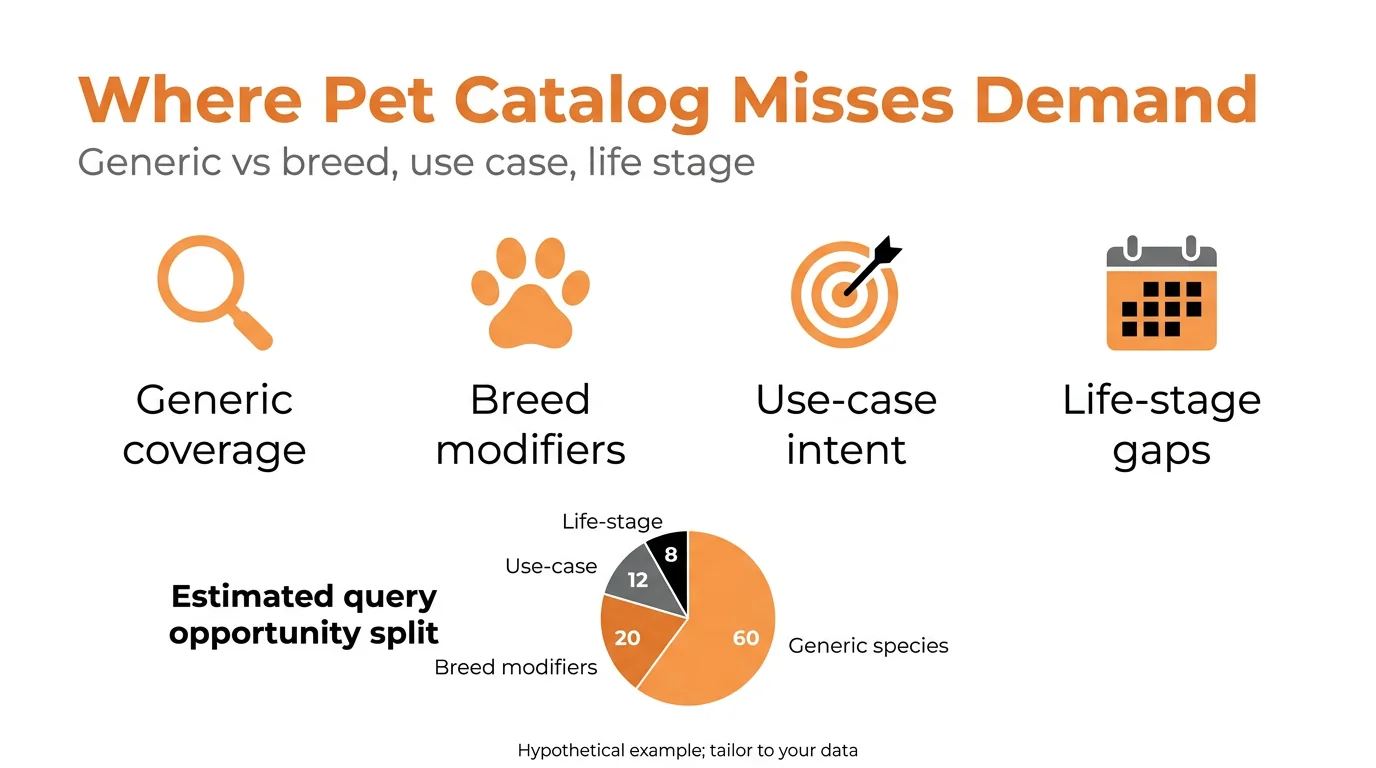
Your pet catalog likely ranks for broad terms while competitors win the nuanced searches. Those nuances reflect species, breed, use case, and life stage intent. Leaving them uncovered leaves revenue behind.
Automated, catalog-aware analysis pinpoints gaps your team may miss at scale. You will learn a practical, step-by-step method to uncover pet-specific keyword gaps, score them, and map each topic to products and internal links.
The scenario: Your pet catalog ranks for generic terms but misses breed, use-case, and life-stage demand
Symptoms that suggest hidden gaps
Your site earns impressions for generic species terms but trails on breed-modified searches. Product pages attract discovery traffic yet underperform for age or size modifiers. Analytics reveal many “near-miss” queries without matching content. These are classic pet catalog SEO gaps where competitors quietly harvest high-intent demand.
Why automated gap analysis helps in pet verticals
Pet taxonomies are complex and fast-evolving. Automation clusters competitor keywords in the pet industry by species, breed, and life stage, reducing manual effort. Industry research indicates technology convergence and text mining are accelerating across pet sectors, supporting scalable approaches to insight discovery[2].
Petbase automates SEO content for pet stores - publishing 10 optimized articles monthly so you can focus on running your shop - start your free trial.
How automated pet-specific gap analysis works from import to prioritized topics
1) Normalize your catalog: species, breed, size, life stage, use case
Start by enriching product data with controlled attributes: species, breed fit, size, life stage, and use case. Use text feature extraction to convert free-text bullets and reviews into structured tags for breed-specific SEO and life stage SEO clusters. Research on structured text extraction supports this normalization approach for pet descriptions[1].
2) Crawl competitors and segment keywords by pet taxonomy
Collect competitor rankings from top marketplaces and specialty sites. Segment queries by species, breed, and intent using pet keyword research automation. Tools such as Petbase AI may automate clustering and align terms to your catalog attributes, helping surface competitor keywords the pet industry already rewards.
3) Score gaps with traffic fit, commercial fit, and difficulty
Score each gap using a weighted model: search volume ranges, conversion potential, and keyword difficulty. Add a “catalog fit” multiplier for SKUs actually in stock. This traffic-fit, commercial-fit, and difficulty triad keeps prioritization grounded in revenue potential, not just clicks.
4) Map each gap to products and internal links
Assign every topic to a specific product set, one taxonomy page, and a species hub. Define internal link anchors that reflect the target modifiers, such as breed and use case. This closes the loop between content output and product discovery pathways.
Quick decision guide: If this is your situation, take this action
Inventory too dog-heavy vs. rankings cat-heavy? Shift topic mix toward cat gaps first
Pivot toward species where you have inventory depth but ranking deficits. Launch species hubs and breed primers for that species to rebalance authority and meet latent demand efficiently.
High impressions, low clicks on breed terms? Enrich titles with breed + use case
Update page titles and H1s to include breed and task language. Test meta descriptions that combine breed, size, and a differentiator like durability or odor control for improved click-through rate.
No pages for life-stage modifiers? Generate age-specific guides tied to SKUs
Create care, training, or nutrition guides for puppy, adult, and senior stages. Link contextually to products suited to each age and size range to support life stage SEO and conversions.
Competitors win long-tail care queries? Publish Q&A hubs linked to products
Build Q&A hubs for recurring owner problems. Structure as answer snippets with schema and link to relevant solutions. This format often captures long-tail and “People also ask” queries effectively.
Thin product descriptions? Create supporting articles before rewriting PDPs
Publish breed and use-case explainers that address buyer objections, then deep-link to product pages. Once traffic proves demand, invest in comprehensive PDP rewrites with technical and usage details.
Seasonal dips in toy searches? Prioritize seasonal breed + durability topics
When demand softens, target resilient subtopics like cold-weather enrichment or indoor durability. Coordinate with campaign calendars and bundles to capture periodic intent waves during promotions.
Prioritization rubric for pet brands and retailers
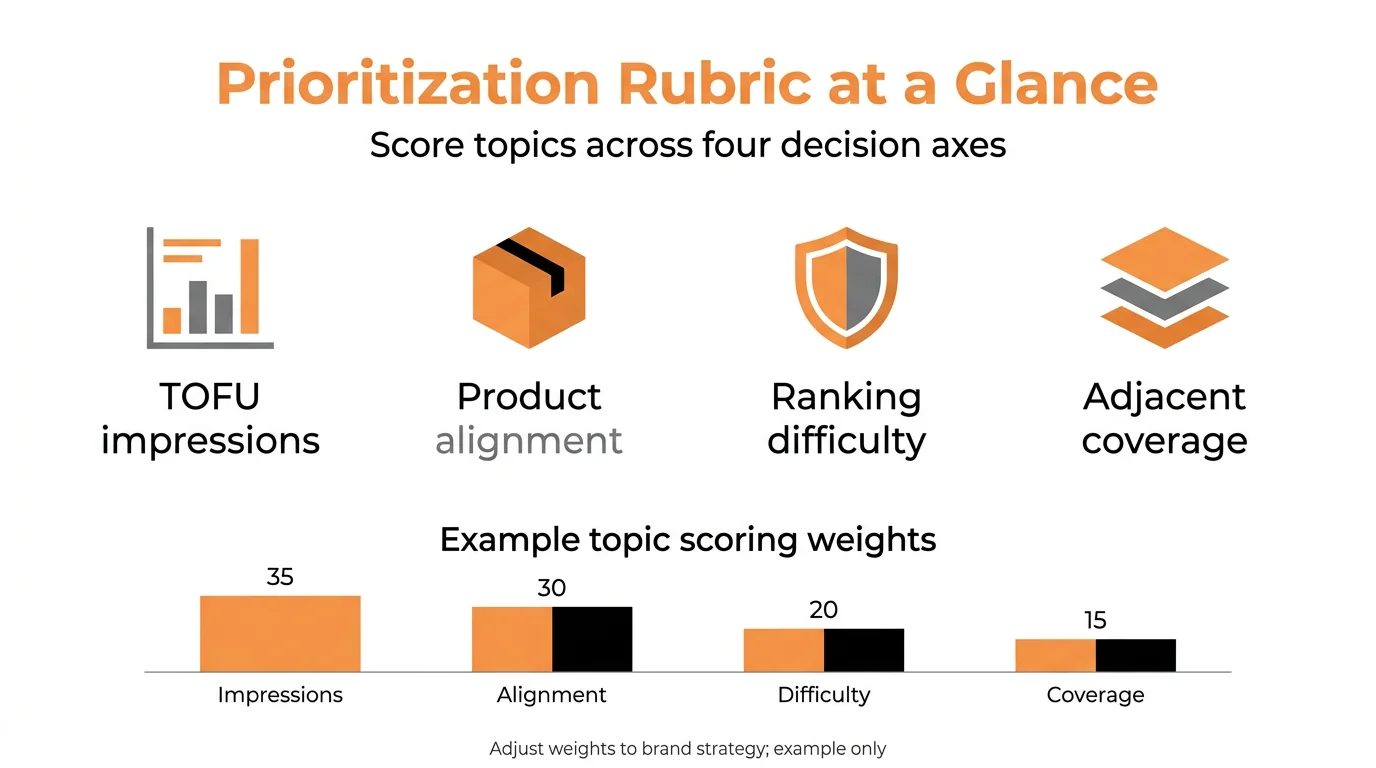
Traffic potential x product relevance x difficulty x topical coverage
Rank topics on four axes: top-of-funnel impressions, in-stock product alignment, ranking difficulty, and how well you already cover adjacent subtopics. Weighting may vary, but many teams begin 35/35/20/10 across those dimensions.
Examples: “indestructible chew toy for Pitbulls” vs. “best kitten litter”
The chew toy term often signals urgent, high-margin intent but may be difficult. The kitten litter term signals broader demand with potentially lower competition. Score both, then prioritize based on your inventory profile and authority.
Monitoring guidance: What to observe after 7-14 days and 4-8 weeks
7-14 days: indexing, early impressions, query mix by breed/species
Confirm indexing for new pages and hubs. Track early impressions, especially queries including breed or age modifiers. Watch for cannibalization with existing posts and adjust internal anchors to clarify relevance.
4-8 weeks: click-through rate, assisted conversions, internal link paths
Evaluate CTR movement on targeted modifiers, assisted conversions in analytics, and crawlability of internal link paths. Strengthen winners with FAQ expansions and schema. Consolidate underperformers into stronger parent guides.
Practical safety boundaries for automated gap filling
Medical, nutritional, and safety claims in pet content
Avoid definitive medical or dietary claims without expert review. Use cautious phrasing and cite authoritative sources when referencing health guidance. Research on euphemistic or ambiguous terms highlights the importance of precise, responsible language[3].
Breed stereotyping, size guidance, and durability disclaimers
Do not stereotype breeds or promise universal suitability. Provide ranges for weight, jaw strength proxies, or activity levels, and add durability disclaimers. Encourage supervision and replacement for damaged products to manage risk.
When to add citations, schema, and expert review
Add citations and medical disclaimers to care, nutrition, and training content. Use FAQPage and Product schema where appropriate. Route specialized topics for veterinarian or trainer review before publishing.
Evidence status: What current data suggests and where uncertainty remains
Evidence suggests long-tail breed/use-case queries may drive higher intent
Industry analyses of technology and information flows indicate growing segmentation in pet buyer journeys, which may benefit long-tail, attribute-rich content aimed at specific needs[2]. Your results will vary by authority and assortment depth.
Automation may speed coverage; quality and E-E-A-T still influence outcomes
Automated clustering and feature extraction can scale identification of relevant modifiers in pet descriptions[1]. However, clear sourcing, expert oversight, and audience trust signals still likely shape rankings and conversion outcomes.
Bring it together: Output checklist you should see after one automated run
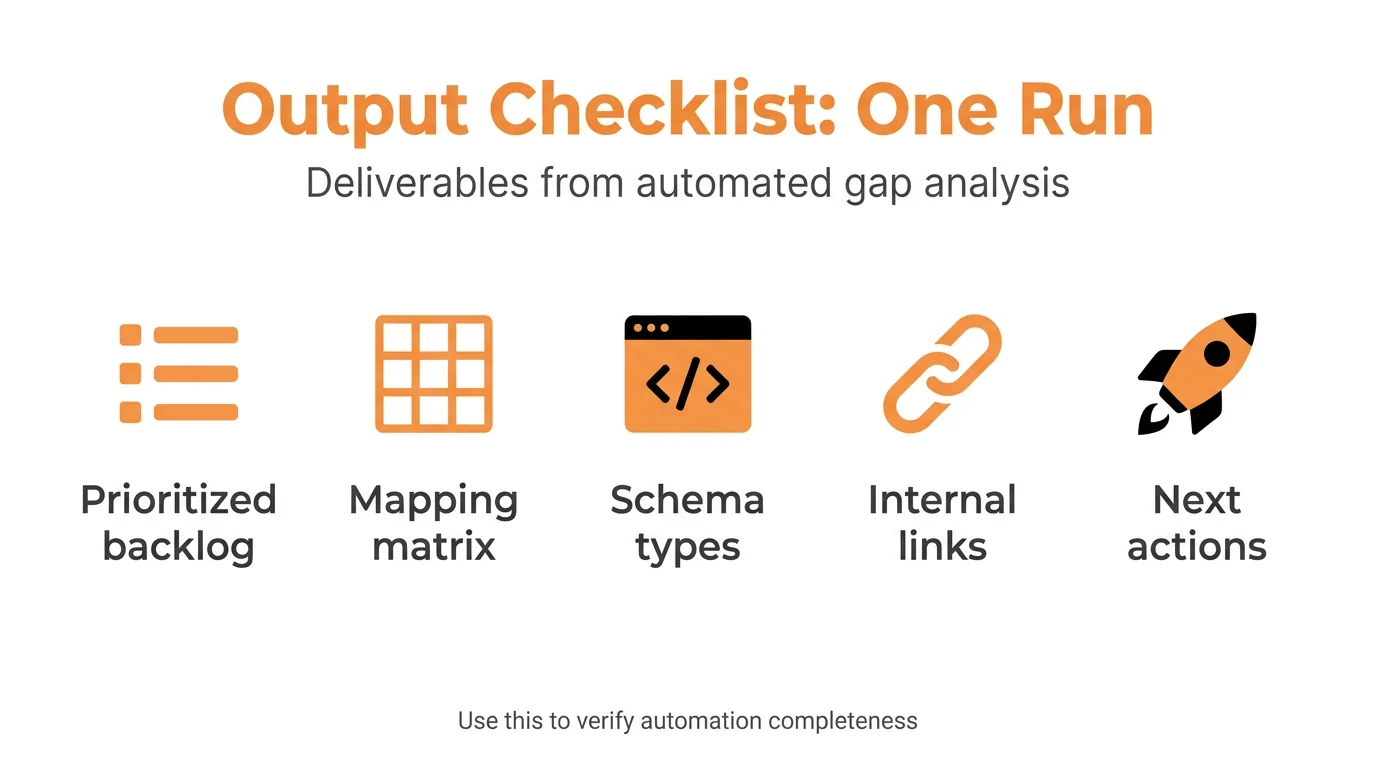
Ranked topic backlog by species/breed/use case/life stage
Expect a prioritized backlog with traffic, product alignment, and difficulty scores, grouped by species, breed, use case, and life stage. For an overview of where automation fits in your SEO plan, connect this backlog to your broader content roadmap and governance.
Content-to-product linking matrix and schema recommendations
Receive a matrix mapping each article or hub to 2-3 products and one taxonomy page, with recommended anchors and schema types. Use these insights to enhance PDP discoverability and structured data coverage. For PDP optimization techniques, see automated product page SEO patterns.
Pointer back to an overview of where automation fits in your SEO plan
Ensure every breed/use-case article template links to the most relevant product pages and a taxonomy hub (e.g., Dog Toys > Power Chewers), and includes a breadcrumb to the pillar. On targeted PDPs, add a “Learn” block linking back to the guide. To improve revenue flow from content, review internal linking that’s product-aware and scalable. For seasonality, reinforce planning with automation for promotional calendars and launches.
Frequently Asked Questions
What is pet-specific keyword gap analysis?
It is the process of comparing your rankings and pages to competitors to find missing queries segmented by species, breed, use case, and life stage. Automation may speed this by clustering and scoring gaps tied to your catalog.
How do I prioritize gaps for a large pet catalog?
Use a weighted score: traffic potential, product relevance, keyword difficulty, and topical coverage. Evidence suggests aligning gaps to in-stock, high-margin SKUs may improve impact. Rebalance weights by seasonality and current authority.
Should I create articles or optimize product pages first?
If gaps are informational (care, training, comparisons), create supporting articles first and link to relevant products. For clear transactional gaps, optimize product pages while adding FAQs and internal links. Combine approaches for blended intent.
How long until I see results from automated gap coverage?
Early signals may appear in 1-2 weeks, including indexing and impressions. More stable traffic and conversions often require 4-8 weeks, depending on competitiveness, site authority, and internal linking strength that channels relevance.
Is breed-specific content risky?
Avoid stereotypes and unverified claims. Provide cautious guidance, cite trusted sources for health or nutrition, and include suitability notes by size, age, and supervision needs. Add disclaimers and route sensitive topics to expert review.
Automated, taxonomy-aware analysis helps you detect what your catalog misses and prioritize work that compounds. Start with normalization, segment competitor terms, and score pragmatically. Publish focused hubs, reinforce with internal links, and monitor indexing, CTR, and assisted conversions. Tight guardrails for claims and precise language reduce risk and maintain trust[3]. When ready to operationalize at scale, catalog-aware clustering and scheduling through a platform built for pet brands may streamline execution without sacrificing quality.
References
- WZ Qie et al. (2025). Text Feature Extraction Techniques for Pet Descriptions. … on Metaverse and Current Trends in …. View article
- D Lee et al. (2025). A study on technology convergence trends in the domestic pet industry using patent information: Using network analysis and text mining. Smart Media Journal. View article
- M Gavidia et al. (2022). Cats are fuzzy pets: A corpus and analysis of potentially euphemistic terms. Proceedings of the …. View article
- ÁA Matias et al. (2020). Use of recycled polypropylene/poly (ethylene terephthalate) blends to manufacture water pipes: An industrial scale study. Waste Management. View article