Programmatic SEO for Pet Breeds, Sizes, and Life Stages-Without Thin Content

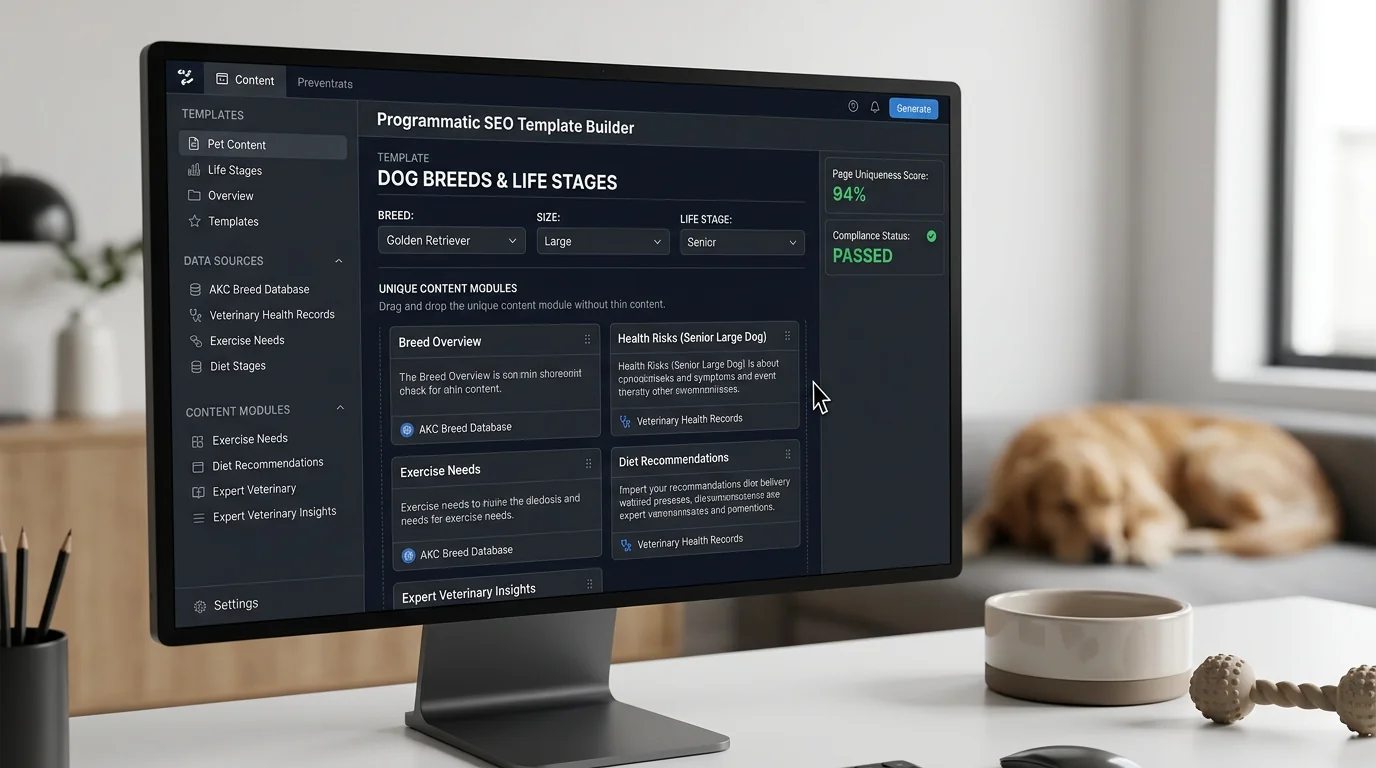
Table of Contents +
- Context: The one template problem this post solves
- Data-first template design that avoids thin content
- Safe content blocks: reusable yet unique
- Quick decision guide
- Practical safety boundaries for pet categories
- Monitoring: what to check after 7-14 days and 4-8 weeks
- Evidence status: where claims need stronger backing
- Implementation blueprint: minimal viable template (MVT)
- Risk recap and navigation
- Frequently Asked Questions
- Conclusion
- References
Design scalable breed, size, and life-stage pages without thin content. Templates, data models, and safeguards that may support unique, compliant SEO.
Programmatic SEO for pet breeds can unlock scale. It can also create duplication, risk, and compliance headaches. Most templates fail under modifier pressure.
This matters because breed, size, and life-stage intents differ. Owners expect expertise, clarity, and safe guidance. In this post, you will learn template logic, guardrails, and monitoring methods that scale pages while preserving uniqueness, trust, and compliance.
Context: The one template problem this post solves
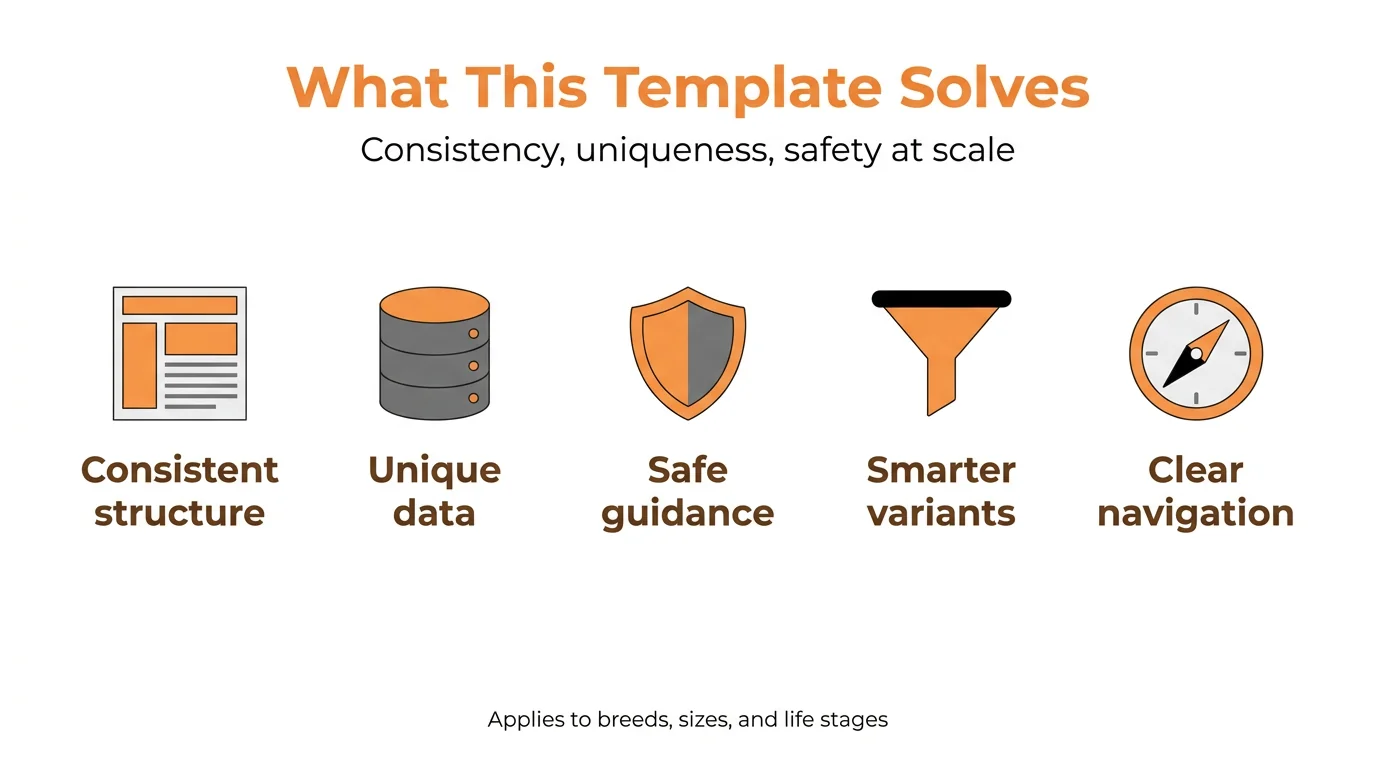
Breed-specific SEO often multiplies pages through size and life-stage modifiers. Without a disciplined template, variants repeat ideas and dilute authority. The solution is a data-first, safety-aware framework that enforces uniqueness.
Scenario focus: Breed × Size × Life stage pages for catalogs and advice
We address catalog and advice templates that combine breed, size class, and life stage. The goal is consistent structure, differentiated data, and controlled guidance that respects evidence and E-E-A-T for pet content.
Risk summary: duplication, medical claims, and modifier bloat
Key risks include near-duplicate bodies, unsafe health guidance at scale, and excessive modifier permutations. These increase crawl waste, cannibalization, and compliance exposure across programmatic templates SEO.
Petbase builds this SEO foundation automatically for pet businesses - 10 optimized articles published every month - start your free trial.
Data-first template design that avoids thin content
Design the template around a canonical entity model, not prose. Structure your CMS fields, align to a taxonomy, then bind safe content boundaries to each modifier.
Canonical entity spine: breed, size class, life stage, purpose
Define a canonical spine with controlled vocabularies for breed, size class, life stage, and page purpose. Evidence suggests taxonomy alignment improves hierarchical consistency and reduces ambiguity during scale-ups.[1]
Differentiators per modifier: what must change to be truly unique
Require hard differences by modifier: product eligibility rules, activity ranges, nutrient targets, and care constraints. Automated taxonomy work notes that unique attributes per node reduce overlap and confusion.[4]
Structured fields inventory: what the CMS must store
Store discrete fields: intake range, feeding bounds, activity minutes, coat length flags, temperament tags, SKU eligibility filters, and disclaimer type. Hierarchical modeling may support scalable classification and clustering.[3]
Safe content blocks: reusable yet unique
Build a library of blocks. Some scale with parameter changes. Others require expert review or softening language for safety and compliance.
Blocks that scale (facts, scoring, constraints)
Safely scale factual blocks: size bands, lifespan ranges, coat types, environment fit scores, chew-strength tiers, and product filters. Use data-driven scores and explanations that reference structured fields, not generic prose.
Blocks that must not scale verbatim (care guidance, feeding ranges)
Care, nutrition, and training advice should not clone across modifiers. Parameterize ranges, add context, and require expert notes. This preserves uniqueness and helps avoid blanket statements that may mislead.
Citation and evidence markers for pet topics
Mark sensitive claims with “evidence” labels and link to sources or review notes. Automation literature highlights the importance of explicit disambiguation and lineage for generated taxonomies and content.[4]
Quick decision guide
If you only have breed but no size/life-stage data
Publish a breed hub with constrained claims and data placeholders. Collect size and life-stage inputs before splitting pages. Expand when differentiators and inventory justify separate variants.
If modifier overlap risks near-duplicates
Consolidate variants into a single page with anchored sections. Use filterable blocks instead of page splits. Merge when cosine similarity or template fingerprinting suggests overlap.
If you lack expert review capacity
Freeze sensitive blocks and ship only factual, catalog, and environment-fit sections. Add explicit “awaiting vet review” markers. Backfill advisory paragraphs during scheduled content sprints.
If medical or nutrition advice appears
Gate with expert review, disclaimers, and hedged language. Parameterize ranges with minimum-maximum bounds. Avoid prescriptive dosing or diagnoses. Escalate unclear topics to a review queue.
If catalog has <5 relevant SKUs for a page
Hold page creation. Aggregate into a broader hub or widen modifiers. Launch only after SKU filters produce meaningful, reviewed assortments that justify user value.
If search demand is below threshold
Set a demand floor, such as minimum monthly impressions or clicks. Bundle low-demand modifiers into expandable sections. Reassess quarterly as inventory and seasonality shift.
If multiple regions/languages are planned
Keep one canonical template with localized fields. Lock sensitive content to regional review. Coordinate hreflang early to prevent cross-market cannibalization and duplication.
Practical safety boundaries for pet categories
Establish default safety lines before scaling. These boundaries limit risk while allowing data-rich uniqueness across breed, size, and life-stage pages.
Claim hygiene and hedging language
Prefer “may support,” “can help,” and “suitable for many” over absolutes. Use numerical ranges and conditions. Avoid deterministic claims about health outcomes, nutrition, or behavior without explicit expert review.
Review workflow and update cadence
Implement tiered reviews: automated checks, editorial QA, then expert sign-off for YMYL blocks. Schedule six-month audits for sensitive content. Log changes with timestamps and reviewer roles for E-E-A-T.
Schema, disclaimers, and YMYL care
Use appropriate schema and add clear disclaimers near advisory blocks. YMYL sections receive stronger moderation and linked sources. Evidence markers help maintain transparency and trust.
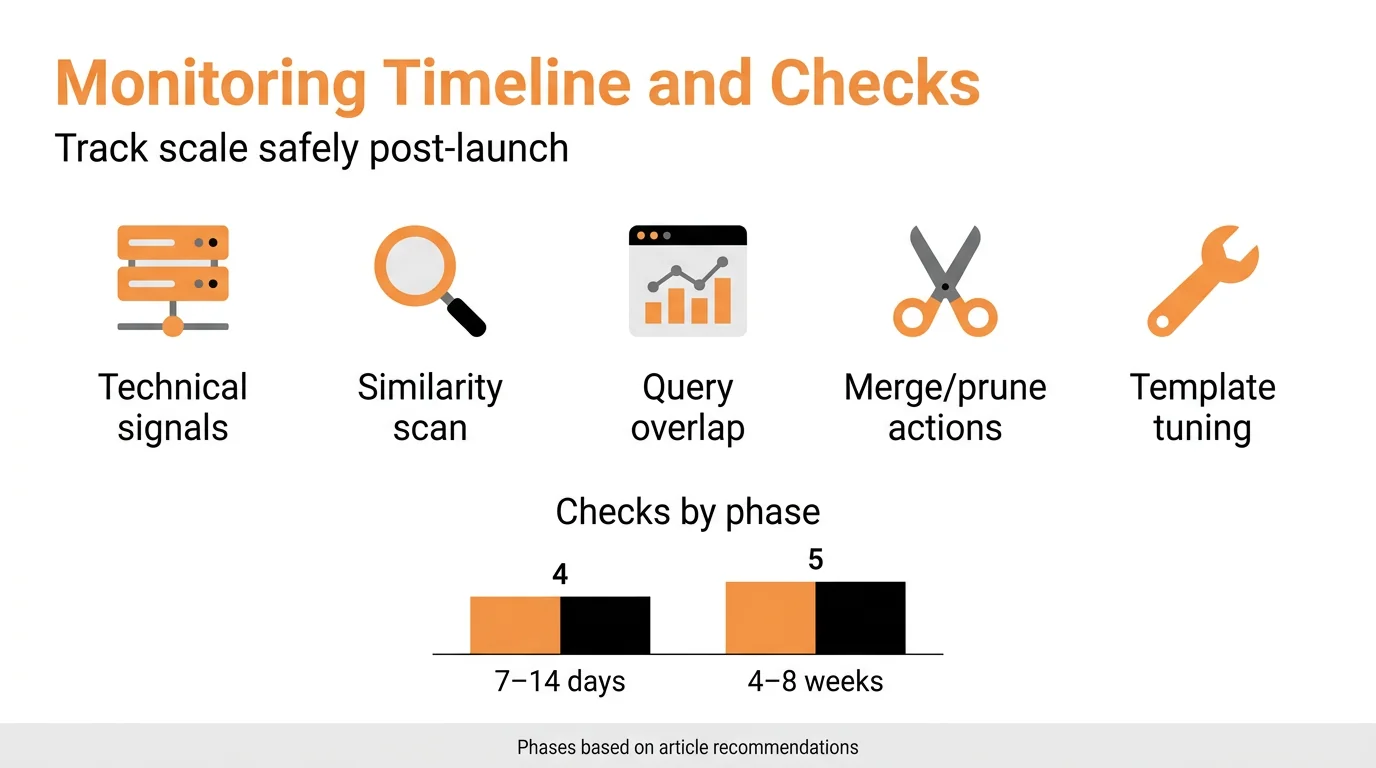
Monitoring: what to check after 7-14 days and 4-8 weeks
Monitoring ensures safe scale. Start with technical signals. Then evaluate search behavior and uniqueness. Be ready to merge or prune underperforming variants.
Early signals (indexation, duplication, crawl budget)
At 7-14 days, check crawl stats, indexation, and duplication flags. Run similarity sampling across variants. For competitive overlaps, follow cannibalization audit methods described in automated keyword gap diagnostics.
Mid-term signals (queries, cannibalization, engagement)
At 4-8 weeks, track modifier-qualified queries, impressions, and CTR. Analyze scroll depth to unique blocks and SKU clicks. See calendar-driven consolidation approaches for examples of when to merge seasonally thin variants.
Rollback and iterate: when to prune or merge
Prune variants with weak demand and minimal unique data. Merge into a stronger hub with anchors. Preserve winning elements and propagate learnings across templates.
Evidence status: where claims need stronger backing
Flag domains where evidence is essential. Require citations, vet review, and strict language for these patterns.
Nutrition, health, and breed predispositions
Demand citations for nutrient ranges, supplement mentions, and predisposition notes. Align taxonomy and language for consistency across pages, as alignment methods may aid coherence at scale.[1]
Activity needs by size and life stage
Use ranges, not prescriptive numbers. Tie activity minutes to life-stage definitions and size classes. Automated taxonomy research emphasizes structured definitions to reduce ambiguity in hierarchical content.[3]
Durability claims for toys by breed/biting style
Rely on testing notes and verified materials. Avoid universal durability promises. For governance and sourcing expectations, review our E-E-A-T and sourcing policy. Emerging methods suggest clearer taxonomies improve reliability indicators.[2]
Implementation blueprint: minimal viable template (MVT)
Start small with a minimal but safe spine. Use fields, not prose, to enforce differentiation. Expand as evidence and inventory grow.
Required fields and ranking logic
Fields: breed ID, size class, life stage, environment fit score, activity range, nutrient target bands, contraindication tags, SKU eligibility filters, disclaimer type. Ranking logic prioritizes fit score, availability, expert notes, and uniqueness density.
Example page anatomy
Suggested order: overview with hedged claims; environment fit and activity block; nutrient band table; curated SKUs with eligibility reasons; care considerations with review badge; FAQs; sources and disclaimers. Populate topics via a topical explorer workflow.
Governance and change log
Maintain a change log with versioned fields, reviewer names, and timestamps. Localize through a controlled process; see multi-language localization workflow. For operational execution, many teams adopt tools like Petbase AI to research, draft, and schedule updates safely.
Risk recap and navigation
Programmatic breed pages can drift into duplication, unsafe advice, or modifier bloat. Enforce differentiators, gate sensitive content, and monitor performance. Consolidate aggressively when uniqueness or demand is weak.
Common failure modes and mitigations
Failures include cloned care guidance, SKU-thin pages, and unmanaged regional variants. Mitigate with structured fields, demand thresholds, expert reviews, and QA rules that block unsafe blocks from publishing.
Where this pattern fits in your cluster
Use this template for catalogs and advisory hybrids where modifiers materially change fit. For governance principles and portfolio scope, see the main orientation on automation scope and risks.
Frequently Asked Questions
How do I keep breed pages from becoming duplicate content?
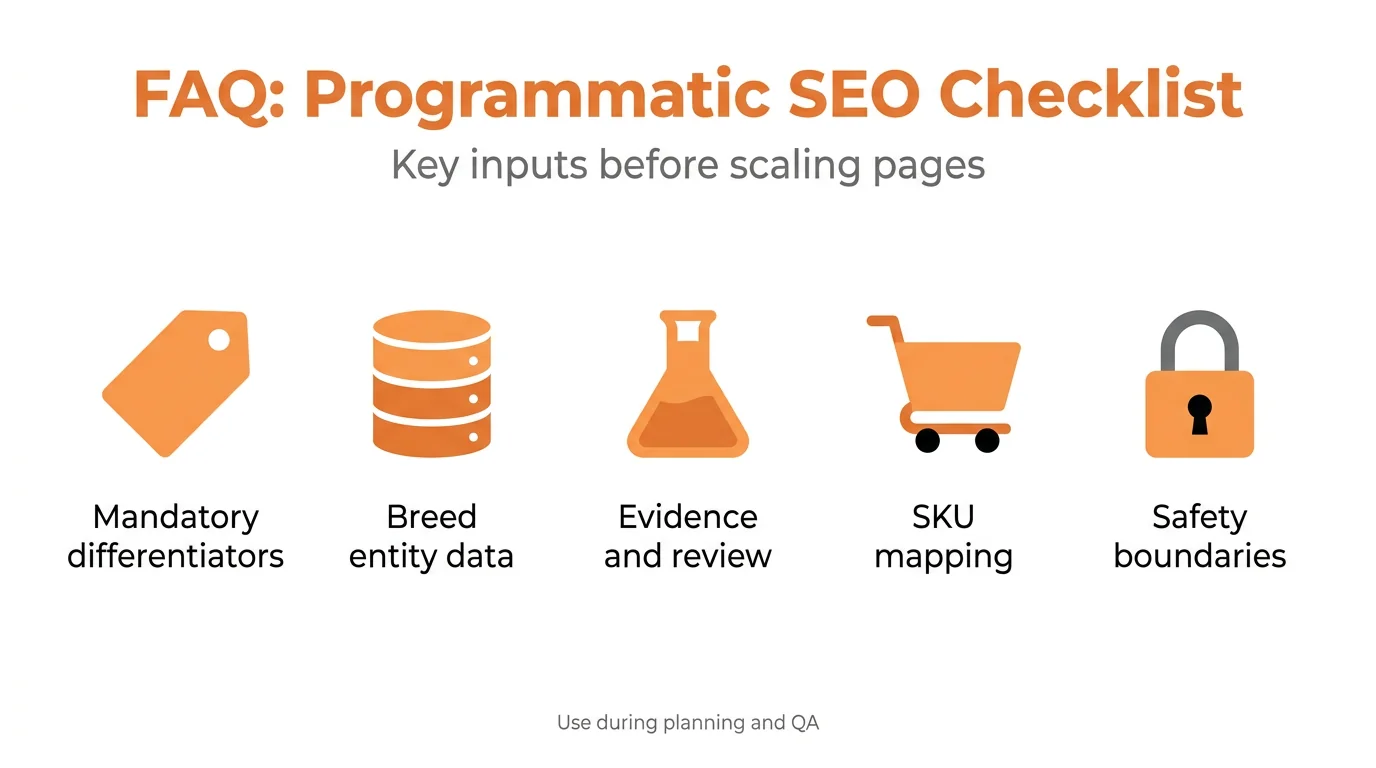
Define mandatory differentiators per modifier, such as size-specific care constraints, life-stage nutrient ranges with citations, and curated product assortments. Use unique data fields, not just wording changes.
What data do I need before generating breed × life-stage pages?
Collect a canonical breed entity, size class mapping, life-stage definitions, vet-reviewed guidance boundaries, and product attributes tied to those modifiers. Evidence suggests this foundation supports unique, compliant pages.
Should I create pages for every breed and size combination?
Consider demand and differentiation thresholds. If search volume or unique data is limited, consolidate into hub pages and expand only when you can add meaningful, reviewed differences.
How do I handle medical or nutrition advice safely at scale?
Use cautious language, cite reputable sources, add vet review for sensitive blocks, and include disclaimers. Mark advice sections with structured data where appropriate and track updates in a change log.
What metrics show my programmatic pages are working?
Monitor indexation, impressions by modifier, cannibalization, scroll depth to unique blocks, and product click-throughs. After 4-8 weeks, evaluate query coverage growth and prune weak variants.
Conclusion
Scaling breed, size, and life-stage pages demands more than clever text. It requires structured data, explicit differentiators, and careful governance. Use safe blocks, evidence markers, and hedged language to protect users and your brand. Monitor closely, consolidate when necessary, and version changes transparently. With this framework, programmatic SEO for pet breeds can produce unique, trusted pages that serve owners and search engines without crossing compliance lines.
References
- W Cui et al. (2024). Automated taxonomy alignment via large language models: bridging the gap between knowledge domains. Scientometrics. View article
- A Lahiri et al. (2025). TaxoAlign: Scholarly Taxonomy Generation Using Language Models. … of the 2025 Conference on Empirical …. View article
- S Iloga et al. (2021). An efficient generic approach for automatic taxonomy generation using HMMs. Pattern Analysis and Applications. View article
- R Irfan et al. (2019). Determining Influential Factors and Challenges in Automatic Taxonomy Generation: A Systematic Literature Review of Techniques 1999-2016.. Information Research: An International …. View article