Automated Product Page SEO for Pet eCommerce: Titles, Descriptions, and Schema

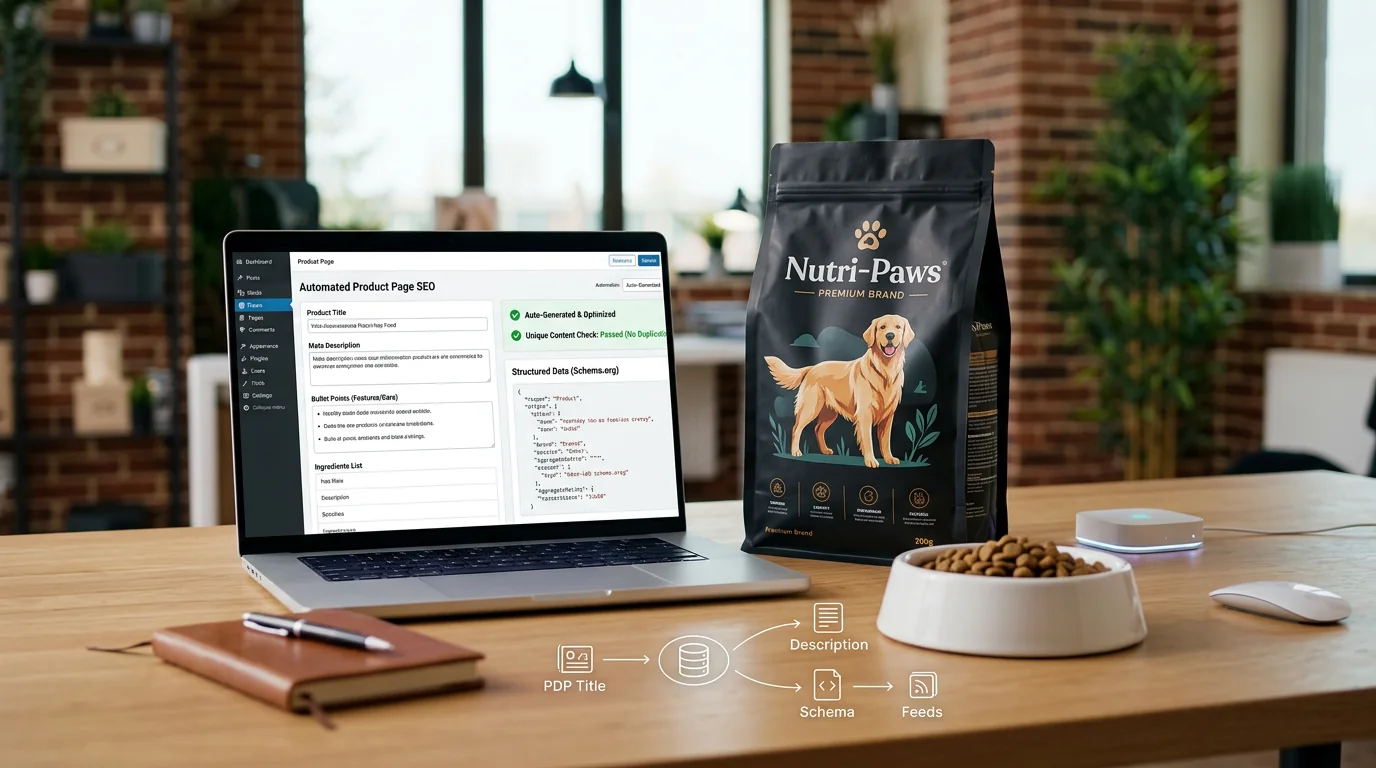
Table of Contents +
- Scenario: Scaling PDP SEO without duplication across large pet catalogs
- Data inputs and brand guardrails to make automation safe
- Title and meta logic that avoids cannibalization
- Bullets, care/use, and ingredients that satisfy search intent
- Structured data: Product, Review, and FAQ schema for pet PDPs
- Quick decision guide
- Monitoring: what to check after 7-14 days and 4-8 weeks
- Practical safety boundaries for automated PDP SEO
- Evidence status and where claims may be strong
- How this supports the pet content automation hub
- Frequently Asked Questions
- Conclusion
- References
Automate pet product page SEO: generate unique titles, meta, bullets, care, ingredients, breed fit, and product schema while staying on brand and avoiding dupli
Your catalog expands. Search performance plateaus. Duplicate and thin PDPs quietly cannibalize intent and suppress visibility. Automation can help, but only if your rules are precise and brand-safe.
This guide shows how to automate titles, meta, bullets, care/use, ingredients, breed fit, and structured data without duplication. It belongs inside your broader pet content automation hub. You will learn guardrails, decision logic, and monitoring steps that keep automation on-brand.
Scenario: Scaling PDP SEO without duplication across large pet catalogs
High-variant catalogs are prone to keyword overlap and self-competition. Controlled PDP SEO automation provides consistent quality while preserving uniqueness across SKUs and intent clusters.
Why pet catalogs create duplication risk (SKUs, sizes, breeds)
Multiple SKUs share near-identical descriptors: flavor, form, size, and variant pack counts. Search engines may conflate these pages. That increases cannibalization risk, especially in pet product page SEO where size, life stage, or species differ minimally.
Decision frame: automate titles, meta, bullets, care/use, ingredients, breed fit, and Schema
Automate text fields that benefit from structured inputs and templated variation. Include titles, meta descriptions, benefit-led bullets, care/use directions, ingredient disclosures, breed fit notes, and product schema for pets. Govern all with compliance and brand lexicon constraints.
Petbase builds this SEO foundation automatically for pet businesses - 10 optimized articles published every month - start your free trial.
Data inputs and brand guardrails to make automation safe
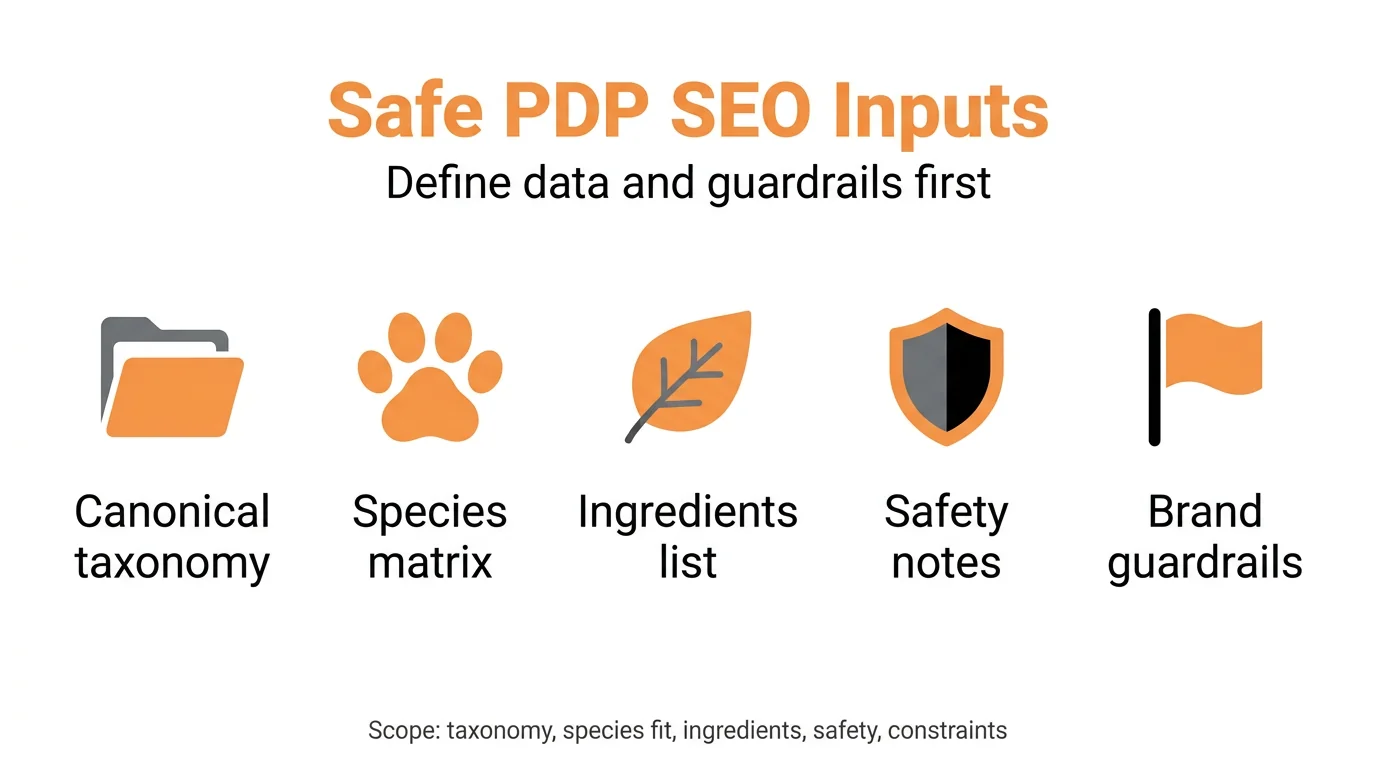
Automation is only as good as the data and constraints behind it. Define mandatory attributes and boundaries first, then generate.
Required fields: taxonomy, species, breed-size matrix, life stage, ingredients, care/use
Populate canonical taxonomy, species, breed-size matrix, life stage, formulation, ingredient list, contraindications, safety notes, and use directions. Add SKU, GTIN/UPC, MSRP, availability, and review aggregates. This foundation enables PDP SEO automation that is specific, compliant, and de-duplicated.
Brand voice constraints: lexicon, tone, compliance terms
Codify approved adjectives, banned claims, medical disclaimers, and reading level. Define tone boundaries and preferred benefit framing. Teams using Petbase AI often encode these rules as reusable templates for consistent, on-brand generation at scale.
Title and meta logic that avoids cannibalization
Titles and meta must clarify intent and disambiguate variants. Use deterministic tokens and capped lengths to prevent overlap.
Title template patterns by species and intent
Pattern: Brand + Primary Benefit + Form + Species + Size/Breed Fit + Key Differentiator. Example: “Brand Joint Support Chews for Dogs, Large Breeds - Glucosamine, 120-Count.” Include one intent modifier such as “hypoallergenic” where verified. Evidence suggests AI can align titles with user intent more consistently at scale.[2]
Meta description rules: uniqueness, benefits, and compliance
Use 150-160 characters. Include one top benefit, form, species, and safety reassurance. Add a subtle differentiator like flavor or formulation. Avoid identical phrasing across variants. Do not include prohibited health claims. Use action verbs that mirror searcher intent.
Bullets, care/use, and ingredients that satisfy search intent
Structured bullets and compliant care/use details answer common questions fast. This improves relevance for pet product page SEO without overselling.
Bullet hierarchy: benefit > feature > assurance
Use three to five bullets: 1) Primary benefit; 2) Key active or material; 3) Fit by species or size; 4) Quality or sourcing note; 5) Safety or guarantee. Link supporting guidance from blogs to PDPs to reinforce discovery using automated, product-aware internal linking.
Care/use and safety: species-, breed-, and life-stage nuances
Map dosing or usage to weight or size tiers. Note contraindications and storage. Include breed fit in cautious language, such as “may suit stronger jaws.” Reflect life-stage specifics where validated. Consistent automation can improve helpfulness signals for search.[4]
Structured data: Product, Review, and FAQ schema for pet PDPs
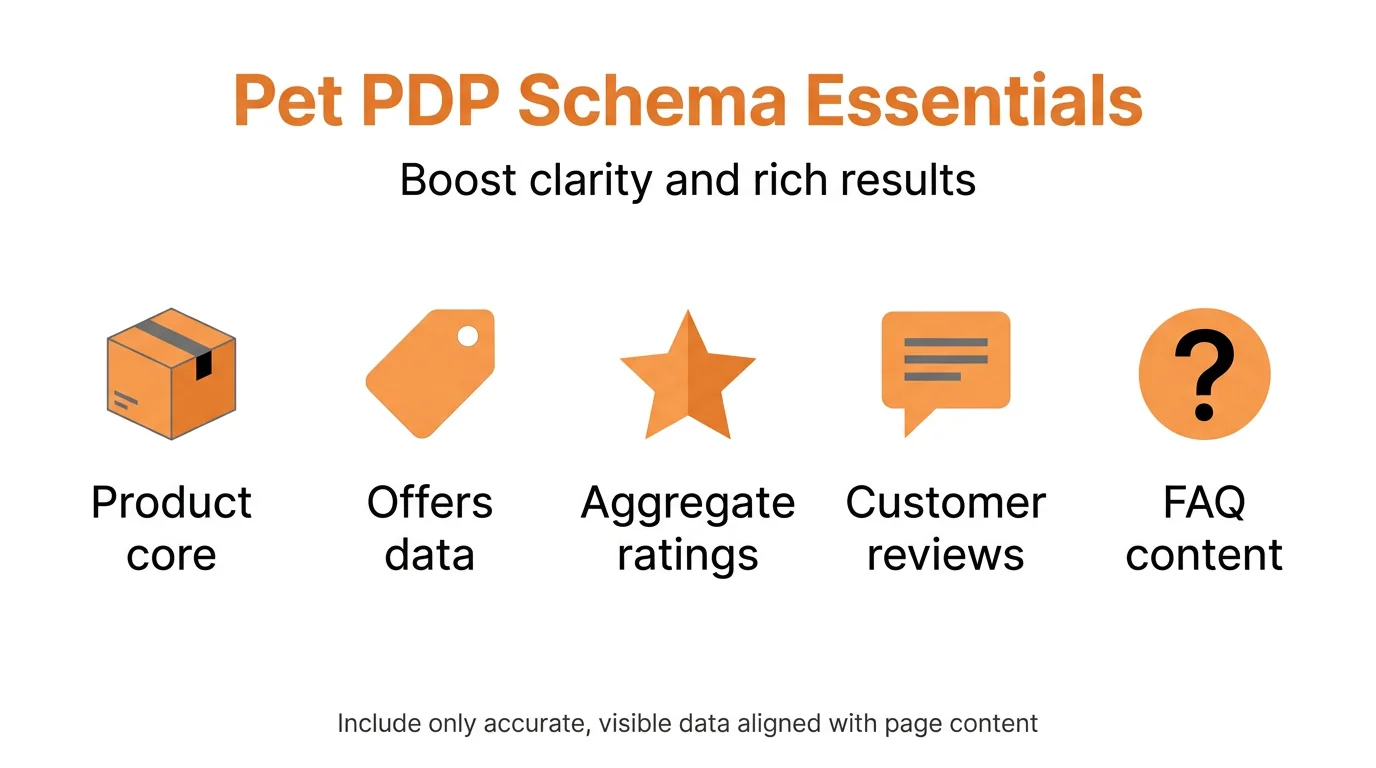
Schema clarifies meaning for crawlers and may support rich results. For product schema for pets, keep data accurate, fresh, and aligned with visible content.
Must-have properties and pet-specific variations
Include Product with name, description, image, brand, sku, gtin/upc, offers (price, currency, availability), and aggregateRating. Add Review where available. Consider FAQPage for care/use clarifications shown on-page. AI workflows can standardize schema output across large catalogs.[3] Explore breed and life-stage facets with programmatic breed and size logic.
Avoiding duplicate or conflicting schema across variants
Use a single parent Product with variant-specific Offer data when variants share a PDP. If variants have separate pages, ensure unique name and sku per page. Prevent multiple conflicting aggregateRating blocks within one URL.
Quick decision guide
If X, then Y rules for titles, descriptions, bullets, and schema
- If variants differ only by count, use one PDP with selectable variants.
- If species differ, create distinct PDPs per species.
- If intent differs, add intent modifier token in title.
- If size tiers differ, include weight/breed fit token.
- If ingredients differ materially, list lead active first.
- If care/use differs, add FAQ schema aligned to page.
- If reviews vary, aggregate at parent level where appropriate.
Monitoring: what to check after 7-14 days and 4-8 weeks
Measure early crawl outcomes and later commercial impact. Track by species, form, and intent clusters to isolate improvements in Shopify pet SEO performance.
Early signals: indexing, duplication, CTR
Within 7-14 days, check new titles and meta in live SERPs. Monitor indexing status, canonicalization, and CTR for renamed queries. Evidence suggests AI-led optimizations can accelerate alignment with searcher intent, improving early CTR stability.[2]
Later signals: conversions, cannibalization, rich results stability
At 4-8 weeks, compare add-to-cart, conversion rate, and revenue per session by cluster. Review rank dispersion to detect cannibalization. Track rich result presence for Product and FAQ. AI-enabled pipelines may improve SEO efficiency at scale.[4]
Practical safety boundaries for automated PDP SEO
Set explicit constraints to reduce risk. Include claim language limits, variant throttles, and structured rollback plans.
Compliance, medical disclaimers, and breed/age sensitivities
Disallow disease-treatment claims. Use “may support” phrasing. Add medical and age-use disclaimers where required. For breed-specific SEO, avoid prescriptive advice unless validated. For governance templates and review workflows, see quality guardrails for AI pet content.
Rate limits and rollback plans
Release updates in 10-20% catalog batches. Keep versioned backups of prior titles, meta, and schema. If CTR or conversions deteriorate, roll back within 24-48 hours and reassess token logic before continuing.
Evidence status and where claims may be strong
Research indicates AI can streamline e-commerce SEO while enhancing intent alignment and operational efficiency, though outcomes depend on data quality and governance.
What studies and platform docs suggest
Studies report that AI-driven SEO may boost competitiveness by automating optimization and predicting user intent in fast-moving markets.[1] Evidence also suggests workflow automation can reduce repetitive errors and improve scalability for e-commerce content.[4]
Where internal tests are needed
Test token sets per category, verify schema validity in production, and measure variant consolidation effects. Each catalog behaves differently. Controlled A/Bs remain essential to confirm benefit framing, disclaimers, and template competitiveness.
How this supports the pet content automation hub
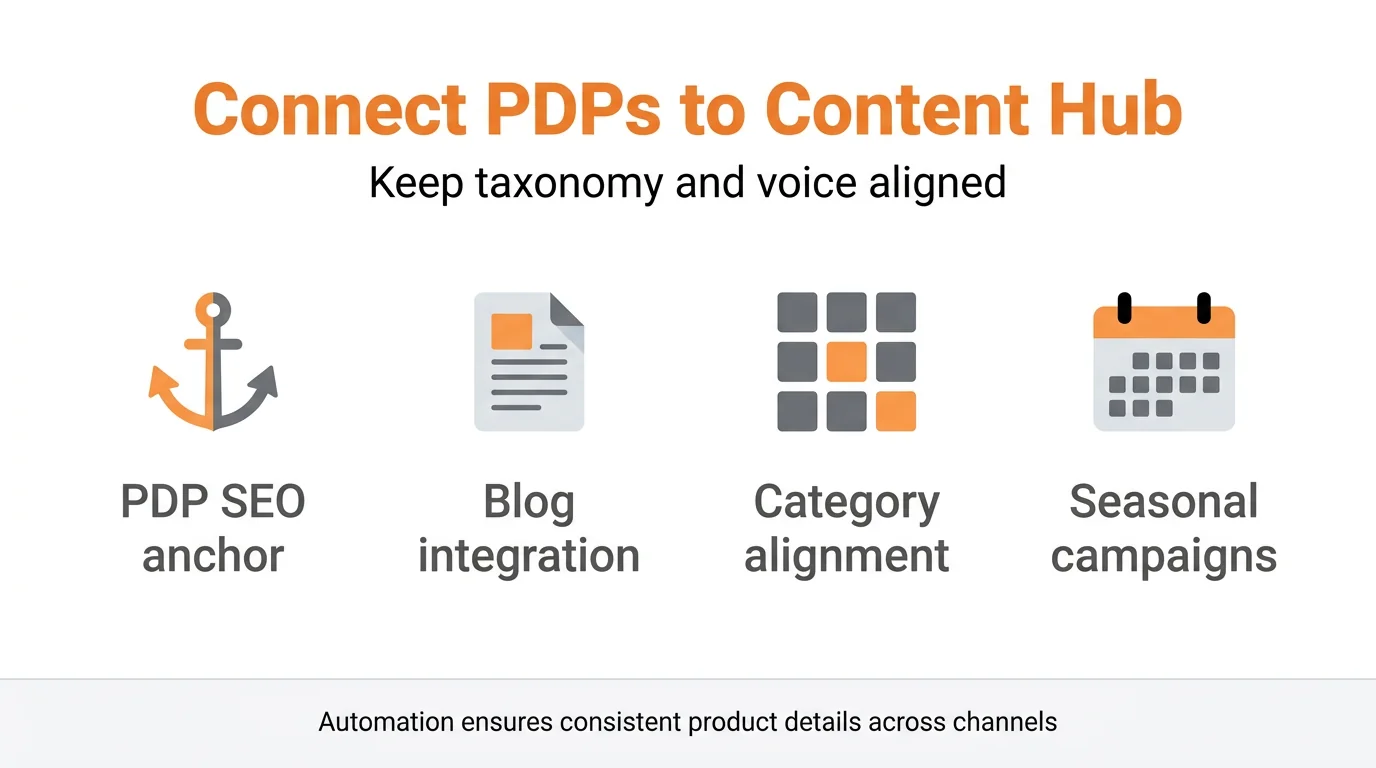
Automated PDP workflows integrate with planning, blogs, and category pages. They ensure product details match intent and voice across your ecosystem, guiding visitors from searches to conversion.
Positioning this PDP workflow within your broader automation roadmap
Use PDP SEO automation to anchor product relevance. Then expand into programmatic education and seasonal campaigns with coherent lexicon and disclaimers. Coordinate with cluster content and promotions for compounding gains.
Frequently Asked Questions
How do I prevent duplicate titles across similar pet product variants?
Use dynamic tokens that reflect species, size/breed fit, form, and primary benefit. Evidence suggests adding one intent modifier (e.g., allergy-friendly) can help reduce overlap and cannibalization.
What product schema is essential for pet PDPs?
Include Product with name, description, image, brand, sku, gtin/upc if available, offers, and aggregateRating. Adding FAQPage for care/use may support richer results, provided content matches the page.
Can I automate breed fit without overpromising?
Yes-map size and jaw strength tiers to tested products and use cautious language like “may suit” or “recommended for.” Avoid absolute performance claims unless validated.
How soon should I expect SEO impact from automated PDP updates?
Indexing changes may appear in 7-14 days. CTR and impressions trends often stabilize in 4-8 weeks, depending on crawl frequency and site authority.
Should I use one PDP for all variants or separate pages?
Evidence suggests a parent PDP with selectable variants helps consolidate signals. Create separate pages only when intent and features differ meaningfully (e.g., cat vs. dog formula).
Conclusion
Automating pet product page SEO demands structure, not shortcuts. Start with reliable data, brand guardrails, and intent-led templates. Validate with cautious language and measured rollouts. Monitor early crawl signals and later commercial outcomes. When configured well, automation reduces duplication, stabilizes schema, and supports scalable, on-brand growth.
References
- R Hasan (2025). Enhancing Market Competitiveness Through AI-Powered SEO And Digital Marketing Strategies In E-Commerce. ASRC Procedia: Global Perspectives in …. View article
- R Macumber… (2024). Google, SEO and helpful content: How artificial intelligence can be helpful for e-commerce websites. Journal of Digital & Social ….
- G Chodak (2024). Artificial intelligence in E-commerce. The Future of E-commerce: Innovations and …. View article
- IDC Arifah (2024). Transforming modern marketing: Artificial intelligence implementation for SEO marketing of online store in e-commerce marketplace. 2024 12th International Conference on Cyber and …. View article