Local SEO Automation for Vets, Groomers, and Trainers: Service Pages and FAQs

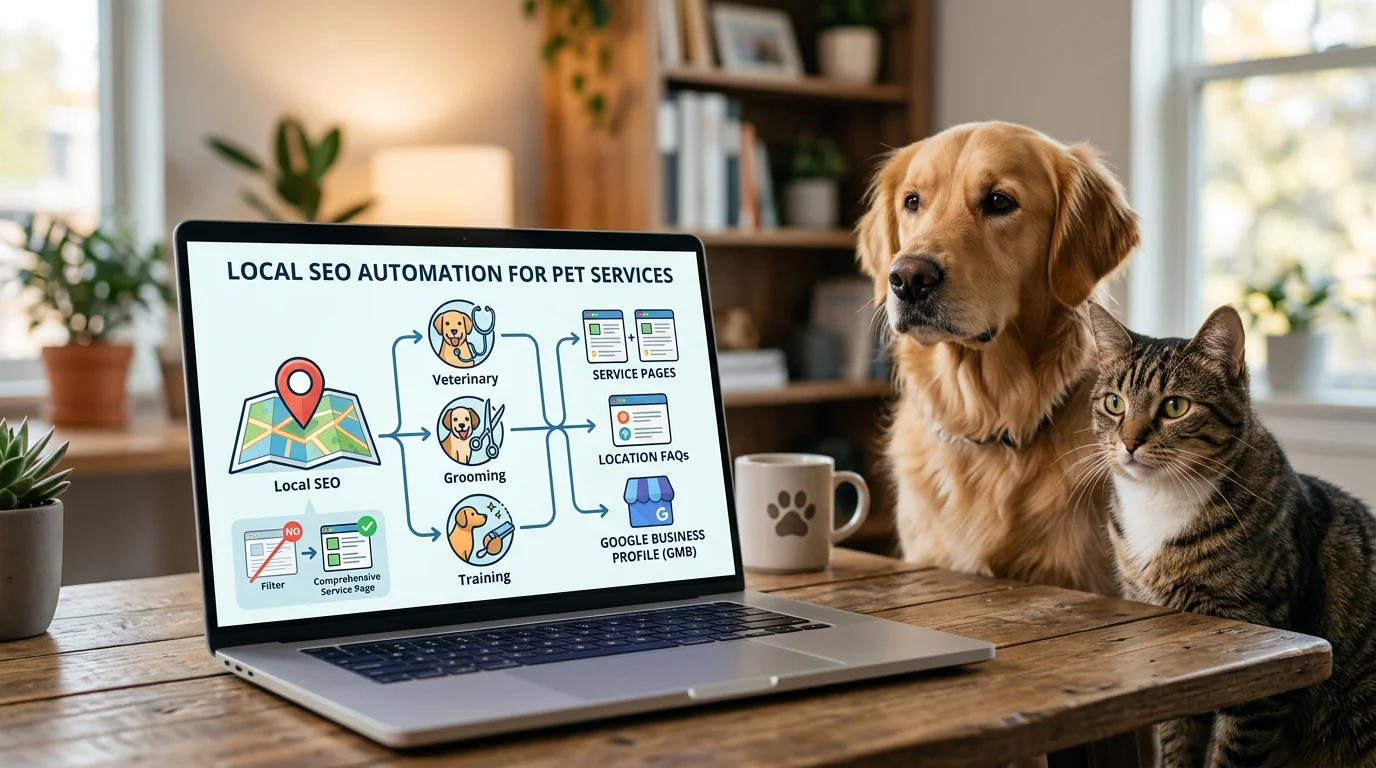
Table of Contents +
- The single decision: automate service + location content without thin city pages
- Data model and templates: how to structure automated service pages
- Quick decision guide
- FAQ automation: capturing real queries without keyword stuffing
- Google Business Profile (GBP) sync: posts, services, and attributes
- Monitoring guidance
- Practical safety boundaries
- Evidence status and what the data suggests
- Implementation checklist with Petbase fields
- Linking strategy: connect service, location, and education
- Frequently Asked Questions
- Conclusion
- References
Automate local service pages, location FAQs, and GMB posts for vets, groomers, and trainers without thin city pages. Practical templates and safeguards.
Local visibility makes or breaks bookings for vets, groomers, and trainers. Owners search by service and proximity first. They compare trust signals next.
Automating service and location content reduces manual effort and inconsistency. It also prevents risky duplication. This guide shows how to auto-create service pages, location FAQs, and Google Business Profile content. You will learn a scalable, non-duplicative model that respects multi-location intent and avoids thin city pages.
The single decision: automate service + location content without thin city pages
Most pet businesses need both service relevance and local proximity signals. The safe route is a canonical service page per service, enriched with location-aware modules that scale responsibly.
Problem framing: multi-location intent vs. duplication risk
Customers expect location details, but search engines penalize near-duplicate city swaps. The challenge is balancing multi-location intent with content uniqueness. Over-templated city clones invite doorway risks and waste crawl budget.
Outcome: one scalable page model per service with location-aware modules
Adopt one canonical page per service. Inject structured, location-aware blocks for hours, service-area coverage, insurance, and reviews. Pair with unique location pages that hold NAP, maps, team, and localized FAQs.
Petbase automates SEO content for veterinary clinics - so you can focus on patients, not blog posts - start your free trial.
Data model and templates: how to structure automated service pages
A robust template splits global service facts from local variables. Hybrid automation that blends global patterns with local search adjustments may improve quality and reduce “local optima” pitfalls in content variants.[3][1]
Core entities: Service, Location, Practitioner, Breed/Species
Model essential fields. Tie each service to species scope. Attach practitioners and credentials. Link locations with NAP and geo-coordinates. This structure underpins veterinary local SEO and groomer SEO service pages.
Template blocks: canonical service page with location injects
Use a canonical service narrative. Insert dynamic modules for service areas, location-specific FAQs, pricing ranges, and UGC reviews. Include schema for Service and LocalBusiness to support rich results eligibility.
Dynamic elements: hours, coverage radius, insurances, emergency notes
Automate business hours, holiday exceptions, and drive-time radius. Show insurance participation and emergency availability only where valid. Keep practitioner bios and qualifications sourced from the location entity.
For hands-off setup, many teams use Petbase AI to generate templates and maintain location data coherently across services.
For a broader automation context, see Pet Content Automation: The Complete Orientation Guide for Pet Brands, Retailers, and Clinics.
Quick decision guide
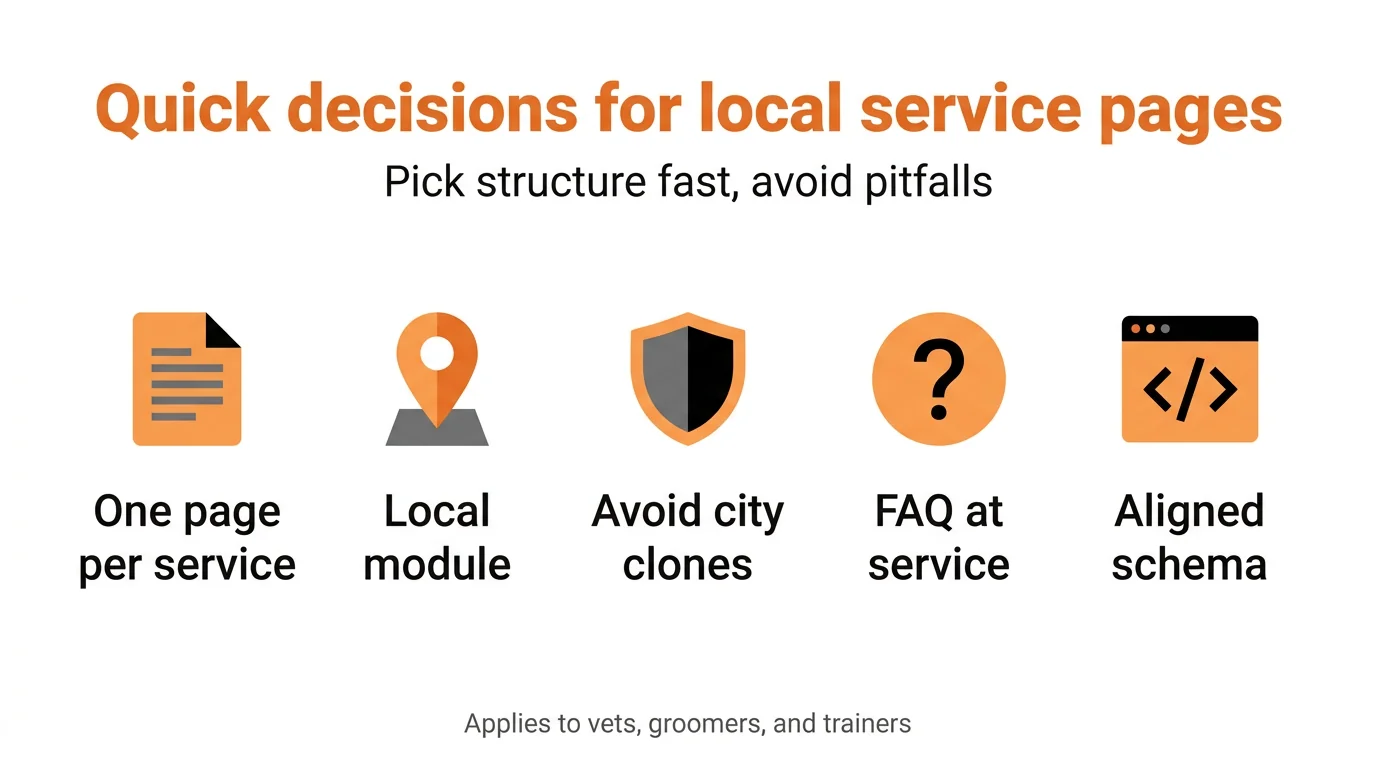
Use the following rules to pick the right structure quickly. These decisions help dog trainer local SEO, veterinary local SEO, and grooming service pages avoid duplication while surfacing true local relevance.
If you have 1 location, then use 1 canonical service page + local module
Publish one service page per service. Add a local module with NAP, map, hours, and service-area radius. Keep FAQs consolidated at service level unless policies differ locally.
If you serve multiple cities from 1 site, then use service pages + service-area snippets, no city clones
List covered suburbs in a small, rotating snippet. Add a “Where we serve” block with distance thresholds. Avoid near-identical city URLs. Link to a single location page with booking.
If you have multiple clinics, then 1 service page + unique location pages with FAQ sync
Maintain one canonical service page. Create unique location pages for each clinic. Sync shared FAQs from the service page. Add only location-specific variants where policy, pricing, or team varies.
If emergency services vary, then conditionally show emergency notice only for eligible locations
Add an emergency flag per location. Surface emergency hours, triage phone, and disclaimer only where true. Hide the module on locations without on-call or after-hours capabilities.
If reviews differ by location, then surface location-specific reviews via schema and UGC block
Pull reviews tagged to the location. Show UGC excerpts and mark up with Review schema when policy permits. Keep aggregate ratings distinct per clinic to reflect genuine experience.
If Spanish/German demand is >10%, then localize FAQs and GBP posts per locale
Mirror service FAQs across languages with hreflang. Translate GBP posts and attributes when available. For workflow efficiency, review multilingual automation without losing voice and tone control.
If pages exceed crawl budget, then consolidate low-impression city URLs
Measure impressions and clicks. If thin city pages underperform, 301 to canonical service pages or the most relevant location page. Preserve intent with updated internal links and breadcrumbs.
FAQ automation: capturing real queries without keyword stuffing
Automated FAQ systems work best when input signals are clean. Self-adaptive optimization techniques emphasize avoiding premature convergence; de-duplicating near-similar questions mirrors that logic for content quality.[2]
Sourcing questions: GBP Q&A, call logs, inbox tags, Search Console
Harvest questions from GBP Q&A, recorded calls, inbox tags, and Search Console. Add front-desk tags to note recurring pre-op, pricing, and policy queries. Update weekly during seasonal spikes.
Deduping near-duplicates and assigning to service vs. location
Cluster variants like “cost for grooming” and “how much is grooming.” Map universal answers to the service page. Add location versions only when hours, eligibility, or pricing ranges differ.
Answer patterns that scale: policy, pricing ranges, prep, recovery
Use templates with four parts: eligibility policy, price range, preparation checklist, and recovery or aftercare. Include disclaimers where clinical nuance applies. Add local modifiers discreetly to avoid stuffing.
Google Business Profile (GBP) sync: posts, services, and attributes
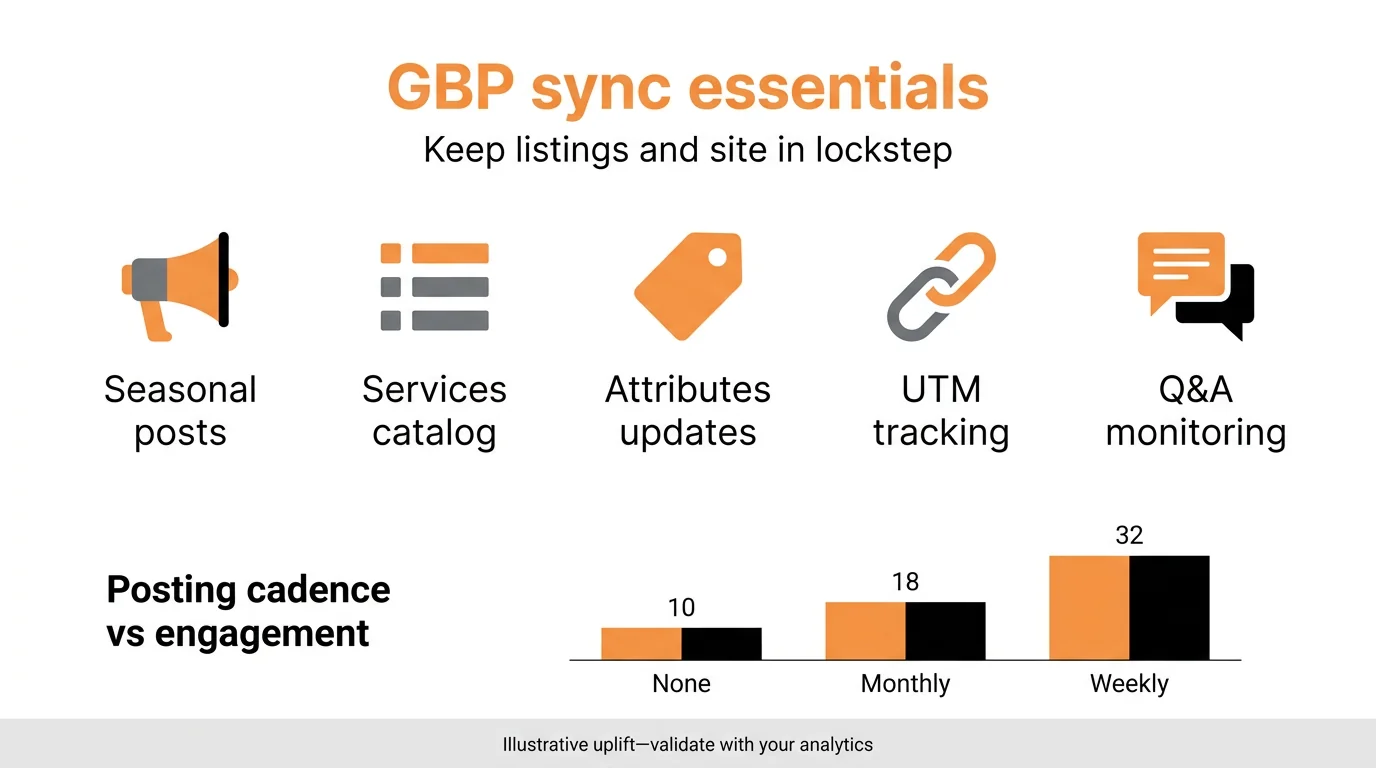
GBP operational data should synchronize with your site. Evidence from scheduling research suggests systematic, iterative updates can improve resource allocation and timeliness at scale.[4]
Automated posts from service promos and seasonal care
Auto-generate posts tied to service lines and seasons. Use concise CTAs and UTM-tagged links. For promotional calendars and bundles, consult seasonal and promotional automation guidance for timing alignment.
Service catalog standardization and UTM hygiene
Keep service names standardized across site and GBP. Maintain clean UTM parameters for website clicks, bookings, and calls. Audit duplicates quarterly to protect dog trainer local SEO integrity.
Attributes, hours, and holiday updates via API
Sync business attributes, accessibility, accepted payments, and holiday hours. Schedule updates before regional closures. This supports Google Business Profile automation and prevents stale or conflicting signals.
Monitoring guidance
Track performance and watch for cannibalization. Hybrid approaches in optimization show that iterative adjustments from early feedback may improve outcomes, reinforcing staged rollouts of automated modules.[1]
After 7-14 days: indexing, cannibalization, and GBP visibility
Confirm canonical service pages index and replace legacy city clones. Check Search Console for query overlap between service and location pages. Monitor GBP discovery versus direct views and post approvals.
After 4-8 weeks: query mix, conversions, and content decay signals
Evaluate growth in long-tail service-plus-location queries. Attribute bookings and calls with UTM data. Watch for FAQ impressions declining and refresh with new queries pulled from calls and inbox tags.
Practical safety boundaries
Boundaries protect credibility and compliance across veterinary local SEO, groomer SEO service pages, and trainer procedures. Apply guardrails to content, claims, and review workflows, and maintain human oversight where regulation applies.
Avoid doorway pages and over-templated city swapping
Do not generate near-identical pages for every suburb. Consolidate thin variants. Use one canonical service page with structured local modules and a unique location page per clinic or facility.
Constrain claims: medical nuance and pricing ranges
Use ranges, not absolutes, for pricing and outcomes. Add disclaimers for procedures and eligibility. Link to policies and consent forms. Avoid guarantees that imply certainty or uniform recovery experiences.
Human review checkpoints for regulated procedures
Enforce editorial review for anesthesia, surgery, or controlled substances. Verify practitioner credentials and emergency availability. For process guardrails, see quality guardrails, fact-checking, and disclaimers.
Evidence status and what the data suggests
Programmatic modules, synchronized GBP updates, and aligned schema are practical levers. While outcomes vary, several signals point to measurable benefits when implemented with restraint and ongoing monitoring.
Programmatic local modules may improve long-tail capture
Combining global templates with location-aware inserts mirrors hybrid optimization that improves solution quality, suggesting better coverage of nuanced, long-tail queries when content avoids duplication risks.[3]
GBP post freshness may correlate with discovery impressions
Regular, scheduled updates align with iterative scheduling research, indicating timeliness may support visibility and engagement. Treat post cadence as an operational discipline rather than sporadic activity.[4]
Schema alignment may support rich result eligibility
Consistent LocalBusiness, Service, FAQPage, and Review markup organizes signals. While not a ranking guarantee, alignment may support eligibility for enhanced displays and clearer entity understanding.
Implementation checklist with Petbase fields
Establish a reliable data backbone before templating. Prioritize required fields, then enrich with optional attributes. Validate schema for every build. Test rendering and structured data using canonical and location page examples.
Required fields: service_name, species_scope, locations[]
Capture the service name, species scope, and an array of locations with NAP, geo, hours, and emergency_flag. Include practitioner references and booking URLs for each location when available.
Optional enrichments: insurance, emergency_flag, languages[]
Add accepted insurances, a binary emergency flag, and languages served. These power conditional modules, multilingual FAQs, and accessibility messaging without duplicating near-identical city pages.
Schema blocks: LocalBusiness, Service, FAQPage, Review
Use appropriate LocalBusiness subtypes, Service details per offering, FAQPage for clustered questions, and Review where policy allows. Validate with testing tools and track warnings for remediation.
Linking strategy: connect service, location, and education
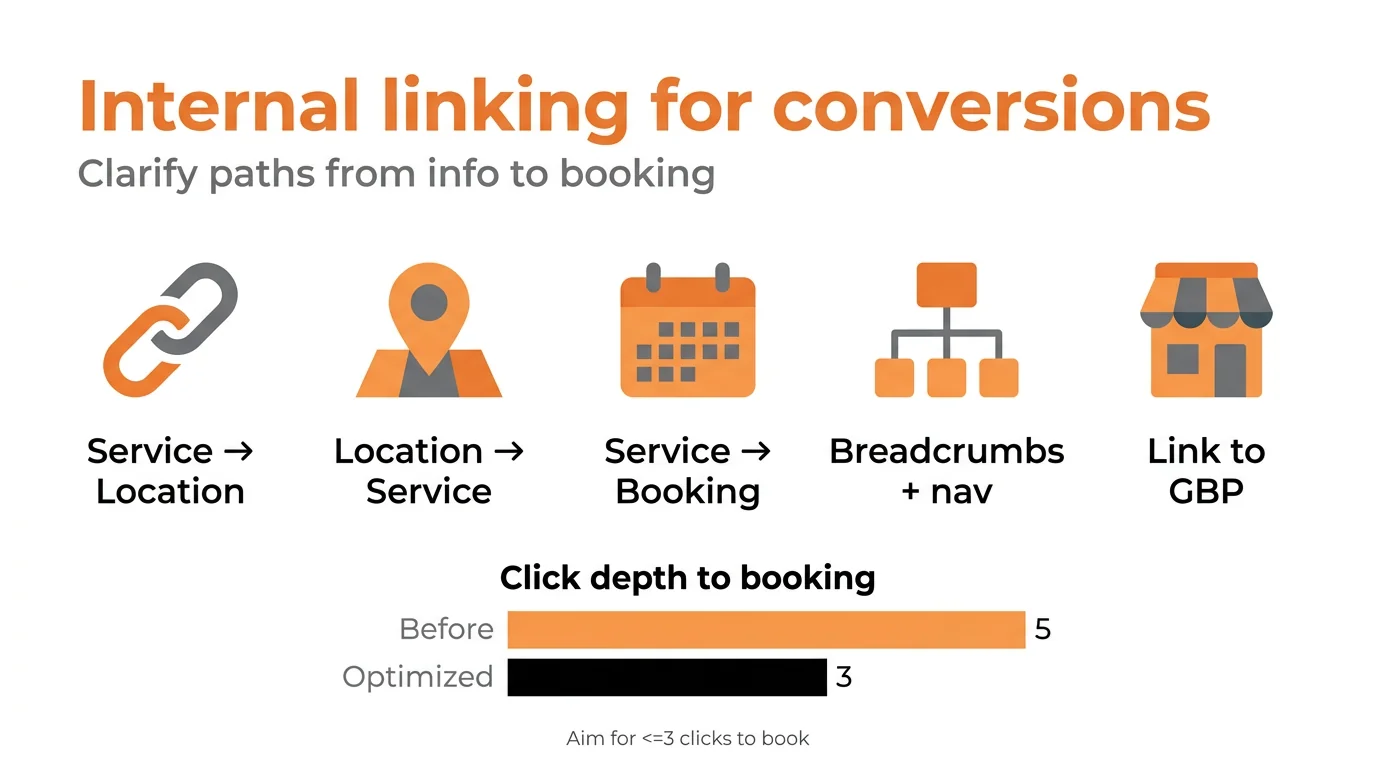
Strong internal linking clarifies intent and funnels users toward conversion. Keep sitewide cues consistent. Use breadcrumbs that reflect service and location hierarchy for clarity and crawlability.
Primary paths: Service -> Location -> Booking
From canonical service pages, link to the nearest location pages and then to booking. From location pages, link back to service pages and to GBP listing URLs with UTM parameters.
Support paths: Service -> Related blog guides
From service pages, link to educational posts such as pre-op instructions or grooming frequency. Use descriptive anchors. For automated internal linking methods, review turning blogs into revenue with internal linking.
Sitewide nav cues and breadcrumb consistency
Ensure navigation labels match service names in GBP and schema. Keep breadcrumb trails consistent: Home → Service → Location. This reduces ambiguity and supports crawl efficiency across templates.
Frequently Asked Questions
Should I create separate city pages for each pet service?
If content would be near-identical, avoid separate city pages. Use one canonical service page with location-aware modules and a unique location page for each clinic.
How can I automate FAQs without duplicate content?
Cluster similar questions and map them to service-level FAQs, then add location-specific variants only when policies, pricing ranges, or availability differ.
Do Google Business Profile posts help local SEO for vets and groomers?
Evidence suggests regular, relevant posts may support visibility and engagement. Maintain consistent posts tied to services, seasons, and promotions with UTM tags.
What schema should pet service pages use?
Use LocalBusiness (VeterinaryCare, PetGroomer, or AnimalShelter as applicable), Service, and FAQPage. Add Review snippets where policy allows and markup is compliant.
How do I handle multi-language local content?
Localize high-demand languages and mirror service and FAQ structures. Implement hreflang, translate GBP posts where possible, and keep NAP data consistent.
Conclusion
Automating service pages, location FAQs, and GBP updates can lift discoverability without risking thin city pages. Use a single canonical service page per offering with location-aware modules. Pair with unique, high-signal location pages. Monitor carefully, adjust iteratively, and keep human oversight for regulated topics. This disciplined model serves veterinary local SEO, groomer pages, and dog trainer local SEO with clarity and scale.
References
- J Zhao et al. (2020). A hybrid of deep reinforcement learning and local search for the vehicle routing problems. IEEE Transactions on Intelligent …. View article
- AG Hussien et al. (2022). A self-adaptive Harris Hawks optimization algorithm with opposition-based learning and chaotic local search strategy for global optimization and feature selection. International Journal of Machine Learning and …. View article
- S Gao et al. (2019). Chaotic local search-based differential evolution algorithms for optimization. IEEE Transactions on …. View article
- C Lin et al. (2023). Autoencoder-embedded iterated local search for energy-minimized task schedules of human-cyber-physical systems. IEEE Transactions on Automation …. View article