Multilingual Pet Content Automation for US, UK, and DACH Without Losing Voice


Table of Contents +
- Focus Scenario: One Product Guide, Three Locales, One Consistent Voice
- Workflow: From Source Draft to Locale-Perfect Pages
- Quick Decision Guide
- Monitoring: What to Check After 7-14 Days and 4-8 Weeks
- Practical Safety Boundaries
- Evidence Status and What It Implies
- Implementation Checklist for US, UK, and DACH
- Frequently Asked Questions
- Conclusion: Localization as a Lever for Scalable Pet Content
- References
Automate pet content for US, UK, and DACH while keeping brand voice. Learn term lists, unit swaps, and compliance checks for English and German locales.
Customers expect clarity in their language, units, and regulations. Your brand voice must travel well across English and German without breaking trust. Automation can make this practical and scalable.
This matters because localization errors damage credibility and search performance. A consistent voice improves conversions and compliance posture. You will learn a reliable workflow for translation and transcreation, plus guardrails for terminology, measurements, and regulatory nuance across US, UK, and DACH.
Focus Scenario: One Product Guide, Three Locales, One Consistent Voice
Imagine a single product guide adapted for US English, UK English, and German. The goal is identical intent, consistent persuasion, and locale-perfect details. Multilingual pet content automation should keep tone, claims, and structure aligned while handling regionally specific expectations.
Scope and constraints for US, UK, and DACH pet content
US uses imperial units and may reference AAFCO language. UK mirrors EU conventions and often applies FEDIAF guidance. DACH requires German language, metric units, and EU consumer law alignment. Voice must remain consistent while claims track local norms.
Common failure modes that dilute voice or accuracy
Typical issues include straight translation without transcreation, missing unit conversions, glossary drift (“kibble” versus “dry food”), unvetted claims, and mismatched SKU slugs. Image text and alt attributes often remain untranslated, undermining accessibility and trust.
Petbase handles this entire content workflow automatically - 10 SEO articles published to your blog every month - start your free trial.
Workflow: From Source Draft to Locale-Perfect Pages
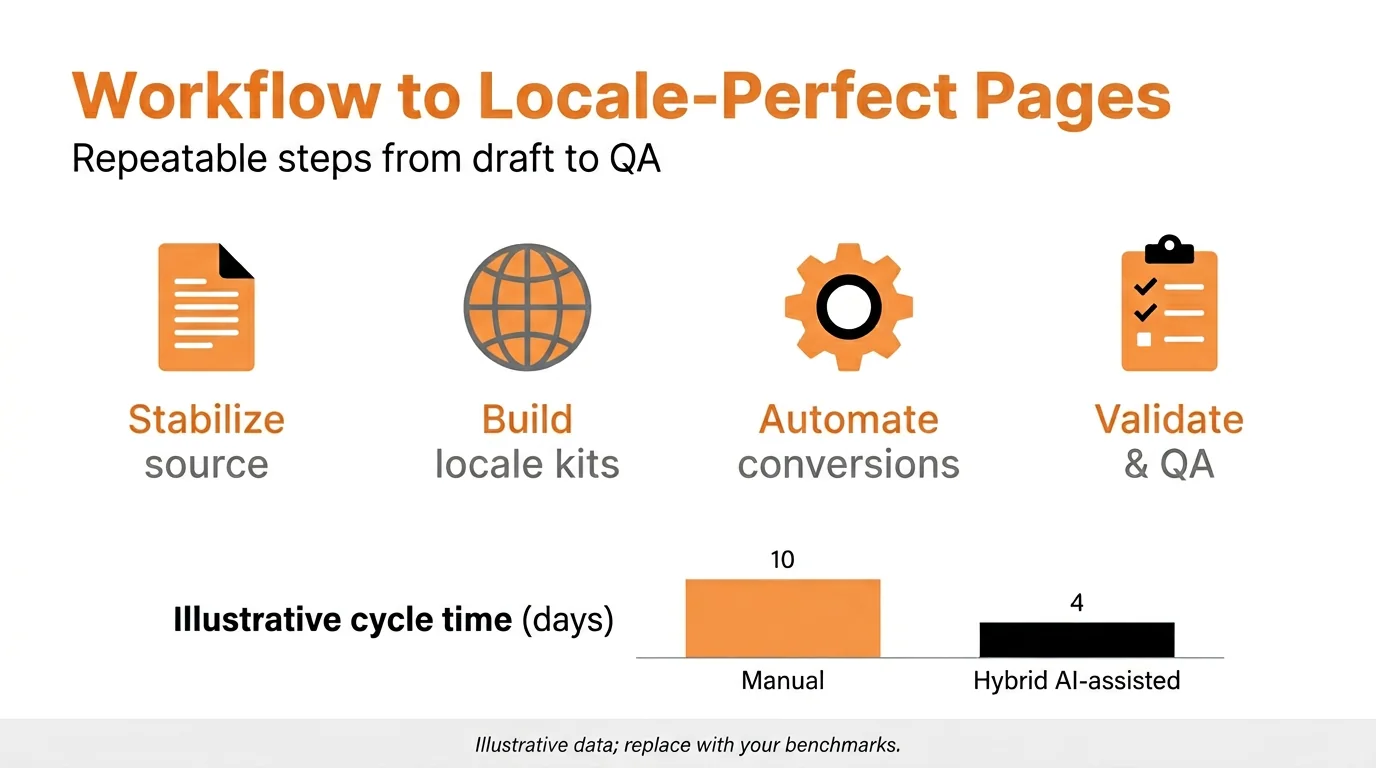
Build a repeatable path: stabilize the source, define locale kits, automate conversions, then validate. This approach supports pet content localization while preserving message integrity and improving US UK DACH SEO signals. Keep reviewers focused on high-impact checks.
Set the source-of-truth and voice guardrails
Start with a master English draft using your brand style guide, benefit ladder, and disallowed phrases. Add tone samples, sample metaphors, and hedging language. Flag sections requiring expert review, especially nutrition, dosing, or functional claims.
Locale kits: terminology, units, and regulatory notes
Create kits per locale: glossary entries, synonym preferences, unit rules, measurement thresholds, and compliance notes. Capture differences such as “flavour” vs. “flavor” and FEDIAF references. Maintain a changelog and ownership for terminology management pets.
Automation steps: detection, conversion, and review gates
Automate detection of units, dates, idioms, and glossary candidates. Auto-convert to target units with parenthetical equivalents. Insert locale-specific compliance snippets. Generate first-pass transcreation, guided by a glossary-first match. Use a topical explorer to ensure intent parity across locales.
For orchestration, many teams use Petbase AI to coordinate keyword plans, multilingual drafts, and review steps within one pipeline.
Validation: spot checks, QE patterns, and style diffs
Apply quality-estimation heuristics to flag risky sentences. Compare style diffs between locales to detect tone drift. Run spot checks on measurements, legal phrases, and headings. Research notes that AI workflows benefit from defined reviewer roles and checkpoints[1].
Quick Decision Guide
Use these rules to move quickly without sacrificing accuracy or voice. Each decision aligns to the locale kits and protects regulatory and linguistic integrity for pet SEO multilingual execution.
If the product is regulated or ingestible, then require locale compliance notes before publishing
Delay publication until the locale kit includes clear AAFCO, FEDIAF, or EU consumer references. Insert hedged language and evidence citations where needed. Lock a legal-review gate for all ingestible or therapeutic claims.
If content includes measurements, then auto-convert units and include familiar equivalents
Show pounds and ounces in US, kilograms and grams in UK/DACH. Add parentheses for helpful equivalents. Keep rounding to two significant figures. For feeding guidance, present both per-day and per-kilogram formats if customary locally.
If terms vary by market, then apply a glossary-first match with fallbacks
Enforce strict term matching for core product and benefit terms. Where locale prevalence differs, provide an in-line synonym at first mention. Track glossary match rate as a quality KPI and re-train where drift appears.
If tone risks overstatement, then use hedging templates aligned to medical/legal guidance
Trigger hedging templates for superlatives or implied health outcomes. Use phrases like “may support,” “is formulated for,” or “designed to.” Ingestibles always require conservative language and a visible disclaimer block.
If SKU naming differs by region, then map slugs and breadcrumbs per locale
Build a SKU-to-slug map by locale. Mirror breadcrumbs and category names to match search behavior. Complement with product schema and localized titles; see guidance on product page SEO and schema readiness.
If breed names differ, then prefer locale-prevalent terms with synonyms
Use the most common regional term and include known synonyms at first mention. Update alt text and captions accordingly. Maintain a breed synonym map in your locale kit to prevent search mismatches.
If images show packaging text, then localize captions and alt text or swap assets
Where text on pack appears, choose locale-specific images or add clarifying captions. Always translate alt attributes. Note regulatory icons or seals, ensuring they correspond to the target market’s standards.
Monitoring: What to Check After 7-14 Days and 4-8 Weeks
Automation requires feedback loops. Track technical health early, then validate market response. Evidence suggests that contextual signals improve multilingual retrieval and may inform refinement cycles for search relevance[4].
7-14 days: crawl health, indexation, and on-page QA
Confirm hreflang coverage, canonical targets, and crawlability. Check indexation by locale. Audit unit conversions, disclaimers, and glossary matches. Validate alt text translations. Sample internal links to country-specific navigations. Fix blocking errors before scaling further.
4-8 weeks: rankings, CTR deltas, and engagement trends
Review non-brand rankings by locale, query alignment, dwell time, and bounce rates. Monitor CTR shifts for localized titles and descriptions. Evaluate glossary match trends and on-page interaction depth to infer voice retention.
Practical Safety Boundaries
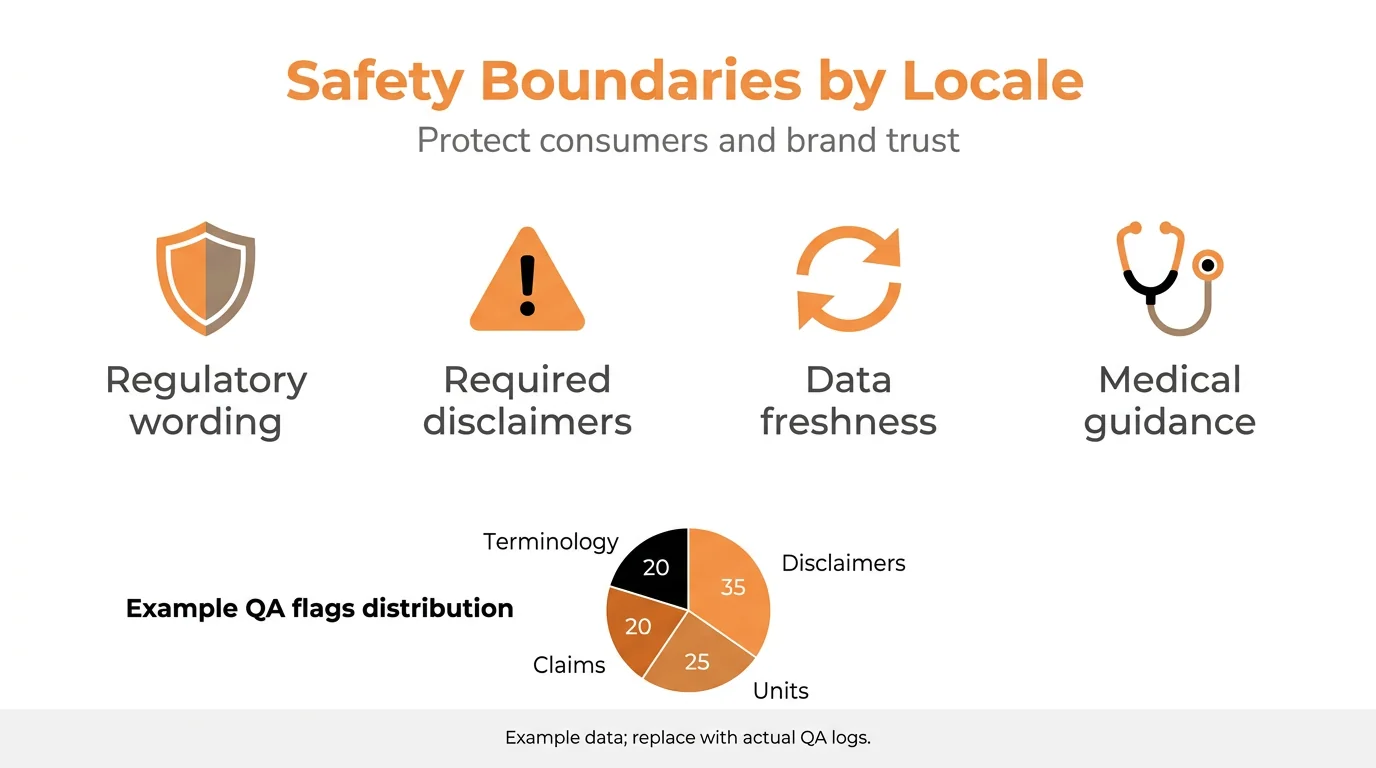
Safety boundaries protect consumers and the brand. They set non-negotiable standards for language, evidence, and data freshness across locales. Use them to gate releases and justify rollbacks when needed.
Medical and nutrition disclaimers by locale
Display locale-appropriate disclaimers on nutrition, supplementation, and health outcomes. Reference AAFCO or FEDIAF wording where relevant. For detailed policy design, review E-E-A-T and medical disclaimers best practices and adapt templates per locale.
Claims and superlatives: tone and evidence controls
Flag superlatives and implied cures. Enforce hedged phrasing and ensure sources are available. Research indicates automated pipelines benefit from human-in-the-loop oversight at critical checkpoints to reduce risk of overclaims[1].
Data sources, last-updated stamps, and rollback plans
Stamp pages with last-updated dates and source lists. Keep snapshots of previous versions and enable one-click rollback. Align rollback criteria to compliance triggers, material glossary errors, or traffic-harming template changes.
Evidence Status and What It Implies
Localization has a growing evidence base. AI-assisted workflows appear promising when paired with clear roles, context signals, and structured review. Yet, market-specific testing remains essential to confirm impact on engagement and conversion.
What industry data suggests about localization and engagement
Studies note that AI-enabled multilingual delivery can improve speed and consistency, reducing cycle times while maintaining quality under human guidance[2]. Gains are strongest when terminology and context signals are codified.
Where evidence is weaker and needs testing
Cross-locale tone retention and claim interpretation vary by audience. Automated transcreation requires market testing to validate sentiment and trust signals. Sector-specific controls are advisable to supplement generic automation approaches[3].
Metrics that may indicate voice retention
Stable glossary match rates, reduced style diffs, and consistent engagement across locales may indicate voice retention. Contextual signals, such as search-session intent alignment, can further validate localization quality[4].
Implementation Checklist for US, UK, and DACH
Use this short checklist to operationalize pet content localization at scale. Prioritize items that prevent regulatory exposure, measurement confusion, and terminology drift for transcreation for pet brands.
Glossaries, units, and synonym maps
Build a shared terminology set, locale synonyms, and banned terms. Include measurement rules and conversion rounding. Update quarterly. Track glossary match rate and false-positive conversions. Store breed synonym maps and image-alt conventions per locale.
Schema, hreflang, and URL structure
Implement Product, HowTo, and FAQ schema where relevant. Configure hreflang pairs and canonical rules for US, UK, and DACH. Mirror slugs and breadcrumbs by locale. Align architecture with your central pet automation strategy for cluster integrity.
Editorial QA and sample prompts
Prepare locale-specific QA checklists and reviewer prompts. Include hedging templates, compliance inserts, and checklist triggers. Sample sentences should demonstrate tone, benefit framing, and disallowed claims to prevent drift in future iterations.
Frequently Asked Questions
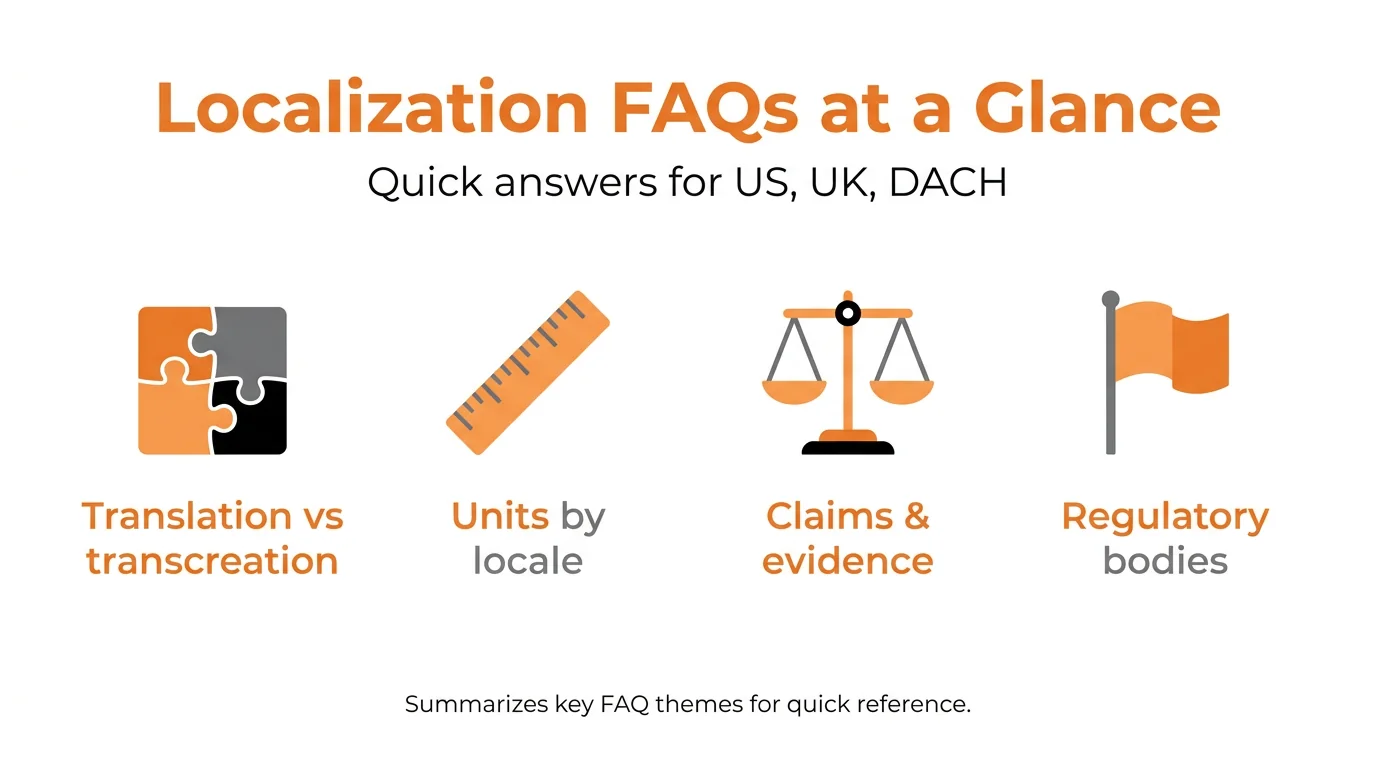
What is the difference between translation and transcreation for pet content?
Translation focuses on meaning equivalence, while transcreation adapts tone, idioms, measurements, and regulatory language for local norms. For pet topics, transcreation may support clarity and trust by aligning terminology and claims with each market.
How should units be handled across US, UK, and DACH?
Evidence suggests using locale-default units with optional familiar equivalents. For example, show pounds in US, kilograms in UK/DACH, and provide a parenthetical conversion where helpful.
How can brand voice be kept consistent across languages?
Use a source-of-truth style guide plus locale glossaries and tone examples. Style diffs and sample sentences may help reviewers catch drift before publishing.
What compliance nuances matter for pet nutrition content?
US content may reference AAFCO language, UK follows FEDIAF guidance via UK/EU norms, and DACH aligns with German-speaking EU consumer law. Claims should be cautious and cite sources where applicable.
Which KPIs indicate successful localization?
Track hreflang indexation, locale-specific CTR, time on page, and glossary match rates. Gradual growth in non-brand rankings may indicate improved relevance.
Conclusion: Localization as a Lever for Scalable Pet Content
Localization is not a string-replace task. It is a system that blends translation, transcreation, terminology control, and compliance nuances. When you codify locale kits, automate conversions, and enforce review gates, you protect voice and trust.
This disciplined workflow powers reliable US, UK, and DACH pages without rework loops. Treat evidence as guidance, then validate with metrics. With tight guardrails and targeted automation, multilingual pet content becomes a repeatable growth lever.
References
- J Moorkens et al. (2024). Artificial intelligence, automation and the language industry. Handbook of the language …. View article
- R Konda (2025). AI in multilingual content delivery: Bridging global digital gaps. International Research Journal of Modernization in …. View article
- P Hegde (2021). Automated Content Creation in Telecommunications: Automating Data-Driven, Personalized, Curated, Multilingual Content Creation Through Artificial …. Jurnal Komputer, Informasi dan Teknologi. View article
- B Zhang et al. (2023). Improve machine translation in e-commerce multilingual search with contextual signal from search sessions. 2023 - amazon.science. View article