Quality Guardrails for AI Pet Content: Fact-Checking, E-E-A-T, and Medical Disclaimers


Table of Contents +
- Scope and Single Decision: How to ship AI pet health articles without unsafe claims
- Source Hygiene and Fact-Checking Workflow
- Operationalizing E-E-A-T for Pet Topics
- Medical Disclaimers and On-Page Safety Language
- Quick Decision Guide
- Practical Safety Boundaries
- Evidence Status: Where claims can be stronger
- Monitoring After Publish
- Workflow Example: Vet-Reviewed AI Pipeline
- Appendix: Red-Flag Triggers to Escalate
- Further Reading
- Frequently Asked Questions
- References
Practical guardrails for AI pet content: fact-checking flows, E-E-A-T signals, medical disclaimers, and monitoring to reduce risk in veterinary topics.
AI can accelerate pet content production. It can also introduce risks when health advice is oversimplified, outdated, or misapplied. Owners deserve careful, accurate guidance.
This article lays out practical governance for AI pet content compliance. You will learn how to choose sources, run a veterinary content review workflow, embed E-E-A-T for pet websites, apply medical disclaimer for pet blogs, and monitor red flags.
Scope and Single Decision: How to ship AI pet health articles without unsafe claims
Risk profile: what changes when content touches symptoms, dosage, or emergencies
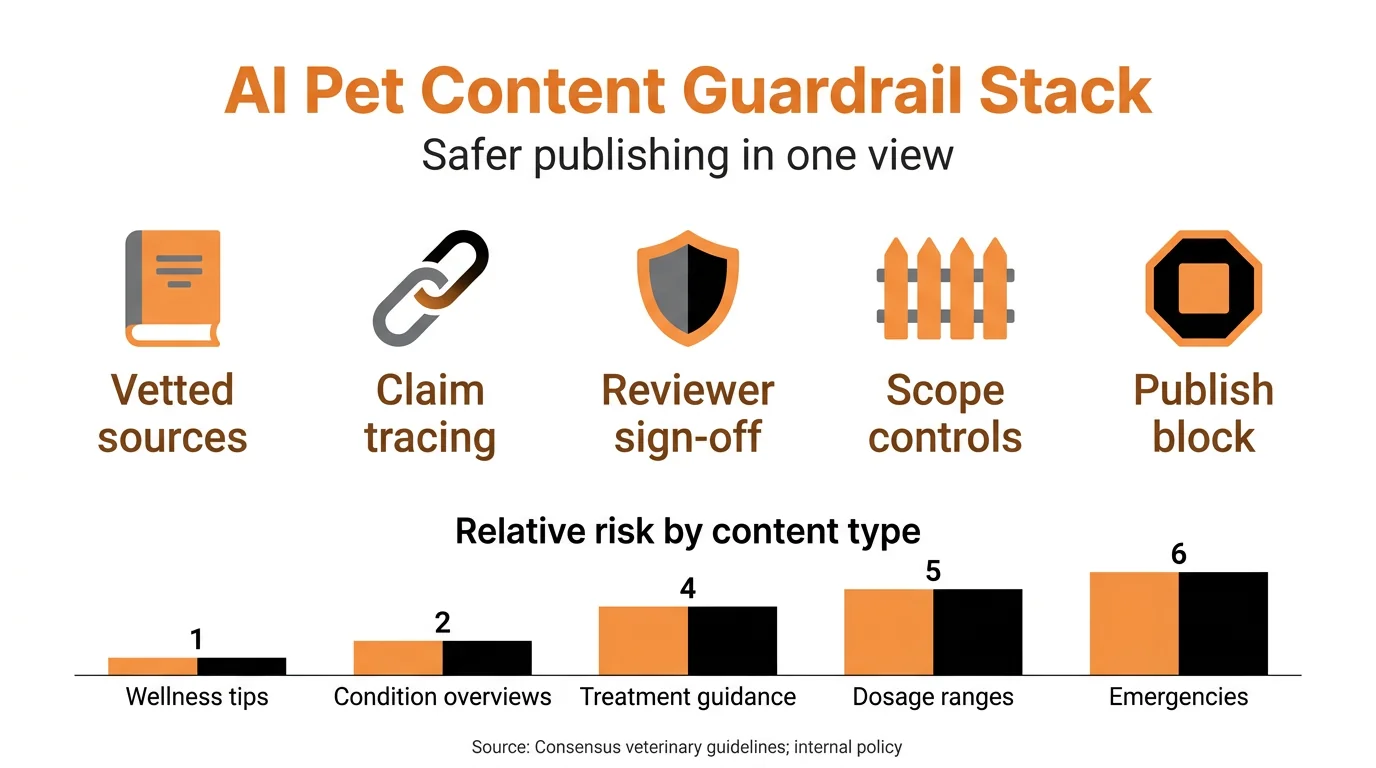
Risk increases when content implies diagnosis, recommends treatments, or names dosage ranges. Emergencies raise stakes further. Move from editorial checks to clinical review when the article discusses symptoms, medications, or urgent triage decisions to avoid unintended harm.
Guardrail stack: source standards, reviewer roles, and release rules
Adopt a layered guardrail stack. Use vetted sources, structured fact-checking, and documented reviewer sign-off. Block publication if sources are weak, review is incomplete, or disclaimers are missing. Require escalation rules for high-risk health assertions before release.
Petbase writes and publishes this kind of content automatically - 10 SEO articles per month for pet businesses - start your free trial.
Source Hygiene and Fact-Checking Workflow
Acceptable sources: veterinary textbooks, peer-reviewed journals, and consensus guidelines
Anchor claims in peer-reviewed journals, veterinary textbooks, and consensus guidance from recognized bodies. Brand blogs and unsourced forums may inform hypotheses but should not be definitive. Avoid relying on AI summaries without primary citations for health-related guidance.
Claim tracing: line-level citations, date checks, and breed/age qualifiers
Trace each factual claim to a specific line-level citation. Record access dates and guideline versions. Qualify advice for breed, age, weight, or life stage where relevant. This structure simplifies audits and supports ongoing fact-checking AI content efficiently.
AI hallucination traps: product benefits, home remedies, and cross-species advice
Flag statements that overstate product benefits, endorse unproven home remedies, or generalize advice across species. AI quality assessment research shows generated outputs can appear confident despite inaccuracies, warranting stricter verification steps[3]. Treat non-sourced claims as suspect until supported.
Operationalizing E-E-A-T for Pet Topics
Experience: case context, real-world handling notes, and photo evidence
Add handling notes that reflect practical realities and limitations. Where images are used, ensure captions match the text and that metadata is accurate, since metadata quality supports content retrieval and trust signals[2]. Avoid staged photos that misrepresent procedures.
Expertise: reviewer credentials, page bylines, and vet-review schema
Display the writer’s role and the veterinary reviewer’s credentials. Use vet-review schema where possible. A topical authority explorer and documented author profiles may reinforce expertise signals across clusters of health content.
Authoritativeness: publisher signals, legal page hygiene, and outbound citations
Publish under a credible brand with clear ownership and contact paths. Maintain legal pages and a transparent privacy policy. Cite authoritative sources and include a programmatic breed coverage framework that demonstrates breadth without thin content.
Trust: transparent limitations, last-reviewed dates, and correction logs
Disclose content limitations and encourage readers to consult veterinarians for medical decisions. Show last-reviewed dates and a visible corrections log. Research suggests disclosure elements may influence perceived authenticity and reduce deception concerns[1].
Medical Disclaimers and On-Page Safety Language
Standard disclaimer templates for general pet wellness vs. condition pages
For general wellness, state that the content is educational and not a substitute for professional care. For condition pages, emphasize non-diagnostic language and encourage veterinary consultation for evaluation, treatment, and dosing decisions.
Emergency routing: when to recommend urgent veterinary contact
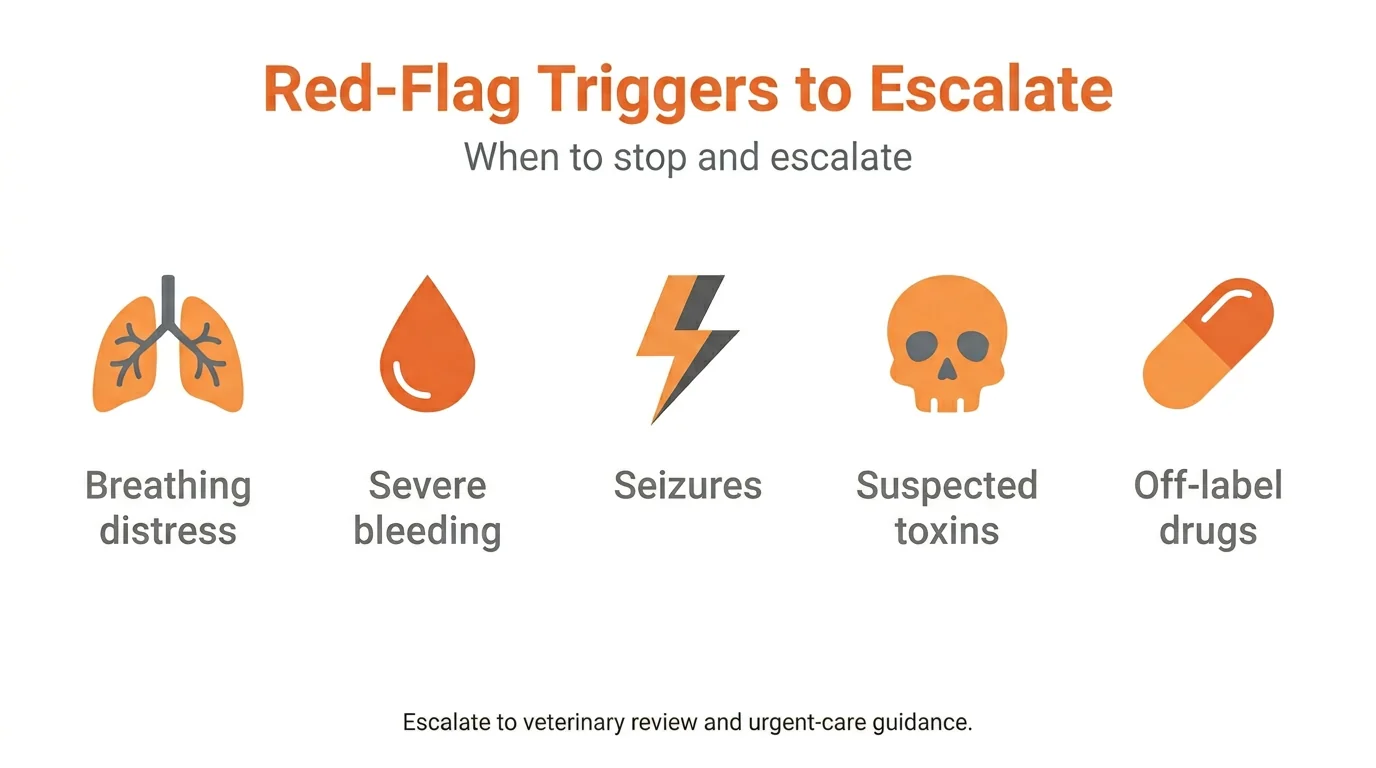
Direct readers to urgent care when there is breathing difficulty, severe bleeding, seizures, suspected poisoning, or rapid deterioration. Use prominent language indicating emergency action may be necessary if symptoms escalate or persist despite home care.
Placement: above-the-fold notes, per-section flags, and footers
Place a concise disclaimer above the fold for health topics. Repeat brief section-level flags near treatment or dosing mentions. Reinforce with a footer note that outlines limitations and provides emergency routing reminders.
Quick Decision Guide
If X then Y: seven common scenarios and safe next steps
- If content mentions symptoms, then require veterinary review and explicit non-diagnostic language.
- If dosing or medications appear, then remove specifics or cite consensus ranges and mandate vet sign-off.
- If an emergency sign is discussed, then add a visible urgent-care directive.
- If advice varies by breed or age, then qualify recommendations or split into targeted pages.
- If evidence is mixed, then present balanced views and avoid prescriptive recommendations.
- If images demonstrate techniques, then verify accuracy and add safety captions.
- If user comments add medical claims, then moderate, flag, or remove and escalate to clinical reviewers.
Practical Safety Boundaries
Topics and phrasings to avoid or soften
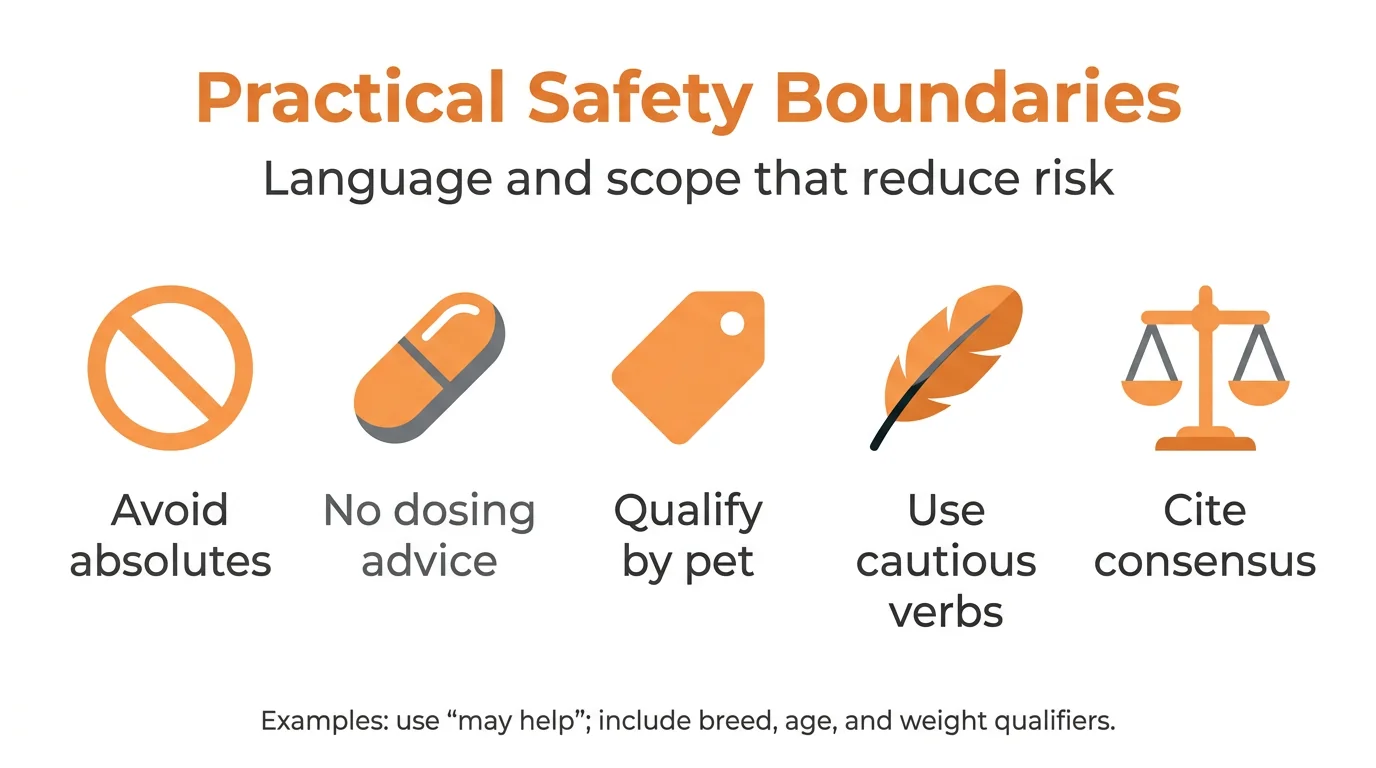
Avoid definitive cure language, guaranteed outcomes, or non-qualified “safe for all pets” statements. Prefer phrasing such as “may help,” “evidence suggests,” and “consult your veterinarian,” particularly around treatments, diets, or behavior interventions.
Dosage and medication policies
Do not provide individualized dosages. If context is essential, cite consensus references and include weight or age qualifiers with clear disclaimers. For prescription medications, instruct readers to seek veterinary evaluation before any use or changes.
User-generated content and comment moderation
Moderate for medical claims, off-label advice, and anecdotal dosing. Remove promotional medical claims without citations. Route potential adverse events or urgent symptoms to clinical escalation and remind users to contact a licensed veterinarian.
Evidence Status: Where claims can be stronger
Consensus areas (vaccination schedules, parasite prevention basics)
Consensus topics allow more confident framing when sourced to current guidelines. Still, avoid diagnostic language, and specify that schedules vary by age and location. Link to primary guidance and note update cadence for accuracy.
Mixed evidence (supplements, alternative therapies)
Present pros and cons with references, including study sizes and limitations. Indicate that effects may vary and that interactions or contraindications require veterinary input. Do not imply equivalence to established treatments without robust evidence.
Low-evidence or anecdotal areas (viral remedies, breed myths)
Treat viral tips and myths as unverified. If covered, frame as anecdotal, explicitly discourage substitution for professional care, and recommend evidence-based options. Avoid untested claims, especially those implying safety or efficacy.
Monitoring After Publish
7-14 day checks: factual QA, query intent alignment, and user flags
Audit for broken citations, misaligned headings, and mismatched intent. Confirm that search queries match non-diagnostic framing. Review user comments and support tickets for confusion or medical claims that require moderation or escalation.
4-8 week checks: E-E-A-T signals, medical query patterns, and red-flag terms
Reassess E-E-A-T signals, schema coverage, and author pages. Monitor search patterns for urgent intent spikes or red-flag terms. Visuals should be evaluated for clarity and usefulness, not only surface quality[4].
Rollback and correction protocol
When a material issue is identified, unpublish or revert to a safe prior version. Add a dated correction note. Re-review with veterinary and legal stakeholders before republishing to maintain transparent accountability.
Workflow Example: Vet-Reviewed AI Pipeline
Draft → auto-citation → vet review → legal review → publish → monitor
Generate a draft with structured headings. Attach line-level citations automatically. Obtain veterinary and legal reviews, then publish with disclaimers, schema, and monitoring tasks. Consider Petbase AI to maintain audit trails and consistent publishing cadence.
Documentation: change logs, source registry, and reviewer attestations
Maintain a source registry, chain-of-custody for edits, and reviewer attestations. Include a versioned change log noting claim adjustments and new citations. This documentation supports audits and accelerates future updates.
Appendix: Red-Flag Triggers to Escalate
Emergency symptoms, off-label drug use, and raw feeding pathogen risk
Escalate immediately when content involves breathing distress, uncontrolled bleeding, seizures, suspected toxins, off-label or compounded drugs, or raw feeding risks. Add emergency routing, remove speculative advice, and obtain prompt veterinary review before republishing.
Further Reading
Link back to automation governance overview for strategy context
For broader process design and team alignment, see our automation governance overview. It explains how topic planning, structured reviews, and publishing workflows connect to risk reduction across content operations.
Frequently Asked Questions
What makes AI pet health content trustworthy?
Trust grows when claims are sourced to veterinary guidance, reviewed by qualified professionals, and framed with appropriate disclaimers. Transparent authorship, dates, and correction logs may further support confidence.
Do I need a veterinarian to review every pet article?
High-risk topics such as symptoms, treatments, or dosing benefit from veterinary review. Lower-risk care content may pass senior editor checks if sources are strong and language remains non-diagnostic.
Where should a medical disclaimer appear on pet pages?
Place a brief disclaimer near the top for health topics, repeat near treatment sections, and include a footer note. Add clear emergency guidance when content may intersect with urgent care.
How often should I update AI pet health articles?
Recheck sources and language at least every 6-12 months, or sooner if guidelines change. Monitor search queries and user feedback for signals that an update may be needed.
Which sources are acceptable for fact-checking?
Peer-reviewed journals, veterinary textbooks, and recognized veterinary bodies are preferable. Brand blogs, unsourced forums, and AI outputs without citations should not be considered definitive.
References
- S Han (2024). Consumer perceptions of AI-generated content and disclaimer in terms of authenticity, deception, and content attribute. 2024 - econstor.eu. View article
- A Thammastitkul (2025). Assessing and optimising metadata quality for AI-generated images: A comparative analysis of generative AI and image recognition approaches. Journal of Information Science. View article
- X Liu et al. (2024). NTIRE 2024 quality assessment of AI-generated content challenge. Proceedings of the …. View article
- Y Tian et al. (2025). AI-generated image quality assessment in visual communication. Proceedings of the AAAI …. View article