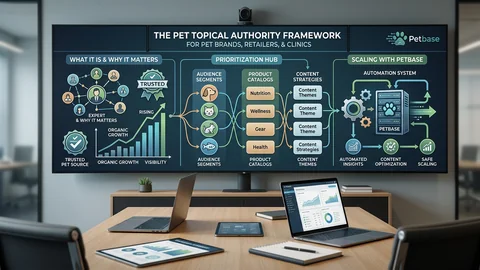
Topical Authority in the Pet Industry: The Strategic Playbook


Table of Contents +
- What topical authority means in the pet industry
- When to invest: timing, readiness, and segment nuance
- What to prioritize first: foundations before scale
- Prioritizing clusters: product-led, margin-aware choices
- Content velocity, cadence, and seasonality at a glance
- Measurement and proof: knowing when authority compounds
- Common mistakes and misconceptions to avoid
- Frequently Asked Questions
- Conclusion
- References
Understand topical authority for pet SEO: why it matters, when to invest, how to choose clusters, set velocity, structure links, and measure impact.
Search engines reward depth, structure, and clear expertise. In the pet industry, that advantage compounds when your content mirrors real product and service needs and scales through multilingual pet SEO across US, UK, and DACH with localized clusters, hreflang, and terminology that preserves intent. Topical authority turns fragmented posts into a measurable growth engine.
This matters because pet SEO competition intensifies across brands, retailers, and services. You will learn how to time your investment, choose clusters that drive revenue, and measure compounding authority without over-engineering.
What topical authority means in the pet industry
Why it matters for pet brands, retailers, and services
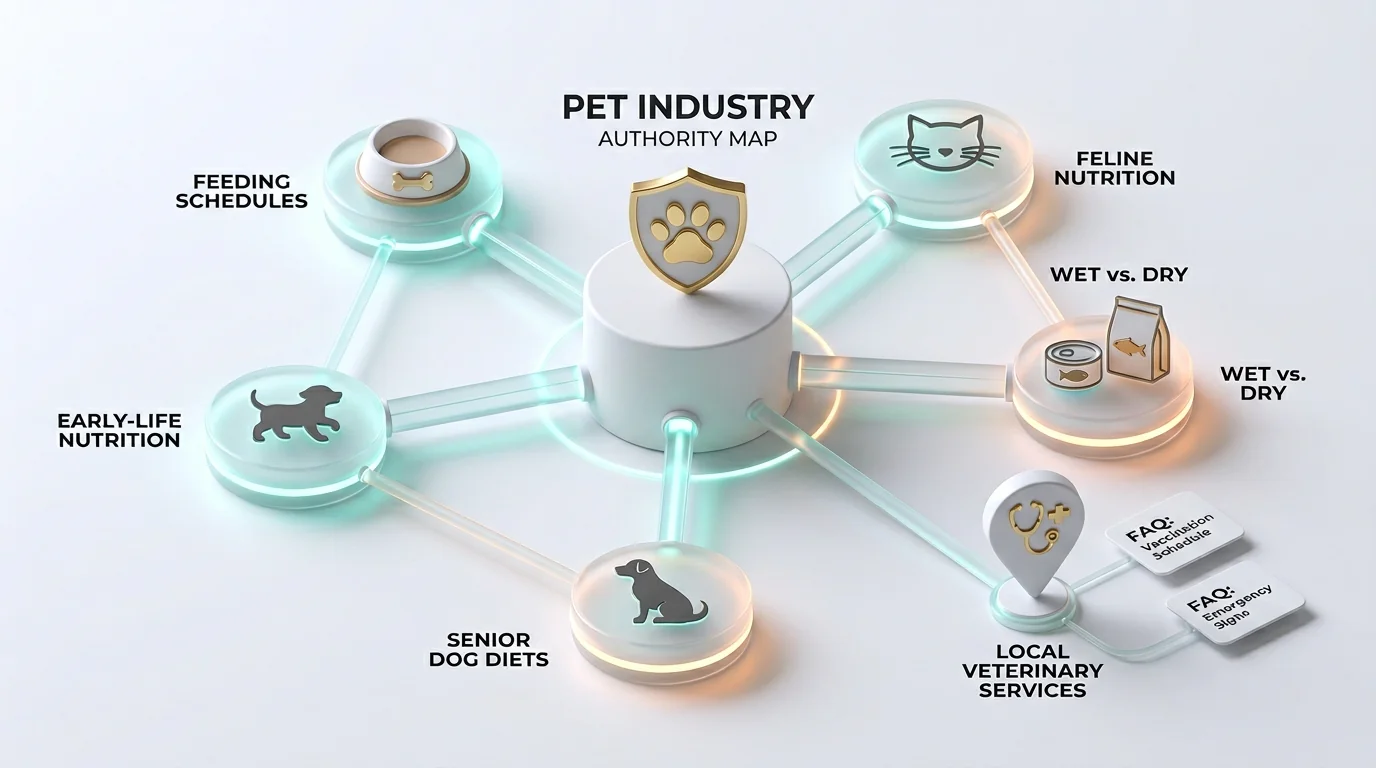
Topical authority signals that you understand a subject more completely than competitors. For pet brand SEO, it aligns education with product positioning. For pet retailer SEO, it organizes large catalogs into intent-driven pathways.
For veterinary SEO and local services, authority unites care pages, FAQs, and area relevance with educational clusters. The result is broader non-brand visibility, stronger internal linking, and steadier assisted conversions.
Signals that build authority without over-engineering
Search engines evaluate connected coverage, clean architecture, and consistent on-page semantics. Coherent topic clusters, clear intent mapping, and reliable internal links outperform sporadic, isolated articles.
Semantically consistent structures reduce ambiguity and improve machine interpretation, a principle well documented in semantics-driven systems engineering research[1]. Modern models also assist zero-shot topic labeling and annotation, accelerating scalable taxonomy and coverage alignment[2].
Petbase builds this SEO foundation automatically for pet businesses - 10 optimized articles published every month - start your free trial.
When to invest: timing, readiness, and segment nuance
Traffic plateaus, catalog size, and seasonality as triggers
Invest when organic growth plateaus despite frequent publishing. Large or fast-growing catalogs also benefit, since clusters tighten crawling and distribute authority. Seasonal swings further justify structured clusters that stockpile evergreen demand between peaks.
Teams with limited capacity can still win. Use a compact cluster plan, focus on intent depth, and expand only when internal links drive product or service engagement. Zero-shot semantic annotation can help prioritize subtopics efficiently[2].
Differences for DTC brands, retailers, and local services
DTC brands benefit from education aligned to product differentiators and post-purchase support content. Retailers should map clusters to category breadth, filters, and comparison needs. Local services should balance informational clusters with location, service, and reputation signals.
Use decision rules, not hunches. If a subtopic cannot link users to a relevant category, product, or booking page, down-rank it until the path to revenue is clear.
What to prioritize first: foundations before scale
Management: site architecture, product mapping, and intent
Begin with one commercially meaningful cluster. Define the user intents, the entry pillar, supporting articles, and the internal links that lead to category, product, or service pages.
Scope before you write. Build your first pet-industry topical map the right way so every subtopic has a clear purpose and a destination that supports conversion.
Forage/basic nutrition before supplements: core clusters > add-ons
Cover fundamentals before edge cases. Establish definitions, comparisons, sizing or fit guidance, safety basics, and care workflows. Add “advanced” pieces only after users can navigate confidently from first principles to products or services.
- Pick one high-revenue cluster and define clear user intents.
- Design internal links from pillars to category, product, or booking pages.
- Commit to a steady publishing cadence and protect article quality.
Prioritizing clusters: product-led, margin-aware choices
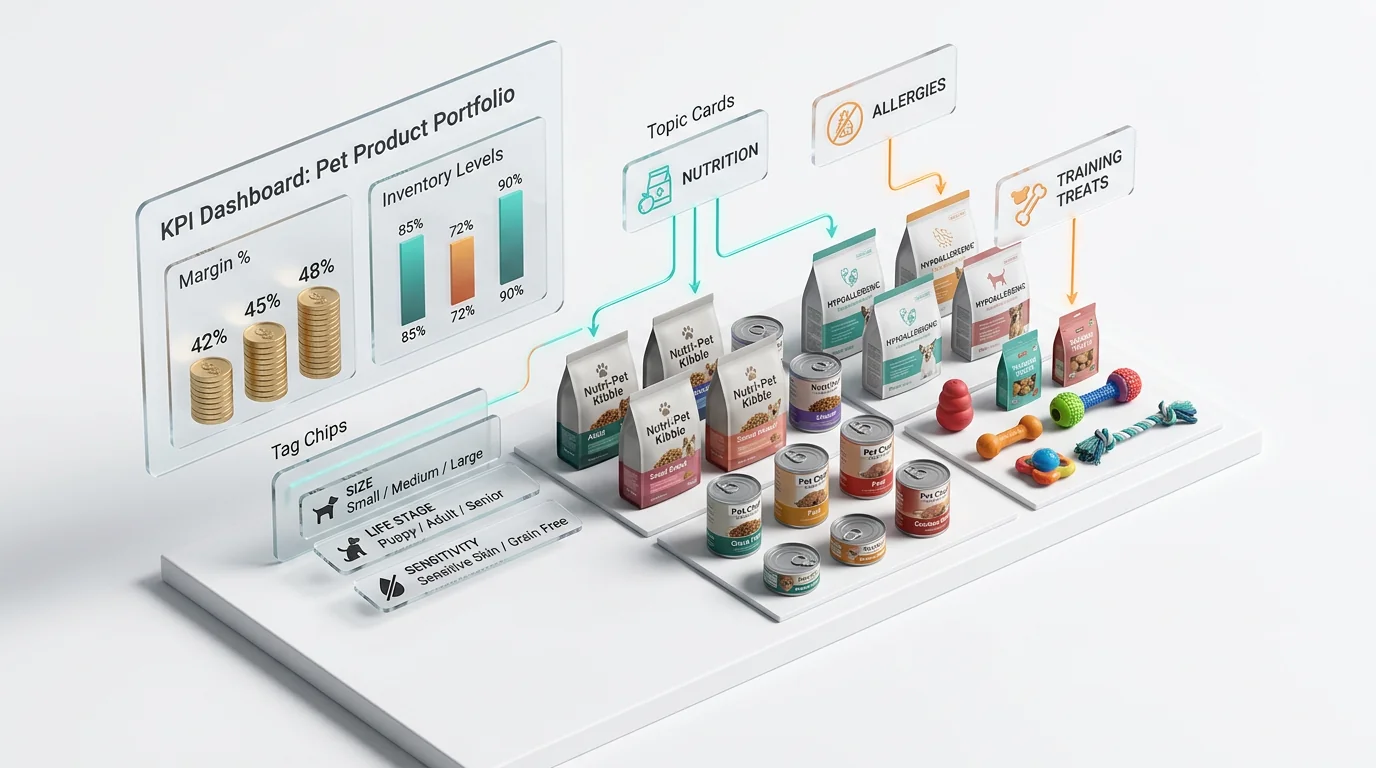
Align clusters to SKU mix, breeds, sizes, and life stages
Lead with margins and inventory depth. Build clusters that reflect your SKU mix, filters, and customer attributes across sizes, life stages, or sensitivities. This is product-led pet SEO that opens direct pathways to commerce.
Need decision help? Choose the best topical cluster for your pet niche and SKU mix to weigh upside, resources, and speed-to-impact pragmatically.
Balance difficulty, demand, and internal link paths to revenue
Keep selection grounded in three signals: rankability, demand shape, and monetization paths. Favor clusters where supporting posts can interlink tightly and route users to high-intent pages with minimal friction.
If a cluster is popular but cannot support relevant internal links, treat it as brand awareness, not a primary revenue driver. Reassess after foundations prove traction.
Content velocity, cadence, and seasonality at a glance
Consistency beats bursts for trust and crawl patterns
Authority compounds through predictable publishing, not sporadic spikes. Match cadence to your capacity, maintain editorial standards, and keep internal links fresh as assortments evolve.
To protect cadence with pet content automation, many teams use tools like Petbase AI to research topics and keep output consistent without sacrificing precision.
For planning depth and operational rhythm, Plan content velocity and cadence for faster topical authority and align publishing with crawl patterns and resourcing realities.
Seasonal ramps around launches, holidays, and pet cycles
Use seasonal windows to expand clusters strategically. Pre-build evergreen pieces, then schedule topical additions that align with launches, gifting periods, and cyclical care needs. Retire or update content that no longer reflects inventory.
Measurement and proof: knowing when authority compounds
Cluster-level KPIs, intent coverage, and quality signals
Track impressions, non-brand clicks, average rank breadth across subtopics, and assisted conversions from entry pages to revenue URLs. Monitor query coverage against your topical map to confirm depth and intent alignment.
Semantic matching techniques help quantify coverage completeness and reveal unanswered user intents at sentence level, improving editorial decisions[3]. Set up dashboards to review cluster health and internal link performance.
Implement resilience checks. Semantic anomaly detection can flag contradictions, outdated statements, or off-topic drift that erode trust and authority[4]. Correction speed is a leading indicator of quality.
For a practical framework and KPIs, Set up measurement to prove topical authority impact and institutionalize quarterly reviews by cluster.
What not to chase: vanity metrics and thin expansion
Avoid celebrating traffic spikes unconnected to products or services. Resist thin content that repeats definitions without adding decisions, comparisons, or sizing guidance. Volume without intent coverage stalls authority and wastes crawl budget.
Common mistakes and misconceptions to avoid
Over-broad topics, orphan content, and ignoring local intent
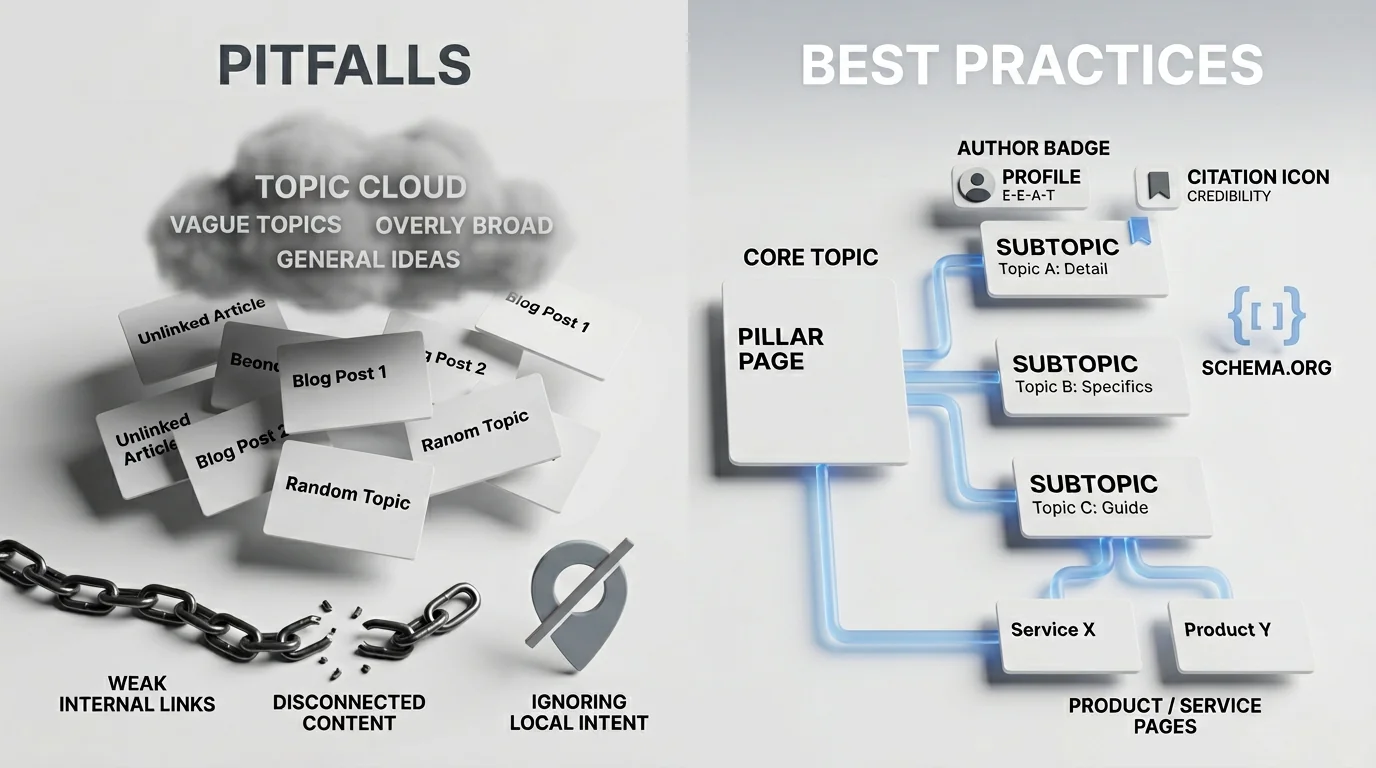
Broad topics attract unqualified traffic and dilute internal linking. Orphan posts confuse crawlers and users. For services, overlooking local intent undermines credibility and visibility in priority areas for veterinary SEO and adjacent providers.
Confusing volume with coverage; skipping credibility signals
Publishing more is not the same as covering search intent. Strengthen author credentials, cite reputable sources, and implement structured data. See E-E-A-T for pet and veterinary content: what to implement for credibility essentials that support trust and authority.
Continuously audit content for semantic contradictions and quality regressions. Automated anomaly checks reduce risk and protect topical integrity at scale[4].
Frequently Asked Questions
What is topical authority for pet SEO?
It’s the demonstrated depth and breadth of coverage on tightly related pet topics that search engines and users trust. In practice, it aligns clustered content with products/services and intent across the buyer journey.
How do pet retailers choose their first topic cluster?
Start with a product-led theme tied to inventory and margins, then map subtopics by breed, size, and life stage. Ensure internal links lead to relevant category and product pages.
How fast should I publish to build topical authority?
Favor steady, predictable cadence over sporadic bursts. Match your resources and ensure each piece advances coverage, interlinks well, and supports products or services.
How do I know if topical authority is working?
Watch cluster-level impressions, non-brand clicks, ranking breadth across subtopics, and assisted conversions from cluster entry pages to product or service URLs.
Does local SEO matter for topical authority in pet services?
Yes. For vets, groomers, and trainers, local signals and service pages combine with clustered educational content to establish authority within a service area.
Conclusion
Topical authority in the pet industry is a strategic commitment to intent coverage, product alignment, and consistent execution. Start with one commercial cluster, build clean internal pathways, and measure progress at the cluster level with discipline.
Keep the focus on depth, not noise. When coverage, architecture, and cadence move in sync, pet SEO becomes compounding growth rather than guesswork.
References
- R Buchmann et al. (2024). Large language models: Expectations for semantics-driven systems engineering. Data & Knowledge …. View article
- J Savelka et al. (2023). The unreasonable effectiveness of large language models in zero-shot semantic annotation of legal texts. Frontiers in Artificial Intelligence. View article
- X Ma et al. (2020). Improving question generation with sentence-level semantic matching and answer position inferring. Proceedings of the AAAI conference on artificial …. View article
- A Elhafsi et al. (2023). Semantic anomaly detection with large language models. Autonomous …. View article