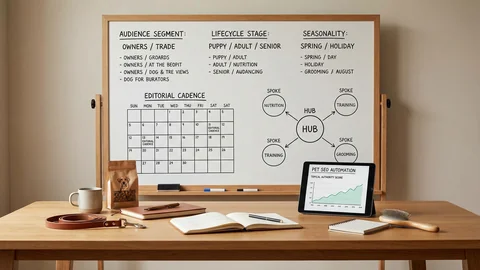
How to Build a Pet-Industry Topical Map: From Seed Topics to Search-Driven Clusters


Table of Contents +
- Introduction: From vague pet niche to search-driven map
- Scenario focus: One catalog, many breeds-avoid scattered content
- Step-by-step: Build the topical map for pet brands and services
- Quick decision guide: If X, then Y
- Monitoring: What to watch at 7-14 days and 4-8 weeks
- Practical safety boundaries for pet content
- Evidence status: What the data suggests vs. what is uncertain
- Worked example: “Indestructible dog toys” to a complete cluster
- Appendix: Reusable templates and scoring sheet
- Frequently Asked Questions
- Conclusion
- References
Learn a step-by-step method to turn pet niches into a topical map with search-driven clusters, intents, and structures tailored to pet brands and services.
Introduction: From vague pet niche to search-driven map
Why pet brands need a cluster-first approach
Vague niches waste budgets and dilute authority. Clustered content aligns research, creation, and conversion. It helps pet retailers and services win non-branded search reliably. This guide turns ambiguity into a precise, repeatable plan.
Linking to the topical authority hub for shared definitions
We use consistent terminology for clusters, hubs, and intents. This ensures your team plans, briefs, and measures the same way. You will learn how to map seeds, expand modifiers, score priorities, and track early signals.
Petbase builds this SEO foundation automatically for pet businesses - 10 optimized articles published every month - start your free trial.
Scenario focus: One catalog, many breeds-avoid scattered content
Decision to solve: centralize around problems, not products
When a catalog spans many breeds and SKUs, centralize around shared problems. Build clusters for chewing, anxiety, shedding, or mobility. Create breed-specific variants only when search demand and intent justify incremental pages and templates.

Step-by-step: Build the topical map for pet brands and services
1) Define seed topics by demand, margins, and seasonality
Start with pet keyword research tied to revenue. Use search volume ranges, margin tiers, and seasonal curves to choose 3-5 seeds. Avoid overreliance on generic topic models without validation and human review[3].
2) Expand with modifiers (breed, life stage, size, condition, use-case, locality)
Systematically combine modifiers: breed, age, size, health condition, use-case, and geo. Keyword-assisted expansion may improve coverage by steering themes with seed terms rather than pure automation[1]. Validate patterns that show consistent intent and transactional adjacency.
3) Cluster by intent (informational, commercial, local, comparative)
Group queries by dominant intent and SERP shape. Do not trust automated “coherence” scores alone; human judgment often diverges from such metrics[2]. For linking plans, see internal linking for pet commerce and services. For market variants, review multilingual pet SEO.
4) Prioritize with a scoring model (difficulty, volume, product fit)
Score each cluster: 0-10 difficulty, 0-10 volume, 0-10 product fit, plus 0-5 seasonality. Triage quick wins first. For repeatable scoring and content velocity, many teams use Petbase AI as a workflow helper.
5) Assign page types and templates (hub, guide, comparison, local)
Match intent to templates: hubs for problems, how-to guides for care tasks, comparison pages for alternatives, and local pages for city-level services. Maintain consistent elements: FAQs, pros/cons, specs, trust signals, and product integration.
6) Outline internal links and schema per cluster
Plan links from hubs to subpages, subpages to products, and lateral links between peers. Add Product, HowTo, and FAQ schema where relevant. For shared definitions on topical authority, reference our topical authority playbook for the pet industry.
Quick decision guide: If X, then Y
Breed-driven searches
If demand shows breed modifiers with distinct SERPs, create breed variants under a central problem hub. Use canonical elements and shared modules to prevent duplication while capturing specific vocabulary and fittings.
Local service intent
If “near me” or city names dominate, build a service hub and child city pages. Reuse a stable template with unique local proofs: photos, licenses, testimonials, pricing ranges, and service boundaries.
Product-adjacent how-tos
If how-to intent precedes purchase, attach guides as supporting pages. Include step lists, tool checklists, and gentle product mentions. Link guides to relevant SKUs and back to the central problem hub for context.
Comparisons and alternatives
If users compare brands or materials, publish structured comparison pages. Use scannable criteria: durability, fit, safety, and cleaning. Add specification tables and clear “best for” notes aligned to life stage or size.
Health-sensitive topics
If a topic touches conditions, show disclaimers and cite credible sources. Emphasize care tips over diagnoses. Keep advice general and nudge readers toward professional guidance when symptoms or risks are present.
Seasonal spikes
If demand peaks by season, prepare content six to eight weeks ahead. Add seasonal modules to hubs and time-bound checklists. Refresh titles and imagery to match upcoming weather or holiday behavior patterns.
Low-volume, high-intent
If volume is small but intent is clear and commercial, build precise pages. Target long-tail modifiers and add robust FAQs. Use internal links to surface these entries from hubs and related how-tos.
Monitoring: What to watch at 7-14 days and 4-8 weeks
Early signals (discovery, crawl, SERP impressions)
Within 7-14 days, check new URL discovery, crawl frequency, and index coverage. Look for first impressions across the cluster, even at low positions. Confirm intra-cluster links are crawled and passing context to priority SKUs.
Mid-term signals (ranking lift, cluster cohesion, assisted revenue)
At 4-8 weeks, measure rising average position for mid-tail queries, broader impression footprints, and denser internal paths to products. Track assisted conversions, comparing hub-led journeys against single-page sessions for signal strength.

Practical safety boundaries for pet content
Medical disclaimers and source hierarchy
Use a visible disclaimer on condition content. Prioritize peer-reviewed or veterinary association sources. Structure advice as general care, and encourage professional evaluation when symptoms, pain, or medication conflicts may exist.
Breed stereotyping and welfare language
Avoid stereotypes. Write neutrally about behaviors and needs. Emphasize enrichment, training, and environment rather than inherent traits. Use respectful welfare language to frame recommendations and product suitability.
User safety with training, grooming, and supplements
Flag risks for tools and supplements. Include age, size, and contraindications. Provide stop-use guidance, supervision advice, and safe usage ranges. Link to manufacturer instructions and certifications where applicable.
Evidence status: What the data suggests vs. what is uncertain
Signals that may support cluster performance
Evidence suggests semi-supervised, keyword-assisted topic modeling helps shape domain-relevant themes when paired with human oversight[1]. Automatic labeling frameworks may speed consistent taxonomy creation in specialized domains, improving mapping throughput with careful validation[4].
Areas with mixed or context-dependent results
Automated topic-model coherence metrics do not always match human judgment of topical quality[2]. LDA-style approaches require tuning and domain adaptation; unvalidated outputs risk incoherent clusters and off-intent pages in applied content pipelines[3].
Worked example: “Indestructible dog toys” to a complete cluster
Seeds, modifiers, intents, and final map
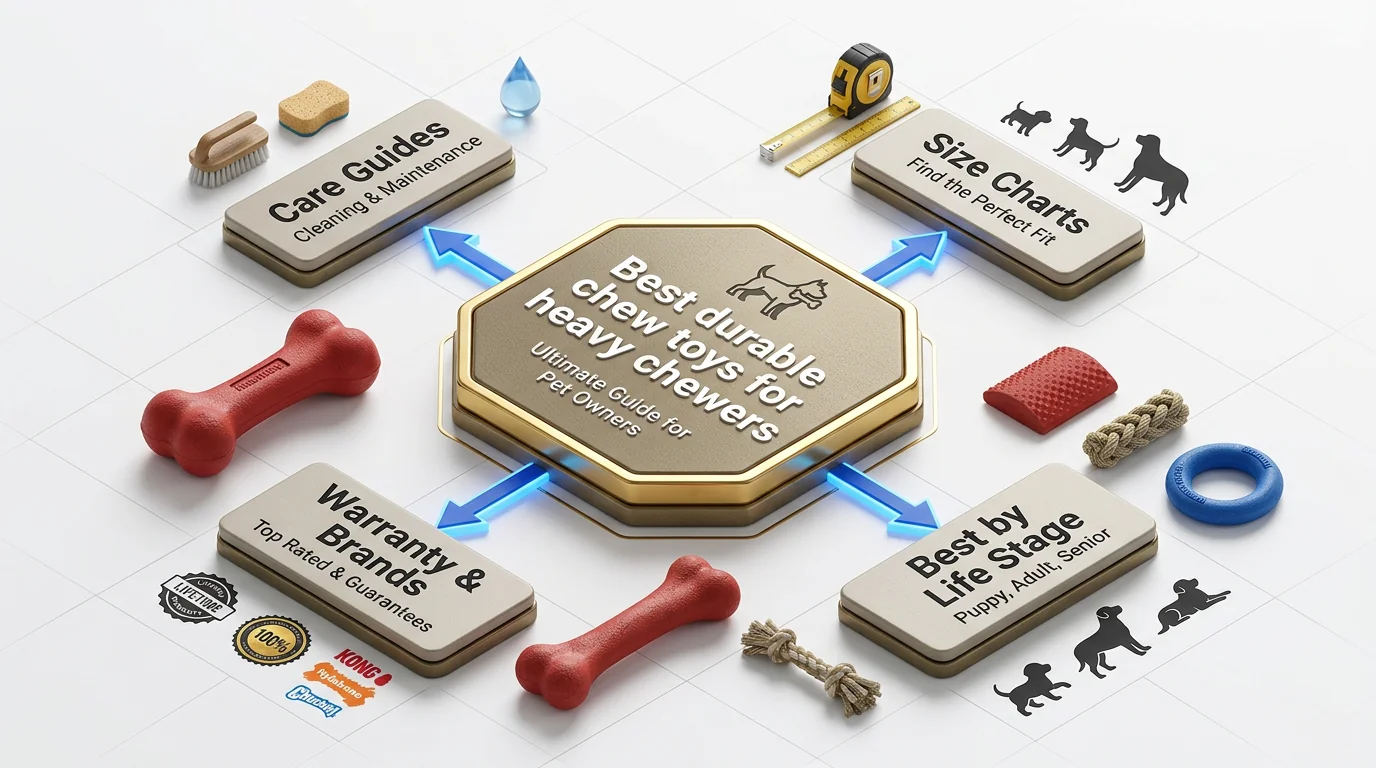
Seed topic: “indestructible dog toys.” Modifiers: heavy chewers, materials, sizes, life stage, indoor/outdoor, fetch, power chewers, warranty, and brand alternatives. Intents: informational durability guides, commercial collections, comparative materials, and local warranty/repair support.
Internal link blueprint and schema stack
Hub: “Best durable chew toys for heavy chewers.” Subpages: care guides, size charts, materials comparisons, and “best for” by life stage. Deep-link to product categories using anchors like “heavy-chewer dog toys.” Implement Product, FAQ, and HowTo schema.
Appendix: Reusable templates and scoring sheet
Cluster brief template
Include: target problem, audience segments, modifiers, SERP notes, competing assets, page types, internal link map, schema, E-E-A-T elements, on-page modules, success metrics, and update cadence. Keep it to one shareable page.
Priority score formula and thresholds
Score = 0.3×Volume + 0.3×Product Fit + 0.2×Difficulty Inverse + 0.2×Seasonality. Prioritize scores ≥7.5 for sprint one. Target 8-15 URLs per cluster, then expand based on monitored performance and inventory depth.
Frequently Asked Questions
What is a topical map for the pet industry?
A topical map is a structured set of related topics, subtopics, and intents that covers a pet niche comprehensively. It organizes hubs, supporting posts, and internal links to signal topical authority.
How many articles should each pet topic cluster include?
Evidence suggests 8-15 tightly related pages may support stronger coverage, but the ideal size depends on search demand, overlap, and product fit. Start small, then expand based on performance.
How do I handle breed-specific content without spreading thin?
Group by shared problems first (e.g., heavy chewers), then create breed-specific variants only where search demand and user intent justify them. Use canonical structures and avoid duplicate phrasing.
Should local pet services build separate clusters per city?
If intent and volume exist, city pages may help. Evidence suggests using a service hub with location pages that reuse a stable template and unique local proofs can support discoverability.
What metrics indicate my clusters are working?
Watch for rising impressions across the cluster, growth of non-branded clicks, denser internal link paths to product pages, and improved assisted conversions over 4-8 weeks.
Conclusion
Turning a vague niche into a precise pet industry topical map requires disciplined inputs, intent-driven clustering, and careful monitoring. Start with profitable seeds. Expand with structured modifiers. Prioritize by product fit and difficulty. Implement consistent templates, links, and schema. Evidence suggests semi-supervised methods and human validation together produce higher-quality clusters than automation alone. Build, observe early signals, and refine. For local services and multilingual markets, adapt patterns while preserving the central problem hub. Your topical authority pet industry strategy will mature as clusters compound.
References
- S Eshima et al. (2024). Keyword‐assisted topic models. American Journal of Political …. View article
- A Hoyle et al. (2021). Is automated topic model evaluation broken? the incoherence of coherence. Advances in neural …. View article
- L Hagen (2018). Content analysis of e-petitions with topic modeling: How to train and evaluate LDA models?. Information processing & management. View article
- M Park et al. (2025). Developing automatic-labeled topic modeling based on SAO structure for technology analysis. PLoS One. View article