Which Pet Topical Cluster Should You Do First? Prioritization for Brands, Retailers, and Vets


Table of Contents +
- The single decision: pick the first cluster by margin × demand × seasonality
- Quick decision guide
- How to score your first cluster (workbench)
- Monitoring: what to check after 7-14 days and 4-8 weeks
- Practical safety boundaries
- Evidence status and assumptions
- Next step: connect prioritization to your topical map
- Frequently Asked Questions
- References
Choose your first pet topical cluster using margin, seasonality, and demand. A practical, data-led framework for brands, retailers, and vets.
Choosing your first pet content cluster can make or stall growth. The right start compounds traffic and revenue within weeks. The wrong start delays momentum.
This decision matters because resources are limited. You need measurable outcomes quickly. In this guide, you will learn a simple, data-led way to prioritize your first pet topical cluster using margin, demand, and seasonality.
The single decision: pick the first cluster by margin × demand × seasonality
Define your SKU/service universe and gross margin bands
List every product category and service you sell, then group into 4-8 candidate clusters. Use contribution margin after discounts, shipping, and labor. Establish margin bands: low (under 25%), mid (25-45%), and high (45-70%+). For services, calculate margin after clinician time, consumables, and overhead.
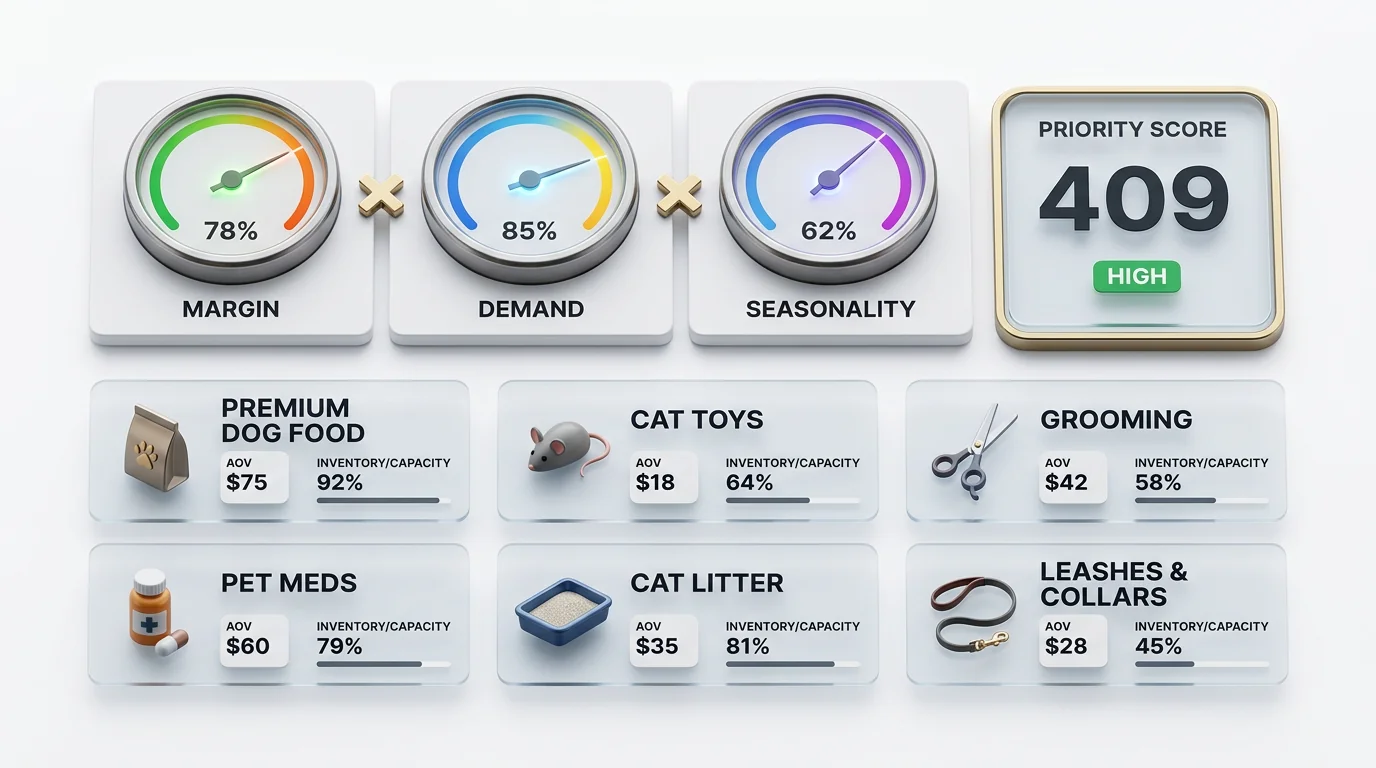
Flag AOV per cluster and attach current inventory or appointment capacity. Your pet topical cluster prioritization should only elevate clusters you can fulfill reliably this month, not hypothetically later.
Estimate search demand and intent fit per cluster
Perform pet keyword research to approximate cluster-level demand. Sum monthly search volumes for high-intent commercial and transactional terms and their closely linked informational terms. Confirm intent fit by reviewing SERP features, ads density, and commercial pages that currently rank. Standard SEO planning emphasizes aligning content with user intent to improve discoverability and conversions[2].
Layer seasonality windows and lead time
Overlay seasonal curves. Flea and tick protection typically rises in warmer months. Grooming often spikes before holidays. Dental care may benefit from awareness months. Consider your lead time for content creation, indexing, and product replenishment or appointment scheduling.
Prioritize clusters with a near-term seasonal tailwind. Ensure your operational lead time can meet potential demand surges without stockouts or overbooked calendars.
Score clusters with a simple weighted formula
Create a score from 0-10 for each dimension, then apply weights. A practical baseline is margin 0.4, demand 0.4, and seasonality 0.2. Multiply and sum for a total score. Adjust weights by business model.
Quantifying decision factors into a single score may support disciplined, repeatable choices and clearer KPIs for pet industry SEO initiatives[4]. Revisit inputs weekly as inventory, bookings, or SERP conditions change.
Petbase automates SEO content for veterinary clinics - so you can focus on patients, not blog posts - start your free trial.
Quick decision guide
If X, then Y scenarios for brands, retailers, and vets (5-7 cases)
- If flea and tick season begins within six weeks and stock is strong, prioritize a flea/tick cluster. Increase content velocity to establish coverage ahead of demand spikes. See guidance on sustainable output in content velocity for pet SEO.
- If your clinic has open preventive care slots and strong local intent is visible, launch a preventive care cluster. Target map-pack queries and appointment CTAs. Apply structures outlined in local topical authority for pet services.
- If your highest-margin dental chews are well stocked and SERPs show mixed intent, start a dental health cluster. Blend educational pieces with product pages. Consider scalable catalog approaches in programmatic SEO for pet catalogs.
- If margins are thin on food but demand is massive, begin with a mid-margin accessories cluster. Bundle offers to lift AOV. Use competitive, long-tail terms to reduce risk while building topical depth.
- If you are capacity constrained in grooming, publish at-home care and maintenance topics first. Capture evergreen queries without overbooking. Pivot toward service pages when capacity improves.
- If multiple viable clusters exist and your topical map is unclear, choose the cluster with the strongest intent clarity and lower SERP difficulty. Build a starter map using how to build a pet-industry topical map.
How to score your first cluster (workbench)
Inputs: margin, AOV, inventory/capacity, demand, SERP difficulty
Gather these metrics per candidate cluster:
- Gross margin band and contribution per order. Pair with AOV to estimate revenue per visit potential.
- Inventory depth or service capacity forecast for the next 8-12 weeks. Add buffer thresholds to avoid overselling.
- Search demand: monthly volume sums for priority terms, intent mix, and seasonality index.
- SERP difficulty: domain authority gap, top competitor content quality, and feature density (ads, shopping, map packs).
For data collection and consistent publishing, many teams use automation. For best results, consider using Petbase AI which is designed for this purpose. AI-assisted workflows may streamline keyword discovery and on-page optimization for pet content clusters[3].
When assembling your cluster, add contextual links to your existing category or product pages, such as flea/tick collections, dental chews, or grooming services. This supports conversion paths and reinforces relevance signals.
Weights and tie-breakers
Set weights by business goals. Many retailers start with 0.4 margin, 0.4 demand, 0.2 seasonality. Services may favor capacity more heavily, shifting to 0.3 margin, 0.4 demand, 0.3 seasonality. Rebalance as inputs evolve.
Tie-breakers help finalize choices. Use inventory or appointment readiness, internal expertise, and SERP attainability. If two clusters tie, pick the one with stronger fulfillment confidence and clearer ranking opportunities within eight weeks.
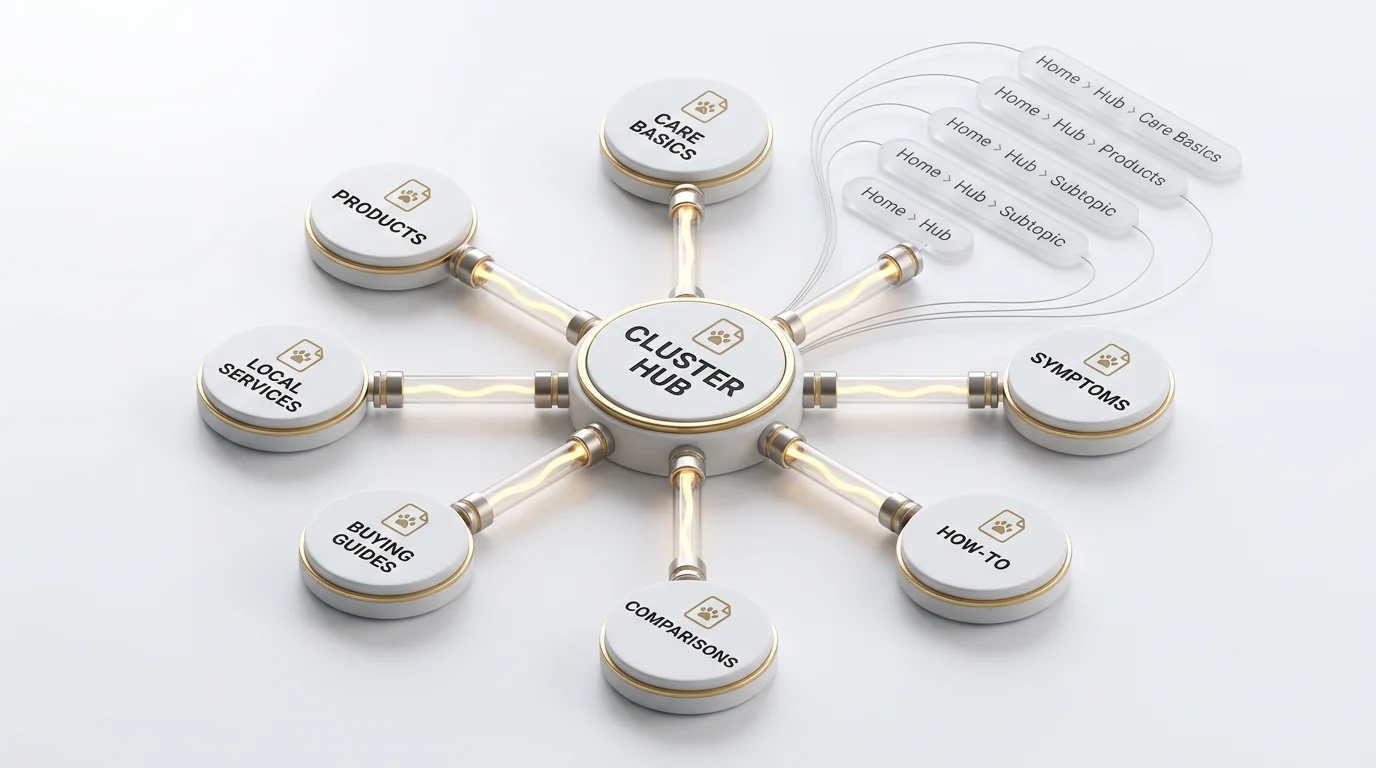
Plan internal link architecture before launch. Link supporting articles to the hub and to relevant SKUs or service pages. Use consistent anchor conventions and breadcrumb patterns for crawl clarity.
Example scoring for food, flea/tick, grooming, dental
| Cluster | Margin (0-10) | Demand (0-10) | Seasonality (0-10) | Weighted Total |
|---|---|---|---|---|
| Flea/Tick | 6 | 8 | 9 | 7.6 |
| Dental | 8 | 6 | 6 | 6.8 |
| Grooming | 5 | 5 | 5 | 5.0 |
| Food | 3 | 9 | 4 | 5.8 |
These are illustrative. Calibrate scores with your margin structure and regional demand patterns. Rerun scoring monthly to reflect inventory cycles and changing SERPs.
Monitoring: what to check after 7-14 days and 4-8 weeks
Early indicators (indexing, impressions, assisted clicks)
In the first 7-14 days, look for rapid indexing of hub and supporting posts. Monitor impression growth on target query stems in Search Console. Track assisted clicks from new articles to product or service pages as directional evidence.
If indexing lags, verify sitemaps, internal links to new pieces, and fetch/crawl requests. Modest growth in impressions may signal healthy discovery, even before rankings move materially.
Mid-term indicators (rank movement, add-to-cart, inquiries)
Within 4-8 weeks, evaluate rank movement for primary and secondary terms. Watch growth in top-30 and top-10 keywords at the cluster level, not only at the page level. Assess add-to-cart, form submissions, or appointment requests as intent proxies.
Structured KPIs help quantify visibility and conversion progress over time, supporting iterative optimization decisions[4]. Segment by content type to identify strong performers for expansion.
Decision gates to expand or pivot
Use predefined thresholds. Expand the cluster if 60%+ of pages are indexed, at least 10 keywords reach top-30, and commercial pages show improving engagement. Increase content depth and add new subtopics.
Pivot if indexing stalls, zero terms move into top-50, or SERPs reveal entrenched brands blocking progress. Shift to the next scored cluster with immediate seasonal opportunity and better SERP feasibility.

Practical safety boundaries
Clinical accuracy and legal compliance for medical topics
For veterinary or medical-adjacent topics, involve credentialed professionals in review. Add clear disclaimers and cite authoritative sources. Avoid prescriptive treatment claims without clinician oversight. Align schema and on-page signals with expertise and trust standards.
Regulatory frameworks and advertising rules vary by region. Ensure claims, dosage guidance, and contraindication statements are correct and appropriately limited.
Inventory and capacity safeguards
Create inventory and appointment guardrails before launch. Pause or throttle content linking if stockouts or overbookings emerge. Offer alternatives or waitlist mechanisms to preserve user trust.
Use conservative demand forecasts during peak seasons. Build safety stock buffers for high-velocity SKUs mentioned prominently in content.
Brand voice and claims control
Establish a style guide that defines benefit language, restricted phrases, and citation requirements. Implement editorial checklists, especially for medical and regulatory claims. Keep tone authoritative and supportive, not alarmist or absolute.
Maintain consistent product naming, feature bullets, and comparison logic across the cluster to avoid user confusion.
Evidence status and assumptions
What the data supports
SEO literature generally supports aligning content to user intent, building structured internal link networks, and measuring visibility via defined KPIs. These practices may improve discoverability and conversion efficiency for clusters[2][4].
Where uncertainty remains
Seasonal curves vary by region and weather. SERP volatility can disrupt early rankings. Some clusters may require more supporting assets than expected to establish relevance or pass competitors’ authority thresholds.
Margin improvements depend on user behavior, pricing, and competition. Results vary by site authority and execution quality.
How to reduce risk with incremental tests
Start with a modest pilot cluster and measure leading indicators. Use A/B content modules, alternative CTAs, and different internal link anchors. Iterate weekly based on indexing, rankings, and engagement.
Keep a pre-scored backup cluster ready. If thresholds are missed, pivot quickly without losing publishing momentum.
Next step: connect prioritization to your topical map
Map chosen cluster to content types and product pages
Translate the winning cluster into a hub-and-spoke plan. Build one hub that addresses core questions and links to 6-10 supporting posts. Connect those posts to closely related product or service pages.
Implement breadcrumb-style links from every subtopic back to the hub. Structured internal linking may strengthen relevance and discovery, especially when relationships between pages are made explicit and consistent[1].
Link to the pet topical authority strategy guide
Finally, align your prioritized cluster with a broader authority roadmap. Expand horizontally into adjacent subtopics and vertically into deeper how-to and comparison content. For a comprehensive framework, see our pet topical authority strategy guide.
Select the highest-ROI cluster you can fulfill, publish decisively, and measure quickly. Evidence suggests that disciplined prioritization, consistent internal linking, and cautious claims control create durable momentum. Repeat the scoring process quarterly to compound gains across categories and services.
Frequently Asked Questions
Should I always start with my highest-margin products?
Not always. Evidence suggests a balance of margin, search demand, and seasonality tends to perform better. If a high-margin line has low demand now, start with a mid-margin cluster with stronger seasonal lift.
How many articles should a first cluster include?
A practical pilot may include 8-15 pieces: 1 hub, 6-10 supporting posts, and 2-4 product or service pages optimized. This size is large enough to signal relevance but small enough to ship fast.
What if multiple clusters tie in the scoring?
Use tie-breakers: inventory/capacity readiness, internal expertise, and SERP difficulty. Choose the cluster you can fulfill reliably and where the SERP looks attainable with helpful content.
How long until results may appear?
Early signals may show within 1-2 weeks (indexing and impressions). More material ranking movement and conversion impact often requires 4-8 weeks, depending on site authority and competition.
Can local services prioritize differently from eCommerce?
Yes. Services may weight capacity and local intent higher. For example, vets could prioritize seasonal preventive care terms if appointment slots are available and SERPs display map packs.
References
- T Suresh (2025). Natural language processing for internal link optimisation: Automating content relationships for better search engine optimisation. Journal of Digital & Social Media Marketing.
- S Das (2021). Search engine optimization and marketing: A recipe for success in digital marketing. 2021 - api.taylorfrancis.com. View article
- C Malaikani et al. (2026). AI AND DIGITAL MARKETING FROM AUTOMATION TO PERSONALIZATION. researchgate.net. View article
- D Mladenović et al. (2023). Search engine optimization (SEO) for digital marketers: exploring determinants of online search visibility for blood bank service. Online information …. View article
Related Reading
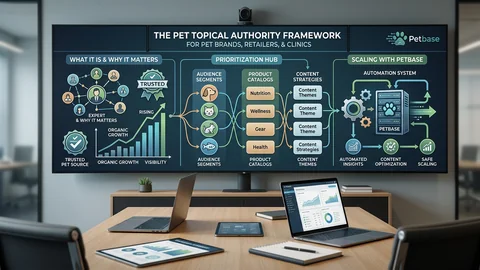
Pet Topical Authority: The Complete Framework for Pet Brands, Retailers, and Clinics

Pet Blog Automation: The Complete Orientation Hub for Pet Brands, Retailers, and Services

Pet Page SEO Optimization: The Complete Orientation Guide for Pet Brands, Retailers, and Services