Measure Topical Authority: KPIs and Dashboards for Pet Brands and Services


Table of Contents +
- Scenario: You published a pet topic cluster-now measure what matters
- Core KPIs that signal topical authority growth
- Quick decision guide: If X, then Y
- Dashboards: a simple, reliable reporting stack
- Monitoring guidance: what to check and when
- Practical safety boundaries for measurement and optimization
- Evidence status: what the data and consensus suggest
- How to implement in one week
- Frequently Asked Questions
- Conclusion
- References
Learn KPIs, tracking methods, and simple dashboards to measure topical authority for pet brands and services. Evidence-aware, practical, and actionable.
Your pet topic cluster is live. The real work begins now. Solid measurement separates growth from guesswork. Topical authority compounds only when you track the right signals with discipline.
This guide focuses on the operational layer. You will learn what to track, how to interpret early movement, and how to build a lean reporting stack. Expect practical thresholds, decision triggers, and safety boundaries designed for pet brands and services.
Scenario: You published a pet topic cluster-now measure what matters
You launched a cohesive set of pages around a pet theme. Now you must verify coverage, rankings, and commercial influence. The goal is trustworthy evidence that your cluster builds topical authority, not noise.
Set a clear scope, capture baselines before launch, and align attribution windows with real buying cycles. These steps keep your metrics credible and your decisions timely.
Define the cluster scope (breeds, life stage, service type)
Map a finite topic area, such as breed care, life stage needs, or a single service. Limit to 30-80 URLs initially to ensure measurable momentum.
Set baseline metrics before new content goes live
Record index status, rankings, impressions, CTR, conversions, internal link counts, and crawl depth. Freeze these as baselines to compare post-launch movement confidently.
Pick attribution windows suited to pet buying cycles
Use 7-14 days for services with short cycles. Extend to 30-60 days for retail or subscription decisions. Separate branded and non-branded influence thoughtfully.

Petbase builds this SEO foundation automatically for pet businesses - 10 optimized articles published every month - start your free trial.
Core KPIs that signal topical authority growth
Authority signals strengthen when multiple KPIs move together. Research on topical influence indicates that combining diverse metrics often outperforms single-signal approaches for ranking and influence estimation[1]. For strategy context, see our pet topical authority KPI framework.
Coverage: percent of subtopics answered in the cluster
Calculate answered versus planned subtopics. Aim for 70-90% within eight weeks. Include FAQs, how-tos, comparisons, and safety content to show completeness.
Cluster rankings: share of keywords in top 3/10/20
Track the ladder by query intent. Set target lifts of 10-20 points in top 10 share over 4-8 weeks, depending on competition and crawl frequency.
Search visibility: weighted impressions and CTR by cluster
Aggregate impressions weighted by position bands. Compare CTR to intent norms. Seek rising impressions paired with stable or improving CTR, not declining click share.
Assisted revenue/leads from cluster touchpoints
Measure assisted revenue attribution by content folder or tag. Compare first-click, time-decay, and data-driven models to avoid over-crediting last click.
Internal link path depth and pass-through rate
Audit clicks-to-target from your homepage and hubs. Shorter paths and relevant anchors may support discoverability and authority propagation[4]. See practical tactics in internal linking for pet commerce and services.
Engagement signals: scroll, time on page, return rate
Review scroll depth and median read time by template. Watch return visit rate by cluster. Sustained engagement suggests relevance reinforcement and experience quality.
Quick decision guide: If X, then Y
Use these triggers to move fast without guesswork. Each condition pairs with a proven, low-risk action that nudges topical authority and revenue alignment.
If coverage <70% after 4 weeks, expand FAQs and long-tail pages
Prioritize question-led and safety-adjacent topics. Fill intent gaps by breed, size, and life stage to improve content cluster performance.
If rankings plateau in positions 5-12, strengthen internal links from authority pages
Route links from high-traffic hubs and evergreen guides. Use descriptive anchors and limit depth to two or three clicks where possible.
If impressions rise but CTR lags, refine titles/meta and add breed/life-stage modifiers
Test intent-specific keywords, price or service clarity, and benefit-led language. Monitor CTR movement weekly using search query buckets.
If traffic grows without revenue, add product/service CTAs and schema; tighten intent match
Place contextual CTAs and validate Service or Product schema. Align pages with transactional modifiers and clear next steps.
If a few pages capture most clicks, redistribute links to underperforming nodes
Build section hubs that link horizontally. Add related-article blocks and breadcrumb improvements to spread pass-through effectively.
If competitors outrank on care or safety queries, add expert review and citations
Include credentialed reviewers and source citations. Elevate trust with visible expertise summaries and update timestamps.
If GSC shows cannibalization, consolidate overlapping pages
Merge near-duplicate intents. Choose the stronger URL, 301 redirect others, and integrate subtopic sections with clear headers.
Dashboards: a simple, reliable reporting stack
Keep your stack lightweight and auditable. Build KPI views once, then update rhythmically. Your dashboards should reduce ambiguity, not increase it. Aim for accuracy over novelty in every chart.
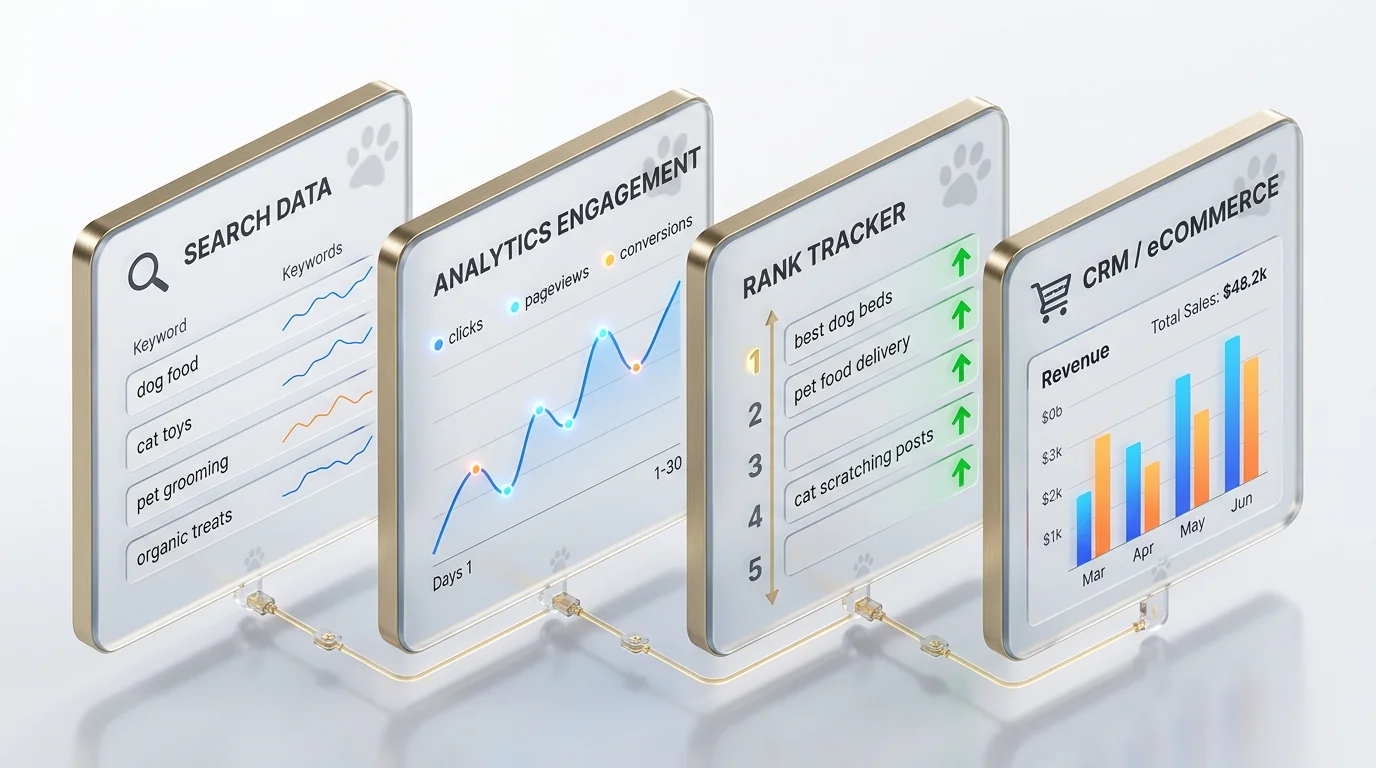
Data sources: GSC, GA4, rank tracker, ecommerce/CRM, site crawler
Use GSC for queries and coverage, GA4 for engagement and assisted conversions, rank trackers for position ladders, ecommerce or CRM for revenue, and crawlers for internal link analysis.
Essential views: coverage, rankings ladder, internal link flow, assisted revenue
Display coverage percentage, top 3/10/20 keyword distribution, node-level inlinks and path depth, and assisted revenue by cluster. Tools like Petbase AI can streamline automated collection for SEO dashboards for pet brands.
Suggested cadence and owners for updates
Update weekly for rankings and impressions, biweekly for internal links, and monthly for assisted revenue. Assign one owner per view to preserve definitions and audit trails.
Monitoring guidance: what to check and when
Time-based checks reduce overreaction to volatility. Establish checkpoints that match crawl cadence and buying windows. Compare clusters separately to prevent cross-contamination of signals and decisions.
After 7-14 days: indexation, early impressions, link integrity
Confirm submitted URLs indexed. Inspect impression emergence and query types. Re-crawl internal links for orphan risks and anchor mismatches across the cluster map.
After 4-8 weeks: ranking shifts, coverage lift, assisted conversions
Review top 10 share movement and incremental coverage. Attribute assisted conversions by cluster folder. Compare year-over-year to control for seasonality and campaigns.
Quarterly: content refresh needs, schema integrity, competitive gaps
Refresh aging winners, validate structured data, and benchmark competitors’ share of care, safety, and local intent. For locality nuances, see local topical authority for pet services.
Practical safety boundaries for measurement and optimization
Boundaries protect your brand and data quality. They prevent false confidence and mitigate risks unique to pet health, safety, and local service contexts.
Avoid over-attribution: use multi-touch and compare models
Compare first-click, time-decay, and data-driven results. Stabilize decisions with rolling four-week windows. Document material differences in assisted revenue attribution.
Respect medical and safety claims for veterinary content
Require expert review, accurate sourcing, and disclaimers. Avoid prescriptive language. Keep revision logs for clinical statements and dosage or procedure references.
Cap link additions per sprint to prevent profile spikes
Limit new internal links to 10-20% growth per sprint. Validate anchors for relevance. Re-crawl after changes to confirm path-depth improvements.
Document edits; keep a rollback plan
Track titles, H1s, schema, and redirects. Snapshot dashboards before major changes. Maintain reversible steps for critical templates and hub pages.
Evidence status: what the data and consensus suggest
Topical authority remains multifactorial. The following statements reflect directional evidence and operational consensus rather than absolute rules.
Internal links and comprehensive coverage may support rankings
Network-based methods, including PageRank-style modeling, suggest link structure and coverage density can influence perceived authority and discoverability[4].
Expert review and citations may improve trust signals
Crisis communication research highlights the role of authoritative sources and consistent metrics in enhancing credibility and response effectiveness[2].
Structured data may enhance eligibility for rich results
Consistent, valid schema for services and products often aligns with improved presentation in results. This may increase visibility and CTR when coupled with strong relevance.
Attribution models vary; triangulation reduces bias
Evidence suggests that combining behavioral and structural indicators provides more reliable topical influence assessment than single metrics alone[3]. Cross-model attribution comparisons can dampen bias[2].
How to implement in one week
Move quickly with a bounded scope. Build just enough instrumentation to guide the next optimization sprint. Favor clarity over comprehensiveness during the first pass.
Tag URLs into clusters and capture baselines
Tag each URL with a cluster label in GSC and GA4. Export current rankings, impressions, CTR, inlinks, depth, and conversions to form reliable pre-launch baselines.
Build the four core dashboard tabs
Create tabs for coverage, rankings ladder, internal link flow, and assisted revenue. Standardize filters by cluster. Include KPI thresholds and week-over-week diffs for quick interpretation.
Run an internal link and title/meta optimization pass
Consolidate cannibalized URLs, add descriptive anchors from hubs, and shorten paths. Tighten titles and meta to reflect intent and modifiers. For production pacing, see content velocity recommendations.

Frequently Asked Questions
What is a good benchmark for topical coverage in a pet content cluster?
Evidence suggests aiming for 70-90% of priority subtopics within a cluster. Start with high-intent and safety-critical pages, then fill remaining long tails over 4-8 weeks. Reassess scope as queries diversify.
How long before topical authority metrics show movement?
Early signals may appear in 2-4 weeks via impressions and indexation. More stable ranking and revenue patterns often need 6-12 weeks, depending on competition and crawl cadence. Expect staggered movement by intent.
Which KPI best indicates commercial impact for pet services?
Assisted conversions or assisted revenue by cluster can provide directional insight. Compare first-click and data-driven models to reduce over-attribution to last click. Review lead quality and close rates.
How do I measure internal link effectiveness?
Track link path depth, inlink count from authority pages, and changes in target URL rankings. Evidence suggests shorter paths and relevant anchors may support visibility. Monitor crawl frequency and indexation.
Do I need separate dashboards for veterinary vs. retail topics?
One framework can serve both, but tailor intent groupings, schema checks, and attribution windows. Veterinary content may need stricter review and medical compliance tracking. Segment revenue and engagement views.
Conclusion
Measuring topical authority starts with disciplined scope, dependable baselines, and a compact dashboard. Watch coverage, rankings ladders, internal link flow, and assisted revenue together. Calibrate decisions with cautious thresholds and clear safety boundaries. Evidence favors multi-metric approaches and structured internal linking to reinforce discoverability and trust. Use monitoring cadences that respect crawl and buying cycles. With this framework, your cluster gains predictable lift, and your team gains a reliable operating rhythm.
References
- D Mittal et al. (2020). Social network influencer rank recommender using diverse features from topical graph. Procedia Computer …. View article
- M Mirbabaie et al. (2020). Social media in times of crisis: Learning from Hurricane Harvey for the coronavirus disease 2019 pandemic response. Journal of …. View article
- ZZ Alp et al. (2018). Identifying topical influencers on twitter based on user behavior and network topology. Knowledge-Based Systems. View article
- J Jin et al. (2020). An integer linear programming model of reviewer assignment with research interest considerations. Annals of Operations Research. View article