Internal Linking for Pet Commerce and Services: From Pillars to Products


Table of Contents +
- Scenario: Turning an educational post into product and service clicks without over-optimization
- Quick decision guide
- Link architecture patterns that may support conversions
- Anchor text and placement safeguards
- Monitoring: what to observe after 7-14 days and 4-8 weeks
- Evidence status: what the data and guidelines suggest
- Practical safety boundaries for pet commerce and services
- Implementation checklist
- Frequently Asked Questions
- Conclusion
- References
Design internal links that move readers from education to product and service pages without over-optimization. Patterns, anchors, and safeguards.
Educational content attracts searchers, but traffic alone does not drive revenue. Smart internal links turn helpful articles into qualified clicks to product, category, and service pages. Done poorly, they can trigger over-optimization and cannibalization. This guide explains how to design balanced link patterns that respect user intent and search guidelines. You will learn practical rules, anchor safeguards, and monitoring steps tailored to pet ecommerce internal links and pet services SEO.
Scenario: Turning an educational post into product and service clicks without over-optimization
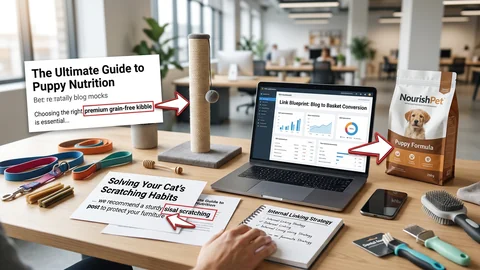
Authority grows when your site structure reflects how owners research problems, compare solutions, and act. For a succinct framework, see our topical authority site architecture overview. In this supporting post, we focus tightly on the moment a reader moves from education to action. The goal is to connect posts to category hubs, SKUs, and service pages with calibrated anchors and safe placement patterns. Evidence suggests this measured approach may support conversions while preserving category page SEO and product linking strategy discipline.
User paths to map: owner problem → solution → product/service fit
Map three consecutive steps: the owner’s problem framing, the solution logic, and the product or service fit. Use article sections to mirror this journey. Place contextual links near each transition. Prioritize the closest commercial fit over broad cross-site promotion.
Anchor text variety: descriptive, intent-matched, and brand-safe
Use descriptive phrases that match intent, not just keywords. Rotate partial-match, branded, and utility anchors. This pattern may diversify click paths and reduce repetitive signals. Keep anchors readable for humans and consistent with page titles.

Petbase automates SEO content for pet stores - publishing 10 optimized articles monthly so you can focus on running your shop - start your free trial.
Quick decision guide
Use these if-then rules to map post intent to targets without over-optimization. Keep links minimal, relevant, and placed where readers decide. When in doubt, link to a higher-level hub first, then add one SKU only if tightly matched.
If post solves a general care problem, then link to category hubs first
Send readers to well-scoped hubs like dog toys or cat litter. Add one early link with descriptive anchor. Avoid stacking multiple near-duplicate anchors in the first screen.
If post compares options, then link to filtered category or curated collection
For comparison queries, a filtered collection aligns best. Use a single collection link and, optionally, one standout SKU. This may guide evaluators without overwhelming them or causing anchor redundancy.
If post teaches a method, then link to 1-2 essential tools/services
When teaching a step-by-step method, add one category link and up to two essential SKUs. Place near the procedural step where the tool is required. Keep anchors instructional and concise.
If post answers a local need, then link to nearest service page with service schema
Use intent-matched anchors like dog grooming in Seattle. Ensure the service page carries accurate schema and NAP. Limit to one primary location to avoid diluting relevance.
If post targets a breed/life stage, then link to breed/life-stage collections
Send readers to pre-filtered hubs or collections aligned by breed, size, or life stage. Programmatic templates may help scale these safely across catalogs. See programmatic templates by breed, size, and stage.
If post is seasonal, then link to time-boxed collection or promo hub
Direct to a seasonal collection with clear timeframe and badges. Sunset or redirect stale hubs post-season. This limits legacy links pointing at expired promotions and preserves user trust.
If post has product FAQs, then link to specific SKU pages via FAQ answers
Use one SKU link per distinct FAQ. Match the anchor to the precise product attribute being discussed. Place the link inline within the answer, not as a clustered list.
Link architecture patterns that may support conversions
Internal link structures work best when they mirror decision psychology. Contextual placements often outperform rigid templates. Usability research suggests prominent, task-relevant elements may improve navigation efficiency and reduce friction[4]. Combine light, mid-content links with modular components that surface category and SKU options at the right moment.
Top/mid-article contextual links (problem → solution fit)
Place 1-2 contextual links in the first half of the article, tied to pain points and solution proof. Ensure each link advances the narrative. Avoid stacking multiple links in adjacent sentences.
Mini comparison modules linking to categories and 1-2 SKUs
Insert a small box summarizing key criteria. Link to a curated collection, such as indestructible dog toys, plus one flagship SKU like Chew Toy XYZ. Keep total links per module to three.
Sticky utility bar linking to category or service finder
A restrained sticky bar with one “Find by need” link can assist scanning readers. Route to a category finder or locator, not multiple destinations. Avoid excessive motion or aggressive CTAs.
Anchor text and placement safeguards
Search systems likely reward clarity and restraint. Over-optimizing anchors or flooding above-the-fold space with links may degrade experience signals. Balanced link density improves scannability and supports category page SEO while defending against cannibalization.
Cautious anchors: diversify and match intent
Use mixed anchors: descriptive (“odor-control litter”), branded, and utility (“view collection”). In recommender research, diversity improves exposure and reduces bias toward a single option set[1][2].
Placement boundaries: frequency, depth, and above-the-fold limits
Consider one commercial link in the top third, then another mid-article. Avoid clusters of three or more links in a single paragraph. Place deeper SKU links near evaluation or FAQs.
No-go rules: doorway patterns, boilerplate spam, and cannibal anchors
Do not auto-inject identical anchors sitewide. Avoid doorway-style blocks listing dozens of products. Prevent cannibal anchors that target multiple pages with the same phrase within the same post.

Monitoring: what to observe after 7-14 days and 4-8 weeks
Measure early engagement, then commercial assist. Instrument click tracking on anchors and modules. A dedicated setup guide like how to track in-content link CTR may help. For scaled operations, consider internal linking automation for pet sites for consistent rollouts.
7-14 days: click-through, scroll depth, and anchor engagement
Track in-content link CTR, dwell time, and scroll depth to linked modules. Evidence from ecommerce usability work indicates clearer pathways may improve task completion signals[4]. Compare anchor variants to identify descriptive phrasing that earns clicks.
4-8 weeks: assisted conversions, rankings drift, and cannibalization checks
Review assisted conversions for linked hubs and SKUs. Watch rankings for source and target pages for drift. Use cannibalization reports and landing page shares to decide whether to consolidate or adjust anchors.
Evidence status: what the data and guidelines suggest
Internal linking influences discovery and user flow, but its effects are context-dependent. Recommendation research shows that link structure and diversity affect exposure and accuracy, which may translate to on-site relevance pathways[1][2]. AI-enabled workflows can standardize best practices at scale while respecting editorial judgment[3].
Search guidelines alignment
Guidelines emphasize helpful, user-first navigation. Contextual anchors that explain destination purpose may align better than keyword-stuffed text. Avoid doorway and manipulative patterns to maintain trust and crawl efficiency.
Behavioral signals that may indicate value
Improved in-content link CTR, longer session depth, and reduced pogo-sticking can indicate value. Usability analyses suggest that clear pathways and relevant suggestions support task completion and satisfaction[4].
Limitations and context for pet verticals
Pet buyers vary by urgency and sensitivity. Education-first journeys may need softer CTAs, while replenishment needs faster routes. Data samples across niches differ, so treat benchmarks as directional, not absolute.
Practical safety boundaries for pet commerce and services
Set caps and templates to defend experience quality. These ranges aim to balance discoverability with restraint. Adjust by word count, template type, and site maturity across the topical authority pet industry.
Quantitative caps per template
For 1,000-1,500-word posts, consider 2-4 contextual commercial links plus one early category link. Keep total commercial links under six. Reserve one slot for a local service if applicable.
Template rules for product, category, and service pages
On category pages, link out to top SKUs with varied anchors and back to relevant guides. On SKU pages, link to one parent category and one care guide. Services link to a single locator.
Multilingual and local nuances
Localize anchor language and units, and reflect regional terminology. For cross-market operations, see multilingual authority approaches. Keep location modifiers only where intent is local, not on global evergreen content.
Implementation checklist
Operationalize the framework so it scales without over-optimization. For analytics and governance, capture before-after metrics and review windows. To plan clusters and measurement, explore topical authority KPIs alongside architecture fundamentals in our topical authority site architecture overview.
Map post intent to target page types
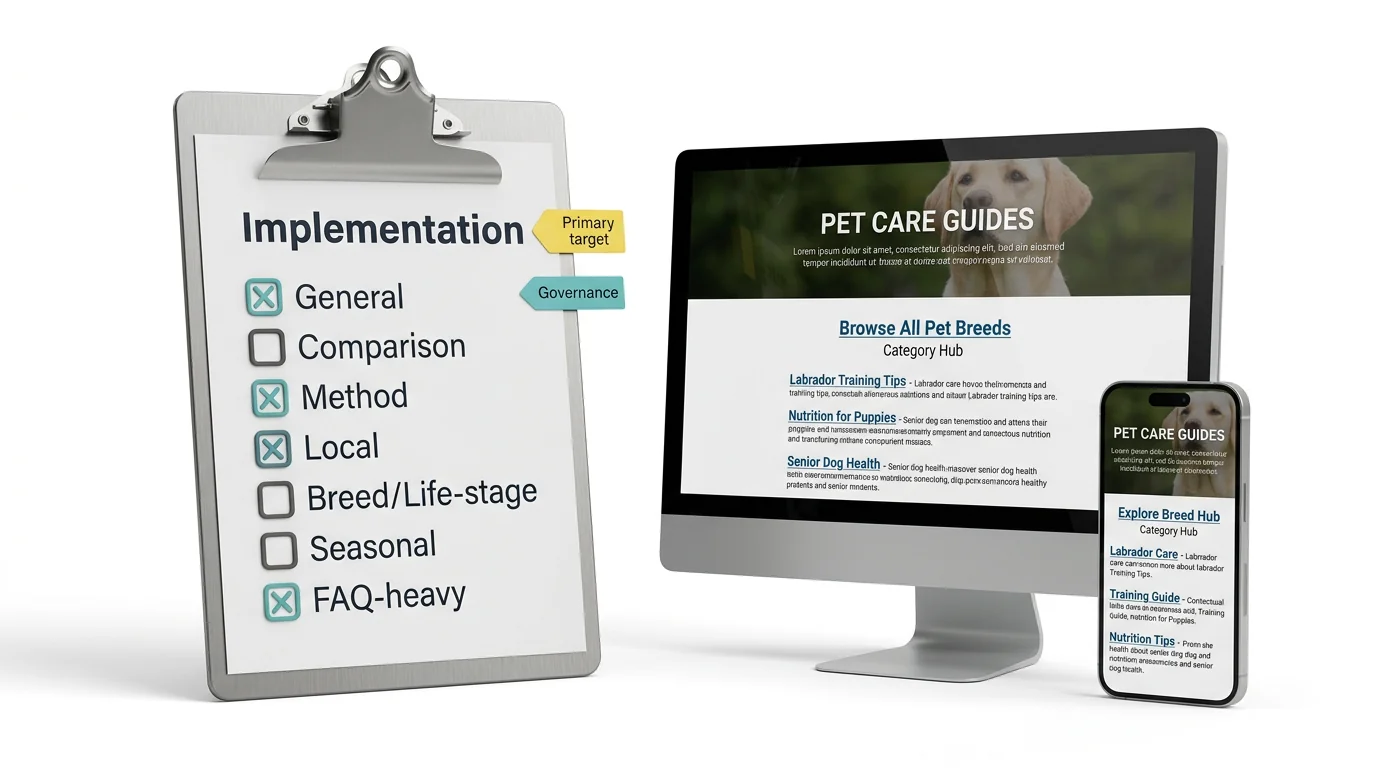
Classify each post as general, comparison, method, local, breed/life-stage, seasonal, or FAQ-heavy. Assign a primary target: category, curated collection, SKU, or service page. Document secondary targets sparingly.
Assign anchor variants
Create 3-5 anchor variants per target: descriptive, partial-match, branded, and utility. Align language with headings on destination pages. Avoid repeating the same variant more than twice per post.
Instrument tracking and review windows
Tag in-content links for CTR, scroll, and assisted conversions. Review after 7-14 days for engagement and 4-8 weeks for commercial impact. For scaled rollouts, consider Petbase AI to enforce consistent rules across content.
Frequently Asked Questions
How many internal links should a pet blog post include to products?
Evidence suggests 2-4 contextual links per 1,000 words may be reasonable when they add clear value. Add one category or service link early, and keep anchors varied and descriptive.
Should I link to category pages or product pages first?
For broad informational posts, category or collection pages often fit better. For method or comparison posts, one category plus 1-2 highly relevant SKUs may support user intent.
Will repeating the same exact-match anchor help rankings?
Overusing exact-match anchors may appear manipulative. Use natural language variants that reflect user intent and page context to maintain a balanced internal link profile.
How do I avoid cannibalization when linking across similar products?
Designate a primary category hub as the default target and rotate SKUs only when tightly matched to the query. Monitor landing page shares and adjust links if rankings drift.
What metrics indicate internal links are working?
Rising in-content link CTR, increased assisted conversions, more impressions for linked hubs, and stable or improved rankings for source and target pages may indicate positive impact.
Conclusion
Internal linking for pet commerce works best when it respects user intent, page roles, and safety boundaries. Start with category hubs for general education, add SKUs only when evaluation begins, and prioritize clear, varied anchors. Calibrate placements, cap link counts, and monitor early engagement alongside longer-window commercial assists. Treat these patterns as operating guidelines, then refine with your own data. Consistency and restraint usually outperform aggressive linking, especially in sensitive service contexts. Finally, align your architecture with clear topical themes so every link supports discovery, trust, and revenue together.
References
- G Liu (2022). An ecommerce recommendation algorithm based on link prediction. Alexandria Engineering Journal. View article
- L Ramoa et al. (2024). Recommendation Systems in E-commerce: Link Prediction in Multilayer Bipartite Networks. Digital Transformation and Enterprise …. View article
- X He et al. (2024). Knowledge evolutionary process of Artificial intelligence in E-commerce: Main path analysis and science mapping analysis. Expert Systems with Applications. View article
- B Kumar et al. (2022). E-commerce website usability analysis using the association rule mining and machine learning algorithm. Mathematics. View article