Local Topical Authority for Pet Services: Groomers, Trainers, Vets, and Daycare

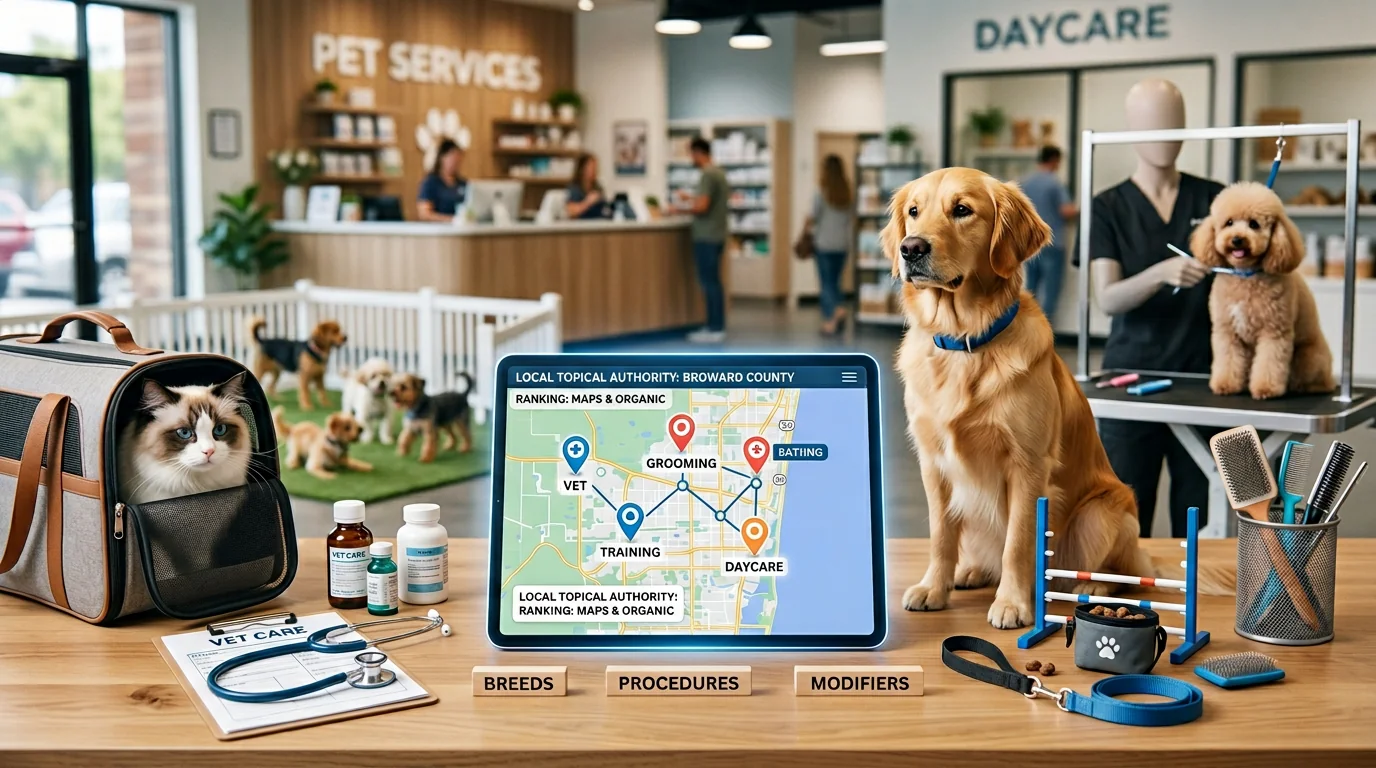
Table of Contents +
- The scenario: One service, many intents (how to cluster locally)
- Quick decision guide
- On-page blueprint for local topical clusters
- Entity, schema, and map pack alignment
- Monitoring and iteration
- Practical safety boundaries
- Evidence status: What the data and guidelines suggest
- Frequently Asked Questions
- Conclusion
- References
How pet groomers, trainers, vets, and daycare can build local topical authority to rank in maps and organic for breeds, procedures, and modifiers.
Local customers search with different intents, even for the same service. Some want prices today. Others want breed expertise, or a specific procedure near them. Your site must reflect these signals.
Winning map pack and organic results may depend on topical depth around each intent. This guide explains how to build clusters for procedures, breeds, and modifiers. You will learn page models, schema, and internal linking patterns that support pet services SEO.
The scenario: One service, many intents (how to cluster locally)
Map out procedures, breeds, and modifiers for one location
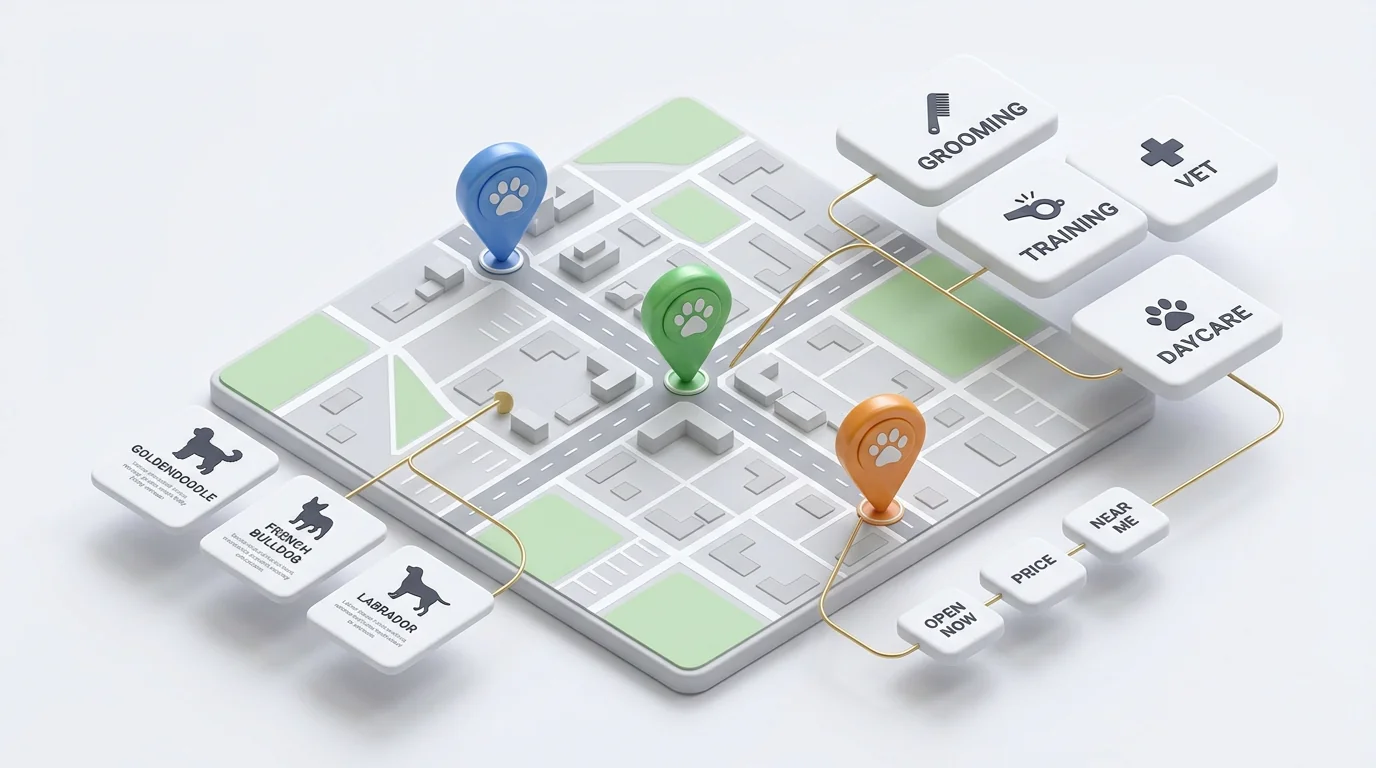
Start with one core service in one city. List procedures customers ask for, top local breeds by demand, and modifiers like “open now,” “price,” “near me,” “mobile,” or “same-day.”
Prioritize based on estimated bookings and observable search patterns. Evidence suggests aligning content supply to actual user queries increases findability and task completion in local search contexts.[1] Build 6-12 spokes first, then expand if impressions grow and calls increase. Keep each page focused and geo-scoped to a single service area.
Choose hub, spoke, and conversion pages (and when to localize)
Create a location-level hub for the service. Use it as the index for procedures, top breeds, and key modifiers. Each spoke targets one procedure, one high-demand breed, or one modifier with booking intent.
Localize when the city is competitive or when suburbs show distinct demand signals. From your cluster overview, align your plan with local SEO within the pet topical authority playbook. If you need a repeatable mapping process, see topical mapping practices in how to build a pet-industry topical map.
Petbase automates SEO content for veterinary clinics - so you can focus on patients, not blog posts - start your free trial.
Quick decision guide
If X situation, then Y action (5-7 common cases)
- If budget is tight, then ship one hub plus six procedure spokes first. Add two modifiers and two top breeds after you see early impressions.
- If franchises dominate, then target breed expertise and urgent modifiers. This positions your groomer SEO or veterinary SEO for higher intent while avoiding generic head terms.
- If you serve multiple services, then cluster per service. Keep grooming, training, and veterinary separate hubs to reduce dilution and clarify dog trainer SEO signals.
- If your market is rural, then consolidate rare procedures into one comprehensive page. Expand into separate pages only when calls or form submissions validate demand.
- If seasonality spikes volume, then prepare modifier pages early. Focus on “same-day” and “price” queries that convert during peak shedding or wellness windows.
- If competitors outrank your city page, then localize high-value procedure pages to the city as well. Use unique proof, reviews, and route-based directions.
- If GMB categories feel mismatched, then recheck category selection and on-page entities. Align brand, service, and breed terminology consistently across the cluster.
Deeper information often supports stronger decision outcomes. Providing richer, well-structured content for specific intents may improve perceived relevance and booking behavior among searchers.[2]
On-page blueprint for local topical clusters
Page models: procedure, breed, and modifier pages
Procedure page model: one procedure per page. Add a short explainer, local suitability notes, prep instructions, step summary, time ranges, risks, aftercare, and a clear booking block.
Breed page model: one high-demand breed per page where volume supports it. Discuss breed-specific considerations, coat or behavior traits, procedure suitability, risk notes, and local proof with reviews mentioning that breed.
Modifier page model: price, same-day, mobile, or near-me. Provide transparent pricing ranges, availability windows, qualification criteria, radius limits, and city-level directions. Keep H1 mirrored with the exact modifier and service.
Copy blocks, internal links, and local signals that may help
Use consistent modules: service overview, local evidence, FAQs, process steps, time and price ranges, and clear CTAs. Reinforce NAP, hours, and service radius. Reference nearby landmarks for navigation intent.
Internal linking patterns can reinforce structure. See anchor and hierarchy best practices in internal linking for pet commerce and services. Apply these guidelines consistently:
- From each procedure page, link to two to three relevant breed pages and one modifier page. Link back to the hub using consistent anchor text.
- On the location landing page, create a bulleted index for top procedures, top five local breeds, and price/modifier options with concise anchors like “for Huskies” or “same-day appointments.”
- From recent blog posts, add contextual links to low-impression but high-conversion service pages, such as seasonal shedding or puppy socials.
Entity, schema, and map pack alignment
Service + breed + procedure entities
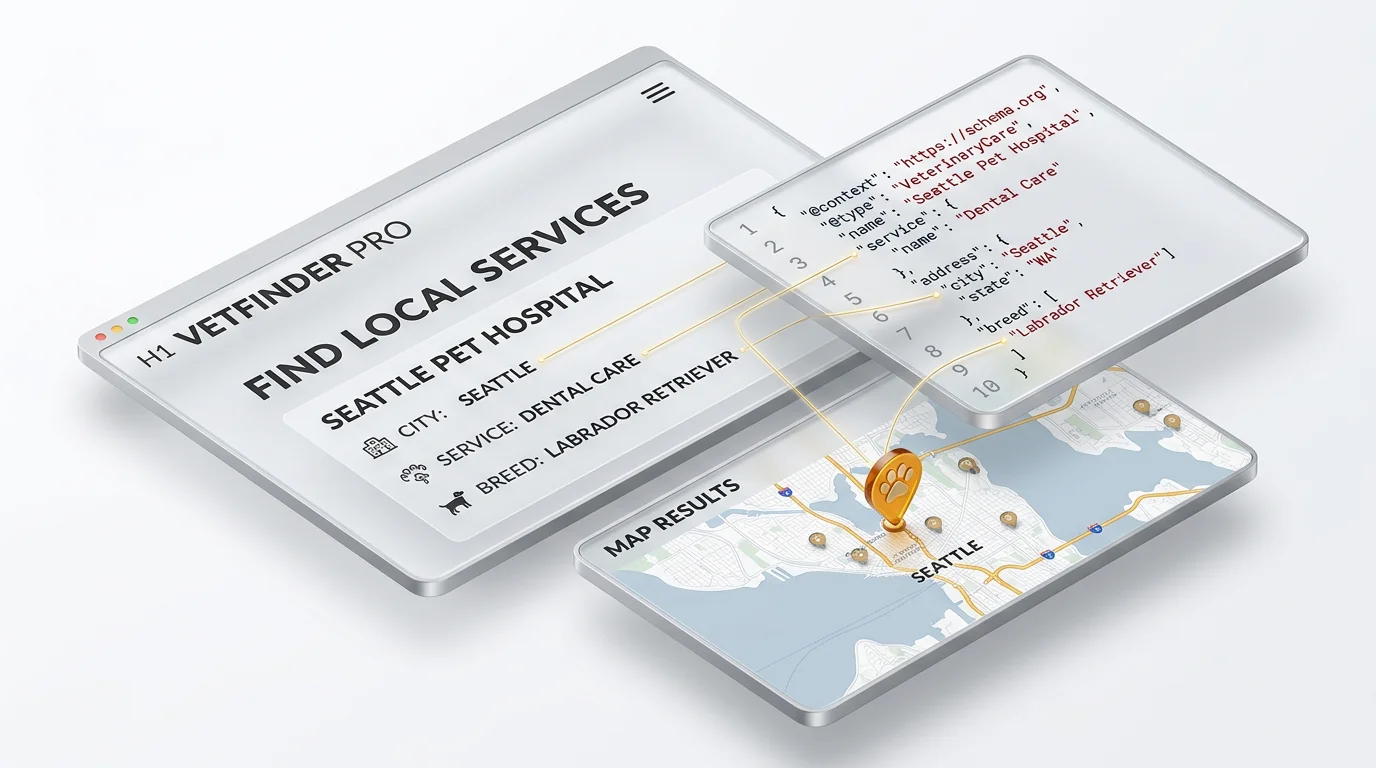
Align entities across copy, headings, schema, and your Google Business Profile. Use consistent naming for services, localities, and breed or procedure terms. This lowers ambiguity for crawlers and helps consolidate relevance.
Publishing structured, authority-oriented data can improve precision and scope in local discovery when implemented correctly, according to linked data experiences from implementers.[3] Maintain exact NAP, city, and category alignment between your site and map listing.
LocalBusiness, Service, and FAQ schema tips
Add LocalBusiness at the hub level with name, address, geo, serviceArea, and sameAs for major profiles. Nest Service schema on procedure, breed, and modifier pages to describe offerings and mentions of relevant entities.
Use FAQ schema for genuine customer questions with concise answers. Avoid repetition across pages. Mark up pricing ranges transparently where applicable. Schema does not guarantee rankings, but it may support eligibility and clarity.
Monitoring and iteration
What to check after 7-14 days
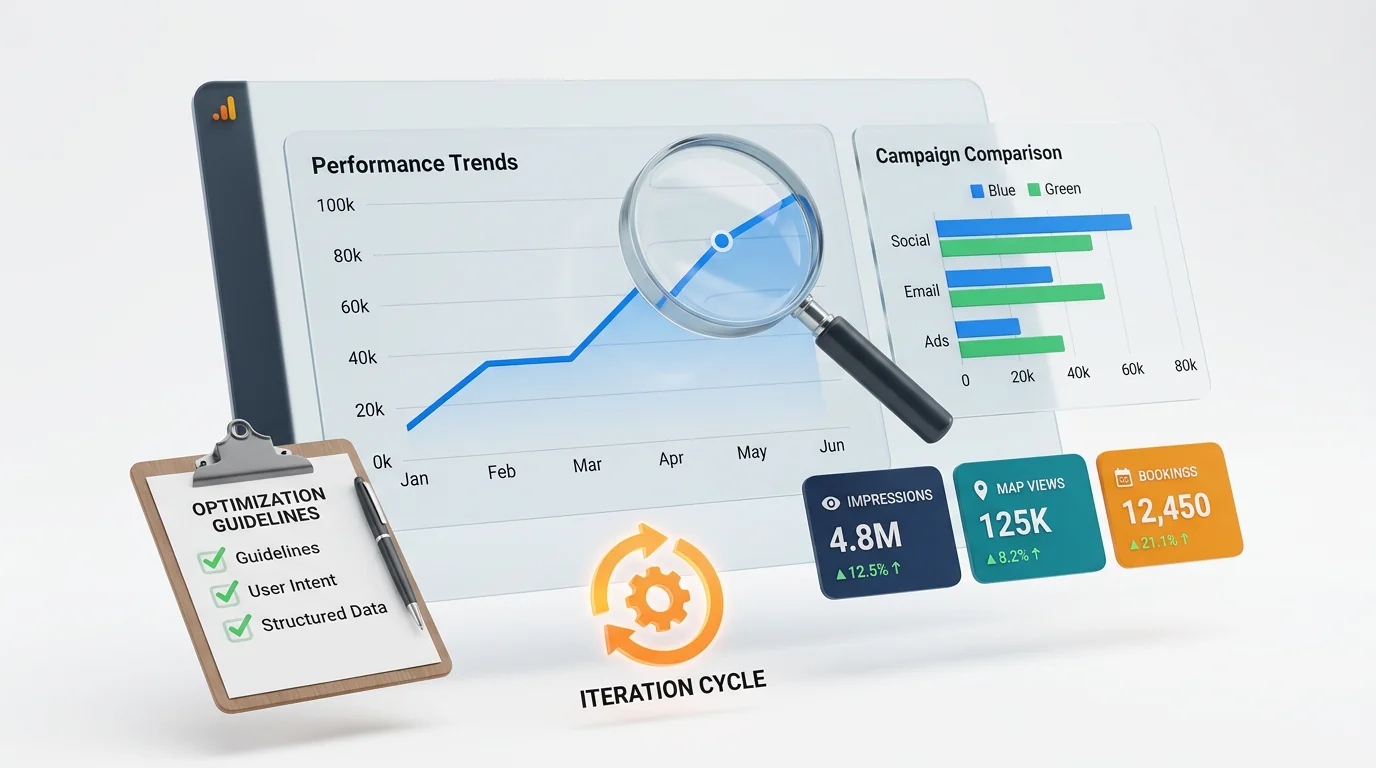
Verify indexation of hub and spoke pages in Search Console. Check for impression emergence on long-tail queries and any early map pack views or discovery searches.
Confirm internal links are crawlable and consistent. Compare headline terms to Google Business categories and services. Early iterations often yield better local optimization outcomes than one-time changes in complex environments.[4] For dashboards and KPIs, review the frameworks in measure topical authority.
What to check after 4-8 weeks
Segment performance by page model. Procedure pages should lift conversions. Breed pages should lift engagement. Modifier pages should attract urgent or price-sensitive traffic and drive calls.
Refine internal links toward underperforming yet promising pages. Expand to new breeds or modifiers only after proving demand. For pace and consistency, many teams schedule generation and updates with Petbase AI to maintain steady content velocity without sacrificing quality.
Practical safety boundaries
Duplication and doorway risks
Avoid near-duplicate suburb pages with only city names swapped. These may resemble doorway pages and dilute authority. If you must localize, add distinct proof, original images, directions, and suburb-specific details.
De-index thin experiments quickly. Consolidate overlapping topics into stronger evergreen pages. Use canonical tags for variant URLs. Keep one clear hub per location per service to avoid internal competition.
Medical and welfare guidance for vets and trainers
When covering procedures or behavior protocols, include clinician credentials and welfare statements. Present risks, contraindications, and aftercare. Cite oversight bodies where appropriate, and avoid prescriptive language that may be misinterpreted as universal advice.
State that individual cases differ. Encourage owners to seek professional evaluation before following procedure or training steps. Keep urgent care directions visible and accurate at all times.
Evidence status: What the data and guidelines suggest
What appears consistent across case studies
Aligning content with user information needs appears to support discoverability and task completion, especially when structure mirrors searcher intents.[1] Clarity in entities and structured data representation tends to improve the system’s ability to match local queries precisely.[3]
Richer, intent-specific pages may influence user perceptions and actions during search, reinforcing the value of detailed topical clusters for local SEO for pet services.[2]
Where evidence is limited or situational
Exact counts of pages per location, or the weight of breed versus procedure pages, vary by market and competition. Iterative testing appears necessary for reliable gains in map and organic rankings.[4]
Schema usage supports clarity, but it does not replace high-quality content or local proof. Results may depend on data freshness, category alignment, and user engagement signals.
Frequently Asked Questions
How many local pages should a pet service create per location?
Evidence suggests starting with a hub plus 6-12 focused spokes covering high-intent procedures, top breeds, and common modifiers. Expand only after you see impressions and map pack engagement.
Should I make separate pages for each dog breed?
Only when search volume or bookings indicate demand. Consolidate long-tail breeds into one guide per service, and create standalone pages for top local breeds that show intent and conversions.
Do I need unique content for nearby suburbs?
Yes, but keep quality high. If suburbs share the same offering, use one strong city page and a single service hub. Create suburb pages only when you can add distinct proof, photos, reviews, and directions.
What schema helps pet services rank locally?
LocalBusiness with Service, FAQ, and Review snippets may support visibility. Include serviceArea, sameAs for profiles, and procedure/breed entities where appropriate.
How long until a topical cluster impacts map rankings?
Results vary. Early signals may appear in 2-4 weeks, with steadier gains over 6-12 weeks as internal links, reviews, and engagement accumulate.
Conclusion
Local topical authority for pet services grows when your site mirrors how people search. Build clusters around procedures, top breeds, and booking modifiers. Use clear on-page models, structured data, and disciplined internal linking.
Iterate based on early signals, not assumptions. Strengthen pages with unique local proof, consistent entities, and precise CTAs. This focused framework supports groomer SEO, veterinary SEO, and dog trainer SEO with measurable, repeatable results in maps and organic search.
References
- C Serrano-Cinca et al. (2019). What municipal websites supply and citizens demand: a search engine optimisation approach. Online Information Review. View article
- P Tavitiyaman et al. (2021). The influence of smart tourism applications on perceived destination image and behavioral intention: The moderating role of information search behavior. Journal of Hospitality and …. View article
- K Smith-Yoshimura (2018). Analysis of 2018 international linked data survey for implementers. Code4Lib journal. View article
- E Aarts et al. (2018). Local search in combinatorial optimization. 2018 - books.google.com. View article