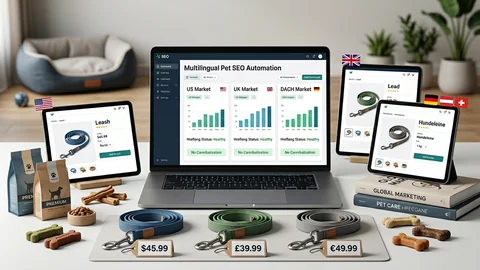
Multilingual Pet SEO: Build Topical Authority Across US, UK, and DACH

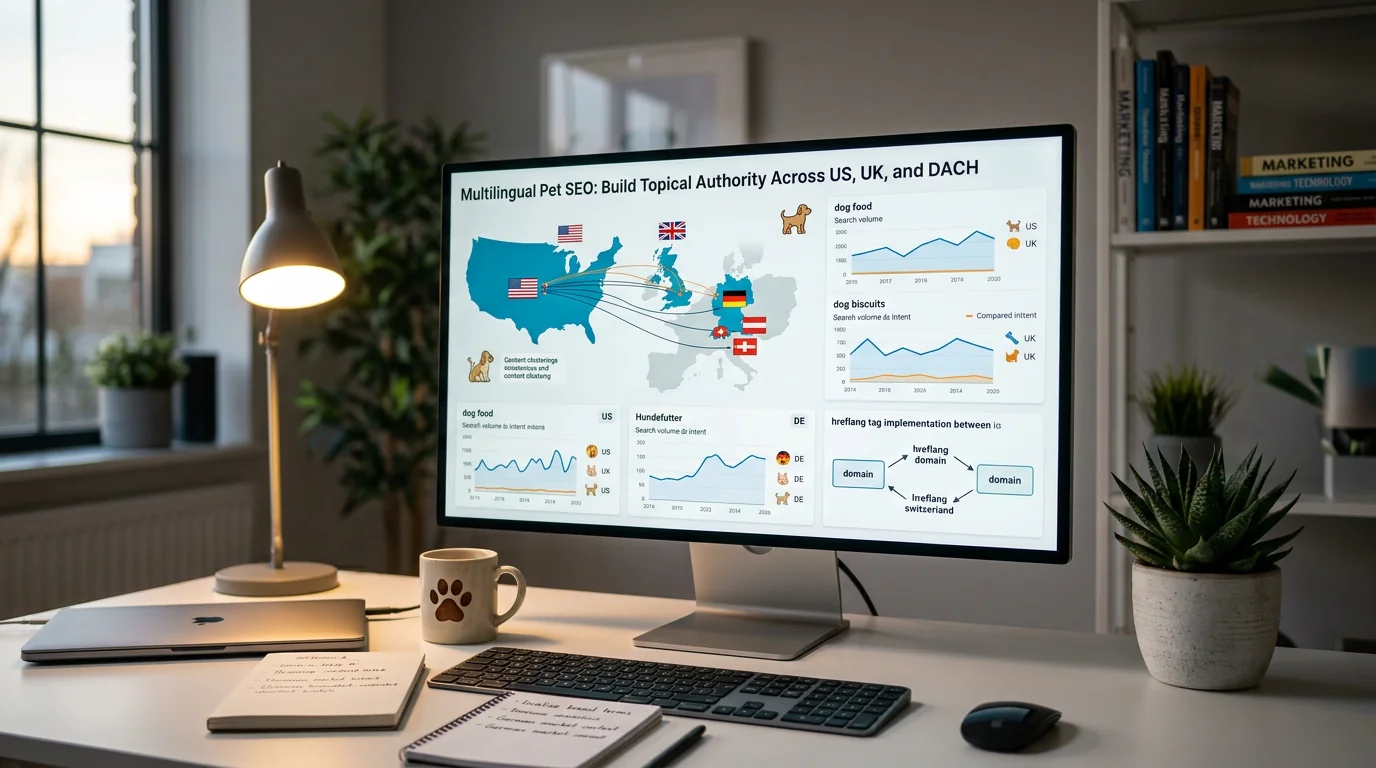
Table of Contents +
- Scenario: Localizing breed and product clusters for US, UK, and DACH without diluting search intent
- Quick decision guide: if X, then Y
- Hreflang and URL architecture that may support clean intent separation
- Term mapping worksheets: sample mappings for breeds and products
- Monitoring guidance: what to observe post-launch
- Practical safety boundaries for multilingual pet SEO
- Evidence status: what current data suggests
- Rollout roadmap and internal linking patterns
- Appendix: sample briefs Petbase can operationalize
- Frequently Asked Questions
- References
Localize pet SEO for US, UK, and DACH. Map hreflang, adapt breed/product terms, and keep intent aligned to build topical authority safely.
Your English and German pages can rank together without tripping over each other. Precise intent mapping keeps authority intact across borders.
This matters because UK vs US pet terminology and DACH expectations diverge. Misalignment wastes crawl budget and suppresses clicks. You will learn how to localize clusters, configure hreflang, and adapt breed and product terms while preserving intent.
Scenario: Localizing breed and product clusters for US, UK, and DACH without diluting search intent
Pet SEO localization succeeds when language, query patterns, and SERP intent align. Treat each market as a distinct user story, not a translation copy.
Intent-first mapping: queries, SERP formats, and terminology by region
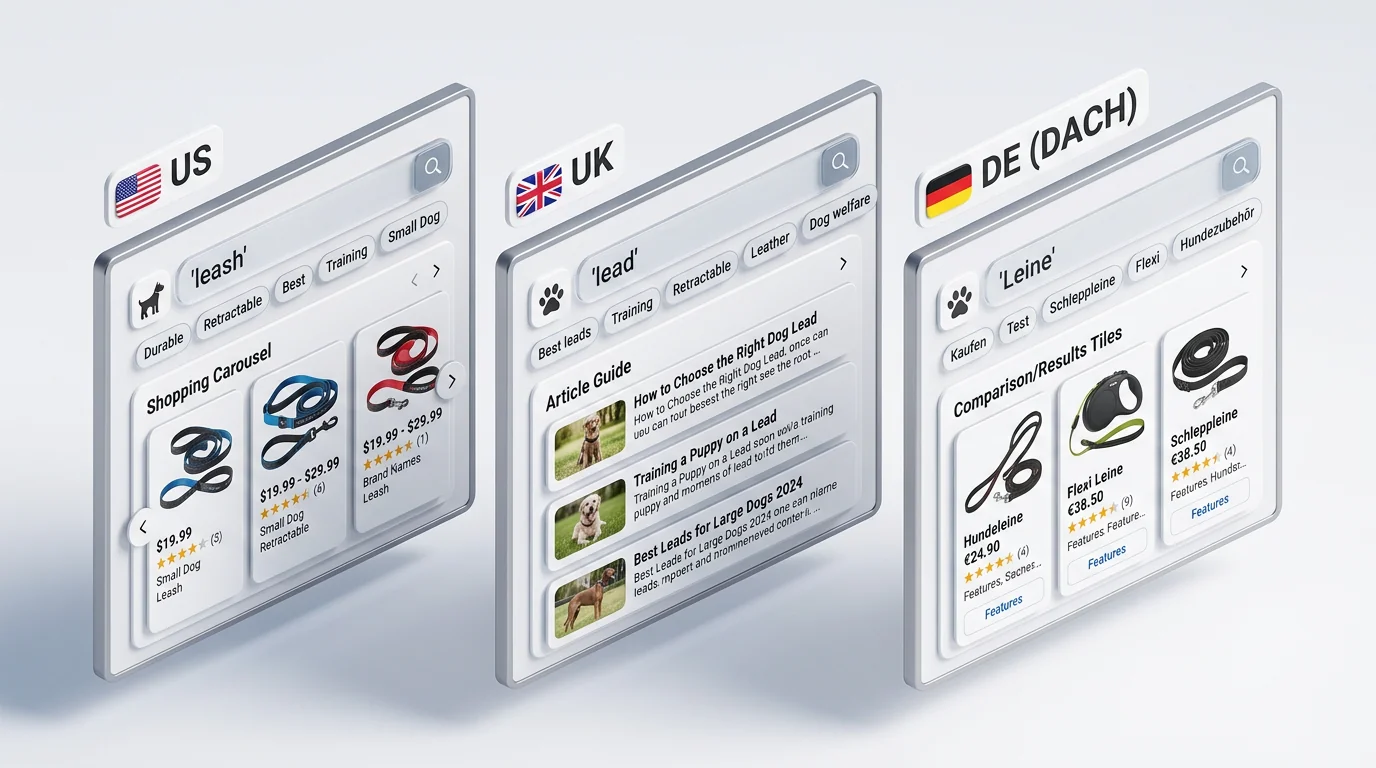
Audit queries, SERP features, and modifiers per locale. US may surface shopping carousels for “leash,” while UK shows guides for “lead.” German users often prefer transactional “Leine kaufen.” Mixed-language behavior also influences result selection[4].
Term variants to watch: US vs UK vs DE examples (dogs, cats, accessories)
US: leash, kibble, vet visit. UK: lead, dry food, vet appointment. DE: Leine, Trockenfutter, Tierarzt. Breeds: Staffy vs Staffordshire Bull Terrier; Dachshund vs Dackel; short-hair vs Kurzhaar. Map variants to guard intent by market.
Petbase builds this SEO foundation automatically for pet businesses - 10 optimized articles published every month - start your free trial.
Quick decision guide: if X, then Y
Term collisions and cannibalization
If two English pages target the same intent, pick the primary by region. Keep self-canonical and set reciprocal hreflang pairs. Consolidate duplicates where the SERP and modifiers fully overlap.
When to translate vs transcreate vs create net-new pages
Translate when terminology shifts but intent remains constant. Transcreate when examples, tone, and modifiers change by culture. Create net-new when regulations, care norms, or products differ substantively by market[3].
How to choose canonical and hreflang pairs
Use self-canonical for each locale page. Add reciprocal en-US, en-GB, de-DE hreflang. Reserve a neutral x-default for a selector or global overview. Avoid cross-canonicals between markets to prevent authority leakage.
Handling regional product availability
If a product is unavailable in the UK, route to a localizable alternative or an informative page. Keep the US transactional page live. Do not present out-of-stock transactional intent to German users.
Blog vs product page targeting
Send informational queries to localized guides. Assign transactional queries to product or category pages. Reinforce paths with anchor consistency and breadcrumbs to minimize intent mingling across locales.
Plural/singular and modifier differences
Segment “lead” vs “leads,” “small harness” vs “harness for small dogs,” and German compound variants. Build distinct templates only when modifiers imply unique SERP intent or commercial depth.
When to split guides by regulation or care standards
Split when airline transport, microchipping, or import rules differ. Keep unified content when practical guidance is universal. Include localized checklists and compliance notes to satisfy jurisdictional expectations.
Hreflang and URL architecture that may support clean intent separation
Hreflang for pet websites should reflect language and region codes consistently. Clear folders reduce ambiguity and speed debugging.
Folder strategy: /us-en/, /uk-en/, /de-de/
Adopt region-language folders like /us-en/, /uk-en/, and /de-de/. Keep mirrored structures for category, breed, and product hubs. Disable IP-based redirects that override explicit URLs or hreflang targeting.
Implementation checklist: tags, sitemaps, and x-default
Use link rel="alternate" hreflang in head or XML sitemaps. Keep self-canonical. Add x-default for selectors when serving multiple English variants. Evidence indicates well-targeted multilingual routing supports relevance[4].
Edge cases: mixed English markets and Switzerland (de-CH)
For English-dominant EU markets, prefer en-GB unless pricing or spelling policies dictate otherwise. Switzerland may warrant de-CH when shipping, currency, or vocabulary differs. If parity holds, de-DE can serve initially.
Term mapping worksheets: sample mappings for breeds and products
Operationalize breed term mapping in a shared worksheet. Capture synonyms, pluralization, and modifiers per locale. Teams sometimes pair spreadsheets with Petbase AI to auto-generate locale briefs and maintain mappings consistently.
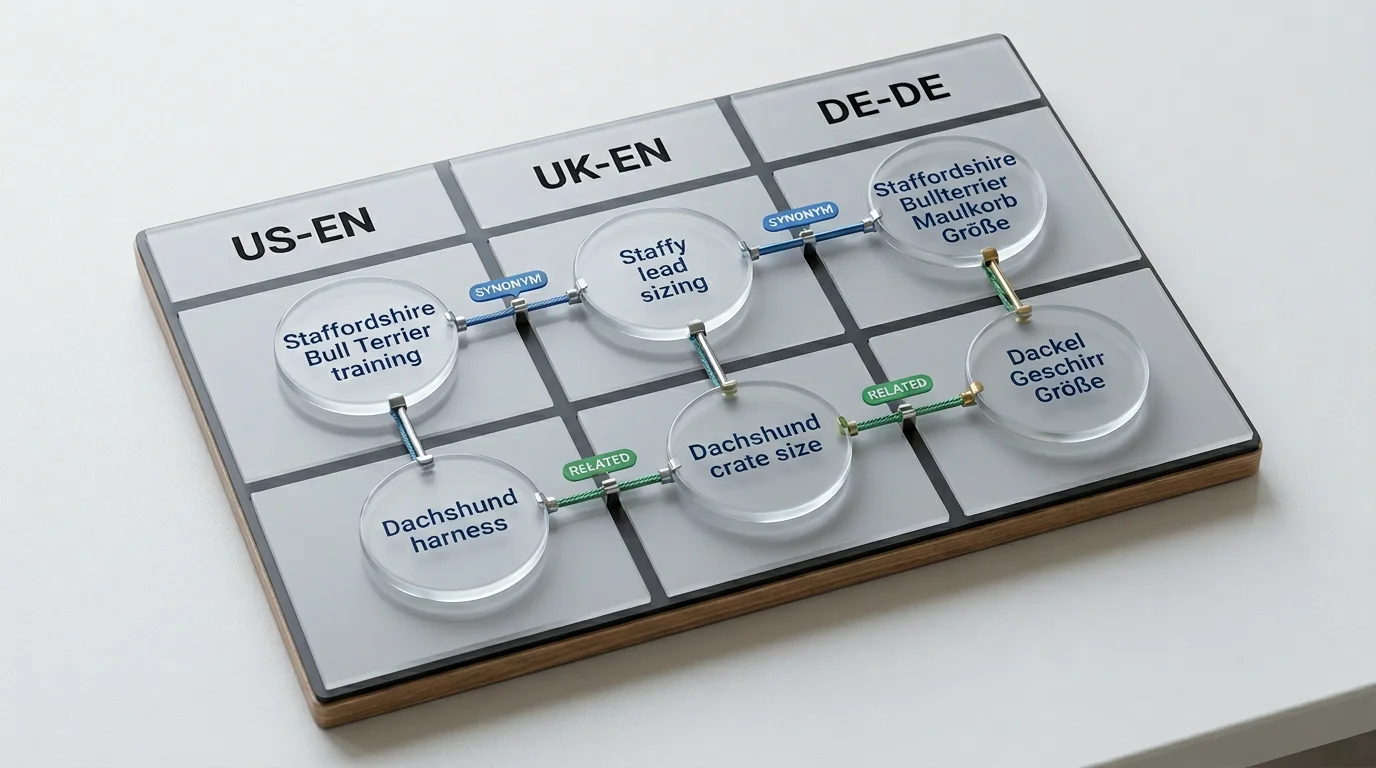
Breed clusters: Staffy vs Staffordshire Bull Terrier; Dachshund variants
US: “Staffordshire Bull Terrier training,” “Dachshund harness.” UK: “Staffy lead sizing,” “Dachshund crate size.” DE: “Staffordshire Bullterrier Maulkorb,” “Dackel Geschirr.” Keep titles, H1s, and schema aligned to locale synonyms.
Product clusters: lead vs leash, kibble vs dry food, harness sizing
US: “nylon leash,” “grain-free kibble,” “XXS harness chart.” UK: “rope lead,” “grain-free dry food,” “XXS harness size guide.” DE: “Nylon Leine,” “getreidefreies Trockenfutter,” “XXS Geschirr Größentabelle.”
Commerce facets: sizes, life stage, material, and regulation notes
Normalize attributes across locales: size (XXS-XL), life stage (Puppy/Welpe), material (Nylon/Leder), closures, and reflect legal notes (e.g., leash laws). Localize units and standards used in DACH pet market SEO.
Monitoring guidance: what to observe post-launch
After launch, track indexing, intent alignment, and behavioral signals. Localization should earn impressions from region-appropriate queries and SERP features.
7-14 days: indexing, coverage, and cannibalization checks
Verify hreflang validation in Search Console. Check coverage for each folder. Confirm en-US queries resolve to en-US pages, and en-GB to en-GB, limiting cross-locale cannibalization and duplicate appearance issues.
4-8 weeks: intent alignment, CTR deltas, assisted conversions
Compare CTR between localized terms (“lead” vs “leash,” “Leine”). Improved alignment may correlate with higher CTR and engagement in multilingual contexts, where sentiment and wording influence selection[2].
Signals to refine: SERP features, internal link flow, query drift
Review featured snippets, shopping units, and People-also-ask. Evaluate internal link anchors’ locale fidelity. Address query drift when unintended cross-locale terms start appearing in impressions or on-page copy.
Practical safety boundaries for multilingual pet SEO
Guardrails reduce risk while you scale pages across markets and templates.
Avoid over-translation of medical/training claims
Localize cautiously when claims involve health or training outcomes. Keep references and schema consistent across locales. Automated content may require expert review before publishing in regulated contexts[1].
Respect legal/regulatory differences
Note import, transport, and identification requirements by country. Add local disclaimers and date stamps for compliance pages. Align structured data with real-world availability and jurisdictional terms.
Guardrails for auto-generated variants and pagination
Cap programmatic generations to high-intent modifiers only. Merge thin variants. Use rel="next/prev" alternatives via robust pagination patterns. Avoid creating fragments that confuse canonical or hreflang logic.
Evidence status: what current data suggests
Evidence continues to mature, but several trends are supported by studies and practice.
Hreflang implementation and duplicate control
Correct hreflang pairing helps search engines present regionally relevant results and may limit duplicate appearance in multilingual contexts, improving clarity for mixed-language users[4].
Localized terminology and CTR uplift patterns
Localized terms can resonate better with audiences, and content tone may influence navigation choices and CTR in multilingual marketing scenarios, suggesting value in precise wording per locale[2][3].
Structured data consistency across locales
Maintaining consistent schema while localizing names and availability supports machine understanding at scale. Automated assistance can help, but QA remains vital to protect accuracy and compliance[1].
Rollout roadmap and internal linking patterns
Sequence by market depth and cluster criticality. Strengthen navigational clarity with locale-matched links and breadcrumbs.
Phased release by cluster and market depth
Phase 1: High-intent products in US and UK. Phase 2: DE core categories and top breeds. Phase 3: Long-tail modifiers. Consider programmatic SEO templates for pet catalogs to scale safely.
Hub-to-spoke links and product bridges
From each locale hub, link to three to five breed or product spokes using local terms. Add breadcrumb reciprocals. For deeper patterns, see internal linking for pet commerce and services focused on pillars to products.
Reinforce the international topical authority strategy for pet brands
Centralize your cluster model, reinforce hubs, and segment locales cleanly to build authority. See the international topical authority strategy for pet brands for positioning your global content footprint.

Appendix: sample briefs Petbase can operationalize
Briefs align teams on intent, terms, and structure. Use these starting points for consistency.
US-EN vs UK-EN editorial briefs
US-EN: “best leash materials,” US spelling, pricing in USD, US retailers. UK-EN: “best lead materials,” UK spelling, GBP pricing, UK shipping norms. Distinct SERP examples and embedded glossary sections.
DE-DE ecommerce template with modifiers
Title: “Leine Größenratgeber.” H1: “Die richtige Leine für Welpen.” Facets: Größe, Material, Verschluss, Einsatz. Schema: Offer with EUR. Compliance notes: Bundesland-abhängige Regeln. Internal anchors in German compounds.
QA checklist for each locale
Validate hreflang pairs and sitemaps. Confirm self-canonicals. Spellings and synonyms verified by locale. Schema localized. Anchors region-matched. Pricing, availability, and legal notes correct. SERP spot-checks for intent alignment.
Frequently Asked Questions
Should I use one English page for US and UK or separate locales?
Evidence suggests separate locales may reduce query mismatch and improve CTR when terminology and SERP features differ. Use hreflang en-US and en-GB with aligned content and distinct spellings.
How do I prevent cannibalization between en-US and en-GB pages?
Implement reciprocal hreflang pairs, keep unique regional terminology and examples, and avoid cross-linking with identical anchor on the same intent. Monitor GSC query splits and canonical signals.
Do I translate product names for Germany or keep English brand terms?
Keep protected brand names and transcreate generic product descriptors. For example, retain brand X and localize “leash” to “Leine” while mapping size and material facets to German norms.
Is x-default needed for multilingual pet stores?
x-default may help route unspecified users to a selector or global page. It is not mandatory, but it can reduce mis-targeting when multiple English variants are present.
How should I handle Switzerland with German content?
Consider de-CH when pricing, shipping, or terminology differs. If minimal differences exist, de-DE may suffice, but monitor GSC impressions and user behavior for de-CH signals.
Conclusion
Multilingual pet SEO succeeds when intent is mapped first, terminology is localized precisely, and hreflang clarifies market boundaries. Use clean URL architecture, cautious automation, and disciplined internal linking. Monitor early, adjust deliberately, and scale your authority methodically. For structured cluster design, explore how to build a pet-industry topical map that aligns with US, UK, and DACH realities while preserving search intent.
References
- G Chodak et al. (2023). Large language models for search engine optimization in e-commerce. International Advanced Computing Conference. View article
- P Biswas et al. (2024). The Importance of Multi-Lingual Sentiment Analysis in Digital Marketing. 2024 11th International …. View article
- A Al-Tarawneh et al. (2025). The Multilingual Marketplace: Translation Strategies for E-commerce Success. From Machine Learning to Artificial …. View article
- B Steichen et al. (2021). How do multilingual users search? An investigation of query and result list language choices. Journal of the Association for Information …. View article