Pet Topical Authority: The Complete Framework for Pet Brands, Retailers, and Clinics

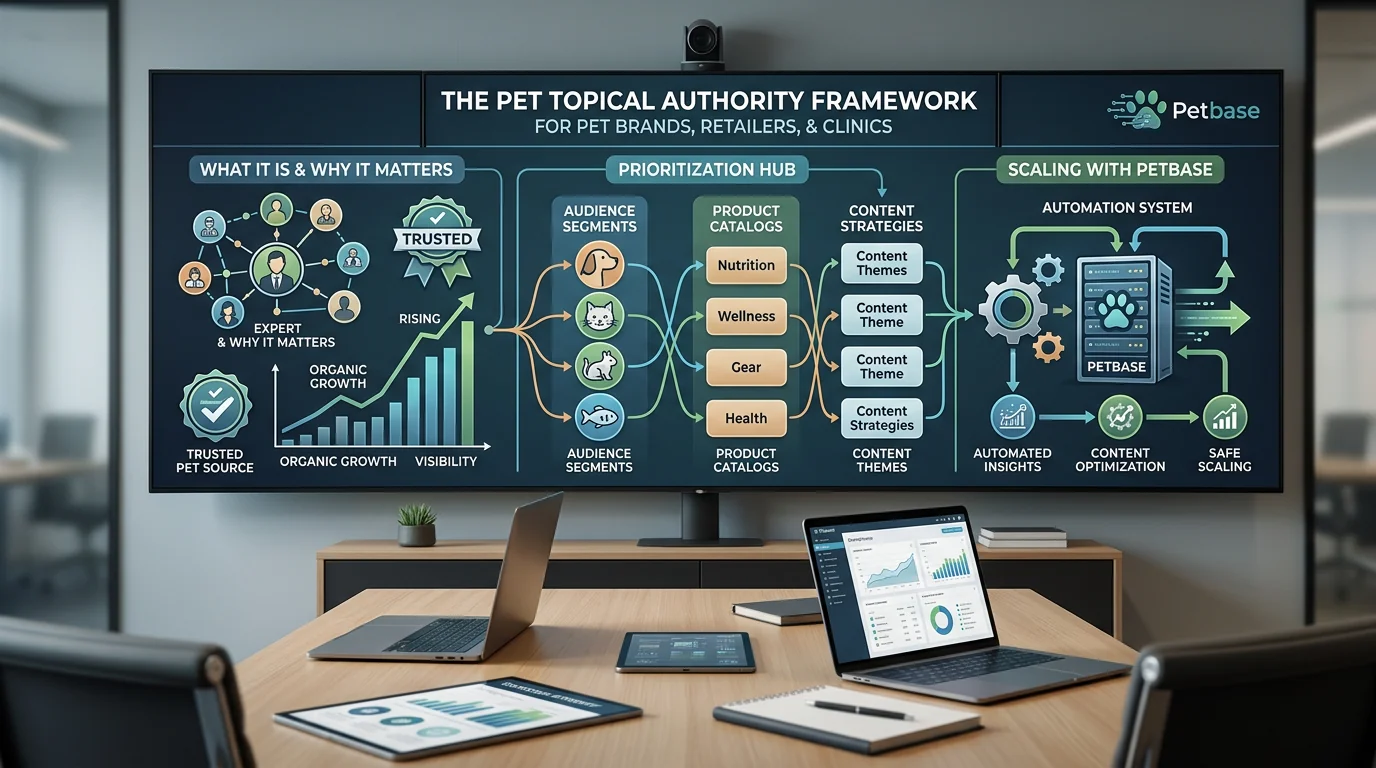
Table of Contents +
- What pet topical authority is and why it drives organic growth
- What to prioritize first: management, forage, and basic nutrition of your content
- Use cases by segment: brands, retailers, and veterinary clinics
- Site architecture & internal linking patterns that compound authority
- Scaling content safely: when to automate and when to hold
- Market expansion & SERP shifts: language, regions, and new result types
- Execution roadmap, mistakes to avoid, and how we built this framework
- Frequently Asked Questions
- References
Learn what topical authority means in pet SEO, why it matters, how to prioritize themes, and when to scale with automation-safely and effectively.
Topical authority now decides which pet sites win search and trust. For brands, retailers, and clinics, it underpins visibility and revenue. This guide turns theory into confident action for pet SEO.
You will learn what to prioritize, how to structure content, and when to automate. See segment-specific tactics, safe scaling rules, and navigation to deep dives. Use this framework to build durable pet topical authority across products, services, and advice.
What pet topical authority is and why it drives organic growth
Define topical authority for the pet industry
Topical authority is your demonstrated expertise on a defined set of pet themes. It blends depth, breadth, and organization across categories, articles, products, and services, reinforced by consistent internal links and credible external signals.
In practice, pet brand SEO, pet retailer SEO, and veterinary SEO each require comprehensive coverage, clear hierarchies, and content that answers intent without ambiguity. Strong digital presence and well-structured sites correlate with stronger performance for veterinary practices and local discovery[3].
Signals that matter across products, services, and advice
- Scope coverage: complete hubs for breeds, life stages, conditions, and care tasks.
- Depth per page: expert-driven advice, product attributes, and clear FAQs aligned to search intent.
- Information architecture: intuitive categories and hub-cluster linking that guide users and crawlers.
- E-E-A-T: transparent authorship, references, and review processes, essential for veterinary credibility[2].
- User signals: engagement, navigation success, and conversions from educational content to product or service actions.

Petbase automates SEO content for veterinary clinics - so you can focus on patients, not blog posts - start your free trial.
What to prioritize first: management, forage, and basic nutrition of your content
Management: site architecture and categories before posts
Plan the map before paving roads. Define primary categories by pet intents such as “care guides,” “conditions,” “training,” “nutrition,” “products,” and “services.”
Assign every page a single parent and a clear role. Establish canonical hubs for breeds and life stages, and reserve tags for discoverability, not hierarchy.
Forage: foundational keyword discovery and clustering
Collect intents from real queries, onsite search, customer support logs, and product filters. Group by problem, outcome, and product fit.
Build a pet keyword map that clusters by breed, life stage, and intent to avoid cannibalization and to reveal gaps that matter most to pet parents and clinicians.
Basic nutrition: evergreen guides before niche topics
Publish evergreen, medically accurate cornerstone pages first. Cover care basics, condition overviews, training fundamentals, and product education that aligns with your inventory or services.
Once hubs are stable, extend into advanced or niche angles. This sequencing compounds authority while protecting quality for sensitive topics.
Use cases by segment: brands, retailers, and veterinary clinics
Brands and DTC manufacturers
Anchor pet brand SEO in problem-to-product narratives. Build clusters around how the product solves care needs, with evidence, usage guidance, comparisons, and safety disclaimers.
Connect educational guides to product pages via structured data and consistent internal links to demonstrate relevance and improve conversion paths.
Retail and eCommerce stores
Lead with category authority. Publish buyer’s guides and care content that map to each category, with filters and attributes mirrored in content subheads.
Design a topical authority cluster for pet retailers with category-to-article linking to move readers from education to add-to-cart without friction.
Veterinary practices and hospitals
Build trust with medically accurate procedure, condition, and aftercare pages, plus clear triage and appointment pathways. Digital marketing and SEO fundamentals are now core capabilities for clinics navigating search and social platforms[1].
Create procedure and condition pages for veterinary SEO that earn E-E-A-T and ensure authorship, review, and disclaimers are explicit and consistent.
Site architecture & internal linking patterns that compound authority
Hub-cluster structure for breeds, life stages, and intents
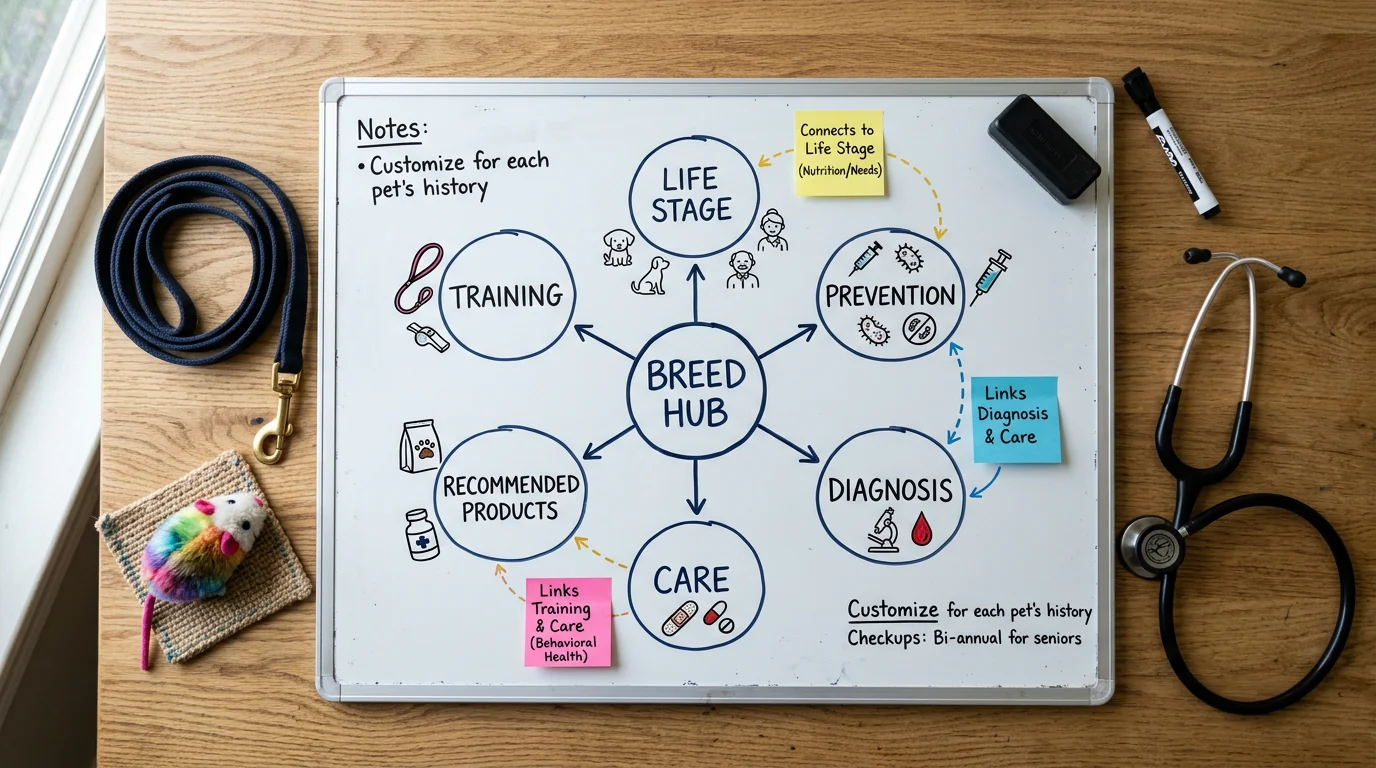
Create hubs for major intents and child pages for specific scenarios. Each child page links back to its hub and across siblings where helpful. Use breadcrumbs and schema to reinforce hierarchy.
Breed and life-stage hubs should resolve common journeys: prevention, diagnosis, care, and recommended products or services per context.
Cross-linking products, categories, and advice
Link guides to categories, categories to products, and products back to the most relevant guides. Keep anchor text descriptive and intent-matched.
Adopt patterns from Internal linking blueprints that move pet parents from guides to product pages to improve discovery, session depth, and revenue.
Scaling content safely: when to automate and when to hold
Templates and programmatic opportunities
Template repeatable formats where data is structured: breed overviews, size-based fit guides, life-stage checklists, and category buyer’s guides. Keep variable fields precise and reviewable.
Use programmatic approaches for catalog breadth and consistency as outlined in Programmatic SEO for pet catalogs: safe templates for breeds, sizes, and life stages. For operational efficiency, many teams leverage tools like Petbase AI within defined guardrails and editorial oversight.
Governance, quality, and risk controls
Establish editorial standards for accuracy, scope, and claims. Require expert review for medical content. Add visible disclaimers and authorship to satisfy E-E-A-T and protect users.
Adopt checklists and automated QA for links, schema, and duplicate risk. See Content QA for pet accuracy: prevent harmful advice and satisfy E-E-A-T for governance models that scale safely.
Market expansion & SERP shifts: language, regions, and new result types
Localize intent for US, UK, and DACH
Localize not only language, but measurements, regulations, seasonality, and retailer availability. Avoid duplicating pages where intent is identical; adapt examples and terminology instead.
Use frameworks from Multilingual pet SEO: localize clusters for US, UK, and DACH without duplicating intent to maintain coherence while signaling regional relevance.
Prepare for AI Overviews and visual search
Structure content with explicit answers, context, and sources. Pair concise summaries with expandable depth. Optimize images with descriptive context and product associations.
Anticipate new result types using AI Overviews and visual search: make your pet content discoverable in 2026 to keep your clusters resilient as SERPs evolve.
Execution roadmap, mistakes to avoid, and how we built this framework
Operationalize your plan with a sustainable cadence, governance, and feedback loops. Start small, prove a cluster, then scale with templates and automation where safe. Explore a 30-day publishing cadence for pet brands using Petbase automations to build momentum.
Top 3 actions (highlight box)
- Design your hub-cluster architecture and assign every URL a single canonical parent.
- Publish evergreen cornerstone guides for core intents before expanding into niche topics.
- Implement consistent internal links from advice to categories to products or services.
Common mistakes and misconceptions
- Publishing isolated posts without a hub, causing cannibalization and weak rankings.
- Over-automating sensitive veterinary content without expert review or disclaimers.
- Ignoring category-to-article linking, which breaks discovery and revenue paths.
- Duplicating translations without adapting regional intent, regulations, or terminology.
- Equating word count with authority; relevance, structure, and signals matter more.
How these recommendations were developed
This framework synthesizes SERP analysis, schema patterns, and onsite behaviors across pet brands, retailers, and clinics. It aligns with evidence that veterinary businesses benefit from strong digital presence and structured websites[3].
It reflects the importance of professional presentation and first impressions for veterinary websites[2] and incorporates current guidance on digital marketing fundamentals for clinics[1]. The brand-building emphasis echoes best practices for veterinary professionals establishing trust online[4].

Frequently Asked Questions
What is topical authority in the pet industry?
It’s the depth and breadth of credible content a site demonstrates on pet themes-organized by clear hubs and clusters, supported by internal links, and validated by engagement and external signals.
How long does it take to see results from building topical authority?
Timelines vary by domain strength and publishing cadence. Expect early traction once foundational clusters are live and interlinked, with compounding gains as coverage deepens.
Should pet brands start with automation or manual publishing?
Start by designing the architecture and initial clusters, then automate repeatable formats once quality guidelines and review workflows are in place.
How do retailers connect educational content to product revenue?
Use consistent hub-cluster linking, map guides to categories and products, and apply structured data to reinforce relationships and relevance.
What’s different about veterinary SEO within topical authority?
Clinics need medically accurate procedure and condition pages, clear disclaimers, and review processes that demonstrate E-E-A-T beyond local listings.
References
- C DeWilde (2023). Social Media and Digital Marketing for Veterinary Practices.. The Veterinary Clinics of North America. Small Animal …. View article
- J Phillips (2022). Branding, websites and the importance of first impressions in the veterinary industry. In Practice.
- N Fejzić et al. (2023). The impact of digital presence and use of information technology on business performance of veterinary practices: a case study of Bosnia and Herzegovina. Frontiers in Veterinary …. View article
- R Bell (2026). Brand Building for Veterinary Professionals. 2026 - books.google.com. View article
Related Reading

Pet Content Automation: The Complete Orientation Guide for Pet Brands, Retailers, and Clinics

Pet Blog Automation: The Complete Orientation Hub for Pet Brands, Retailers, and Services

Pet Page SEO Optimization: The Complete Orientation Guide for Pet Brands, Retailers, and Services