Retailer Playbook: Category-Led Pet Topical Clusters that Drive Add-to-Cart


Table of Contents +
- Scenario: Your pet collections get traffic but few add-to-carts
- Cluster architecture that moves readers to SKUs
- Quick decision guide
- Templates and examples (food, toys, supplements)
- Monitoring: 7-14 days and 4-8 weeks
- Safety boundaries for compliant, helpful content
- Evidence status: what is well supported vs. emerging
- Implementation workflow for retailers
- Tie-in to your broader topical authority model
- Frequently Asked Questions
- Conclusion
- References
Blueprint for pet retailers to build category-led topical clusters that link education to SKUs, boosting relevance and add-to-cart without heavy dev work.
Your category pages attract clicks, yet add-to-carts stay flat. The traffic is not translating into revenue. Something in the journey is breaking.
This matters because pet ecommerce SEO works best when education flows into confident purchase paths. You need category-led topical clusters that bridge intent to SKUs. In this playbook, you will learn how to architect clusters around food, toys, and supplements. You will also learn how to connect educational content to collections and product detail pages with safe, measurable tactics.
Scenario: Your pet collections get traffic but few add-to-carts
Diagnose the gap: intent, information debt, and weak product pathways
Low add-to-cart rates often indicate mismatched intent and “information debt.” Visitors lack enough clarity to act. They bounce or loop. Evidence from e-commerce intent research shows question types are diverse and nuanced. Intent taxonomies improve matching and response quality[4].
Audit three things: search intent on your target queries, content completeness on the first screen, and link visibility to relevant SKUs. Many pet category pages SEO issues stem from thin help sections, missing comparisons, and buried links.
Define one cluster per category: food, toys, supplements
Limit scope to three revenue-driving categories. Assign one cluster to each: food, toys, and supplements. This avoids dilution. It also focuses resources on core margins and inventory depth.
Each cluster should map educational intent to filtered collections and flagship SKUs. This product-led SEO for pet retailers may shorten evaluation time and clarify next steps.

Petbase builds this SEO foundation automatically for pet businesses - 10 optimized articles published every month - start your free trial.
Cluster architecture that moves readers to SKUs
Hub-and-spoke map: collection hub, consideration posts, solution posts
Build one hub per category. The hub is the collection page with enhanced content. Spokes include consideration posts (comparisons, buying guides) and solution posts (ingredient, safety, transition, dosing). Category trees that reflect product realities can improve discovery and browsing efficiency[3].
From each spoke, send readers to the hub and top SKUs in context. This is pragmatic pet ecommerce SEO that turns learning into action.
Anchor types: breed, life stage, size, ingredient, problem
Standardize anchors to reduce duplication and aid filters. Use five anchor types: breed, life stage, size, ingredient, and problem. These anchors mirror shopper questions and collection filters.
They also support faster internal linking to SKUs with more predictable relevance.
On-page link schema: EDU → Collection → Top 3 SKUs
Use a consistent schema on every spoke. Place a short resolution paragraph, then present a “Next best actions” block: link to the collection, and list the top three SKUs with fit notes.
Example ItemList module you can embed mid-article:
- Grain-Free Salmon Kibble - best for medium breeds; omega-rich; small-to-medium kibble size.
- Durable Tug Toy - heavy-chewer friendly; rope plus rubber; size L for 50-80 lb.
- Joint Support Chews - glucosamine + chondroitin; weight-based dosing; soft chew.
For governance details on UX patterns and link placement, see internal linking blueprints that connect education to commerce.
Quick decision guide
If search shows mixed intent, then add collection CTAs and top SKUs in fold
Mixed intent warrants immediate clarity. Add a visible collection CTA and three SKUs above the fold. Keep copy neutral and guide scrollers to detailed comparisons.
If readers compare brands, then publish vs. pages and link to filtered collections
Launch head-to-head brand comparisons. Include structured tables. Link “Shop Brand A for large breeds” to filtered collections like /food?brand=brand-a&size=large.
If owners ask dosage/fit, then add calculators/guides and pre-filtered SKUs
Provide dosing calculators and sizing guides. Pre-filter collections by weight, age, or chew strength. Link into pre-filtered URLs to reduce choice overload.
If seasonality spikes, then spin seasonal spokes and cross-link to evergreen hub
Create seasonal spokes for shedding, heat, or holidays. Cross-link them to the evergreen hub to preserve authority. When season ends, keep archived with year-agnostic guidance.
If AOV is low, then cluster bundles and link from comparison content
Create bundle PDPs for complementary items. Add bundle CTAs to comparison posts. Encourage “complete the routine” with basket-level incentives.
If reviews drive trust, then surface UGC blocks near EDU → SKU jumps
Place UGC and ratings adjacent to SKU links. Emphasize authenticity. Small nudge blocks may support confidence at the moment of transition.
If returns are high, then add sizing/transition guides before add-to-cart
Insert pre-cart guides addressing fit, sizing, and food transition. Replace uncertainty with practical steps. Clear returns policies near CTAs may further reduce hesitation.
Templates and examples (food, toys, supplements)
Food cluster: life stage + ingredient + transition guides
Hub: /food with enhanced filters for species, life stage, size, and ingredient. Spokes: “Puppy vs. adult feeding,” “Grain-free vs. whole-grain,” “How to transition foods.” Link to /food?life-stage=puppy and /food?ingredient=salmon. For structured mapping, review keyword clustering by breed and life stage.
Toys cluster: durability + breed bite style + safety checks
Hub: /toys with filters for durability, material, and size. Spokes: “Tug vs. fetch,” “Heavy-chewer toy materials,” “Toy safety checklist.” Link to /toys?durability=heavy-chewer and /toys?size=large.
Supplements cluster: condition + active ingredients + dosing
Hub: /supplements with filters for condition and active. Spokes: “Joint support ingredients,” “Skin and coat omega types,” “Weight-based dosing.” Link to /supplements?condition=joint and /supplements?active=omega-3.

Monitoring: 7-14 days and 4-8 weeks
Early signals (7-14 days): scroll to SKU blocks, CTR to collection/SKU, exit rate
Watch scroll depth to SKU modules, CTR from EDU to collection and SKU, and exit rates. Identify content that draws views but fails to trigger clicks. Shift blocks higher if scrollers stall.
Mid-term signals (4-8 weeks): assisted conversions, add-to-cart rate, cluster share of revenue
Track assisted conversions, add-to-cart rate changes, and revenue share from the cluster. These stabilize after indexing and UX adjustments. Expect gradual lift as internal linking compounds.
Safety boundaries for compliant, helpful content
Medical disclaimers and evidence grading
Mark supplement and condition content with medical disclaimers. Grade evidence by source tier and study type. For governance and review policy patterns, see content QA guidelines for pet accuracy.
Avoid overpromising; use cautious language and cite sources
Use cautious phrasing like “may support” or “evidence suggests.” Reference reputable sources for ingredient mechanisms and dosing ranges. Avoid therapeutic guarantees and unqualified claims on outcomes.
Children/pet safety, chew testing, and choking risk notes
Disclose chew testing methods and appropriate supervision. Flag choking hazards by size thresholds. Recommend routine inspection and retirement of worn toys to reduce risk.
Evidence status: what is well supported vs. emerging
Internal linking’s impact on discoverability and engagement
Structured taxonomy and consistent cross-links can improve navigation efficiency and content discoverability. Research on e-commerce taxonomies indicates automated, coherent structures support scalable browsing and retrieval[1][3].
Behavioral nudges (UGC, comparisons) and conversion
Consistent intent handling and structured decision aids may reduce friction. Intent taxonomies guide which nudges to surface for each question type, improving perceived relevance and engagement[4].
Supplement efficacy: variable evidence; link to source tiers
Supplement outcomes vary by ingredient quality, dosing, and individual response. Use conservative language and link to evidence summaries. Avoid claims beyond observed ranges in peer-reviewed literature or authoritative compendia.
Implementation workflow for retailers
Inventory-aware keyword mapping
Start by exporting inventory with attributes: species, life stage, size, ingredient, problem. Map keywords to category anchors and filters. Automated classification methods can scale SKU-to-taxonomy mapping reliably across large catalogs[2].
For tooling, some teams use Petbase AI to align pet-specific queries with collections and content drafts.
Content-to-collection linking rules and pinning logic
Define pinning logic per spoke: one hub link plus up to three SKUs. Rotate SKUs monthly based on stock, margin, and reviews. When stock is low, swap to comparable alternatives dynamically.
This content to product mapping ensures continuity while preventing dead ends and OOS frustration.
Schema and filters: Product, ItemList, and FAQ
Use Product schema on PDPs, ItemList on collection and mid-article SKU blocks, and Article or HowTo with FAQ on educational posts. Category trees and subsumption logic improve structure and reduce ambiguity in large catalogs[1].
Tie-in to your broader topical authority model
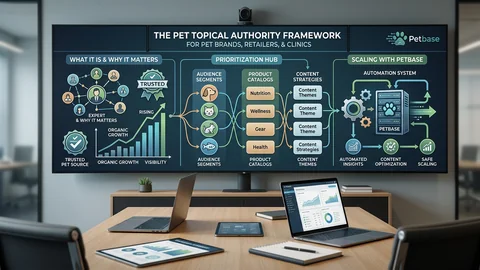
Each category-led cluster builds depth for a clear theme: nutrition, play and enrichment, and wellness. Over time, these clusters reinforce your domain’s expertise and navigation consistency.
Integrate your cluster plan with your main topical authority guide. Align cadence, schema patterns, and cross-category references. This coherence may support stronger ranking signals and sustained add-to-cart growth.

Frequently Asked Questions
How many posts should a category-led pet cluster include?
Many retailers start with 1 hub and 6-10 spokes per category. Evidence suggests a balanced mix of comparison, how-to, and problem-led posts may support both rankings and conversion.
Where should I place product links inside educational posts?
Add a contextual SKU block after the first resolution paragraph, then another near the bottom. Heatmaps often indicate mid-article placements may improve CTR without disrupting reading.
Do I need separate clusters for dog and cat products?
Yes, species intent diverges. Separate hubs for dogs and cats, with breed or life-stage spokes, may improve relevance and reduce pogo-sticking.
What schema helps connect content to products?
Consider Article or HowTo on posts with FAQ, plus ItemList linking to top SKUs and Product on PDPs. Structured data may help search engines understand relationships.
How fast can a new cluster impact add-to-cart rates?
Early engagement shifts can appear in 1-2 weeks, while meaningful add-to-cart changes often need 4-8 weeks as indexing, rankings, and user paths stabilize.
Conclusion
Category-led clusters transform scattered pet category pages SEO into measured journeys from question to confident cart. Start with food, toys, and supplements. Map intent to filters, reinforce with structured links, and monitor early and mid-term signals.
Use conservative claims and clear safety boundaries. Iterate pinning and layout to strengthen internal linking to SKUs. With disciplined implementation, these clusters may steadily increase qualified clicks and add-to-carts across your catalog.
References
- J Shi et al. (2023). Subsumption prediction for e-commerce taxonomies. European Semantic …. View article
- L Tan et al. (2020). E-commerce product categorization via machine translation. ACM Transactions on Management Information …. View article
- U Avron et al. (2022). Automated category tree construction in E-commerce. Proceedings of The 2022 …. View article
- D Yang et al. (2024). A bespoke question intent taxonomy for e-commerce. 2024 - amazon.science. View article