Veterinary SEO: Procedure and Condition Pages that Build E-E-A-T

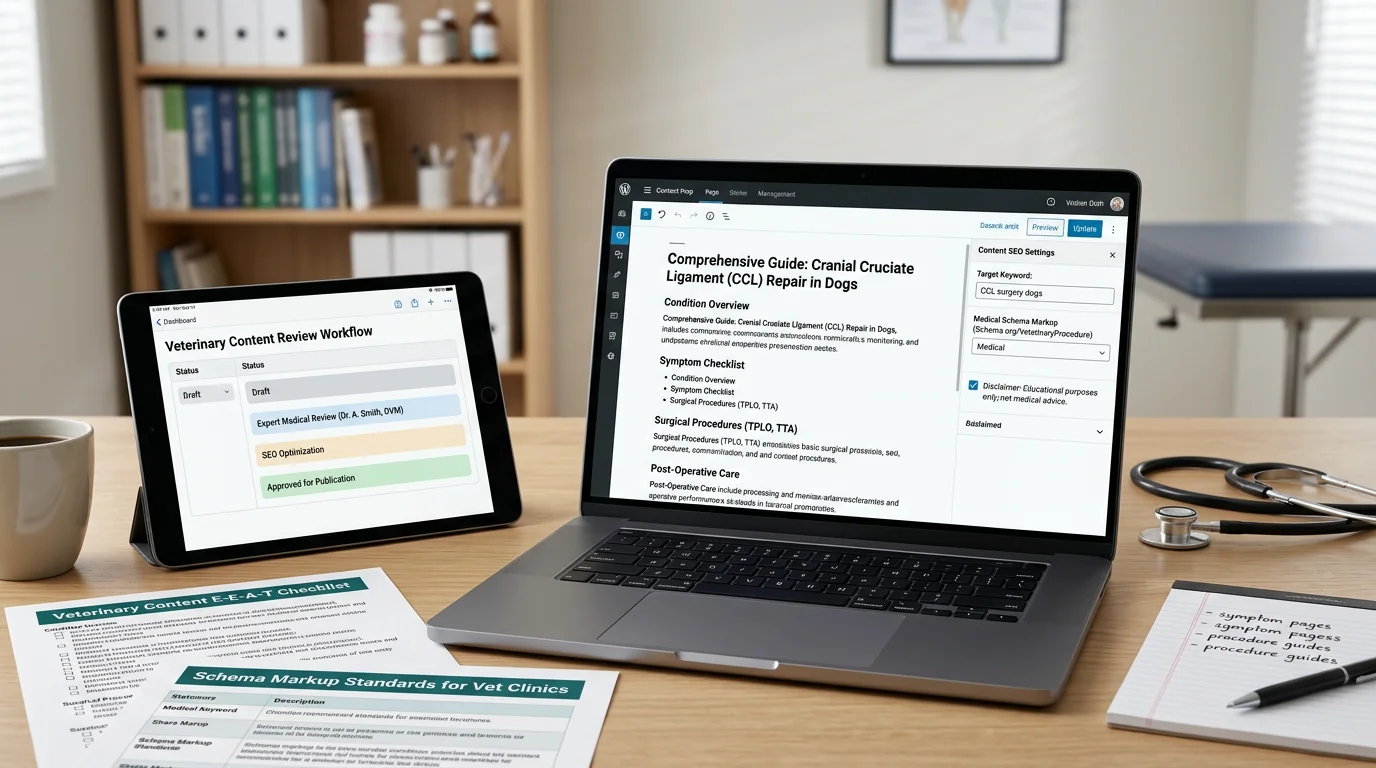
Table of Contents +
- Why procedure and condition pages are the E-E-A-T backbone for veterinary SEO
- Quick decision guide: what to publish first and how to structure it
- Page architecture blueprint: procedures, conditions, and symptoms
- Medical structured data: schema patterns that may support trust and visibility
- Editorial safeguards: disclaimers, review workflows, and update cadence
- Evidence status: how strong is the backing for these recommendations?
- Monitoring plan: what to observe after 7-14 days and 4-8 weeks
- Measurement and iteration checklist
- Frequently Asked Questions
- References
Learn how clinics can build E-E-A-T with procedure, condition, and symptom pages using medical schema, disclaimers, and review workflows.
Owners search symptoms and procedures before calling a clinic. They compare credibility in seconds. Your site either signals authority or introduces doubt.
This matters because accurate, structured medical content improves trust and discoverability. In this guide, you will learn how to build veterinary procedure pages, condition explainers, and symptom checker content with compliant schema, clear disclaimers, and defensible review workflows.
Why procedure and condition pages are the E-E-A-T backbone for veterinary SEO
The single scenario we solve: turning clinical knowledge into trust-rich, rank-ready pages
Clinicians hold the expertise. Yet content often sits in PDFs, social posts, or front-desk scripts. The solution is standardized pages that translate clinical reasoning into accessible explanations, risk ranges, and next steps. E-E-A-T for veterinarians strengthens when every claim is attributed, time-stamped, and reviewed. Evidence suggests clinics with clear online information may see stronger performance and client confidence compared to those without structured web content.[1]
How this supports the pet topical authority framework
Topical authority is built by covering symptoms, conditions, and procedures in a connected model, using consistent terminology and internal links. Align your hub with a clinic-level taxonomy and intent mapping. For a structured approach, see the pet topical authority framework, which organizes clusters to help searchers progress from concern to appointment.
Petbase automates SEO content for veterinary clinics - so you can focus on patients, not blog posts - start your free trial.
Quick decision guide: what to publish first and how to structure it
If X situation, then Y action (5-7 scenarios)
- If phones repeat the same triage questions, publish symptom pages with red-flag guidance and care urgency bands. Link to likely conditions and first-line procedures.
- If a high-margin procedure lacks visibility, launch a comprehensive procedure page with indications, contraindications, risks, cost ranges, and recovery milestones.
- If the clinic treats niche cases, prioritize condition pages that clarify differential diagnoses and referral thresholds. Add decision trees and conservative care options.
- If you field post-op queries, add recovery FAQs and day-by-day expectations to procedure pages. Embed aftercare downloads.
- If competitors outrank on generic terms, target long-tail intent: “recovery timeline for [procedure]” and “[symptom] when to seek care.”
- If pages exist but underperform, add medical schema for vets, author credentials, and last-reviewed dates. Improve crosslinking depth.
- If resources are limited, produce one symptom, one condition, and one procedure page per month. Maintain a repeatable review workflow.
Page architecture blueprint: procedures, conditions, and symptoms
Canonical templates and required on-page elements
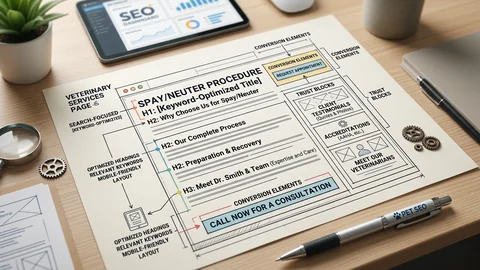
Procedure template: Indications, preparation, anesthesia plan overview, steps summary, risks with likelihood bands, recovery timeline, cost range, who performs it, alternatives, aftercare, FAQs, and appointment call-to-action.
Condition template: Definition, common causes, symptoms, diagnostics pathway, staging/severity, first-line management, advanced options, prognosis ranges, home-care boundaries, referral criteria, and related procedures.
Symptom template: Plain-language description, possible causes with probability signals, red flags, self-care do’s and don’ts, when to seek urgent care, and links to conditions. This supports vet condition pages SEO while respecting uncertainty.
Crosslinking logic: symptom → condition → procedure → local appointment
Build predictable pathways. From symptom pages, link to top probable conditions and initial tests. From conditions, link to first-line and advanced procedures. From all pages, link to clinic locations and veterinarian bios. For crosslink depth patterns, review internal linking blueprints for pet sites to reduce dead-ends and strengthen intent paths.
Medical structured data: schema patterns that may support trust and visibility
Required and optional properties for Procedure and MedicalCondition
For procedures, use MedicalProcedure with name, alternateName, howPerformed, indication, contraindication, followup, bodyLocation, estimatedCost (range), and possibleComplication. For conditions, use MedicalCondition with name, alternateName, signOrSymptom, possibleTreatment, associatedAnatomy, typicalTest, and epidemiology when appropriate.
Use mainEntityOfPage, author, reviewedBy, and dateModified to reinforce editorial signals. Evidence from digital education sites suggests that structured, findable content may improve engagement and preparedness when SEO fundamentals are executed consistently.[3] For schema at scale, many teams adopt Petbase AI to templatize metadata and keep review dates synchronized.
LocalBusiness + Physician/VeterinaryCare integration
Mark each clinic location with LocalBusiness and VeterinaryCare types, including name, address, geo, openingHours, telephone, and sameAs. Associate medical pages using provider pointing to the location entity. Prefer VeterinaryCare over Physician, which is human-medicine oriented.
Where individual veterinarian profiles exist, use Person with jobTitle, hasCredential, affiliation, and medicalSpecialty. Link bios from procedure and condition pages. This supports E-E-A-T for veterinarians by aligning visible author data with structured claims.[2]
Common schema pitfalls to avoid
Avoid mismatches between schema fields and on-page copy. Do not use human-only types for veterinary content. Do not publish medical claims without visible context. Keep cost figures as ranges, not guarantees.
Validate JSON-LD with multiple tools and maintain consistent terminology across entities. Evidence suggests disciplined use of information technology correlates with stronger performance signals for clinics adopting web best practices.[1]

Editorial safeguards: disclaimers, review workflows, and update cadence
Practical safety boundaries for clinical content
Use a plain-language disclaimer on every medical page. Clarify that information is educational, not diagnostic, and that urgent signs require immediate care. Avoid dosage specifics unless reviewed by a licensed clinician and local regulations permit.
State uncertainty explicitly. Use phrases like “may indicate,” “can present as,” and “evidence suggests.” Provide home-care advice only when low-risk and time bound. Emphasize when to stop self-care and seek professional evaluation.
Author, reviewer, and last-reviewed metadata
Display the author’s name, credentials, and role. Add a clinical reviewer with credentials and a clear last reviewed date. Store this metadata on page and in schema.
Adopt a two-step review: medical accuracy, then editorial clarity. Evidence indicates that strong first impressions on websites influence trust and selection in competitive local searches, underscoring visible expertise markers.[2] For policy design, see guidance on content QA for pet accuracy.
Media use: diagrams, before/after, and image EXIF hygiene
Use labeled diagrams to explain anatomy and procedure steps. Secure consent for patient images. Avoid claims implied by “after” photos; add context and timeframes. Compress images and include descriptive alt text.
Strip sensitive EXIF data, especially GPS. Where appropriate, include controlled EXIF fields for copyright and creator. Consistent media standards support clarity and reduce legal and privacy risks while reinforcing professional presentation.[2]
Evidence status: how strong is the backing for these recommendations?
What guidelines and public statements suggest
Industry literature emphasizes the importance of professional online presence, consistent branding, and clear information architecture for client decision-making in local search contexts.[2] Research on veterinary businesses also indicates that structured adoption of information technology can correlate with improved organizational performance, supporting investment in scalable web systems.[1]
Where evidence is emerging or mixed
Educational site studies suggest optimization and structured content may enhance engagement and preparedness, though causality can be complex and context dependent.[3] AI-assisted workflows may improve operational efficiency in veterinary settings, yet quality depends on rigorous human oversight and governance frameworks.[4]
Monitoring plan: what to observe after 7-14 days and 4-8 weeks
Early indicators (crawlability and SERP features)
Within 7-14 days, check indexing status, impressions for long-tail queries, and presence of rich results for FAQs or HowTo blocks. Validate that internal links from symptoms to conditions are crawled and pass relevance.
Track average position for niche modifiers like “recovery timeline” and “risk of complication.” Review error logs for schema. If discovery remains weak, strengthen page headings and internal links, and reassess intent coverage using guidance on AI Overviews and visual search.
Mid-term indicators (engagement and qualified leads)
At 4-8 weeks, evaluate dwell time on procedure pages, scroll depth to cost and recovery sections, and click-through to appointment forms. Monitor call tracking for symptom-related queries converted to consultations.
Analyze assisted conversions from symptom and condition pages. Evidence suggests that clinics with better digital operations observe improved business outcomes, so link analytics to scheduling data for clarity.[1]
Measurement and iteration checklist
Content quality signals to log each month
- Percentage of pages with visible author, reviewer, and last-reviewed dates.
- Schema validity rate and coverage for core entities.
- Unique symptom queries captured and their click-through rates.
- Average scroll depth to decision sections (risks, costs, recovery).
- Internal link density from symptoms → conditions → procedures.
- Appointment conversions originating from medical pages.
Where resources are constrained, schedule a 30-day cadence and triage updates by search demand and medical risk. For planning discipline, see a 30-day content automation cadence.
When to expand into multilingual or referral pages
Consider multilingual expansion when 10-15% of local queries appear in another language, or when cross-border referrals grow. Localize medical terminology with clinical reviewers, not direct translation.
Add referral-focused pages when advanced procedures demonstrate waitlists or regional demand. Build distinct intent pathways for peer referrals and second opinions. When scaling, leverage templates as in programmatic pet SEO to reduce risk.

Frequently Asked Questions
What should a veterinary procedure page include for E-E-A-T?
Include indications, risks, preparation, recovery timeline, cost range, who performs it, author and reviewer bios, last-reviewed date, and medical schema. Add a plain-language disclaimer and internal links to related conditions and symptoms. Present uncertainty clearly and cite sources.
Is Medical schema necessary for veterinary pages?
While not mandatory, MedicalEntity schema variants may support clarity for search engines. Pair with accurate fields, consistent terminology, and LocalBusiness data for the clinic. Keep schema aligned with visible content and validate regularly to prevent mismatches.
How often should vet medical content be reviewed?
Evidence suggests annual clinical review for stable topics and 3-6 months for evolving treatments or drug guidance. Always display last-reviewed and reviewer credentials. Update sooner when guidelines change, adverse events emerge, or pricing shifts materially.
Can symptom pages rank without offering diagnoses?
Yes. Use cautious language, outline possible causes, red-flag signs, and when to seek urgent care. Link to related conditions and procedures without asserting a diagnosis. Emphasize triage guidance and appointment options for urgent and routine evaluations.
What are common pitfalls on vet condition pages?
Overstating certainty, missing reviewer details, vague sources, and inconsistent terminology are common issues. Avoid medical claims without citations and keep schema consistent with visible content. Add prognosis ranges, referral criteria, and clear aftercare guidance.
Build procedure, condition, and symptom pages as standardized assets that earn trust, not just clicks. Use careful language, structured data, and visible reviewers to show accountability. Crosslink intent paths toward booking, while preserving medical caution. Incrementally refine based on early and mid-term indicators. As your library grows, reinforce taxonomies, expand high-demand segments, and preserve consistency across pages. With disciplined workflows, veterinary SEO becomes a clinical communications system that may support better outcomes for clients and clinics alike.
References
- N Fejzić et al. (2023). The impact of digital presence and use of information technology on business performance of veterinary practices: a case study of Bosnia and Herzegovina. Frontiers in Veterinary …. View article
- J Phillips (2022). Branding, websites and the importance of first impressions in the veterinary industry. In Practice.
- C Varga (2026). Designing a biosecurity educational website and assessing user engagement to enhance disease prevention and preparedness on beef cattle farms in the United …. Available at SSRN 6295266 - papers.ssrn.com. View article
- K Beyer et al. (2025). THE ROLE OF ARTIFICIAL INTELLIGENCE AND ICT IN VETERINARY BUSINESS: A LITERATURE REVIEW. Intelligent Management and …. View article