Content QA for Pet Accuracy: Policies, Disclaimers, and Expert Review


Table of Contents +
- Scenario: Publishing pet health content at scale without risking harmful advice
- Operational checklist: policies, disclaimers, and expert review
- Quick decision guide
- Practical safety boundaries
- Evidence status: how strong are the claims?
- Monitoring after go-live
- Documentation and transparency
- Workflow template for Petbase users
- Appendix: example disclaimer and escalation language
- Frequently Asked Questions
- Evidence status: how strong are the claims?
- Documentation and transparency
- Monitoring after go-live
- Operational checklist: policies, disclaimers, and expert review
- Workflow template for Petbase users
- Appendix: example disclaimer and escalation language
- Conclusion
- References
Operational checklist to reduce harmful pet advice: safety policies, medical disclaimers, veterinary review, and update logs that support E-E-A-T.
Publishing pet health information at scale is powerful. It is also risky. A single unclear sentence can be misread and delay urgent care.
This guide helps teams reduce medical risk without halting velocity. You will learn a practical checklist for pet content disclaimers, veterinary expert review, evidence grading, and change logging that strengthens E-E-A-T for pet sites.
Scenario: Publishing pet health content at scale without risking harmful advice
Scope: pages that describe symptoms, treatments, dosing, or risk factors
Apply this framework to any page that discusses signs, treatment options, medication dosing, supplement interactions, or risk factors. Include breed, age, and species parameters. Consider pages that address emergency indicators, post-procedure care, and product safety notes.
Risk model: severity x likelihood for pet owners acting on content
Rate each statement by potential harm severity and the likelihood a reader will act without professional guidance. High-severity, high-likelihood items require vet review, urgent banners, and stronger qualifiers. Use conservative language where evidence is mixed.

Petbase writes and publishes this kind of content automatically - 10 SEO articles per month for pet businesses - start your free trial.
Operational checklist: policies, disclaimers, and expert review
Safety policy: prohibited claims, red-flag terms, and escalation
Create a pet health content policy that bans cure claims, prescriptive dosing without vet review, and off-label recommendations. Maintain a red-flag lexicon covering dosage numerals, drug names, contraindications, and emergency terms. Automate detection using text-mining to surface items for escalation at scale.[1]
Standardized medical disclaimer: placement, wording, localization
Adopt a standard disclaimer that clarifies informational intent, not medical advice. Place a short version near the title and a fuller version before the conclusion. Localize legal wording and hotline details for each target region.
Vet review protocol: roles, cadence, and evidence citation
Define veterinary expert review for dosing, treatment, diagnosis, and red-flag symptoms. Assign credentialed reviewers, specify turnaround SLAs, and require inline citations. Borrow principles from established veterinary QA standards to formalize checkpoints and documentation.[2]
Update log and versioning: date stamps, change notes, and sources
Version every health page. Add visible date stamps, reviewer names, and change notes. Log new or retired sources. For significant updates that alter risk guidance, display a sitewide notice for seven days.
Source hierarchy: guidelines for grading evidence quality
Grade sources by strength. Elevate peer-reviewed veterinary journals and consensus guidelines. Then consider universities and veterinary associations. Mark weaker signals, and qualify statements accordingly. When evidence evolves, revise and document promptly.
Quick decision guide
If the page mentions dosing or treatment, then require pre-publish vet review
Any dosage, frequency, route, or treatment schedule requires documented veterinary expert review with citation checks and reviewer attribution before publishing.
If advice could delay urgent care, then add a prominent urgent-care banner
Insert a colored, persistent banner with “seek immediate care” language. Place it above the fold and repeat near directions for at-home steps.
If evidence is mixed or low quality, then qualify claims and link to sources
Use cautious phrasing, such as “may support” or “limited evidence suggests.” Provide direct links to graded sources and note known limitations.
If content targets multiple regions, then localize legal wording and hotlines
Adjust disclaimer language to local regulations. Include region-specific emergency contacts and poison control numbers. Confirm availability and operating hours quarterly.
If UGC contradicts guidance, then moderate and add clarifying editor’s note
Do not delete responsibly stated experiences. Add a visible editor’s note that clarifies evidence status and directs readers to professional care.
If products are referenced, then disclose affiliations and separate editorial from commercial
Insert disclosure near the first product mention. Keep clinical guidance independent from sales copy. Avoid implying prevention, cure, or guaranteed outcomes.
If AI was used, then add an AI-assist note and human reviewer attribution
Disclose AI assistance and name the human reviewer with credentials and date. Reinforce that clinical content underwent human vet validation.
Practical safety boundaries
Never publish drug dosages or off-label uses without vet sign-off
Require verifiable references and explicit veterinary approval before any dosage appears. Hide dosage snippets from SERP features to reduce decontextualized exposure.
Avoid differential diagnosis; steer to seeking professional care
Describe common signs with ranges and uncertainty. Emphasize that overlapping symptoms merit examination. Provide decision cues directing readers to a clinician.
Do not claim prevention, cure, or risk-free outcomes
Replace absolutes with probability language and evidence grades. State that individual responses vary. Highlight known risks and contraindications prominently.
Clearly mark breed/age/species limits and contraindications
Call out life-stage, size, and species constraints next to recommendations. Consider templated notices to maintain consistency across scalable pages.safer templates for breeds, sizes, and life stages
Use time-to-vet guidance for red-flag symptoms
Offer time-bound triage cues, such as “seek urgent care now,” “within 24 hours,” or “monitor for 48 hours.” Err on the side of earlier care for uncertainty.
Evidence status: how strong are the claims?
Stronger signals: peer-reviewed veterinary journals, consensus guidelines
Rely on systematic reviews, randomized trials, and specialty consensus statements first. These sources anchor clinical accuracy and reduce variability.
Moderate signals: university extensions, veterinary associations
Academic extensions and association briefs provide practical guidance. Cite them with clear dates and revise when new guidelines are issued.
Weaker signals: reputable pet NGOs, textbooks, expert interviews
Use cautiously. Cross-check with primary literature. Mark such sections as “emerging” or “expert opinion,” and avoid prescriptive language.
Low signals: anecdotal reports, forums, manufacturer brochures
Treat as context only. These sources may reflect bias or incomplete data, especially for supplements where quality assurance varies widely.[3]
Language to use: "may support", "limited evidence suggests"
Adopt conservative phrasing for anything below moderate evidence. For methodology and E-E-A-T alignment, review our guidance on citation standards for veterinary pages.
Monitoring after go-live
After 7-14 days: user comments, support tickets, SERP snippets for risky truncations
Scan comments and tickets for confusion or risky reinterpretations. Audit SERP snippets and AI Overviews for truncations that remove qualifiers. Adjust meta descriptions and FAQ markup to protect intent.
After 4-8 weeks: E-E-A-T cues, click-through on disclaimers, medical query intent drift
Track author/reviewer impressions, byline CTR, and disclaimer click-through. Evaluate whether search queries shift toward clinical intent. Align updates with your pet topical authority framework to reinforce governance and coverage.
Trigger thresholds: escalation when harmful interpretation may occur
Escalate if more than 1% of page sessions show signals of unsafe interpretation, or if SERP features display dosing unqualified. Temporarily remove risky fragments while vet reviewers reassess.
Documentation and transparency
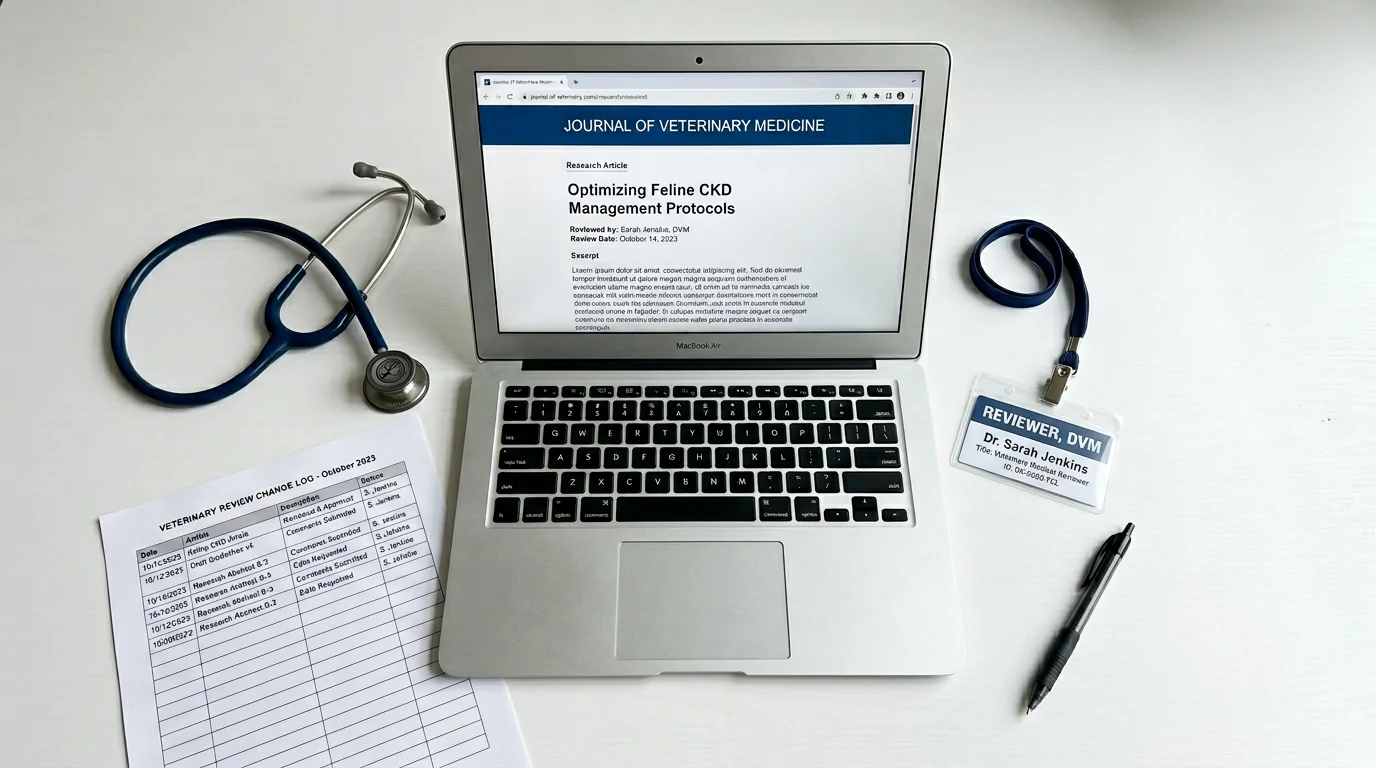
Reviewer byline with credentials and review date
Display the veterinary reviewer’s name, credentials, and review date near the header and in the schema. This improves credibility and clarifies freshness.
Change log with rationale and source updates
Maintain a public change log noting what changed, why, and which sources were added or removed. Include a contact for clinical feedback.
Schema markup: MedicalWebPage attributes and author/reviewer
Implement MedicalWebPage, Author, and Review schema with “medicalSpecialty,” “lastReviewed,” and “reviewedBy.” This may support richer SERP displays and clearer E-E-A-T signals.
Workflow template for Petbase users
Pre-publish checks in automation: red-flag scanner and disclaimer injection
Run a red-flag scanner against dosage numerals, drug names, and emergency phrases. Auto-inject a localized disclaimer block and disclosure. For teams scaling output, consider using Petbase AI to centralize scanning, disclaimer placement, and queueing.
Reviewer assignment and SLA inside content queue
Route flagged drafts to a veterinary expert with a defined SLA, typically 48-72 hours. Require acceptance notes and evidence links before merging to publish.
Post-publish audit: evidence links, schema, and internal links
Within 72 hours, verify citations, disclaimer visibility, and schema validation. Confirm internal links support user navigation, such as your 30-day content cadence with automation plan.
Appendix: example disclaimer and escalation language
Standard disclaimer template (EN, adaptable to region)
This information is for educational purposes and does not replace professional veterinary advice. Do not start, change, or stop treatments without consulting a licensed veterinarian. If you notice sudden or severe symptoms, seek urgent care.
Customize with region-specific legal text and emergency contacts. Ensure readability on mobile devices and contrast compliance for accessibility.
Urgent-care banner examples for life-threatening symptoms
Urgent: If symptoms are severe, worsening, or involve breathing difficulty, seek emergency care now.
Time-sensitive: If vomiting persists over 24 hours, dehydration risk may increase. Contact a veterinarian today.
Monitor: If mild symptoms improve within 48 hours, continue monitoring. If they persist or worsen, book an appointment promptly.
Frequently Asked Questions
Where should a pet health disclaimer appear on a page?
Place a concise disclaimer above the fold near the title and repeat a fuller version near the conclusion. Ensure it is readable on mobile and not hidden behind accordions.
When is veterinary expert review necessary?
Require review for any content mentioning diagnosis, dosing, treatment, supplement interactions, or red-flag symptoms. For general wellness tips, schedule periodic review based on risk.
What sources are acceptable for pet medical claims?
Prioritize peer-reviewed veterinary journals and consensus guidelines, then veterinary associations and universities. Use cautious language when evidence is limited or mixed.
How often should pet health articles be updated?
Reassess high-risk pages every 6-12 months or sooner if guidelines change. Log updates with dates, reviewer names, and source changes for transparency.
How can we reduce risk when using AI to draft pet content?
Use AI for drafting but enforce human vet review on clinical topics, run red-flag term checks, inject standardized disclaimers, and require citations from high-quality sources.
Evidence status: how strong are the claims?
Stronger signals: peer-reviewed veterinary journals, consensus guidelines
Prioritize high-quality research and published consensus. These sources may reduce variability and improve reliability of clinical statements.
Moderate signals: university extensions, veterinary associations
Use academic extensions and association resources for practical context. Track updates to avoid outdated advice and clarify scope limitations.
Weaker signals: reputable pet NGOs, textbooks, expert interviews
Deploy as supplemental context. Label as expert opinion. Cross-reference with primary research when available to strengthen claims.
Low signals: anecdotal reports, forums, manufacturer brochures
These may carry bias or incomplete data. For trending therapeutics like CBD, quality assurance challenges demand extra caution and clear qualifiers.[3]
Language to use: "may support", "limited evidence suggests"
Adopt conservative wording for uncertain areas. Such phrasing aligns with medical content governance and strengthens editorial accountability.
Documentation and transparency
Reviewer byline with credentials and review date
Show the reviewer’s credentials and date prominently. This supports E-E-A-T for pet sites and communicates the freshness of clinical oversight.
Change log with rationale and source updates
Log significant modifications, note source changes, and explain rationale. Transparent notes help readers interpret evolving guidance responsibly.
Schema markup: MedicalWebPage attributes and author/reviewer
Use MedicalWebPage with author and reviewer. Include “lastReviewed,” “reviewedBy,” and “medicalSpecialty” attributes to signal structure to search engines and improve snippet accuracy.
Monitoring after go-live
After 7-14 days: user comments, support tickets, SERP snippets for risky truncations
Audit snippets and AI aggregations for lost qualifiers. Update meta, FAQ markup, and headings to reduce truncation risk. Text-mining methods may help detect problematic phrases across large sets.[1]
After 4-8 weeks: E-E-A-T cues, click-through on disclaimers, medical query intent drift
Measure byline visibility, reviewer CTR, and disclaimer engagement. Monitor query mix for more clinical intent. Align refresh cycles with your pet topical authority framework to keep coverage and governance synchronized.
Trigger thresholds: escalation when harmful interpretation may occur
Escalate if user feedback reveals misinterpretations, or if risk-heavy snippets surface. Temporarily depublish sensitive fragments pending expert review and updates.

Operational checklist: policies, disclaimers, and expert review
Safety policy: prohibited claims, red-flag terms, and escalation
Codify a zero-tolerance list for prescriptive cures, unverified dosing, and claims minimizing risks. Formalize escalation pathways to a clinical lead within 24-48 hours for high-severity items.
Standardized medical disclaimer: placement, wording, localization
Adopt consistent pet content disclaimers. Keep the short version under 30 words. Ensure mobile readability and WCAG contrast. Localize legal verbiage and emergency contacts per region.
Vet review protocol: roles, cadence, and evidence citation
Set reviewer roles, response times, and citation requirements. Align with principles from veterinary QA frameworks to maintain reproducibility and auditability.[2]
Update log and versioning: date stamps, change notes, and sources
Publish a version history on the page. Include date, reviewer, and sources added or removed. For major changes, show an alert badge for returning readers.
Source hierarchy: guidelines for grading evidence quality
Maintain a documented ladder of sources and required qualifiers. Update the ladder annually or when clinical guidance changes materially.
Workflow template for Petbase users
Pre-publish checks in automation: red-flag scanner and disclaimer injection
Run automated scans for dosing numerals, drug names, and urgent phrases. Auto-place a localized disclaimer above the fold. Validate with a human pass for context. AI assistance requires domain validation and oversight.[4]
Reviewer assignment and SLA inside content queue
Auto-route flagged drafts to a credentialed reviewer. Enforce SLAs, require evidence links, and store sign-off notes. Archive reviewer Q&A for future audits.
Post-publish audit: evidence links, schema, and internal links
Verify schema, disclaimer visibility, and evidence integrity. Confirm navigation assists users with safe pathways, supported by your 30-day content cadence with automation operations plan.
Appendix: example disclaimer and escalation language
Standard disclaimer template (EN, adaptable to region)
This article is for educational purposes only and does not replace professional veterinary advice. Always consult a licensed veterinarian for decisions about diagnosis, treatments, medications, or dosing. Seek urgent care for sudden or severe symptoms.
Localize legal terms and emergency contacts. Keep length concise. Ensure accessibility and mobile visibility. Repeat a longer disclaimer before the conclusion.
Urgent-care banner examples for life-threatening symptoms
Emergency now: If symptoms include breathing difficulty, collapse, uncontrolled bleeding, or seizures, seek emergency care immediately.
Urgent today: If severe pain, persistent vomiting, or toxin exposure is suspected, contact a veterinarian today.
Monitor closely: If mild symptoms persist beyond 24-48 hours or worsen at any time, book a veterinary appointment promptly.
Conclusion
Content QA for pet accuracy is not a single checklist item. It is an ongoing governance system. Codify policies, standardize disclaimers, require veterinary expert review, and document updates transparently. Grade evidence, monitor real-world signals, and escalate quickly when risk emerges. With disciplined processes and clear accountability, teams can scale responsibly, safeguard readers, and demonstrate durable E-E-A-T for pet sites.[1][2]
References
- JS Jones-Diette et al. (2019). Validation of text-mining and content analysis techniques using data collected from veterinary practice management software systems in the UK. Preventive veterinary …. View article
- JE Arnold et al. (2019). … quality assurance and standards for veterinary clinical pathology (version 3.0): developed by the American Society for Veterinary Clinical Pathology's (ASVCP) Quality …. 2019 - repository.up.ac.za. View article
- J Polak et al. (2026). Cannabidiol in veterinary medicine: Therapeutic potential and quality assurance challenges in therapeutic trend products. Planta …. View article
- D Leary et al. (2022). The role of artificial intelligence in veterinary radiation oncology. Veterinary Radiology & Ultrasound. View article