Pet Page SEO Optimization: The Complete Orientation Guide for Pet Brands, Retailers, and Services


Table of Contents +
- What Pet Page SEO Is and Why It Matters
- Start Here: What to Prioritize First
- Product, Category, and Service Pages: Where Each Fits
- Topic Discovery and Internal Linking That Move Visitors
- Technical Foundations and International Expansion
- Common Mistakes and Misconceptions
- How We Built These Recommendations + Highlight Box
- Frequently Asked Questions
- References
Understand pet page SEO, where to start, common pitfalls, and how to prioritize product, category, service, and blog pages for faster organic growth.
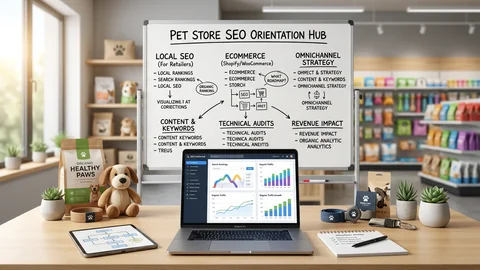
Pet page SEO optimization decides whether searchers find your products, services, and advice first, and it works best when you're tracking pet page SEO performance and ROI to see how rankings, rich results, CTR, assisted conversions, and revenue reflect that impact, especially when multilingual pet SEO helps you align hreflang, currency/units, and breed naming for US, UK, and DACH markets without diluting brand voice. It aligns real intent with pages that convert and pages that educate.
This matters because pet buyers and service seekers evaluate fast, then act. You will learn how to prioritize fundamentals, map page types to funnel roles, and route work to focused playbooks with confidence.
What Pet Page SEO Is and Why It Matters
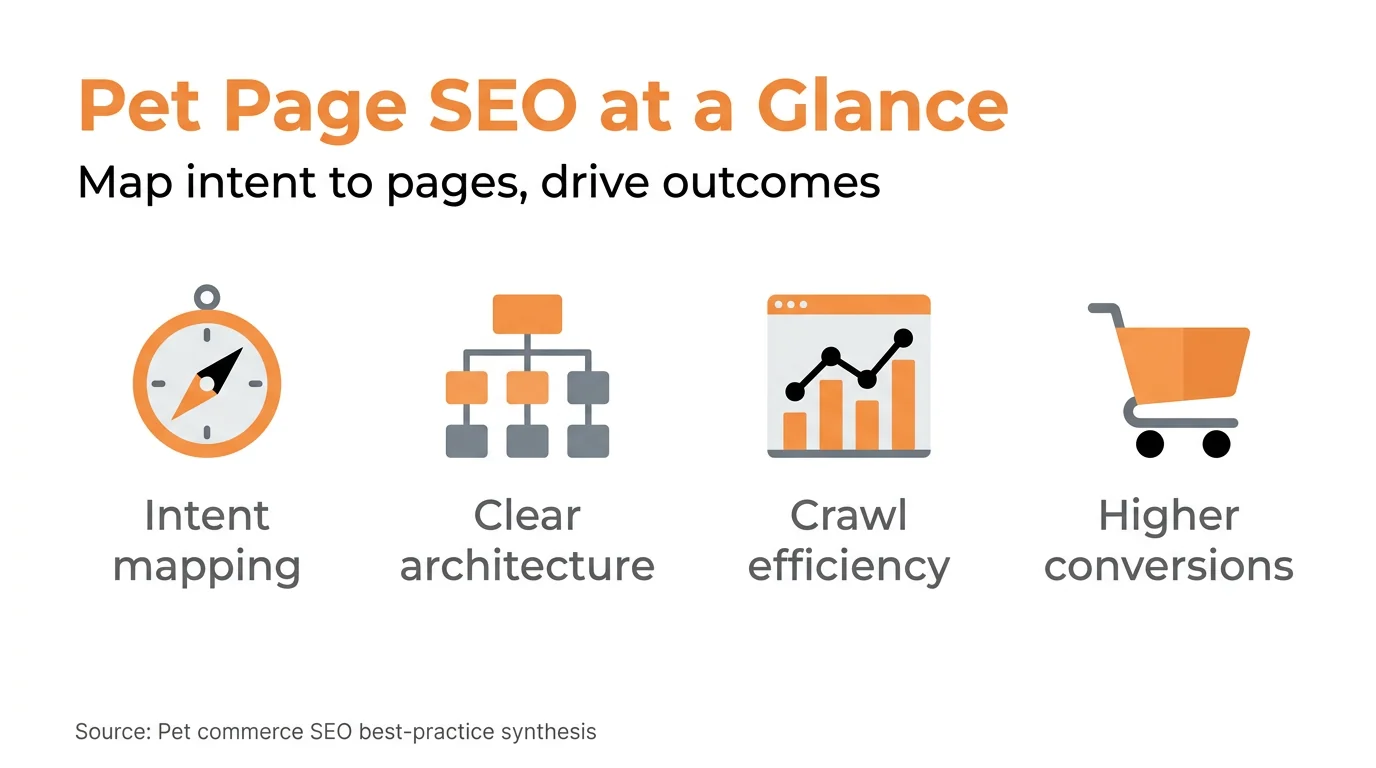
Understand: How pet page SEO connects search intent to products, services, and education
Pet page SEO links specific intents to the right destination: product, category, service, or educational content. It structures your catalog and content so discovery becomes purchase or booking. Modern SEO benefits from data modeling and machine learning, which sharpen targeting and reduce wasteful iteration[2]. For pet brands, this means tighter pet SEO focus, clearer pathways, and measurable impact on revenue.
Do not implement yet: Advanced schema stacks or bulk page rewrites-capture the big picture first
Resist jumping into complex markup or large-scale rewrites. First confirm which intents matter most and where they belong in your site architecture. Then set baseline measurements to evaluate change.
Route to: Structured data and rich results for pet pages (see supporting post #4)
Use structured data as a force multiplier only after on-page basics are consistent across templates.
Petbase automates SEO content for pet stores - publishing 10 optimized articles monthly so you can focus on running your shop - start your free trial.
Start Here: What to Prioritize First
Understand: Management (site structure), forage (evergreen topics), basic nutrition (on-page essentials) before supplements
Prioritize information architecture, evergreen pet keyword research themes, and on-page fundamentals. Focus your highest-value product, category, and service pages first. This sequence strengthens pet brand SEO foundations before scaling tactics.
Do not implement yet: Faceted expansion at scale or multi-language rollouts
Do not add dozens of filters, tags, or languages before validating demand and crawl budgets. Undisciplined expansion often fragments signals and dilutes authority in pet eCommerce SEO.
Route to: On-page SEO checklist for pet brands (see supporting post #6)
Standardize titles, descriptions, media, and trust signals with the On-page SEO checklist for pet brands. Consistency across templates compounds ranking gains and reduces maintenance overhead.
Product, Category, and Service Pages: Where Each Fits
Understand: Roles of product, collection, and local service pages in the funnel
Product pages convert precise commercial intent. Category and collection pages capture mid-funnel exploration and comparison. Local service pages satisfy proximity-driven needs with availability, proof, and clear calls to book-critical for veterinary SEO.
Do not implement yet: Programmatic templates without validated intent mapping
Avoid generating product or collection templates at scale without proof of search intent and unique value. Map modifiers like breed, size, and life stage before template proliferation.
Route to: Optimize pet product pages for breed, size, and life-stage intent (see supporting post #0) and Create SEO-ready category and collection pages for pet catalogs (see supporting post #1) and Local SEO for veterinarians, groomers, and trainers (see supporting post #2)
Deep-dive on product alignment with Optimize pet product pages for breed, size, and life-stage intent. Build scalable browse experiences with Create SEO-ready category and collection pages for pet catalogs. For location-driven services, prioritize presence and proof signals via local pages and reviews. E-commerce research shows coordinated SEO and paid tactics can reinforce product visibility when aligned to user intent[1].
Topic Discovery and Internal Linking That Move Visitors
Understand: How research flows into clusters and how blogs connect to commerce
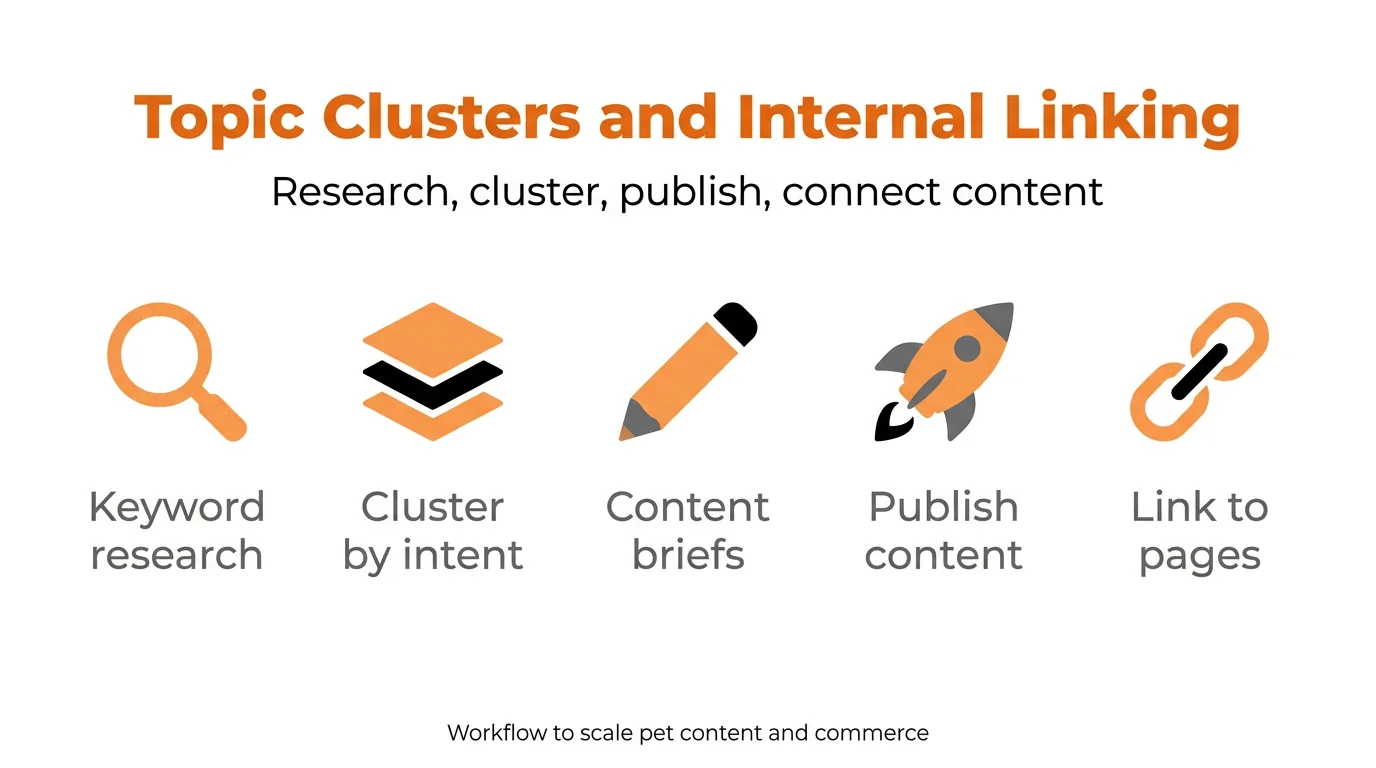
Start with pet keyword research across head terms, long-tail modifiers, and seasonal interest. Cluster topics around core categories and services, then position blogs to educate and pass visitors forward. Review data from real customers helps surface priorities and language that convert in the pet market[4].
To operationalize this at scale, many teams automate research, brief creation, and publishing with tools like Petbase AI, keeping clusters fresh while preserving governance.
Do not implement yet: Large-scale interlinking automations without guardrails
Do not auto-link every occurrence of a keyword. Define anchor patterns and destination rules, and cap per-page links to preserve hierarchy and relevance.
Route to: Pet keyword research: head, long-tail, and seasonal (see supporting post #5) and Internal linking that moves pet parents from blogs to products (see supporting post #3)
Design paths that turn education into action with Internal linking that moves pet parents from blogs to products. Use these patterns to guide readers from advice to the exact product or service that matches intent.
Technical Foundations and International Expansion
Understand: Core technical signals and when to localize for new regions
Prioritize crawlability, indexation, canonical logic, page speed, and media delivery before complex enhancements. Once performance is stable, assess international demand and local compliance before rolling out localized sites for pet brand SEO. Advanced SEO approaches increasingly apply modeling to inform these decisions at scale[2].
Do not implement yet: Complex schema nesting or hreflang for every variant
Avoid exhaustive hreflang coverage or nested schema until you stabilize templates and content. Over-engineering early creates maintenance burdens without proportional gains.
Route to: Structured data and rich results for pet pages (see supporting post #4) and Multilingual SEO for US, UK, and DACH pet markets (see supporting post #7)
Adopt structured data after on-page consistency, then consider localized experiences once you validate regional search demand and fulfillment readiness.
Common Mistakes and Misconceptions
Understand: Pitfalls like intent mismatch, thin collections, and over-faceting
Biggest pitfalls include misaligned page intent, thin or duplicate collections, unchecked filters, and weak internal linking from blogs to commerce. In the pet industry, SEO remains a core lever across brand growth strategies[3].
Do not implement yet: Aggressive pruning or mass redirects without analysis
Do not purge content or roll out bulk redirects without evaluating traffic, backlinks, and assisted conversions. Remove or consolidate only when a page cannot be rehabilitated to meet clear intent.
Route to: On-page SEO checklist for pet brands (see supporting post #6)
Use the checklist to close common gaps before restructuring or retiring URLs. Consistency reduces noise that masks genuine underperformance.
How We Built These Recommendations + Highlight Box
Understand: Based on practice with pet catalogs, literature, and SERP observation
These recommendations synthesize pet eCommerce SEO practice, sector research, and search results analysis. They prioritize durable levers over one-off tricks so teams can plan with conviction.
Do not implement yet: Advanced testing frameworks without baseline metrics
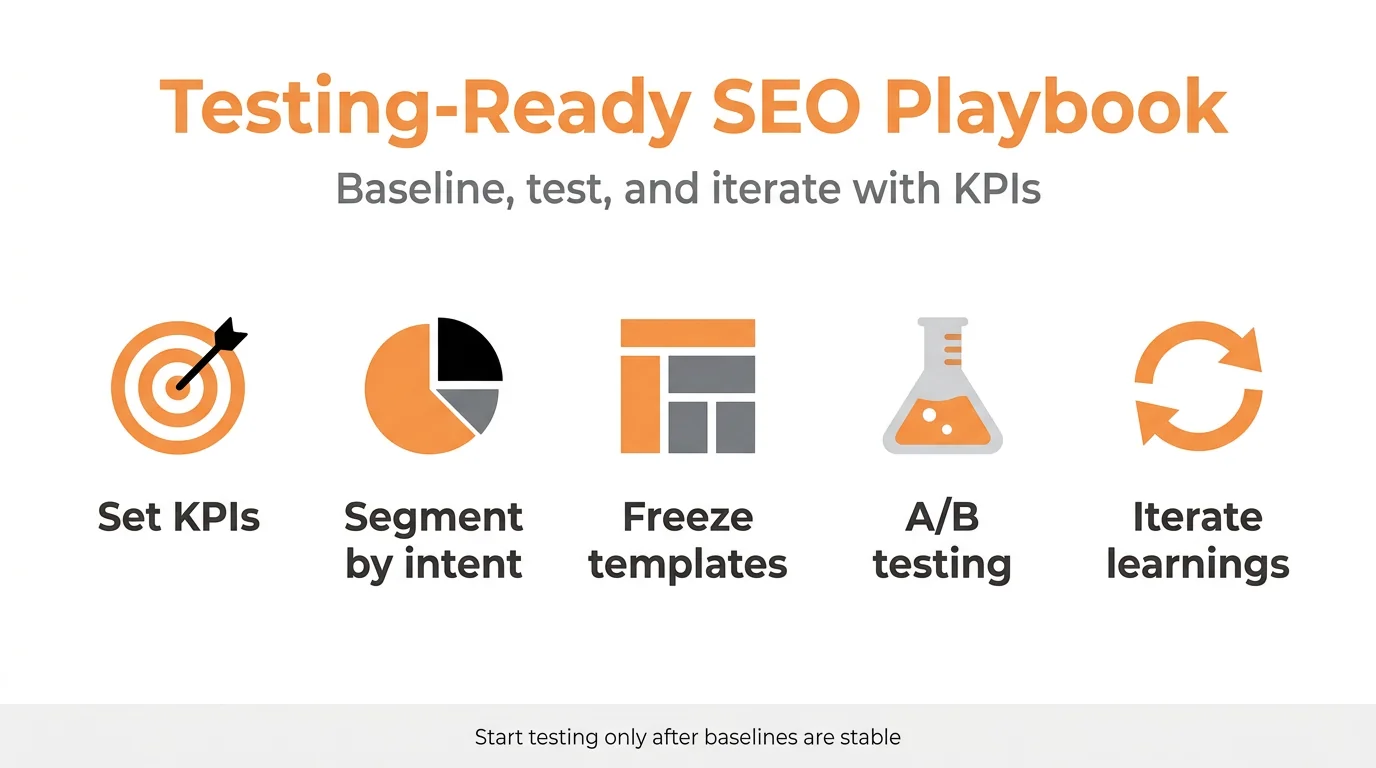
Establish KPIs, segment by intent, and freeze templates before A/B or multivariate testing. Testing without baselines confuses signal and slows iteration.
Route to: Measuring pet page SEO performance and ROI (see supporting post #8)
Score progress by page type and intent, then decide where to double down or simplify as models mature.
Highlight Box: Top 3 Actions - 1) Map intent to product/category/service pages. 2) Ship on-page basics site-wide. 3) Build clusters and link blogs to money pages.
Top 3 Actions
- Map search intent to the correct product, category, and service templates, then standardize coverage.
- Ship on-page fundamentals site-wide before scaling schema, filters, or languages.
- Build topic clusters and link educational content directly to high-intent “money” pages.
Frequently Asked Questions
What should a pet brand optimize first for SEO?
Start with site structure and on-page basics across your highest-value product, category, and service pages. Ensure clear intent mapping and internal links from relevant blogs.
How do category pages help pet eCommerce SEO?
They capture mid-funnel demand by aggregating related products with filters aligned to breed, size, and life stage. Well-structured collections improve discoverability and navigation.
Do pet services need different SEO tactics than retailers?
Yes. Services rely on local signals like NAP consistency, location pages, reviews, and service schemas, while retailers emphasize product, category depth, and commercial intent keywords.
When should I add schema to pet pages?
After core on-page elements are consistent. Add Product, Organization, and LocalBusiness first, then extend thoughtfully to FAQs and articles to support rich results.
How do I measure pet page SEO impact?
Track rankings by intent, clicks to priority pages, assisted conversions, and internal link paths from blogs to products. Compare before/after changes over consistent time windows.
References
- H Ibrahim et al. (2024). A Dual-Focused Approach to E-Commerce Product Ranking: Leveraging Search Engine Optimization and Search Engine Marketing.. Library of Progress ….
- A Darrazi (2024). Pushing the Boundaries of Digital Marketing with SEO-Modeling. 2024 - diva-portal.org. View article
- S Xu (2024). Research on marketing strategies in the pet food industry: A case study based on existing brands. SHS Web of Conferences. View article
- A Suwanmosi et al. (2026). Consumer Insights Discovery for Pet Products from Online Customer Reviews Analysis in E-commerce Market.. datascience.cmu.ac.th. View article