Local SEO for Pet Services: Build Vet, Groomer, and Trainer Pages That Rank and Book

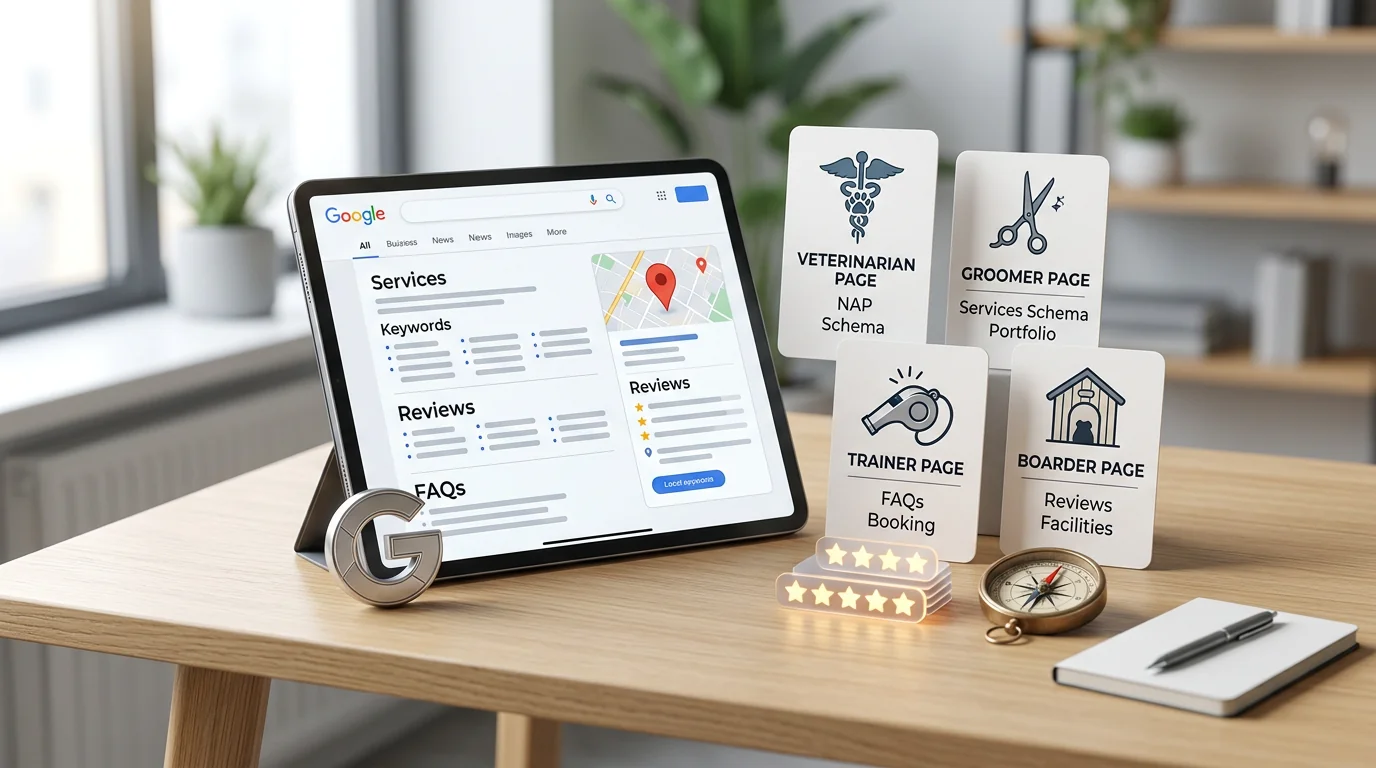
Table of Contents +
- The scenario: One location, multiple pet services-how to structure pages to rank and convert
- Quick decision guide
- Implement the page template for vets, groomers, trainers, and boarders
- Google Business Profile optimization that supports your pages
- Monitoring guidance: what to check after 7-14 days and 4-8 weeks
- Practical safety boundaries
- Evidence status: what current data and guidelines suggest
- Frequently Asked Questions
- Checklist to publish and validate a single service + city page in one week
- Connect this playbook to your broader pet page strategy
- References
Practical local SEO for pet services. Structure vet, groomer, and trainer pages with NAP, services schema, reviews, FAQs, and GBP to rank and win bookings.
Your local pages decide whether searchers become booked appointments. Poor structure confuses Google and pet owners. Consistent templates turn discovery into trust and action.
This guide explains how to build effective service and location pages for veterinarians, groomers, trainers, and boarders. You will learn page structure, NAP placement, service schema, reviews, FAQs, and Google Business Profile optimization that may support rankings and conversions.
The scenario: One location, multiple pet services-how to structure pages to rank and convert
Core decision: one service page per intent and per location
Evidence suggests one page per core service and per city aligns with clear intent. Consolidate overlapping sub-services under the parent service to avoid cannibalization. If you operate in multiple cities, create distinct service area pages with localized content.
Page blueprint: modules that may support rankings and bookings
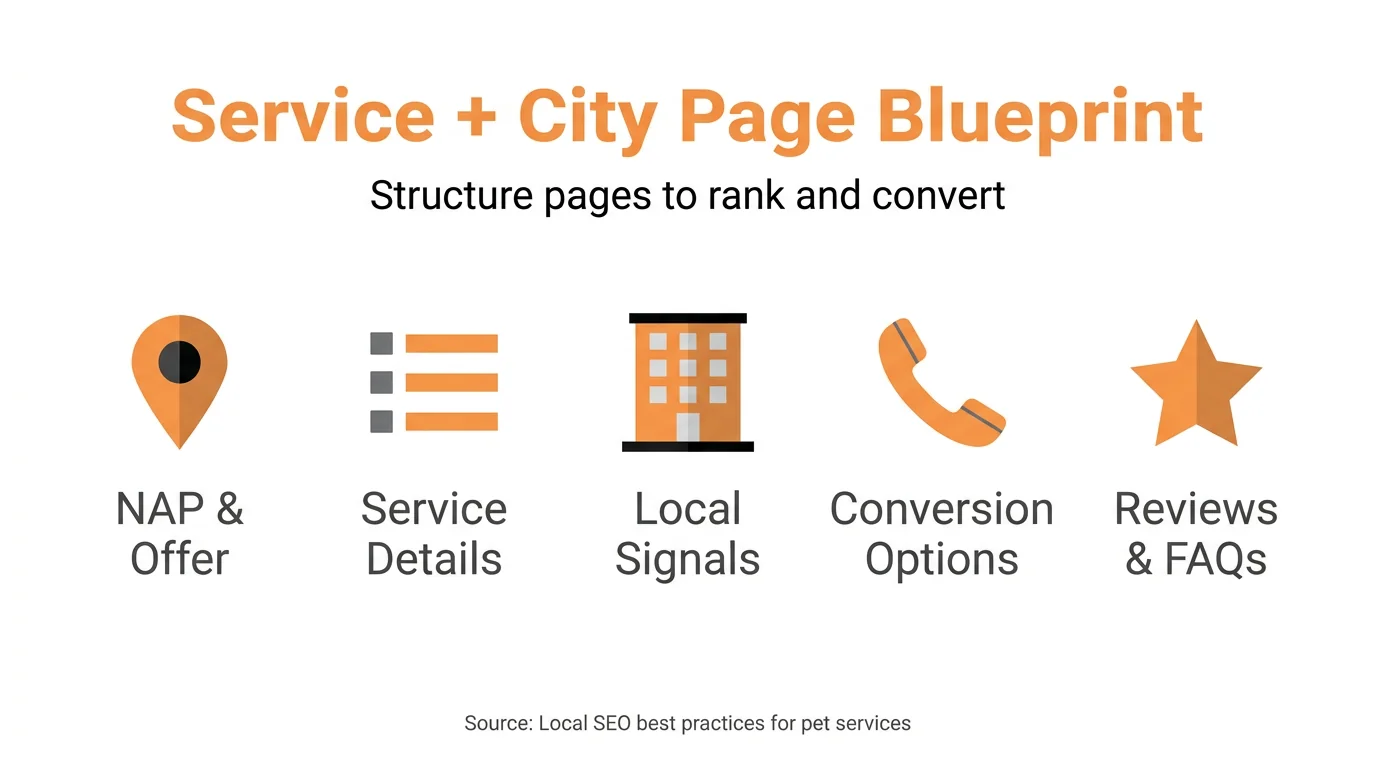
Build a predictable block order: above-the-fold NAP and offer, service detail sections, local signals, conversion options, reviews, FAQs, and structured data. This layout supports veterinary SEO, groomer SEO, and dog trainer SEO consistently. For broader strategy context, see the Pet Page SEO Optimization overview.
Petbase automates SEO content for veterinary clinics - so you can focus on patients, not blog posts - start your free trial.
Quick decision guide
If X situation, then Y action (5-7 concise rules)
- If one location offers three services, create one page per service for that city. Avoid bundling unrelated intents on one URL.
- If a service includes variants, add on-page anchors for variants. Keep a single canonical page per city.
- If you add a new city, clone the service template and localize NAP, neighborhoods, and media. Do not copy reviews verbatim.
- If thin content risks duplicate intent, expand with procedures, breeds served, and modifiers. Add original photos.
- If multiple practitioners exist, list them with credentials. Retain one primary service URL to consolidate authority.
- If demand varies seasonally, surface timely modules first, such as shedding-season grooming or puppy training availability.
- If you change pricing or hours, update on-page details and Google Business Profile the same day to maintain consistency.
Iterative rules like these mirror effective local search heuristics, where focused, incremental adjustments may improve outcomes over time.[4]
Implement the page template for vets, groomers, trainers, and boarders
Above-the-fold: NAP, primary service offer, and trust cues
Place business Name, Address, and Phone (NAP) at the top, with a prominent city tag. Add a headline such as “Veterinary Care in [City]-Same-Day Appointments.” Include rating stars, membership logos, and a visible “Book Now.”
Service details: procedures, breeds, and modifiers users search
Group details by user intent. For vets, list wellness exams, vaccinations, dental, and surgery. For groomers, include baths, nail trims, and deshedding. For trainers, add puppy basics, behavior modification, and advanced skills. Incorporate breed and life-stage modifiers. Use keyword research to prioritize modules; the pet keyword research guide offers practical modifiers.
Local signals: embedded map, neighborhoods, and parking info
Embed a map pinned to your precise location. Mention nearby neighborhoods, landmarks, and transit lines. Add parking instructions or drop-off directions. These cues clarify relevance and reduce friction for mobile users.
Conversion elements: booking options and availability indicators
Offer two or three actions: online booking, call now, and text/chat. Surface next available times or “booking within 48 hours” to encourage action. Reduce form fields. Display insurance or payment options for veterinary services.
Structured data: Organization, LocalBusiness, Service, and FAQ
Implement JSON-LD for Organization and the appropriate LocalBusiness subtype (e.g., VeterinaryCare, PetGrooming, AnimalShelter for boarders, or AnimalTraining). Mark each offering with Service schema. Add FAQPage markup for top questions. For patterns and examples, review schema for pet pages.
Google Business Profile optimization that supports your pages
Categories, services, and attributes
Select a primary category that matches your main offering for each location. Add services with clear names and short descriptions. Populate attributes such as wheelchair access, payment types, and online care options when relevant.
Photos, products, and posts alignment
Upload exterior, interior, team, and service imagery that matches page content. Feature popular packages as products. Use weekly posts to highlight promotions or educational tips. Align wording with your page headlines and modules.
Reviews strategy: prompts, response patterns, and UGC
Request reviews after appointments with a direct link and guidance to mention the service received. Respond within 24-72 hours using consistent, brand-safe patterns. Encourage user-generated content where terms allow. Strategic signal selection mirrors feature selection approaches that often improve classification quality.[3]
Monitoring guidance: what to check after 7-14 days and 4-8 weeks
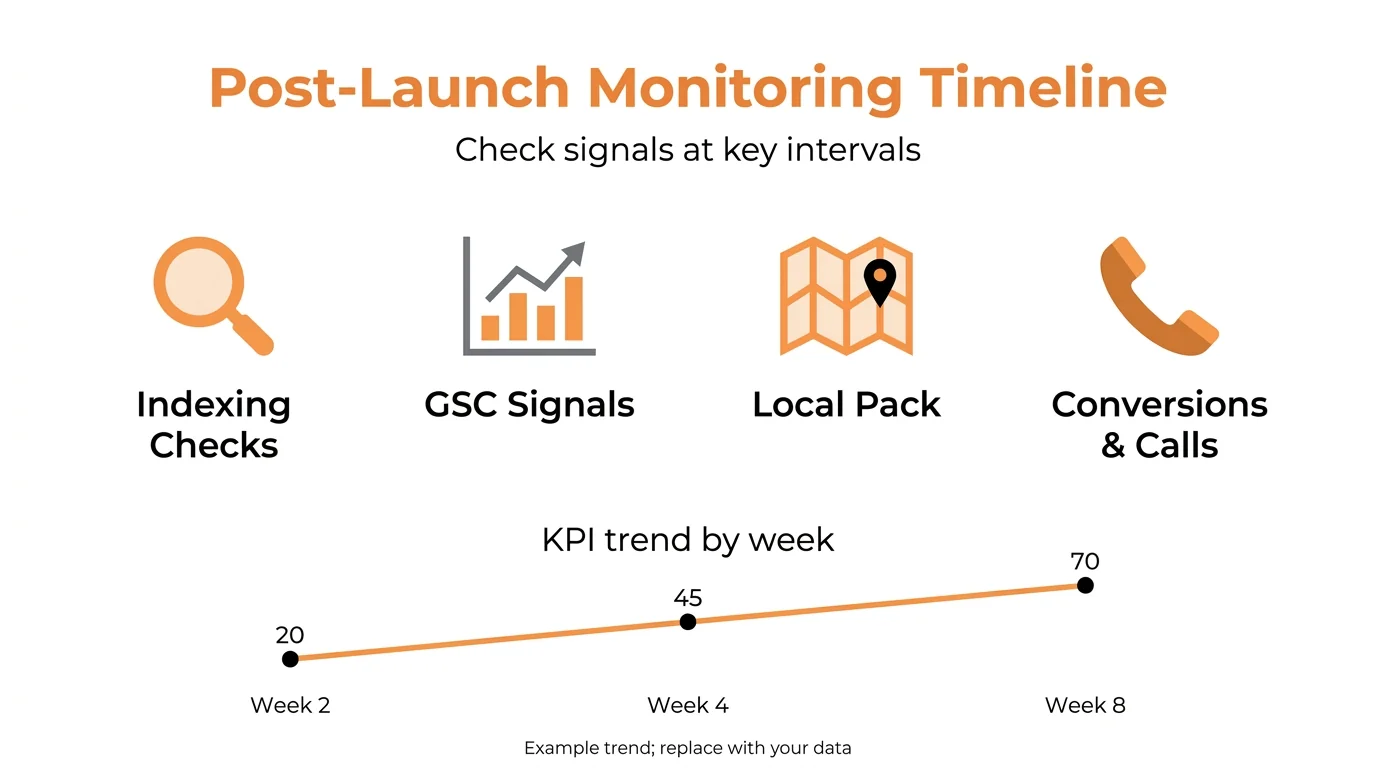
Early signals (7-14 days): indexing, impressions, and GSC coverage
Confirm indexing via site: queries. In Google Search Console, watch Coverage and Performance for impressions and early queries. Iterate titles and H1s if impressions remain flat. Iterative, gradient-informed updates may accelerate improvement when feedback is timely.[2] For setup details, see measurement guidance in tracking pet page SEO performance.
Later signals (4-8 weeks): local pack visibility and bookings
Evaluate local pack presence for “[service] [city]” and “[service] near me” within your service radius. Track calls, bookings, and GBP Insights. Guided, penalty-aware tuning-adjusting only underperforming modules-often yields steadier gains.[1] Consider using Petbase AI to scale consistent updates across service and city pages without drift.
Practical safety boundaries
Medical claims and compliance for veterinary pages
Avoid curative guarantees. Use cautious language for outcomes and reference individualized exams. Include licensing, emergency protocols, and consent policies. Ensure after-hours guidance and disclaimers appear on pages and schema consistently.
Policy-aligned review handling and testimonials
Do not incentivize positive reviews or filter out negatives. Invite honest feedback and disclose any material connections. Avoid copying testimonials across cities to prevent duplication and misrepresentation.
Tracking privacy and consent for call/booking analytics
Disclose call tracking usage and consent for session recording where required. Rotate tracking numbers while preserving NAP consistency via dynamic insertion. Remove personally identifiable information from analytics exports when sharing reports.
Evidence status: what current data and guidelines suggest
What is consensus-based (Google docs, industry studies)
Consistency of NAP, clear primary categories, unique localized content, and structured data alignment are widely recommended. Reviews, photos, and complete profiles correlate with better visibility. Matching on-page copy to user intent supports conversion.
What is directional (correlations and case observations)
Module order, availability badges, neighborhood mentions, and anchor links may correlate with improved engagement. Iterative, stochastic-style optimization-small tests with measured rollouts-often outperforms large, infrequent changes in practice.[4]
Frequently Asked Questions
Should I create separate pages for each pet service and city?
Evidence suggests one page per core service per city may perform better than catch-all pages. Avoid thin duplicates-localize with unique details, reviews, and media.
What is the best primary category for a pet service on Google Business Profile?
Choose the category that matches your main offering (e.g., Veterinarian, Pet Groomer, Dog Trainer). Add secondary categories for other services only if they are substantial.
Do reviews with keywords help local SEO for pet services?
Studies indicate reviews and selected keywords within them may correlate with better visibility. Encourage natural, honest reviews rather than scripting exact phrases.
How long until a new service page impacts local rankings?
You may see early indexing and impressions in 1-2 weeks. Local pack and booking impact often emerges over 4-8 weeks as signals (reviews, behavior) accumulate.
What schema should pet service pages use?
Consider LocalBusiness subtype (e.g., VeterinaryCare), Service for each offering, Organization, Breadcrumb, and FAQPage. Ensure details match on-page content.
Checklist to publish and validate a single service + city page in one week
Day-by-day actions and acceptance criteria
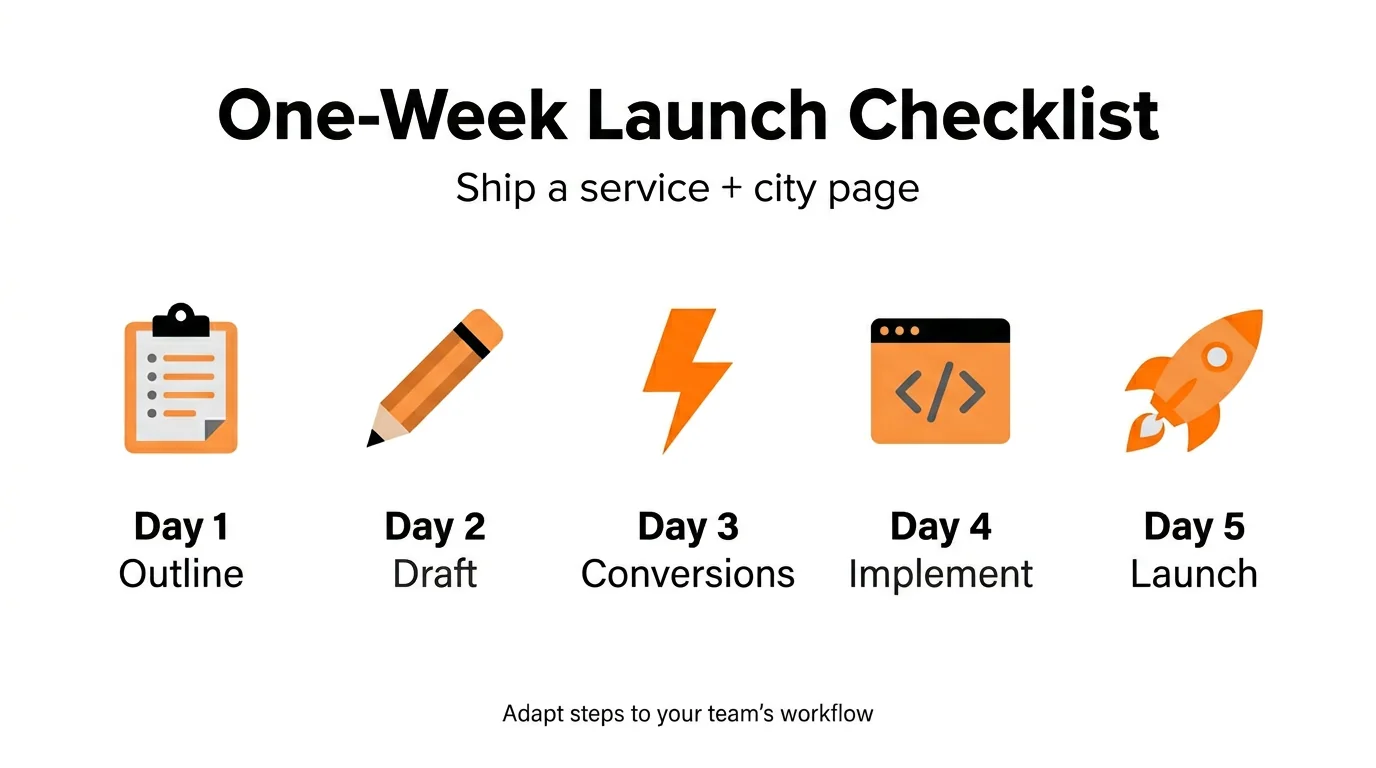
Day 1: Outline modules and collect NAP, hours, and practitioner bios. Accept when copy blocks are approved. Day 2: Draft service details with modifiers and localized references. Accept when keyword coverage is clear.
Day 3: Add conversion elements, booking integrations, and availability messaging. Accept when all CTAs function on mobile and desktop. Day 4: Implement schema (Organization, LocalBusiness subtype, Service, FAQ). Validate with Rich Results Test.
Day 5: Upload original photos and embed a precise map. Accept when images are optimized and geo-relevant. Day 6: Publish, submit URL in GSC, and update GBP services. Accept when indexing begins and GBP aligns with page.
Day 7: Request first five reviews referencing the service experience naturally. Accept when at least two early reviews post and on-page FAQs address real questions. For on-page polish, use the on-page SEO checklist.
Connect this playbook to your broader pet page strategy
How this supports topical authority and internal linking
Service + city pages form the transactional layer of your site. Link upstream to educational content and downstream to booking flows. Consistency across veterinary SEO, groomer SEO, and dog trainer SEO reinforces relevance.
Use hub pages to unify cities and cross-link related services. Coordinate keyword focus and schema naming conventions. As you scale, refer back to the full Pet Page SEO framework to maintain coherence across clusters.
Finally, monitor performance and refine with small, guided updates. This approach resembles guided local search, where targeted penalties and adjustments can steer improvements without overhauls.[1] When content quality and demand vary by region, selective iteration often beats global changes.[4]
References
- C Voudouris et al. (2025). Guided local search. Handbook of Heuristics. View article
- D Santos-Martins et al. (2021). Accelerating AutoDock4 with GPUs and Gradient-Based Local Search. Journal of chemical …. View article
- M Tubishat et al. (2020). Improved Salp Swarm Algorithm based on opposition based learning and novel local search algorithm for feature selection. Expert Systems with …. View article
- HH Hoos et al. (2018). Stochastic local search. Handbook of approximation algorithms and …. View article