From Blog to Basket: Internal Linking Paths That Drive Product Discovery

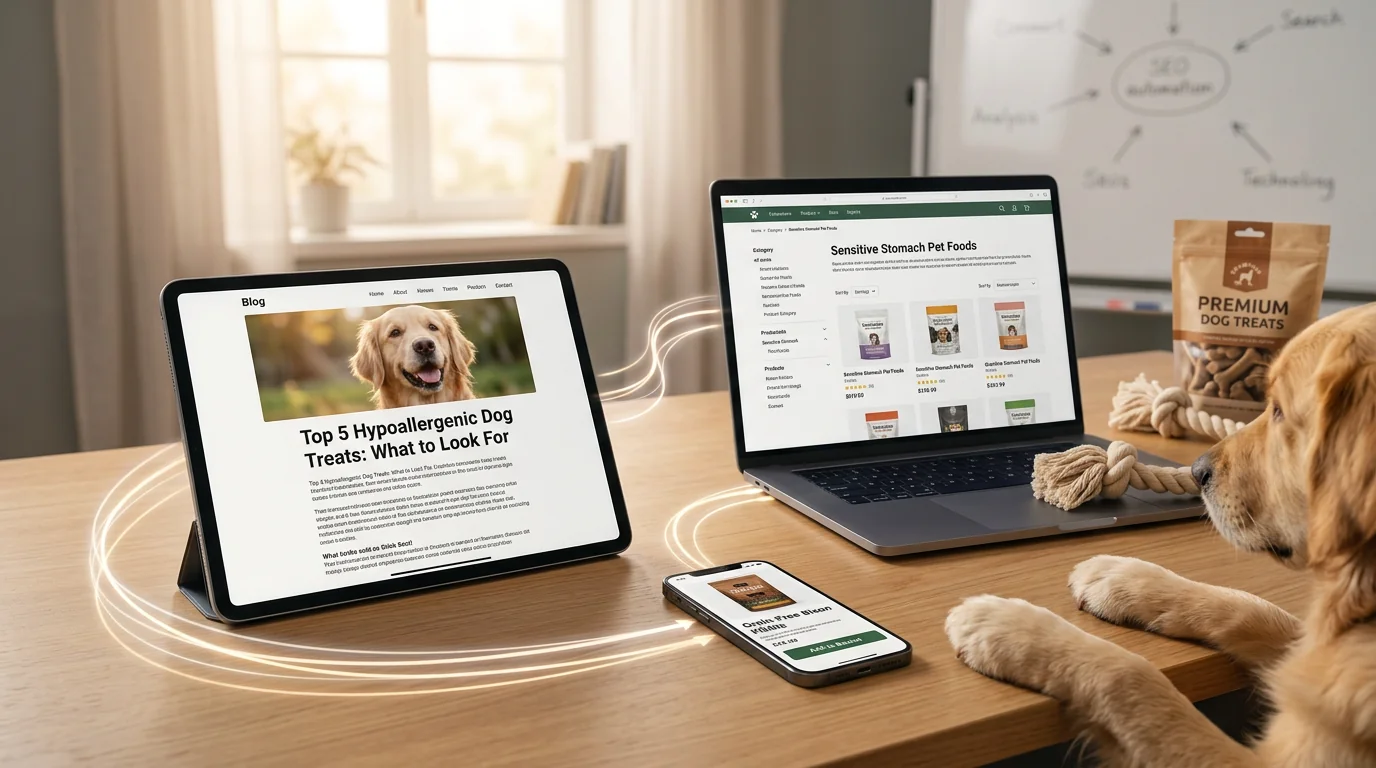
Table of Contents +
- Why this matters: turning pet blog interest into product discovery
- Exact internal linking blueprint (one blog path, end-to-end)
- Quick decision guide: if X, then link Y
- Safety boundaries to protect UX and SEO
- Monitoring: what to check at 7-14 days and 4-8 weeks
- Evidence status: what is well-supported and what is emerging
- Implementation details for pet catalogs
- Diagnostics: when the path stalls and how to fix it
- Frequently Asked Questions
- Conclusion
- References
Exact internal linking patterns that move pet readers from blog to category and product pages without harming UX or SEO.
Most educational pet content stops short of the cart. Readers learn, then bounce. That gap costs discoverability and revenue. The solution is thoughtful internal linking paths that guide, not push.
This article shows how to move visitors from informational posts to category and product pages without harming UX or SEO. You will learn an exact pattern, decision rules, safety boundaries, and what to monitor next.
Why this matters: turning pet blog interest into product discovery
Place a clear, above-the-fold utility link to the visitor’s most likely task, such as chew toys for power chewers. This primes discovery early, sets intent, and prevents aimless scrolling.
Scenario focus: informational blog to relevant category, then to top products
The highest-yield path often moves readers from an informational article to a tightly matched category. Then it advances to two or three top products. This sequence respects intent, supports product discovery, and aligns with pet SEO objectives.
Anchor the flow within your Pet Page SEO strategy hub
Treat this path as a system, not isolated links. Document it, measure it, and maintain it within your internal governance and your Pet Page SEO strategy hub. That ensures consistency as content and assortments change.
Petbase automates SEO content for pet stores - publishing 10 optimized articles monthly so you can focus on running your shop - start your free trial.
Exact internal linking blueprint (one blog path, end-to-end)
Step 1: Above-the-fold utility link to the most relevant category
Add a compact text link under the hero or first paragraph. Use descriptive anchor text that mirrors intent, such as “shop chew toys for power chewers.” Keep it neutral, not promotional. Style as a utility link, not a bold CTA, to preserve informational framing.
Step 2: Mid-article contextual links to subcategory or filters
Answer a specific need, then link to a pre-filtered collection like indestructible chew toys for pit bull-type jaws. Contextual internal links work because hypertext lets users traverse information spaces efficiently, especially when anchors clarify relationships.[1]
Step 3: Module: "Top Picks" inline list (3 SKUs, schema-enabled)
Insert a lightweight “Top Picks” module after the first solution section. Include three products with concise benefits. Mark up each with Product schema and price/availability to support rich results. See implementation notes below.
- Chew-Pro XT - Reinforced rubber for heavy chewers. Tested for durability.
- Grip Ring Max - Textured ring that reduces slipping and keeps engagement high.
- Flex Bone Tough - Flexible core to reduce tooth stress while maintaining resistance.
For structured data design, review Schema for Pet Pages and apply consistent markup to enhance search eligibility.
Step 4: Sticky footer micro-nav to category and buying guide
Deploy a slim sticky footer after 30% scroll. Primary link targets the main category. Secondary leads to a buying guide. Example: [Shop chew-toy category] → Browse chew toys | [Guide] → Chew-toy buying tips. Keep it 48px high, dismissible, and non-intrusive on mobile.
Step 5: End-of-post decision box with two clean paths
Conclude with a distraction-free box offering only two options. Avoid tertiary links. Example: Browse category or Compare top picks. This reduces cognitive load and channels action naturally.
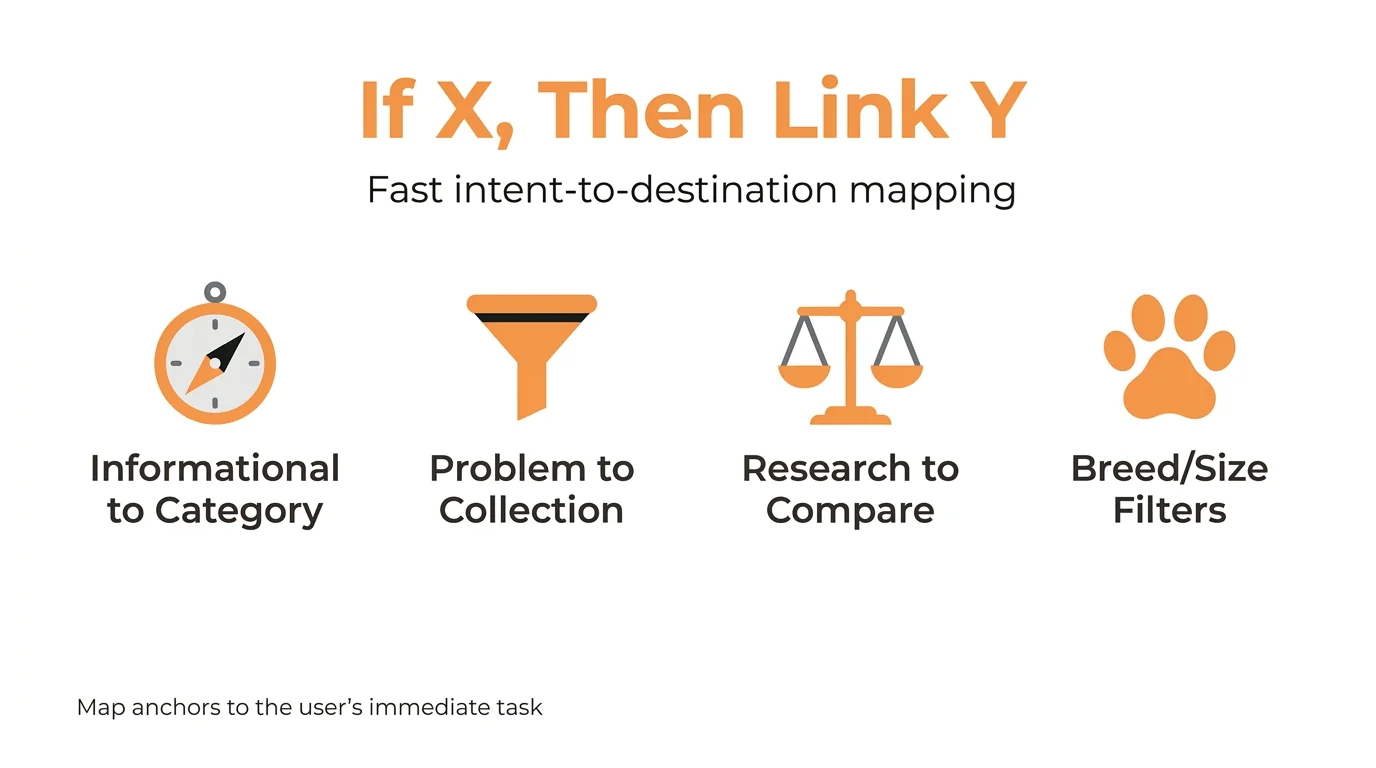
Quick decision guide: if X, then link Y
5-7 common situations mapped to the next-best link target
- If the article answers a general “what/why” question, link to the parent category.
- If it resolves a “which type is best” query, link to a filtered subcategory.
- If it covers a specific use case, link to two or three high-fit product pages.
- If readers compare materials or features, link to a comparison-focused collection.
- If the audience needs sizing guidance, link to a size-filtered category or sizing guide.
- If the user shows shopping intent mid-article, surface the “Top Picks” module.
- If uncertainty remains at the end, present the two-choice decision box.
Safety boundaries to protect UX and SEO
Anchor text, depth limits, and module placement
Use human-readable anchors of 3-7 words that reflect the destination’s purpose. Avoid repetitive exact matches. Cap total internal links at a practical range, then test. Keep the “Top Picks” module after the first solution section to respect informational flow.
Mobile considerations and accessibility
Ensure touch targets are at least 44-48px high. Make the sticky footer dismissible and keyboard-accessible. Provide visible focus states, aria labels for micro-nav, and compressed imagery to protect Core Web Vitals and rankings.
Monitoring: what to check at 7-14 days and 4-8 weeks
Short-term behavioral signals
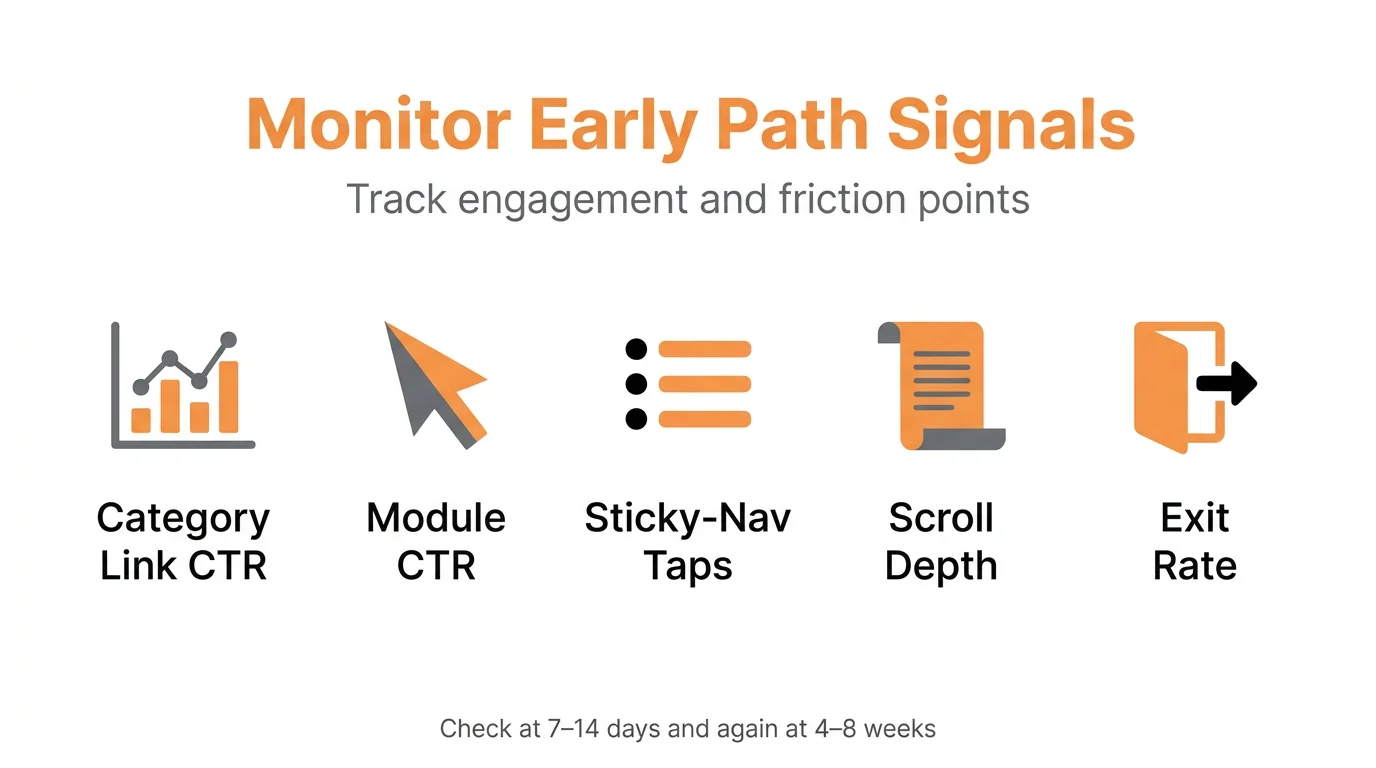
Watch click-through rate on the above-the-fold category link, module CTR, sticky-nav interactions, scroll depth, and exit rates. Systems research highlights that continuous verification and adjustment improve resilience in dynamic environments.[2] Tie these metrics to session-level product discovery.
Medium-term SEO and revenue indicators
Over 4-8 weeks, monitor category indexation, ranking movement for intent-matched queries, and assisted revenue from blog-originating sessions. Route analysis into dashboards for tracking SEO performance and ROI. Annotate deployments to isolate linking changes from other variables.
Evidence status: what is well-supported and what is emerging
Supported by multiple studies and case series
Hypertext design shows that meaningful links help users traverse information spaces efficiently, with anchor context conveying implicit relationships.[1] Organizational research suggests applying architectural principles improves coherence across teams and artifacts, supporting systematic internal linking governance.[4]
Emerging practices worth cautious testing
Sticky micro-navs with scroll-triggered visibility, in-article product schema lists, and pre-filtered collection links may support engagement. Evaluate carefully to avoid UX clutter and crawl inefficiencies. Document design rules to retain architectural consistency across content teams.[4]
Implementation details for pet catalogs
Mapping blog intents to category facets (breed, size, life stage)
Create a matrix aligning article intents to category facets such as breed, size, and life stage. Use parameters to pre-filter collection pages without creating thin duplicates. For scalable category SEO patterns, review Category & Collection Page SEO for Pet Catalogs.
Structured data and link hygiene checklist
Apply Product schema to “Top Picks,” BreadcrumbList to the article, and ensure canonical tags remain stable. Keep internal links dofollow, use one canonical category per path, and standardize parameter order. Teams using automation may prefer Petbase AI to maintain link hygiene and schema consistency across large catalogs.
Diagnostics: when the path stalls and how to fix it
Identify bottlenecks in the journey
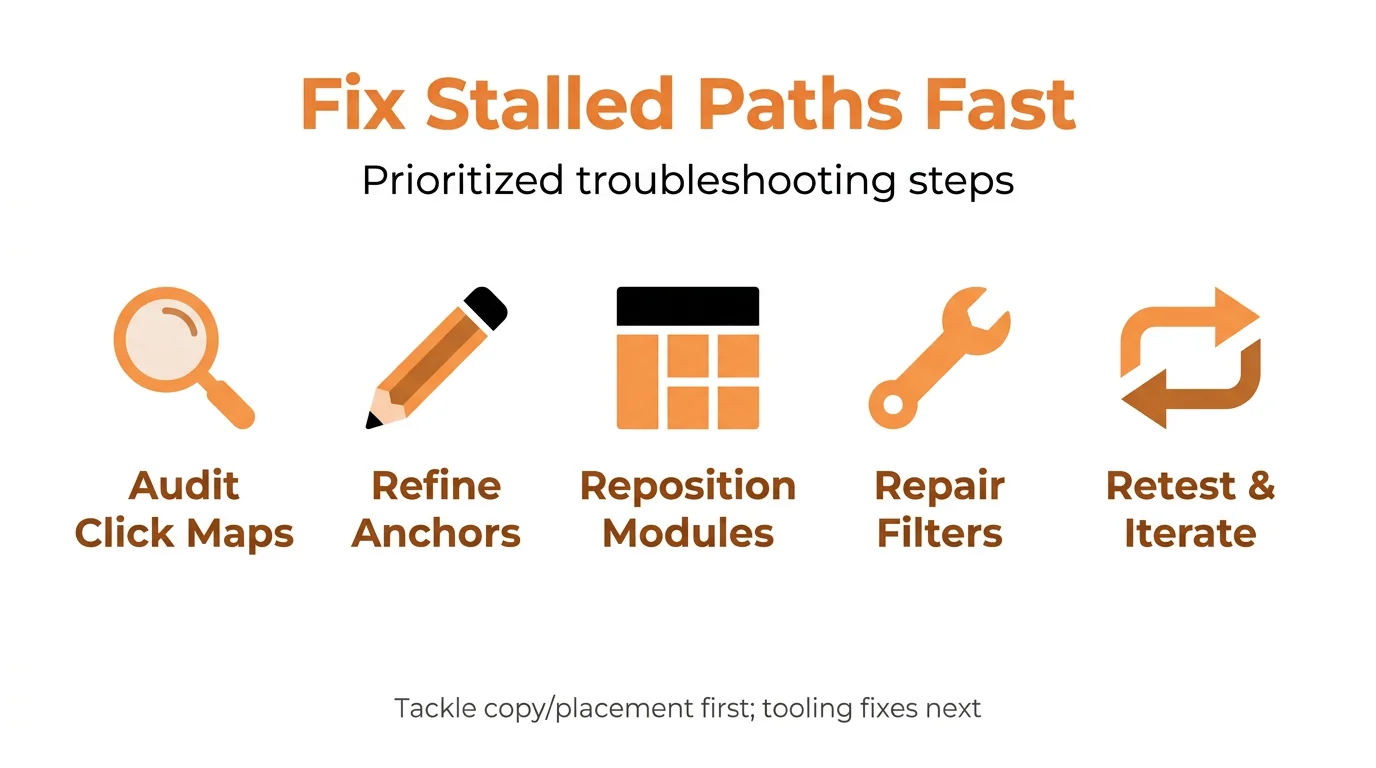
Audit click maps. If the above-the-fold category link underperforms, anchors may be vague or misaligned. Low module CTR suggests relevance gaps or poor placement. High exits from the filtered collection indicate mismatched facets or slow-loading media.
Prioritize fixes by impact and effort
Start with copy and placement: refine anchor text, move the module higher, and simplify the sticky footer. Next, repair filters and sorting. Finally, iterate product selection and visuals, and re-measure after each discrete change.
Frequently Asked Questions
How many internal links per blog post are safe for UX and SEO?
Evidence suggests 5-12 well-placed links may work for long-form posts. Prioritize one category link, 2-3 contextual subcategory links, and a compact product module to avoid clutter. Test variations and watch engagement, not only counts.
Should I link directly to products or to categories first?
For informational intent, category or filtered collection pages often perform better as the first hop. Add 2-3 high-fit product links only when the article addresses a specific use case. Match destination granularity to reader intent.
What anchor text should I use for internal links?
Use descriptive, human-friendly phrases that match the destination’s purpose, such as “chew toys for heavy chewers.” Avoid repetitive exact-match anchors across the page. Vary phrasing while preserving clarity to support both readers and crawlers.
Do internal link modules hurt Core Web Vitals?
Lightweight, server-rendered modules may have minimal impact. Monitor CLS and LCP after deployment and defer non-critical images to maintain performance. Keep modules compact, remove unnecessary JavaScript, and test on mid-tier mobile devices.
How soon can internal linking changes affect rankings?
Crawling and re-evaluation may take days to weeks. Early engagement shifts can appear in 7-14 days, while ranking movement often needs 4-8 weeks or longer. Annotate changes to attribute performance accurately.
Conclusion
Internal linking paths should feel natural, not forced. Start with a precise category utility link, add contextual filters, present three relevant products, and finish with a two-choice decision box. Respect UX boundaries, then measure, polish, and repeat. The result may be stronger product discovery, healthier engagement, and more revenue from informational traffic-without jeopardizing SEO. Keep the pattern documented in your strategy hub, align it with category architecture, and maintain structured data hygiene to scale confidently across your catalog.
References
- C Bizer et al. (2023). Linked data-the story so far. Linking the World's Information …. View article
- Y He et al. (2022). A survey on zero trust architecture: Challenges and future trends. … and Mobile Computing. View article
- D Kim et al. (2020). The architecture of SARS-CoV-2 transcriptome. Cell. View article
- B Horlach et al. (2020). Everyone's Going to be an Architect: Design Principles for Architectural Thinking in Agile Organizations.. HICSS. View article