Schema for Pet Pages: Product, Service, Review, and FAQ Markup for Rich Results


Table of Contents +
- Focus scenario: choosing the right schema for a pet product vs. a service page
- Quick decision guide
- Implementation essentials: JSON-LD patterns that may support rich results
- Validation and monitoring
- Practical safety boundaries
- Evidence status and what is still evolving
- Checklist: ship-ready schema for a single pet SKU or service
- Frequently Asked Questions
- References
Implement Product, Service, Review, and FAQ schema for pet pages. Validate, monitor rich results, and avoid pitfalls to improve visibility safely.
Structured data turns pet pages into machine-readable inventory and service listings. It clarifies what you sell, where you operate, and why users should trust you.
This matters because correct schema may unlock rich results and improve how search systems interpret your catalog. You will learn which types fit products versus services, how to validate, and how to monitor eligibility.
Focus scenario: choosing the right schema for a pet product vs. a service page
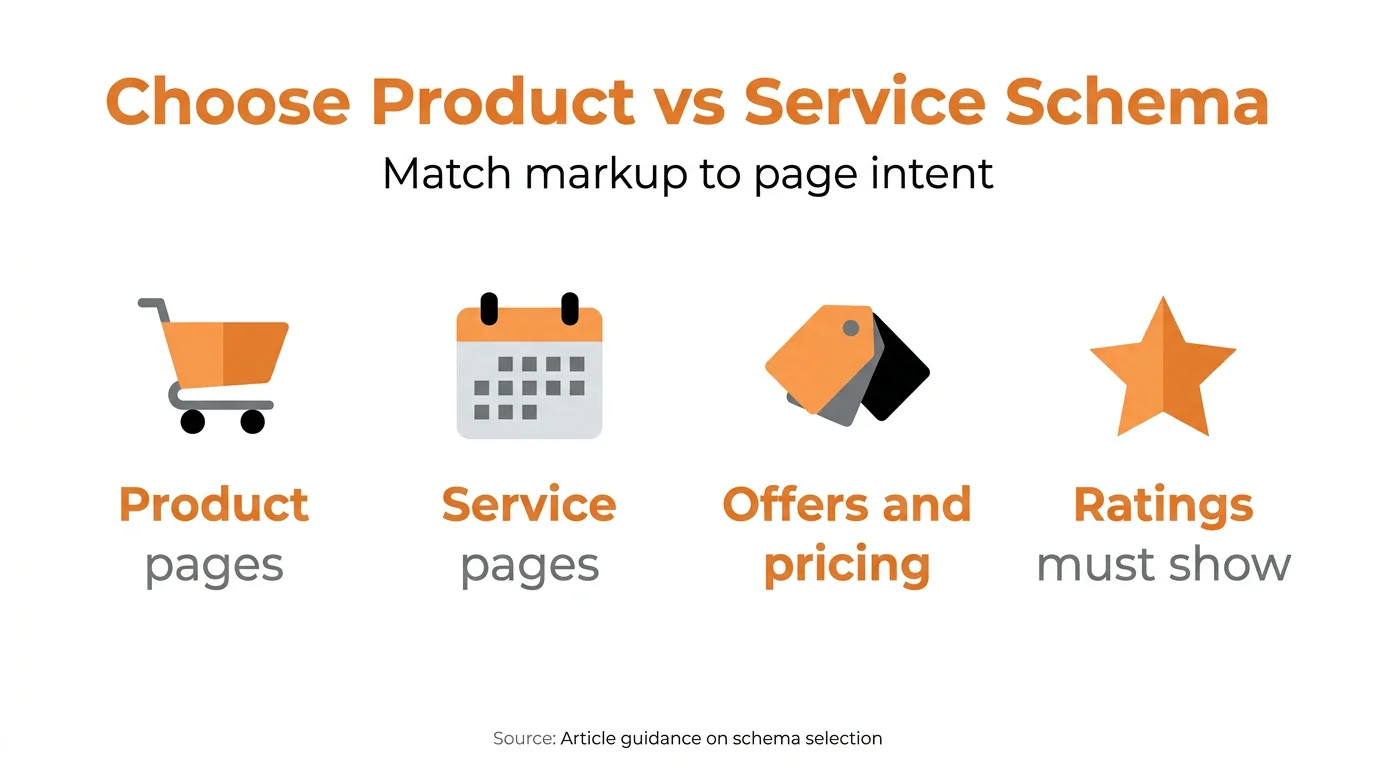
The right schema depends on what the page primarily offers. Treat product SKUs and bookable services differently to match search expectations and reduce compliance issues.
When to use Product, Offer, and AggregateRating on pet SKUs
Use Product for tangible items, like food, accessories, or devices. Add Offer for price, currency, availability, and condition. Include AggregateRating only when ratings are present on the page and comply with review schema guidelines.
When to use Service and LocalBusiness for vets, groomers, and trainers
Use Service for bookable or quoted services, such as grooming or training. Add LocalBusiness (or VeterinaryCare) on location pages with address, geo, and openingHours. Link the service to the provider to express who delivers it.
Petbase automates SEO content for pet stores - publishing 10 optimized articles monthly so you can focus on running your shop - start your free trial.
Quick decision guide
Use these pragmatic routes to avoid overthinking the type system. Each route matches a common pet industry scenario with a schema action.
If X situation, then Y action (5-7 practical routes)
- If the page sells a specific SKU, use Product with one or more Offer objects for price and availability.
- If the page collects bookings or quotes, use Service and attach provider as LocalBusiness or VeterinaryCare.
- If the page lists multiple SKUs, use a list view and ensure each product tile contains minimal product data without duplicating full Product markup.
- If reviews are visible, add AggregateRating to Product or to LocalBusiness when they reference the business overall.
- If the content answers discrete questions, use FAQPage structured data and ensure Q&A appears visibly on the page.
- If you run multiple locations, apply LocalBusiness per location and use Service on each location’s service pages.
- If the page is educational and non-transactional, avoid Product and Service schema. Consider Article or BlogPosting only when appropriate.
Implementation essentials: JSON-LD patterns that may support rich results
JSON-LD is easier to maintain at scale and keeps markup separate from presentation. Historically, microdata was common, but JSON-LD has become operationally efficient for teams and tooling.[2]
Product with Offer, availability, and review signals
Add Product with name, description, image, sku, and brand. Nest an Offer with price, priceCurrency, availability, and url. Include gtin8, gtin12, or mpn when available. Add AggregateRating only if user-visible and compliant. For merchandising strategy and conversion signals, align field content with your page experience; accuracy and consistency may support eligibility.[1] For merchandising patterns aligned to search intent, see Pet Product Page SEO: Matching Breed, Size, and Life-Stage Intent to Convert.
Service with areaServed, serviceType, and provider
Use Service for grooming, training, or daycare pages. Include serviceType, areaServed, and offers when pricing is published. Reference provider as LocalBusiness or VeterinaryCare with address and sameAs. This combination models bookable services while clarifying business identity.
Review vs. AggregateRating: compliant usage on pet pages
Individual Review objects represent specific reviews. AggregateRating summarizes ratings. Only use self-serving reviews when platform policies allow, and ensure ratings are visible to users on the same page. Evidence suggests correct, transparent markup increases trust and eligibility.[1]
FAQPage do’s for genuine Q&A blocks
Use FAQPage only for Q&A content shown on the page. Each Question needs a direct, concise Answer. Avoid promotional answers. Keep questions user-centric and non-duplicative. This pattern may still surface enhancements when implemented faithfully.[3]
Validation and monitoring
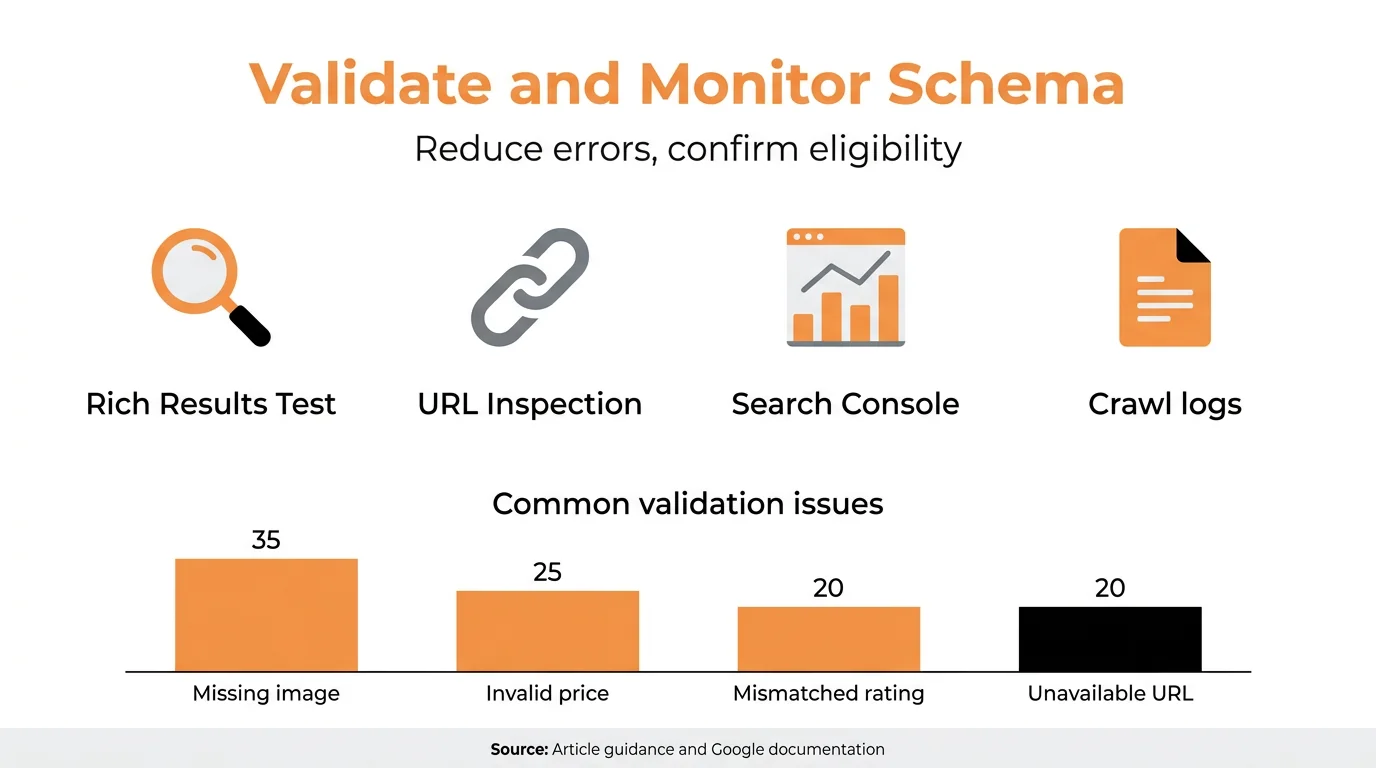
Validation reduces ambiguity and may prevent avoidable eligibility issues. Monitoring confirms whether search systems can interpret and trust your markup over time.[1]
Pre-launch checks: Rich Results Test and URL Inspection
Run the Rich Results Test on representative URLs and templates. Confirm required and recommended fields are present. Use URL Inspection to verify indexing signals and canonical targets. Larger catalogs may benefit from automated JSON-LD deployment via tools like Petbase AI.
After 7-14 days: indexing and enhancements review
Check Search Console for indexing status and enhancements for Products, FAQs, and LocalBusiness. Look for warnings about missing fields. Evidence suggests search engines use structured data to maintain understanding over time, so early fixes help.[3]
After 4-8 weeks: coverage trends and CTR deltas
Evaluate coverage counts, rich result impressions, and click-through rate changes. Compare period-over-period trends, controlled by template. For broader performance context and ROI alignment, see Measure What Matters: Tracking Pet Page SEO Performance and ROI.
Practical safety boundaries
Establish safety rails to minimize policy risks and mismatches. Quality and consistency are central to sustained eligibility and confidence in schema interpretation.[1]
Avoiding mismatches and self-serving reviews
Ensure schema content exactly matches on-page content and UI states. Do not add AggregateRating when no reviews are visible. Be cautious with self-serving first-party reviews; align practices with review schema guidelines and platform policies.
Price, availability, and rating freshness windows
Keep price, availability, and ratings up to date. For active catalogs, daily updates may help minimize stale data. Evidence suggests inaccurate values can limit trust, resulting in reduced enhancement eligibility over time.
Multilingual and regional nuances (US/UK/DACH)
Localize priceCurrency, measurement units, and address formatting. Use inLanguage where relevant and align content language with hreflang. For localization patterns without losing voice, see Multilingual Pet SEO: Localizing US, UK, and DACH Without Losing Brand Voice.
Evidence status and what is still evolving
Structured data interacts with ranking and rendering in ways that continue to evolve. The following points summarize established signals and areas with variability.
What evidence suggests helps eligibility
Accurate, complete fields; alignment between schema and visible content; and consistent identifiers may support eligibility. Schema also helps populate knowledge graphs and facilitate machine understanding across systems.[4]
Areas where outcomes may vary
Display of rich results may fluctuate with query intent, device, and experiment cohorts. FAQ visibility has been inconsistent. Product enhancements can vary by market and seasonality, even with valid markup and stable templates.
Checklist: ship-ready schema for a single pet SKU or service
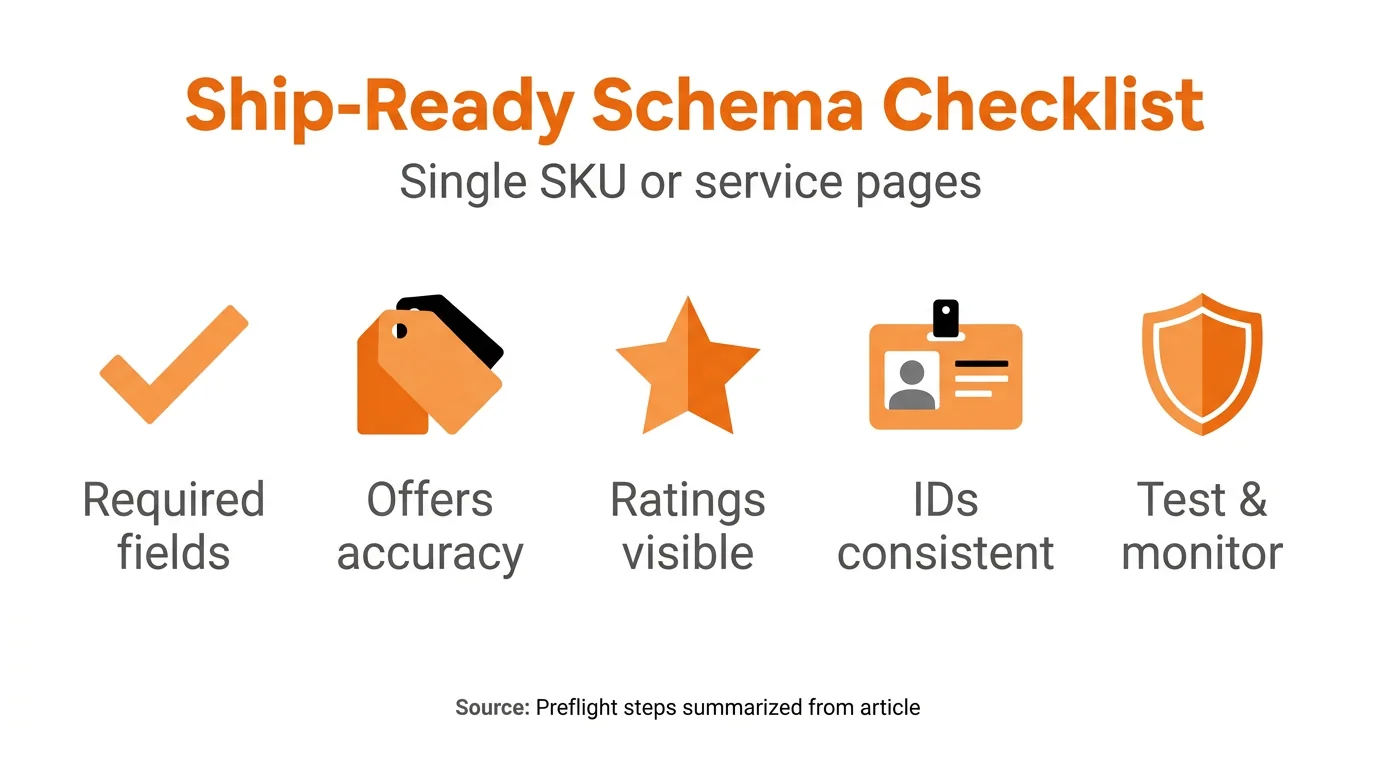
Use this compact preflight list to reduce rework and help your page qualify for enhancements across product and service contexts.
Final pre-publish audit items
- Product pages: name, description, image, sku, brand, identifiers, and Offer (price, priceCurrency, availability, url) are present and accurate.
- Service pages: Service with serviceType, areaServed, offers (if public), and provider as LocalBusiness or VeterinaryCare with NAP details.
- Reviews: visible on-page; AggregateRating matches UI; no self-serving practices that violate policies.
- FAQ: real user questions and concise answers, both visible; FAQPage structured data mirrors on-page order and text.
- LocalBusiness: address, geo, openingHours, telephone, sameAs; use veterinarian local business schema when applicable.
- Validation: Rich Results Test passes; no required fields missing; URL Inspection confirms canonical and indexing signals.
- Monitoring plan: 7-14 day check for enhancements; 4-8 week review for coverage, impressions, and CTR changes.
- Governance: automation rules for price and availability freshness; rollback plan for markup changes across templates.
- Documentation: changelog of schema deployments and mapped fields for merchandising, shipping, and rating sources.
- Orientation: for broader context and prioritization, consult the complete Pet Page SEO guide.
Frequently Asked Questions
Should a pet grooming page use Product or Service schema?
Use Service for grooming pages. If booking online is offered, include provider as LocalBusiness and add offers where appropriate. Reserve Product for tangible SKUs like shampoos or toys.
Can I add AggregateRating without visible reviews on the page?
No. Ratings used in structured data should be visible to users on the page. Evidence suggests hidden ratings may reduce eligibility and risk manual actions.
Is FAQPage markup still useful?
FAQ rich results appear less often than before, but valid, on-page Q&A content with FAQPage may still support eligibility and address user questions that improve UX.
How often should I refresh price and availability for Product schema?
Update whenever your feed changes. For active catalogs, refreshing at least daily may help accuracy. Inaccurate values can limit trust and rich results.
What schema should a veterinary clinic use?
Use LocalBusiness or VeterinaryCare as the base, with Service for specific procedures. Add openingHours, address, geo, and sameAs. Reviews must follow platform policies.
Thoughtful schema choices help search systems interpret pet product schema, service schema markup, and FAQs without guesswork. Validate, monitor, and iterate. For local practitioners, pair LocalBusiness and Service carefully; for catalogs, keep price, availability, and ratings fresh. For deeper context beyond implementation, explore Local SEO for Pet Services: Vet, Groomer, and Trainer Pages That Rank and Book and Category & Collection Page SEO for Pet Catalogs: Filters, Facets, and Copy That Scales. Accurate markup that mirrors visible content remains the strongest foundation for durable rich result eligibility.[1]
References
- M Edgar (2023). Schema and structured data markup. Tech SEO Guide: A Reference Guide for Developers …. View article
- P Ristoski et al. (2018). A machine learning approach for product matching and categorization: Use case: Enriching product ads with semantic structured data. Semantic web. View article
- N Tempelmeier et al. (2018). Inferring missing categorical information in noisy and sparse web markup. … of the 2018 World Wide Web …. View article
- V Ryen et al. (2022). Building semantic knowledge graphs from (semi-) structured data: a review. Future Internet. View article