Pet Keyword Research: Head Terms, Long-Tail Modifiers, and Seasonal Demand


Table of Contents +
- Scenario: Launching breed-specific pages for Q4 while avoiding cannibalization
- Step-by-step process to find and cluster pet keywords
- Competitor gap analysis for pet SERPs
- Quick Decision Guide
- Monitoring: what to observe after 7-14 days and 4-8 weeks
- Practical Limits and Operational Safety
- State of the Evidence
- Worked Example: "indestructible dog toy for pitbulls" in Q4
- Templates and Recommended Schemas
- How to Connect This Research with Automation
- Next Steps and Guidance
- Frequently Asked Questions
- References
Learn a step-by-step method to map pet head terms, long-tail modifiers, and seasonal demand by species, breed, size, life stage, and condition.
Breed-specific pages can win Q4, but only if they are precise. Cannibalization erodes authority and dilutes intent. Avoid that with disciplined keyword segmentation and seasonally aligned timing.
This guide matters because pet SEO thrives on attributes like breed, size, and life stage. You will learn a step-by-step workflow to find long-tail pet keywords, add seasonal pet keywords, and close pet content gaps without overlap.
Scenario: Launching breed-specific pages for Q4 while avoiding cannibalization
Define the scope: species → breed → size → life stage → condition
Start broad with species, then refine by breed, size, life stage, and condition. Use one stack of modifiers per page. This creates clean intent, prevents duplication, and aligns content with high-signal purchase decision points.
Map search intent: head terms vs. long-tail modifiers
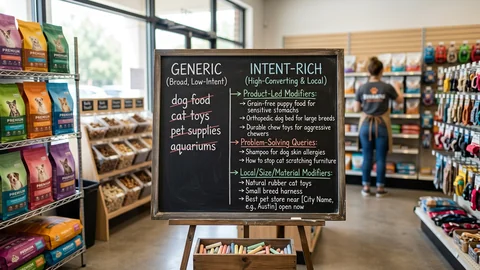
Head terms capture discovery. Long-tail modifiers carry problem detail and conversion cues. Separate guides from shopping pages. Keep navigation tight to move users from learning to selecting products without query collision.
Seasonality overlay: identify Q4 spikes and evergreen demand
Overlay monthly trends to find Q4 surges like holiday gifting and winter care. Validate with year-over-year Google Trends patterns to avoid false peaks and short-lived noise in pet demand signals.[1]
Petbase builds this SEO foundation automatically for pet businesses - 10 optimized articles published every month - start your free trial.
Step-by-step process to find and cluster pet keywords
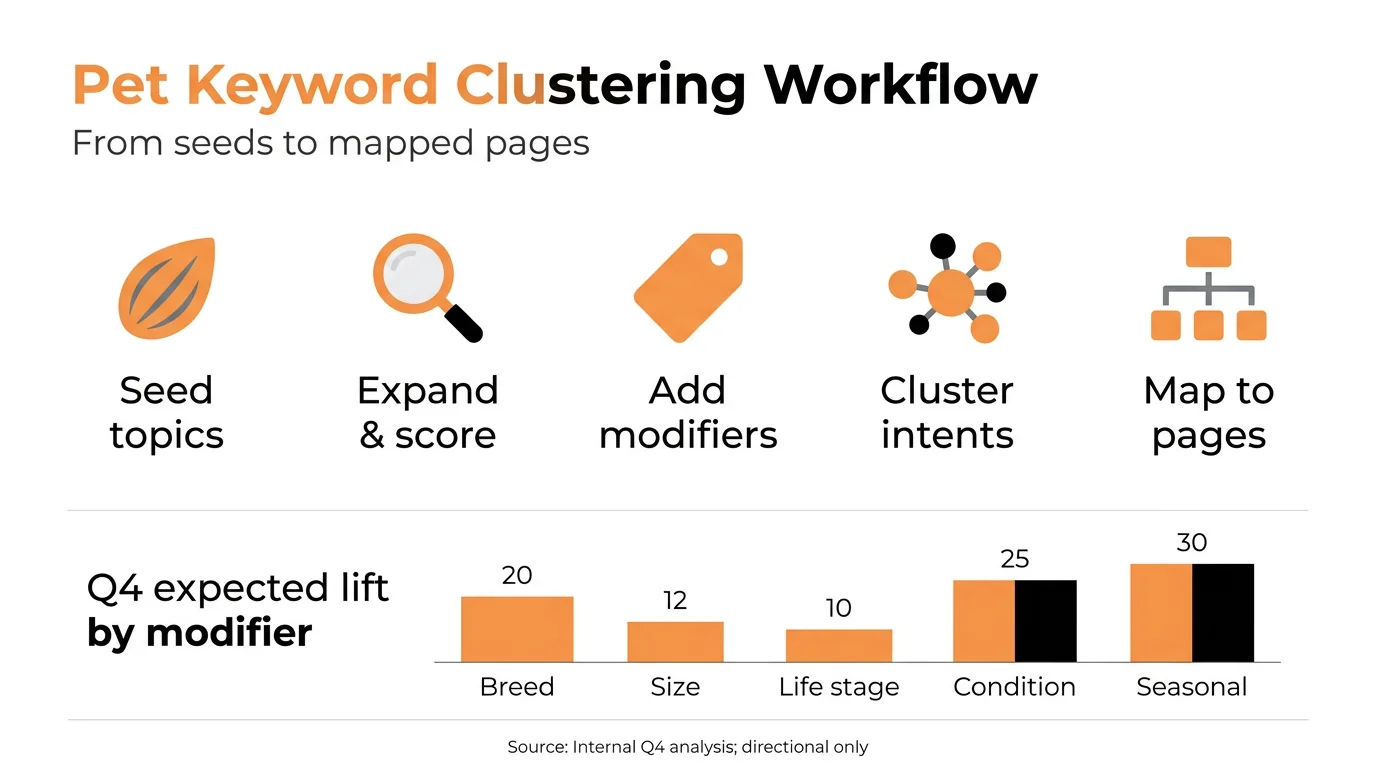
Collect head terms by species and category
List category anchors like dog toys, cat food, and small animal bedding. Add care topics and services. Use these as seeds for breadth. Gather baseline volume and difficulty to understand feasible entry points.
Expand with long-tail modifiers (breed, size, life stage, condition, task)
Attach modifiers such as pitbull, large breed, senior, anxiety, and chewing. Conditions and behavior themes often reflect real owner needs and may drive urgent searches for solutions.[3]
Segment by search intent (informational, commercial, local)
Classify modifiers by intent. “How to,” “best,” and “near me” split informational, commercial, and local. Travel and pet-friendly queries show mixed local and purchase intent, requiring separate templates and markup.[2]
Add seasonal qualifiers (month, holiday, weather, events)
Append months, winter, snow, holiday, and Black Friday. Include climate cues and event triggers. Prioritize seasonal pet keywords that historically lift Q4 demand while preserving evergreen anchors for continuity.
Score and cluster: volume, difficulty, business fit, season trend
Score each keyword on a 0-3 scale for volume, difficulty, and business fit. Add a seasonal trend flag. Group siblings with the same core need and intent. Prioritize clusters with multiple viable long-tails.
Create page templates to prevent cannibalization
Assign one URL per intent plus modifier set. Use consistent H1/H2 patterns and FAQ blocks to absorb near-duplicates. Cross-link guide to product hub. This structure reduces internal competition and clarifies relevance.
Competitor gap analysis for pet SERPs
Identify competing URLs by modifier pattern
Search head terms plus each modifier and log recurring domains. Note how competitors segment breed, size, life stage, and conditions. Record which intents they win for and where their coverage thins.
Extract missing modifiers and under-served breeds
List modifiers your competitors do not cover or only mention lightly. Underserved breeds and conditions signal easy wins. Use these opportunities to create highly specific, helpful content blocks.
Contrast content depth, schema, and media types
Compare tables, safety notes, videos, and reviews. Check technical signals and apply rich results through structured data; see schema for pet pages. Fill media gaps and elevate on-page evidence.
Quick Decision Guide
If head term has mixed intent, then split into guide + product hub
Create a comprehensive guide and a separate shopping hub. Use reciprocal links and distinct CTAs. This approach clarifies relevance and supports both early research and ready-to-buy visitors.
If long-tail has low volume but high fit, then target with FAQ or subsection
Fold precise modifiers into the primary page as an H2 plus FAQ. Capture incremental intent without spawning thin URLs. Monitor impressions for expansion potential before dedicating a new page.
If two URLs target same modifier, then merge and redirect strongest signals
Identify overlap, consolidate into the best template, and 301 the redundant URL. Transfer internal links. Use canonicals if temporary. This preserves authority and improves ranking stability.
If seasonal spike is ≤6 weeks away, then publish now and refresh pre-peak
Push content live for crawling and early impressions. Update closer to peak with stock checks and deals. Evidence suggests pre-season updates may support stronger visibility curves.
If competitor dominates head term, then enter via modifier clusters first
Build density with breed- and size-specific articles. Win cumulative long-tail traffic, then ladder up to head terms. This compounding approach reduces risk and builds topical authority methodically.
If local intent appears, then add location modifiers and local schema
Include city and neighborhood terms, map embeds, and NAP consistency. Add review excerpts and availability windows. Align with service discovery behavior that often blends proximity and trust signals.
If SERP favors video, then embed short demo and transcript
Produce concise, captioned clips and a written transcript. Support with step lists and safety checks. Video plus text often improves engagement and may capture additional SERP features.
Monitoring: what to observe after 7-14 days and 4-8 weeks
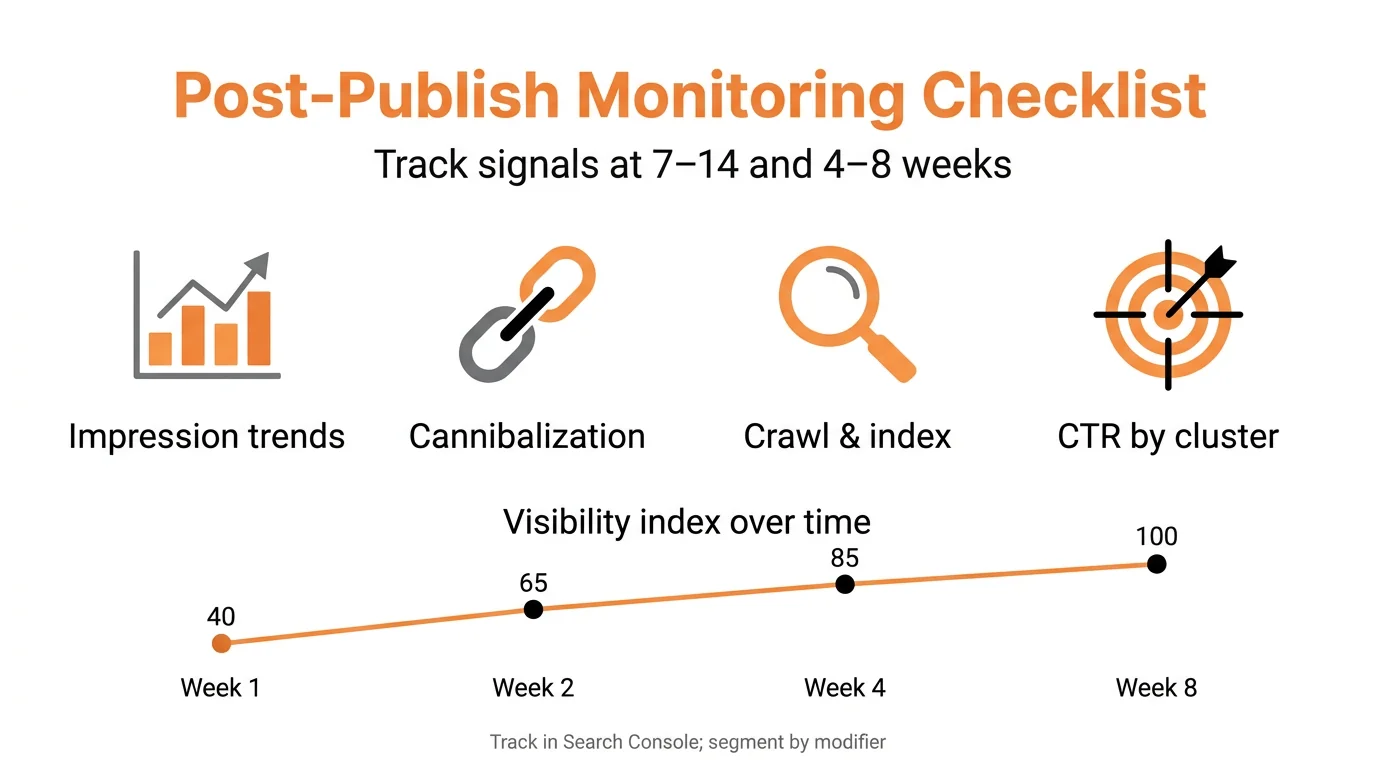
After 7-14 days: impressions by modifier, cannibalization flags, crawl stats
Track impressions segmented by modifier. Watch for duplicate URL ranking and declining CTR on sibling pages. Check crawl frequency, indexation, and internal link discovery across the new cluster.
After 4-8 weeks: clicks by cluster, ranking distribution, seasonal lift vs. baseline
Evaluate clicks and average position by cluster, not just keywords. Compare seasonal lift to historical baselines. Use the orientation guide for Pet Page SEO to adjust internal links and on-page signals.
Practical Limits and Operational Safety
Avoid medical claims; cite reputable veterinary sources
Provide supportive care advice, not diagnoses. Reference authoritative veterinary bodies for safety notes. This lowers risk and maintains credibility while addressing common owner concerns responsibly.
Cap page proliferation; one URL per intent/modifier set
Prevent index bloat by consolidating near-identical modifiers. Prefer robust sections and FAQs over spawning many thin pages. This focuses link equity and simplifies maintenance across seasons.
Use canonical/redirects to consolidate near-duplicates
When overlap occurs, canonicalize short term and plan a merge. Redirect outdated pages. Preserve structured data and media assets to retain coverage and minimize volatility during consolidation.
Mark user reviews and UGC clearly; avoid thin pages
Differentiate editorial content from user reviews. Enrich with original photos, pros/cons, and safety notes. Thin UGC pages may underperform and can confuse intent for pet SEO relevance.
State of the Evidence
Seasonality insights are based on historical SERP trends and may vary
Observed Q4 surges reflect past search behavior. Public interest patterns, such as adoption or gifting waves, can shift with broader events and culture, so validate annually before scaling.[1]
Long-tail conversion tendency is supported by multiple industry studies but can differ by niche
Owners seeking specific solutions often prefer detailed, tailored pages. Research on pet parenting emphasizes problem-solving behaviors, suggesting targeted guidance may resonate more strongly with engaged audiences.[4]
Breed and size modifiers often correlate with higher CTR; results depend on SERP competition
When copy reflects breed and size needs, users may perceive greater relevance. This alignment mirrors owners’ desire for tailored care, though outcomes depend on competitors and snippet quality.[4]
Worked Example: "indestructible dog toy for pitbulls" in Q4
Head term vs. modifiers: durability, breed, size, holiday gifting
Head term: indestructible dog toy. Modifiers: pitbull, power chewer, large breed, rubber, winter, holiday gift. Build a guide for durability science and a product hub filtering by breed and size.
SERP features: shopping, video, buying guides
You will likely see Shopping, videos of chew tests, and listicles. Win with a video demo, comparison table, expert notes, and FAQs addressing material safety and supervised play recommendations.
Content outline: main guide, comparison table, safety notes, care tips
Provide a durability framework, materials overview, and size guidance. Add a safety checklist and care tips for cold weather play. Link to internal linking paths that drive product discovery.
Templates and Recommended Schemas
Template for informational guides with modifier blocks
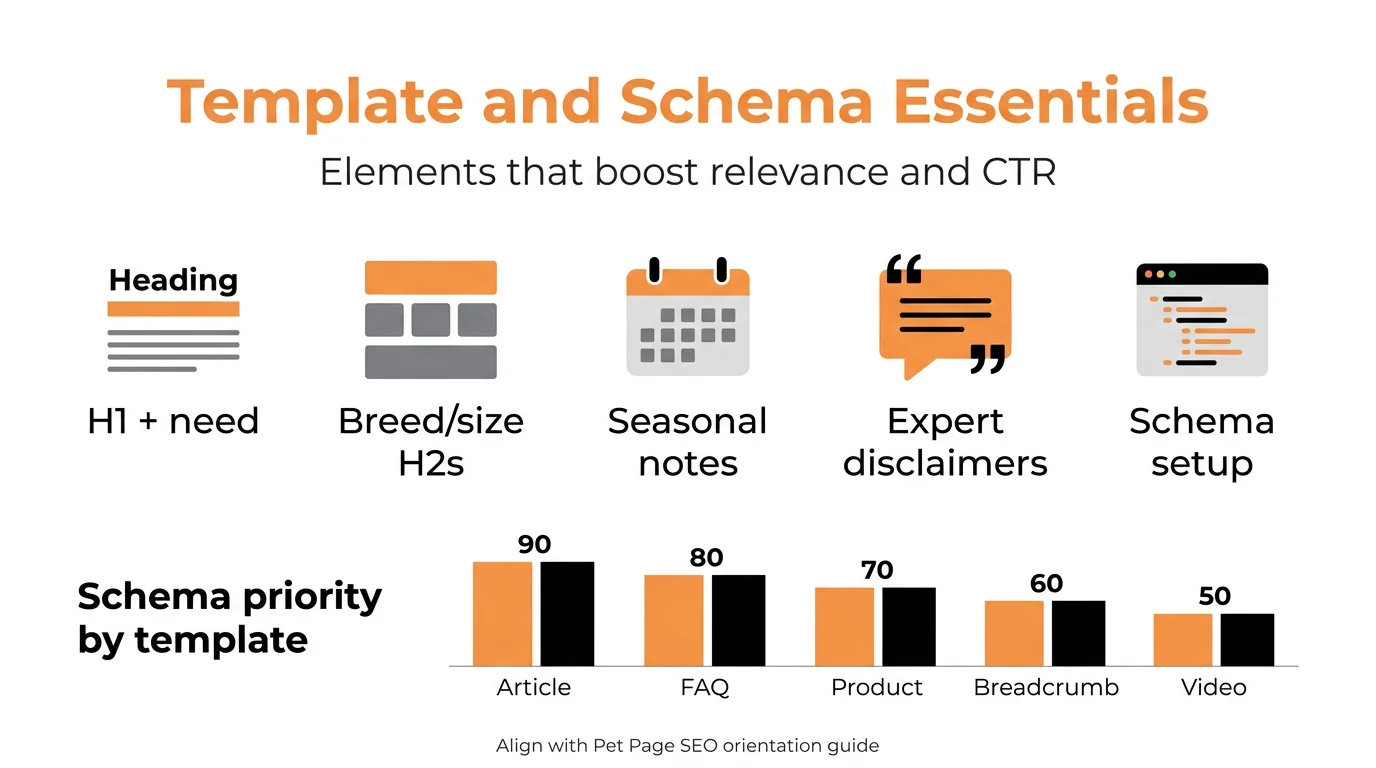
Structure: H1 with species and need, H2 blocks for breed, size, and life stage, plus condition FAQs. Include seasonal notes. Add expert quotes and media to strengthen topical depth.
Template for commercial listicles with breed/size filters
Use a sortable table for breed, size, and material. Embed pros/cons, safety badges, and care icons. Include clear CTAs and related questions to capture adjacent long-tails without duplication.
Recommended schema: Article, Product, FAQ, Review, VideoObject
Implement Article for guides, Product with Review aggregates on hubs, FAQ for modifiers, and VideoObject for demos. For more structure decisions, consult the orientation guide for Pet Page SEO.
How to Connect This Research with Automation
Map clusters to automated publishing queues
Assign each cluster a queue with defined templates, media specs, and review workflows. Schedule evergreen cores first, then attach seasonal variants to pre-peak sprints for predictable deployment.
Use dynamic internal linking by modifier and season
Automate sidebar modules that surface breed, size, and seasonal siblings. Rotate Q4 gift links during November-December. Update anchors and snippets to match the dominant modifier for each page.
Schedule updates pre-season and post-season
Set pre-season refreshes and post-season rollbacks. Teams may consider using Petbase AI to operationalize pet keyword research, templated content, and timed updates across large catalogs efficiently.
Next Steps and Guidance
Prioritize clusters for Q4 vs. evergreen
Push winter care and gifting clusters now. Keep evergreen care and training moving weekly. Protect head terms with strong informational coverage and interlink supporting long-tails upwards.
Link to orientation guide for Pet Page SEO for broader prioritization
For governance across templates, internal linking, and schema, review the orientation guide for Pet Page SEO. Align teams on intent mapping and cadence before expanding pages.
Frequently Asked Questions
What are head terms vs. long-tail keywords in pet SEO?
Head terms are broad, high-volume phrases like “dog toys”. Long-tails add intent or attributes such as breed, size, life stage, or season, e.g., “indestructible dog toy for pitbulls in winter.”
How do I avoid keyword cannibalization with breed pages?
Assign one primary intent per URL, group near-duplicate modifiers on the same page, and use redirects or canonicals to consolidate overlapping content.
When should I publish seasonal pet content?
Evidence suggests publishing 6-10 weeks before peak may support indexing and ranking. Refresh closer to the event with updated picks and availability.
Which modifiers matter most for pet products?
Commonly useful modifiers include breed, size, life stage, material, problem/condition, and occasion or season. Impact can vary by niche and competition.
How can I measure success of long-tail pet keywords?
Track impressions and clicks by modifier cluster, ranking distribution, assisted conversions, and internal click-through from guides to product pages.
Conclusion
A disciplined modifier stack, intent-specific templates, and seasonal timing may lift visibility without cannibalization. Evidence-guided decisions reduce risk and accelerate compounding gains. Use clusters to earn breadth and precision. Then reinforce with schema, media, and internal links that echo user intent. Maintain operational safeguards to protect credibility while scaling. With this workflow, your breed-specific pages can align with Q4 demand and build durable authority for year-round growth.
References
- J Ho et al. (2021). Did the COVID-19 pandemic spark a public interest in pet adoption?. Frontiers in Veterinary Science. View article
- B Meng et al. (2024). Traveling with pets and staying at a pet-friendly hotel: A combination effect of the BRT, TPB, and NAM on consumer behaviors. International Journal of …. View article
- K Buller et al. (2020). Living with and loving a pet with behavioral problems: Pet owners' experiences. Journal of Veterinary Behavior. View article
- M Barina-Silvestri et al. (2024). Pet parenting: A systematic review of its characteristics and effects on companion dogs. … of Veterinary Behavior. View article