Multilingual Pet SEO: Localizing US, UK, and DACH Without Losing Brand Voice


Table of Contents +
- The one decision: single brand voice, locally adapted lexicon
- Hreflang and URL strategy for US, UK, and DACH
- Localized keyword research that respects regional pet language
- Handling currency, measurements, and compliance details
- Breed and product naming differences that change ranking
- Schnell entscheiden: Was tun in typischen Szenarien?
- Monitoring and iteration cadence
- Practical safety boundaries
- Evidence status and sources to watch
- Appendix: Example lexicon snippets (US, UK, DACH)
- Frequently Asked Questions
- Conclusion
- References
Practical guide to multilingual pet SEO for US, UK, and DACH: hreflang, variants, currency/units, breed names, and localized keyword research.
Your brand can sound consistent worldwide and still rank locally. The key is deciding what never changes and what flexes by market. Many teams delay this decision and leak traffic.
This matters because language variants, units, and breed naming influence discoverability and conversions. Here, you will learn a practical framework for hreflang, URL patterns, currency and units, breed nomenclature, and localized pet keyword research that fits US, UK, and DACH.
The one decision: single brand voice, locally adapted lexicon
Define your immutable voice traits vs. flexible local levers
Start with a one-page brand voice charter. Lock tone, values, and sentence rhythm. Allow flexibility for nouns, units, and price formats. Research suggests consistent global voice with local lexis reduces confusion and strengthens recognition across languages[1][2]. Use this charter to arbitrate copy disputes.
Create a US-UK-DACH lexicon map (terms, spelling, units, currency)
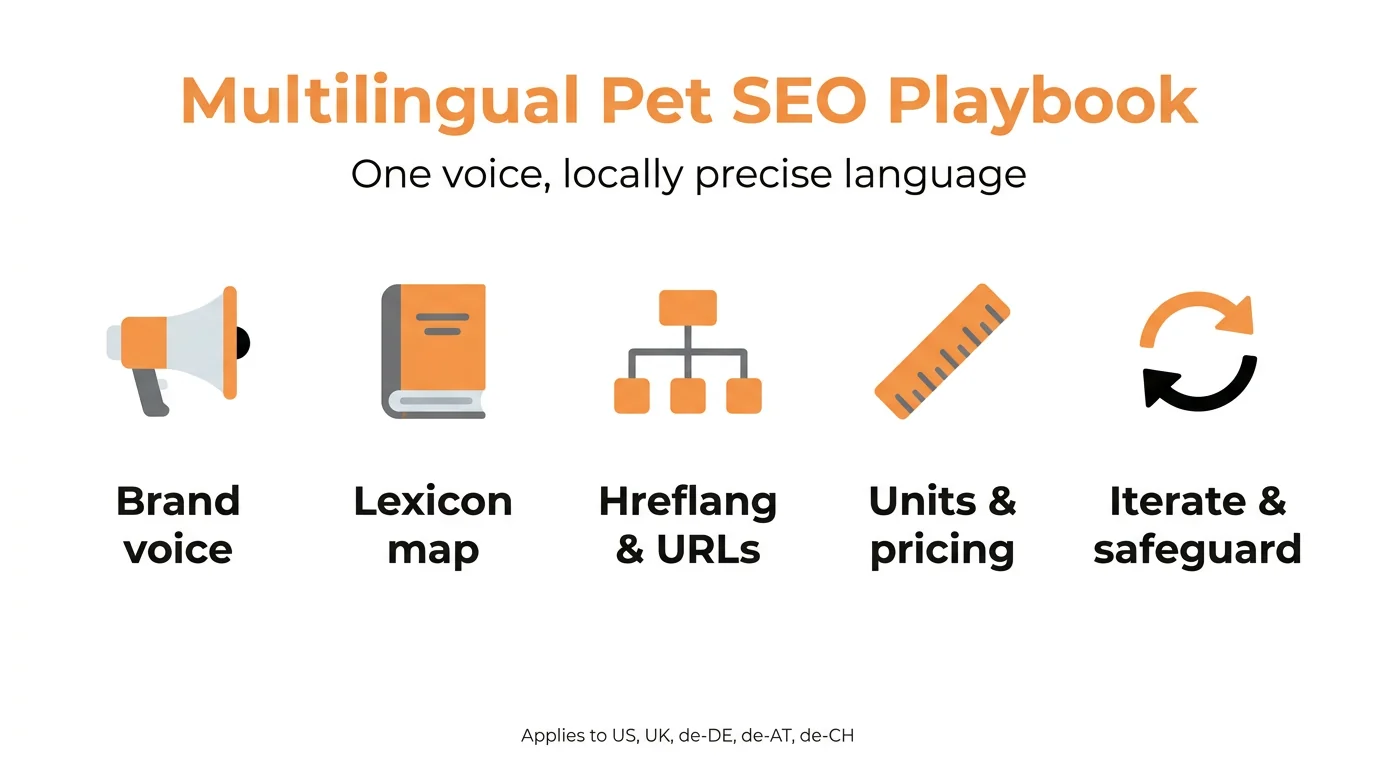
Build a living lexicon map covering UK vs US pet terminology, plus de-DE, de-AT, and de-CH variants. Include spelling, synonyms, hyphenation, decimal separators, and currency display. Store approved translations and examples. Link the map from your editorial SOP and your central Pet Page SEO guide to ensure universal access.
Petbase handles this entire content workflow automatically - 10 SEO articles published to your blog every month - start your free trial.
Hreflang and URL strategy for US, UK, and DACH
Recommended URL patterns and canonical logic
Prefer subfolders for speed and authority consolidation: /en-us/, /en-gb/, /de-de/, /de-at/, /de-ch/. Use self-referencing canonicals on each locale page. Avoid cross-locale canonicals unless pages are truly identical and currency-less. When migrating, redirect one-to-one and preserve URL slugs where possible to retain equity.
Hreflang implementation and validation workflow
Pair each locale with reciprocal hreflang tags in HTML or XML sitemaps. Include an x-default for language selectors or global pages. Validate with a crawler and a third-party hreflang tester. Then QA key templates using Google’s URL Inspection. For deploy checklists, see our technical SEO checklist for pet brands. English as a global touchpoint does not replace localized signals, so retain regional tags[4].
Localized keyword research that respects regional pet language
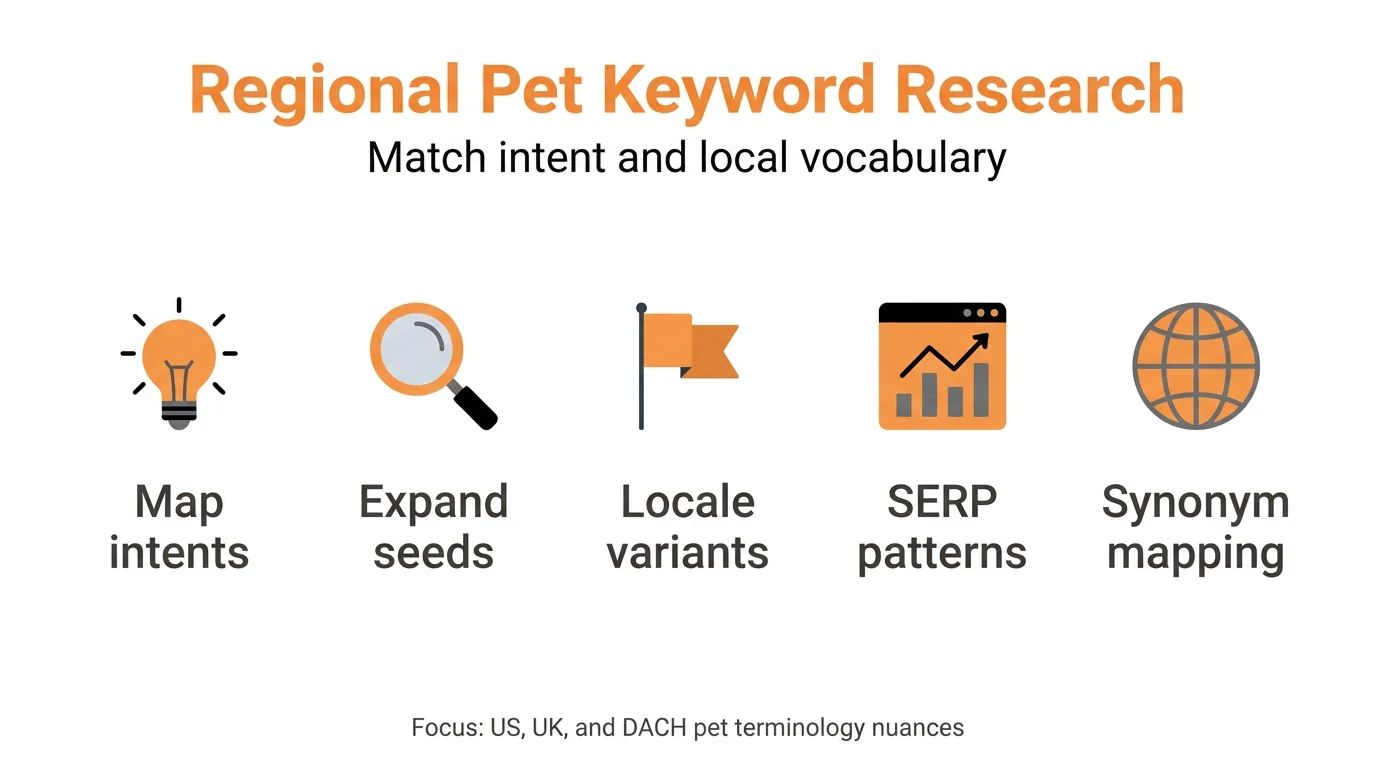
Seed expansion: US, UK, de-DE, de-AT, de-CH nuances
Begin with intent clusters, then expand seeds per market. In the US, collect imperial and generic terms. In the UK, check pluralization, hyphenation, and colloquialisms. For DACH pet SEO, separate German variants and Austrian/Swiss preferences. English may bridge audiences, yet regional phrasing often drives higher relevance[4]. For scalable planning, some teams use Petbase AI to standardize research notes and locale drafts.
Query intent checks and SERP feature differences
Evaluate top queries by market. In the UK, SERPs may emphasize retailers or advice snippets. In DACH, expect “Preisvergleich,” marketplace dominance, and stricter shopping feeds. Local conventions, including hashtags and orthography, may shift engagement patterns and ad-labeled click behavior[3]. Document SERP features and adjust titles, schema, and media accordingly. Explore cross-market entities and FAQs to close intent gaps.
Handling currency, measurements, and compliance details
Currency, tax notes, and price display
Display local currency by default: $, £, €, CHF. Use space or narrow no-break space before EUR or CHF where customary. Many EU and UK markets expect tax-inclusive consumer pricing; confirm your category requirements. Show localized thousands and decimal separators. Provide a lightweight toggle to view alternate currencies when helpful.
Imperial vs. metric and pet-weight dosing language
US expects imperial units, often with ranges in pounds and inches. UK users accept dual units, so present primary metric with imperial in parentheses. DACH users expect metric exclusively. For dosing or size guides, write weight bands clearly and avoid mixing separators. Tooltips may reduce confusion for cross-border customers.
Breed and product naming differences that change ranking
Breed synonyms and protected terms in DACH
Map breed synonyms that affect search, such as “German Shepherd” vs. “Alsatian” in the UK. In DACH, verify national naming customs and avoid legally restricted phrases or regional certifications. Evidence suggests governance of brand language can prevent misalignment and legal risk[2]. Document preferred canonical names and permitted alternates per locale.
Product category labels: leads vs. collars, toys, treats
UK “lead” equals US “leash.” “Treats” vs. “snacks” vs. “Leckerlis” vary by market. Use the preferred local head term in H1 and title. Store alternates as synonyms in on-page copy and structured data. This approach may capture broader demand while clarifying category intent.
Schnell entscheiden: Was tun in typischen Szenarien?
Quick decision guide (if X, then Y) for localization choices
- If products, prices, or compliance differ by country, then create separate locale pages with distinct pricing blocks.
- If wording differs but price and stock are identical, then localize copy and units, with self-canonical per locale.
- If the UK and US share products but differ in terms, then duplicate the page and optimize for UK vs US pet terminology.
- If DACH has uniform inventory, then use one German template with market-specific shipping and decimal formats.
- If marketplaces dominate a SERP, then prioritize comparison content and price clarity over long-form copy.
- If CTR is low for a localized page, then rewrite title/meta to match local nouns and unit patterns.
- If crawl budget is tight, then localize high-intent categories first and defer low-impact informational clones.
Monitoring and iteration cadence
What to observe after 7-14 days
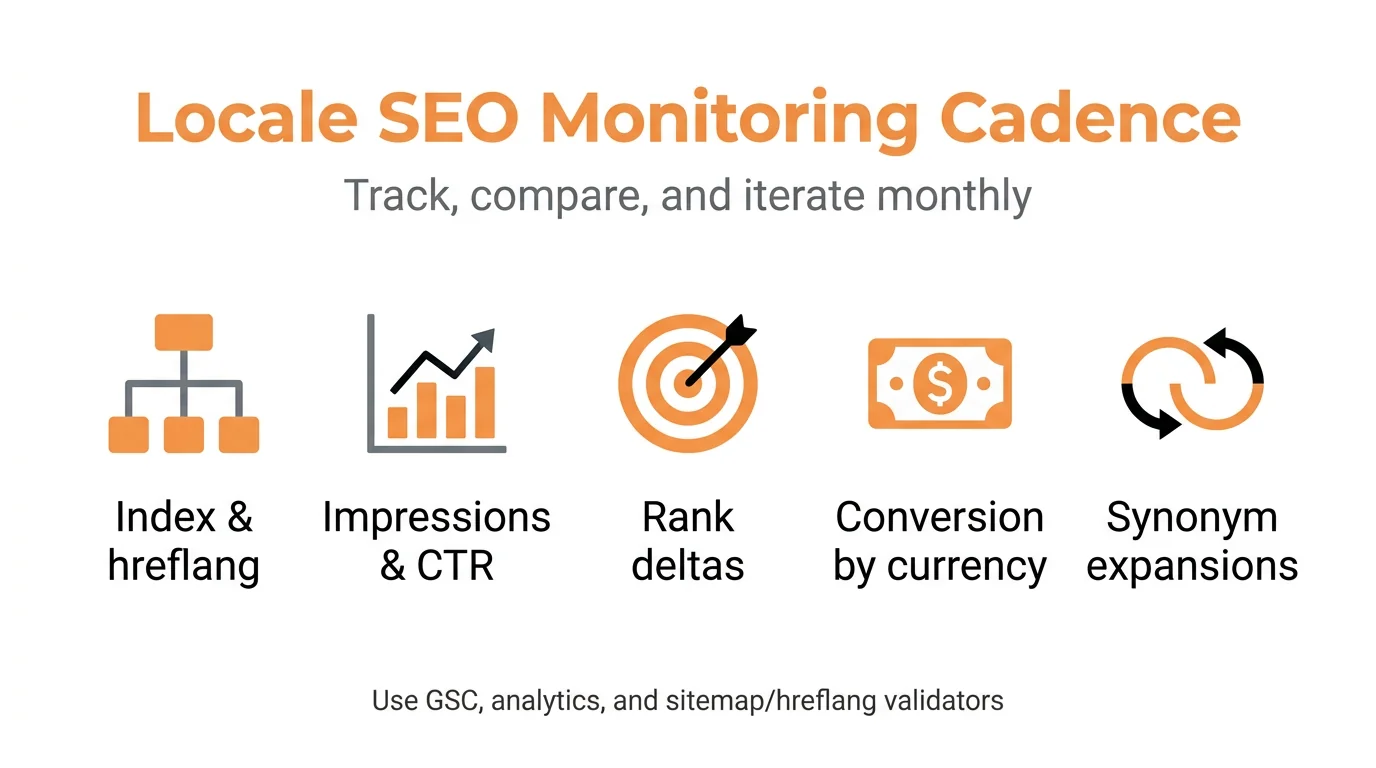
Check indexing status for each locale and ensure hreflang reciprocation. Compare impressions by query in each market. Audit click-through on localized titles. Validate structured data coverage. Re-test a sample of pages with URL Inspection for canonical and language detection issues.
What to observe after 4-8 weeks
Evaluate rank deltas for core terms per locale. Review conversion metrics by currency and unit preference. Inspect query expansions triggered by synonyms. Monitor cannibalization between en-US and en-GB. For analytics guardrails, see search console and analytics setup for multilingual sites. Iterate copy where intent mismatches persist.
Practical safety boundaries
Where to avoid automation, when to require legal/compliance review
Automate templated elements only after human-reviewed lexicon and units are final. Handcraft high-risk pages: dosage guidance, regulatory claims, and warranty language. For DACH, review claims intersecting with health or certifications. Escalate trademarked breed or product names. Evidence indicates strict governance stabilizes brand language and reduces errors across locales[1].
Evidence status and sources to watch
Where evidence is strong vs. emerging in multilingual SEO
Evidence is strong for maintaining consistent voice with localized terminology and structured hreflang pairings[1][2]. Emerging areas include the impact of English-influenced branding on non-English SERPs and regional engagement conventions like hashtags[3][4]. Track SERP feature shifts and policy updates on internationalization.
Appendix: Example lexicon snippets (US, UK, DACH)
Spelling, breed names, and category terms
| Concept | US (en-US) | UK (en-GB) | Germany (de-DE) | Austria (de-AT) | Switzerland (de-CH) |
|---|---|---|---|---|---|
| Walking gear | Leash | Lead | Leine | Leine | Leine |
| Treats | Treats | Treats | Leckerlis | Leckerlis | Leckerli |
| Poop bags | Poop bags | Poo bags | Kotbeutel | Kotbeutel | Säckli für Hundekot |
| Color/Colour | Color | Colour | Farbe | Farbe | Farbe |
| Breed synonym | German Shepherd | Alsatian | Deutscher Schäferhund | Deutscher Schäferhund | Deutscher Schäferhund |
| Decimal separator | 1,299.99 | 1,299.99 | 1.299,99 | 1.299,99 | 1’299.99 or 1’299.95 |
| Currency | $ | £ | € | € | CHF |
Frequently Asked Questions
Should I use subfolders or ccTLDs for US, UK, and DACH?
Subfolders with proper hreflang may be sufficient for most pet brands and can consolidate authority. ccTLDs may help when legal or trust signals are region-specific. Evidence suggests testing subfolders first unless you already run separate country operations.
Do I need separate pages for de-DE, de-AT, and de-CH?
If pricing, compliance, or vocabulary differs, separate locale pages may support relevance. If differences are minor, a single de page with country-specific elements may be adequate. Monitor locale-specific impressions and CTR to decide.
How do I avoid duplicate content with language variants?
Use self-referencing canonicals, reciprocal hreflang pairs, and regional copy differences (currency, units, terms). Evidence suggests even light localization plus hreflang reduces duplication risk.
What matters more: voice consistency or local terminology?
Both matter, but intent-matching local terminology may influence discoverability more. Keep brand tone consistent while adapting key nouns and units to align with local searches.
How should I localize prices and measurements?
Display local currency and typical formats, and switch between imperial and metric as expected. Where relevant, show dual units to reduce friction; test impact on conversions.
Conclusion
Multilingual pet SEO succeeds when one brand voice meets locally precise language. Decide your immovable traits, then localize the levers users and search engines notice: nouns, units, and price. Implement a clean hreflang architecture, validate continuously, and watch intent shifts. Document lexicon choices, protect legal boundaries, and iterate by market signals. With disciplined governance and thoughtful research, US, UK, and DACH pages can compound authority, reduce duplication risk, and convert more consistently across borders.
References
- B Zhang et al. (2023). Brand Consistency for Multilingual E-commerce Machine Translation. Proceedings of Machine …. View article
- E De la Cova (2021). Language and brand: Problems for localization. HERMES-Journal of Language and Communication in …. View article
- E Martin (2019). Global marketing translation and localization for French‐speaking countries. World Englishes. View article
- SA Bibi et al. (2024). Globalization and English in advertising exploring how English is used as a global language in branding. Journal of Applied Linguistics and TESOL …. View article