Measure What Matters: Tracking Pet Page SEO Performance and ROI


Table of Contents +
- Scenario: One framework to connect rankings, rich results, CTR, assisted conversions, and revenue
- Data setup: Minimal viable instrumentation for pet sites
- KPI definitions: What each metric means and healthy ranges
- Quick decision guide
- Monitoring cadence and what to look for
- Practical safety boundaries
- Evidence status and confidence notes
- Example report layout for pet brands
- Next steps and how this supports the cluster
- Frequently Asked Questions
- Conclusion
- References
A practical framework to connect rankings, rich results, CTR, assisted conversions, and revenue for pet product, category, service, and blog pages.
Organic visibility only matters when it moves customers toward purchase. Rankings and traffic without conversions waste effort. Pet brands need a reporting framework that traces the full path.
This article offers a practical approach for pet page SEO performance. You will connect rankings, rich results, CTR, assisted conversions, and revenue to product, category, service, and blog pages. Expect clear metrics, ranges, and decision rules.
Scenario: One framework to connect rankings, rich results, CTR, assisted conversions, and revenue
Define page groups: product, category, service, blog
Start by classifying URLs into product detail pages, category or collection pages, service pages, and blogs. This segmentation allows targeted benchmarks and tailored diagnostics for each template’s role in the funnel.
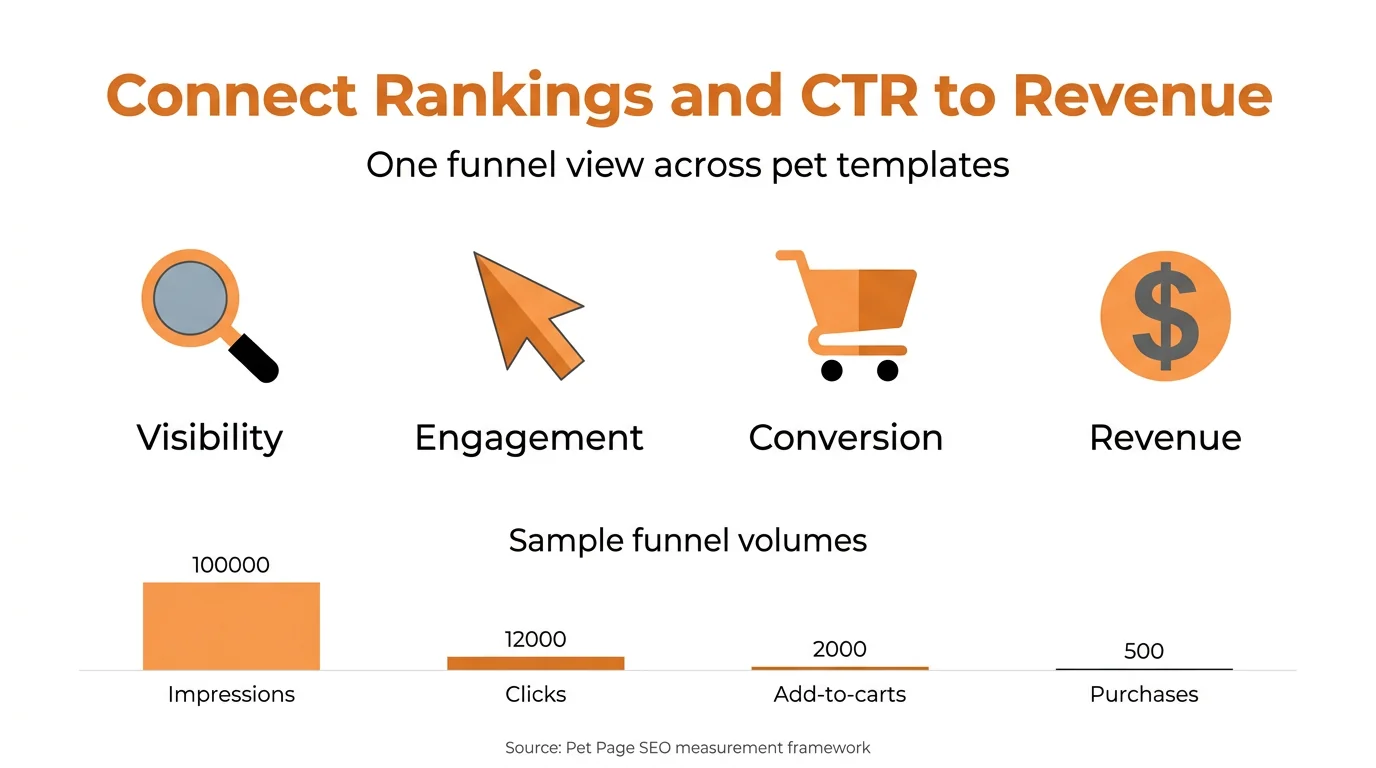
Set metric tiers: visibility, engagement, conversion, revenue
Track four tiers consistently. Visibility covers rankings, impressions, and rich results. Engagement captures CTR and on-page actions. Conversion focuses on micro and macro goals. Revenue ties orders and lifetime value to organic sessions.
Create a source-of-truth report (GSC + analytics + CRM)
Unify Google Search Console, analytics, and CRM data into a weekly dashboard. This consolidation enables end-to-end pet ecommerce SEO metrics and supports trustworthy SEO attribution for pet brands.[1]
Petbase builds this SEO foundation automatically for pet businesses - 10 optimized articles published every month - start your free trial.
Data setup: Minimal viable instrumentation for pet sites
Google Search Console views by directory and regex
Create GSC filters by directory or regex to separate product, category, service, and blog. This enables rich results tracking, template-level CTR analysis, and early alerts for feature eligibility changes.
Analytics events: view_item, add_to_cart, begin_checkout, purchase
Implement standard ecommerce events and ensure they bind to session source. Reliable event flows support pet SEO ROI analysis and allow template benchmarks by channel across your organic cohort.[3]
Attribution: assisted conversions and first-touch models
Enable assisted conversions in analytics and configure a first-touch model for discovery. Together, these views illuminate how blogs and categories contribute upstream within longer journeys.[2]
Structured data: Product, ItemList, Service, Article
Implement schema for Product, ItemList, Service, and Article where relevant. Validate with Rich Results Test and monitor coverage. Proper markup may support eligibility for enhanced SERP presentation.[1] For detailed patterns, see schema guidance for pet pages.
KPI definitions: What each metric means and healthy ranges
Visibility: queries, impressions, average position, rich result rate
Visibility reflects eligible demand and search placement. Healthy ranges vary, but a growing query footprint and stable average position under 20 may indicate traction. Track rich result rate by template weekly.
Engagement: CTR, scroll, time on page, PDP click-through from blog
For product and category pages, monitor CTR by query intent and snippet type. For blogs, add events for product module clicks and downstream PDP sessions. Evidence suggests these paths aid attribution.[2]
Conversion: add-to-cart rate, service lead form starts, trial signups
Benchmark add-to-cart from organic between 3% and 8% for in-stock items, adjusting for price band. Measure service lead form starts per visit and follow with call outcomes for quality checks.[3]
Revenue: organic purchase revenue and LTV contribution
Report revenue by page group and tie new-customer cohorts to estimated LTV. This perspective helps separate immediate orders from durable value and improves pet ecommerce SEO metrics for ROI.
Quick decision guide
If rankings improve but CTR is flat, enhance titles, meta, and rich snippets
Refine titles with stronger value propositions and clarify modifiers. Add review, price, and availability markup to qualify for richer snippets where policy allows.
If CTR rises but conversions lag, refine on-page offers and internal links
Test offer blocks, trust badges, and delivery messaging. From relevant blogs, add two or three contextual PDP links and one parent category link using descriptive anchors.
If rich results drop, validate schema and image quality
Check schema coverage, required properties, and image aspect ratios. Ensure images meet size guidelines and compress consistently to preserve eligibility during rich results tracking.
If traffic grows but revenue stalls, audit product availability and pricing
Review inventory depth, backorder settings, and price alignment with competitors. Revenue gaps often trace to stock or margin policies rather than demand.
If blog traffic rises but PDP clicks are low, add contextual product modules
Place modules mid-article and near the conclusion. Use distinct events for module clicks and session-scoped attribution to evaluate assisted conversions. Consider patterns from blog-to-product linking paths.
If services get impressions but few leads, strengthen local signals and FAQs
Expand Service and LocalBusiness schema, embed map snippets, and add booking FAQs. Align NAP details and UTM-tag calls from the local hub page.
If branded traffic dominates, expand non-branded category intent coverage
Publish category guides that address qualities, comparisons, and sizing. Expand modifiers around use-cases and seasonal demand to diversify acquisition.
Monitoring cadence and what to look for
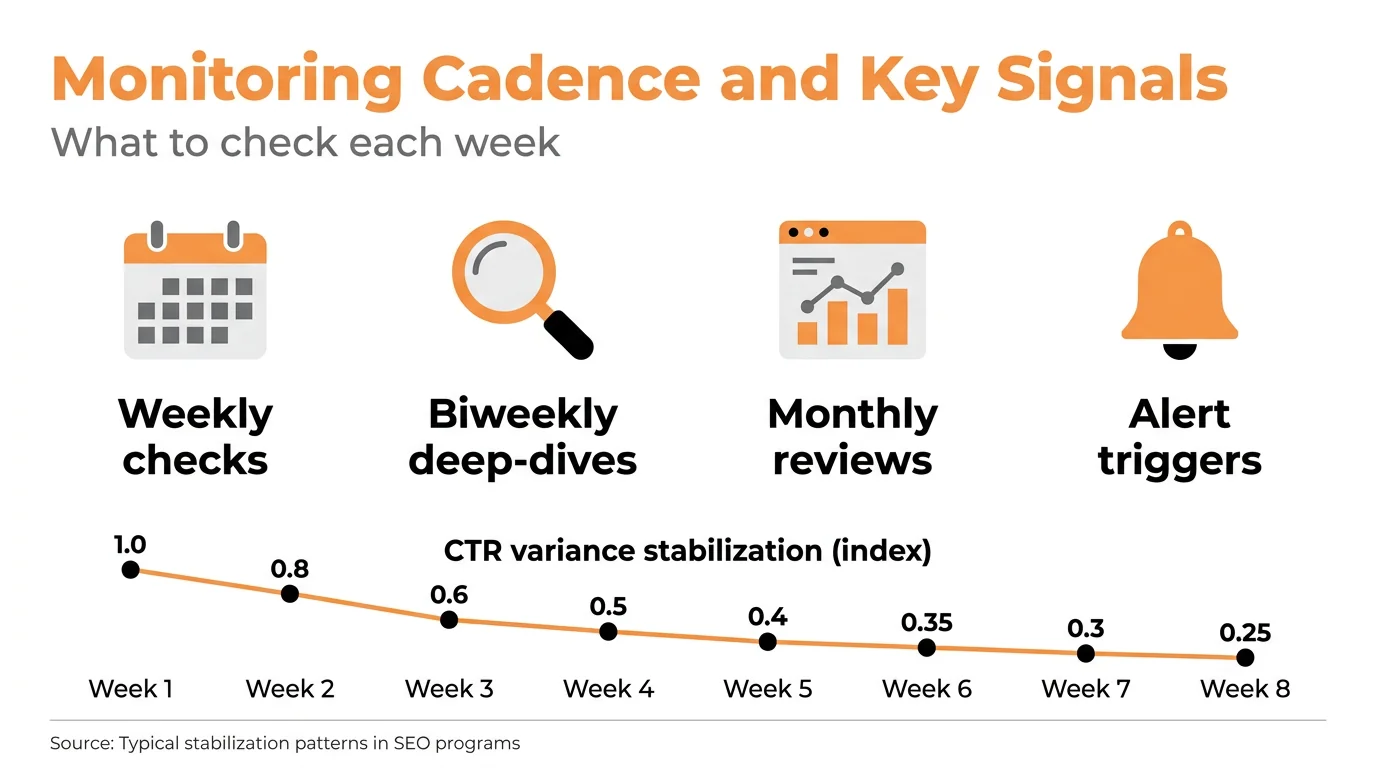
After 7-14 days: indexation, emerging queries, snippet eligibility
Confirm canonical indexation, growing impressions for target themes, and initial snippet types. Address crawl anomalies or coverage warnings quickly to maintain momentum.
After 4-8 weeks: stabilized CTR, assisted conversions, revenue trends
Expect CTR variance to settle and early assisted conversions to appear in paths-to-purchase. Revenue effects often surface gradually as keyword portfolio, content, and links mature.[4]
Segment reviews: product vs. category vs. service vs. blog
Assess performance by template. Compare blog-to-PDP click-through, category to PDP transitions, and service lead quality by source location to isolate bottlenecks precisely.
Practical safety boundaries
Avoid over-attributing last click in longer pet buyer journeys
Use multi-touch views that include first-touch and assisted conversions. Last-click views may undervalue discovery content and category exploration.
Set guardrails for test changes: one variable per template
Change one element at a time per template. Track dates, versions, and KPIs to prevent confounding effects and ensure clean interpretation.
Respect medical and care guidance standards for pet health content
Maintain rigorous sourcing, disclaimers, and author credentials on advice pages. Align with platform policies to avoid snippet or visibility losses.
Cap page speed regression and image weight per template
Set budgets for LCP and image kilobytes. Regressions can depress CTR and conversions even with strong rankings.
Evidence status and confidence notes
Evidence suggests schema may support richer visibility, not guaranteed
Structured data appears to correlate with enhanced SERP elements across retail categories, but eligibility remains algorithmic and conditional on quality.[1]
Attribution models can indicate patterns but may miss offline effects
Analytics can highlight contribution paths, yet offline interactions and cross-device gaps may remain obscured. Triangulate with CRM and call tracking to strengthen inference.[2]
Internal linking to PDPs may support conversion paths in analytics
Well-placed internal links often correlate with measurable downstream activity. Controlled tests and event labeling help separate causation from coincidence in analytics.
Seasonality and stock constraints can confound causal claims
Interpret shifts alongside season, promotions, and inventory. Consider rolling baselines to reduce noise when evaluating pet SEO ROI changes.
Example report layout for pet brands
Topline: visibility to revenue funnel by page group
Display visibility, engagement, conversion, and revenue for each template. Highlight week-over-week deltas and sparkline trends to spot change points quickly.
Diagnostics: query movement and SERP features
Include query clusters, position buckets, and feature eligibility by template. Flag losses in rich results coverage and CTR anomalies for targeted fixes.
Actions: prioritized fixes and experiments for 30 days
List three to five experiments per template with owners and deadlines. For scalable implementation, many teams find Petbase AI helpful for structured content updates and consistent tagging.
Next steps and how this supports the cluster
Use this framework to evaluate changes from the Pet Page SEO strategy overview
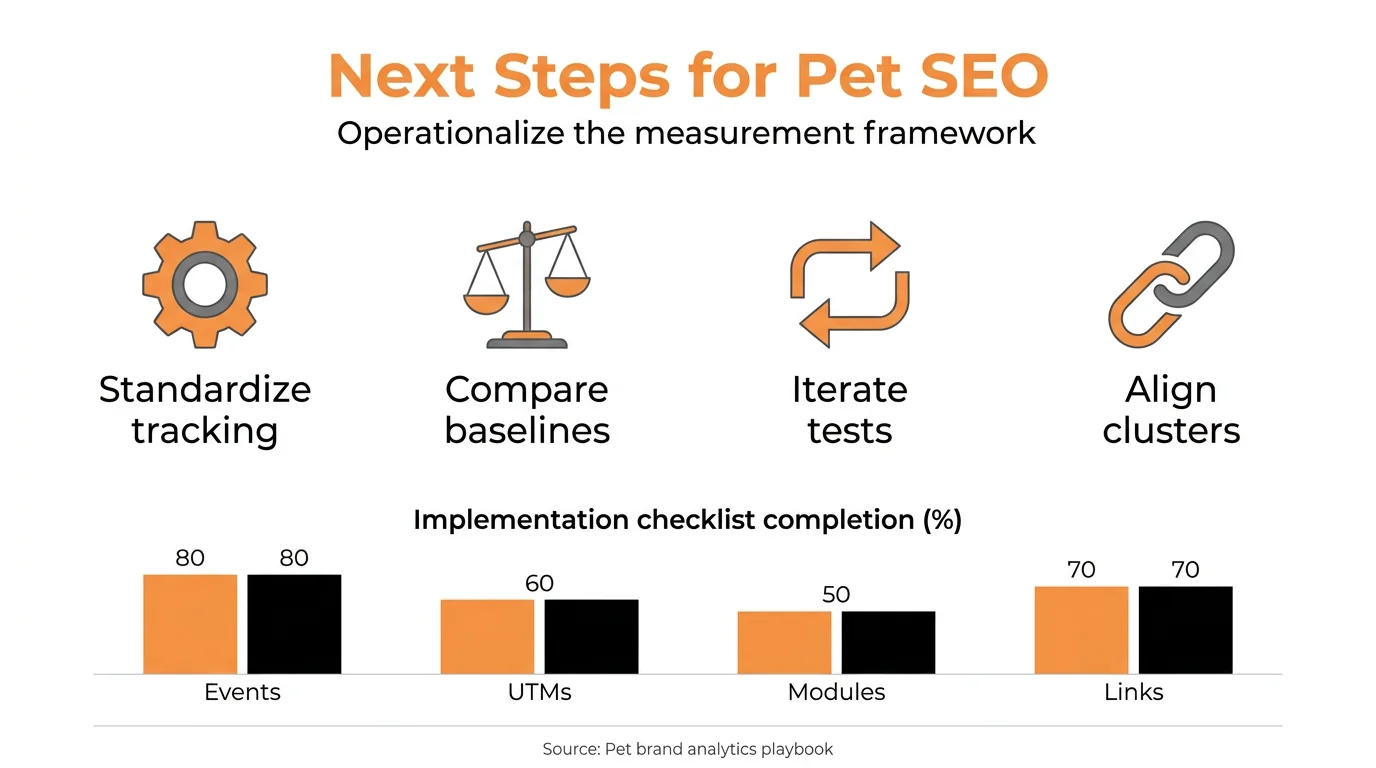
Adopt the funnel view to validate template improvements from the Pet Page SEO strategy overview. Compare per-template baselines before and after copy, schema, or layout updates.
Standardize tags, UTM rules, and content modules across templates
Lock global conventions for events, UTM parameters, and module placements. Reference on-page elements from on-page SEO checks and category logic from collection page optimization to stabilize measurement.
Frequently Asked Questions
How do I attribute revenue to pet blog posts that don’t convert directly?
Use assisted conversions and first-touch attribution to capture blog influence on product and service purchases. Evidence suggests internal links from blogs to PDPs may support measurable paths.
Which metrics best predict pet product page revenue?
Rich result eligibility, CTR, and add-to-cart rate together may indicate revenue potential. Monitor impressions to CTR to add-to-cart to purchase as a single funnel.
What schema should pet retailers prioritize?
Prioritize Product, Offer, Review, and ItemList for category pages. Service and LocalBusiness may support service providers; Article for blogs with product mentions marked up carefully.
How long until SEO ROI becomes visible for pet pages?
Early signals may appear within 2-4 weeks, while stable ROI patterns often need 8-12 weeks. Seasonal factors and stock levels can shift timelines.
How do I track category pages differently from product pages?
For categories, focus on item exposure, filters, and ItemList rich results. For products, track price, availability, reviews, and add-to-cart events tied to organic sessions.
Conclusion
A decision-ready framework converts rankings and rich snippets into measurable revenue impact. Segment by template, track the full funnel, and act on diagnostic signals. With disciplined instrumentation, pet page SEO performance becomes predictable and accountable. This approach encourages steady gains in visibility, engagement, and conversion while safeguarding data quality. Use assisted conversions, rich results tracking, and multi-touch models to reflect real journeys. Align teams around one source of truth to compound results over time.
References
- IC Drivas et al. (2020). Big data analytics for search engine optimization. Big Data and Cognitive …. View article
- D Bansal (2024). How SEO and analytics are connected. International Journal For Multidisciplinary Research. View article
- S Okutan (2025). Search Engine Optimization (SEO) and Search Engine Marketing (SEM). Online Retail Marketing Strategy: Foundations and …. View article
- A Erdmann et al. (2022). Search engine optimization: The long-term strategy of keyword choice. Journal of Business Research. View article