How to Build a 30-Day Automated Pet Blog Calendar (Without Losing Control)


Table of Contents +
- Scope, roles, and one-month objective
- Set up inputs: brand voice, taxonomy, and product map
- Generate the 30-day plan with safeguards
- Review and approval workflow that scales
- Scheduling and publishing cadence
- Quick decision guide
- Practical safety boundaries
- Monitoring: 7-14 days and 4-8 weeks
- Evidence status and where claims may be strong
- Annex: 30-day sample calendar structure
- Frequently Asked Questions
- References
Step-by-step to generate, review, and schedule 30 days of pet blog posts with approvals, guardrails, and cadence so you maintain quality and voice.
An automated pet blog calendar can lift output without sacrificing quality. It also reduces coordination friction across research, writing, and publishing teams.
This matters because consistency and relevance drive discoverability and trust. With guardrails, automation becomes a reliable partner rather than a risk. In this guide, you will learn step-by-step generation, review, and scheduling with clear approvals and cadence.
Scope, roles, and one-month objective
Define the 30-day goal and output mix
Set a 30-day objective that blends awareness, consideration, and conversion posts. Aim for 12-20 articles, depending on review bandwidth. Target a 60/30/10 mix of informational, comparison, and soft product-led content. Keep each output tied to a measurable intent.
Assign owners for research, review, and publish
Designate a research owner for keyword sourcing and clustering. Assign two reviewers: a subject matter reviewer and an SEO reviewer. Give publishing rights to one operator to avoid collisions. Define service-level agreements for handoffs.
Petbase handles this entire content workflow automatically - 10 SEO articles published to your blog every month - start your free trial.
Set up inputs: brand voice, taxonomy, and product map
Brand voice rules and pet-specific language
Document tone, reading level, and banned claims. Specify preferred terms for species, life stages, and measured language. Include sample paragraphs showing ideal clarity. Lock this style into your pet SEO workflow prompts and checklists.
Topic taxonomy by species, life stage, and intent
Create a taxonomy that separates species, life stage, and search intent. Map each node to example queries and seasonal modifiers. Use this map to shape the pet content calendar and internal linking routes.
Product and service linkage map
List top product categories and services that align with each intent. For example, training guides map to harnesses and treats. Establish rules for contextual, non-pushy mentions and one featured product module per page.

Generate the 30-day plan with safeguards
Keyword sourcing and clustering (informational first)
Pull seed terms across care, behavior, nutrition, and gear. Cluster by shared intent and difficulty tiers. Front-load informational topics to build topical authority before commercial posts. See automated pet keyword research for deeper logic on clustering prioritization.
Drafting constraints: length, tone, claims, and links
Constrain drafts to 900-1,400 words for core posts and 400-700 for micro-explainers. Require cautious phrasing for health content. Enforce internal link minimums and schema directives. Tools like Petbase AI may streamline these guardrails within template prompts.
Template for title, outline, and on-page SEO
Standardize a template: intent-led title, scannable H2/H3s, FAQs, and a clear conclusion. Add meta title rules, meta descriptions, and canonical logic. Include a placeholder for one category hub link and one product module.
For broader context on orchestration, connect to the Pet Blog Automation Orientation Hub to maintain alignment across your cluster.
Review and approval workflow that scales
Two-gate review (subject matter + SEO)
Gate one checks accuracy, safety, and clarity. Gate two checks search intent match, on-page SEO, and internal linking. Require both approvals before scheduling. Use checklists to keep reviews fast and consistent.
Fact and safety checks for pet health content
Flag health advice for heightened scrutiny. Validate claims against reputable sources and avoid diagnostics. Add disclaimers and redirect medical concerns to professionals. Maintain a source log for traceability.
Versioning and change logs
Track edits by date, owner, and reason. Store diffs and comments in a shared workspace. Note whether changes affect title, headings, or schema. Versioning protects continuity and accelerates future updates.
Scheduling and publishing cadence
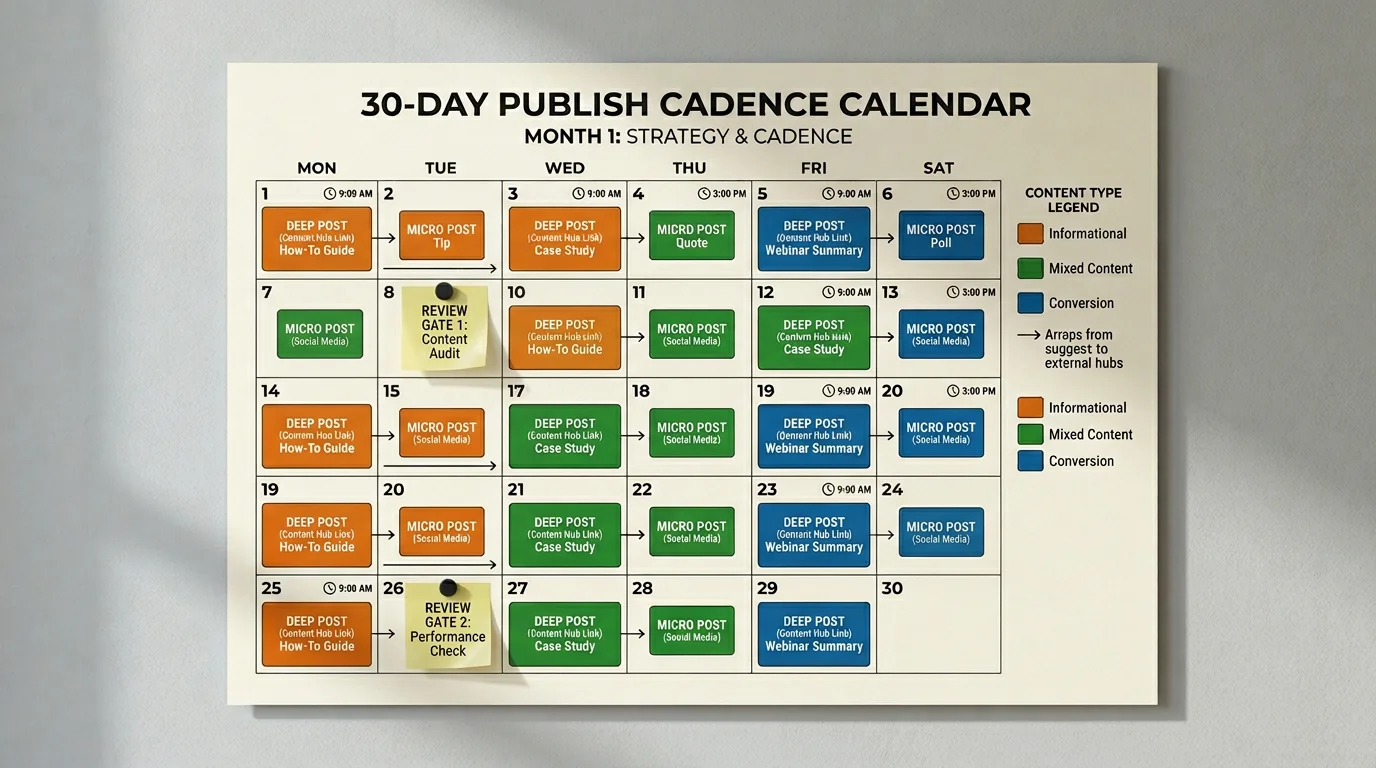
Cadence model: 3x/week vs daily micro-posts
Choose 3x/week for deeper pieces when review capacity is limited. Use daily micro-posts to cover common queries and build breadth. Time-of-day optimization may improve visibility and engagement according to scheduling research[1].
Internal linking and schema on publish
On publish, add 2-4 internal links toward hubs and relevant products. For example, connect training guides to category pages using descriptive anchors. Apply Article, FAQ, and Product schema as appropriate. See automating internal links to product pages for practical patterns.
Localization sequencing (US/UK/DACH)
Localize only after the primary version is indexed and stable. Sequence US → UK → DACH within 2-4 weeks, adapting spelling, regulations, and retailers. Reference multilingual pet blog automation for US, UK, and DACH when planning market rollouts.
Quick decision guide
If X situation, then Y action (7 common cases)
- If drafts exceed review capacity, then switch to 3x/week and queue micro-explainers.
- If impressions rise but CTR stalls, then rewrite titles and meta descriptions first.
- If thin content is flagged, then merge related micro-posts into a comprehensive guide.
- If crawl budget appears constrained, then slow publishing to 3-4 posts weekly.
- If internal links are sparse, then add cross-links between theme-week posts.
- If health claims trigger edits, then escalate to subject expert before rescheduling.
- If product mentions feel pushy, then convert to a single contextual feature box.
Practical safety boundaries
Medical disclaimers and sourcing
Add a visible disclaimer on all health-adjacent pages. Cite consensus sources where possible. Avoid prescriptive treatment steps. Encourage readers to consult professionals for diagnosis and emergencies.
Breed and product suitability cautions
Note size, age, and material considerations for gear recommendations. Avoid universal statements. Provide ranges for measurements and behavior advice. State when supervision is required for safety.
What to blocklist in generation
Blocklist diagnostic language, dosage advice, and unverified claims. Exclude superlatives like “best ever” and “guaranteed.” Disallow price promises and competitor disparagement. These constraints help keep automated outputs compliant.
Monitoring: 7-14 days and 4-8 weeks
Early diagnostics and quality spot checks
After 7-14 days, check index coverage, crawl errors, and rendering issues. Spot-check five posts for factual accuracy, E-E-A-T signals, and internal link health. Schedule quick title tests if CTR underperforms baseline ranges.
Mid-range SEO signals and iteration rules
At 4-8 weeks, review impressions, average position, and query clustering. Iteration can follow forecast-driven scheduling logic, where adjustments learn from prior performance and resource constraints[3]. Rebalance output toward topics showing early momentum.

Evidence status and where claims may be strong
What evidence suggests for cadence and clustering
Evidence from scheduling research indicates that timing considerations may influence engagement and visibility, which supports structured publication routines[1]. Studies on automated scheduling in other domains suggest consistent, rules-driven automation can match or outperform manual approaches under defined constraints[4].
Where to be cautious with performance attribution
Be cautious attributing gains solely to automation. Externalities like seasonality, SERP changes, and competitor moves can confound results. Schedule automation research shows benefits depend on context and constraint design[2].
Annex: 30-day sample calendar structure
Theme weeks and intent mix
Week 1: Care basics (informational). Week 2: Training and enrichment (mixed). Week 3: Nutrition fundamentals (informational). Week 4: Gear comparisons (consideration). Interleave two micro-posts per week to answer narrow, high-intent questions.
Review slots and contingency posts
Reserve two review windows weekly for batch approvals. Keep three contingency posts ready to replace delayed items. Cross-link all Training Week posts with intent-based anchors to consolidate relevance and distribute authority.
Frequently Asked Questions
How many pet blog posts should I schedule per week with automation?
Evidence suggests starting with 3-5 posts per week for new sites to balance crawl and quality. Increase volume once review throughput and internal linking remain stable.
How do I keep control of brand voice with automated pet blogs?
Create a short style guide with examples, required phrases, and banned terms. Use pre-publish checklists and a two-gate review to ensure tone and accuracy.
Should automated pet content include medical advice?
Limit to general care tips with citations and add medical disclaimers. Route any diagnosis or treatment content through a qualified reviewer before publishing.
What metrics should I watch in the first month?
Track indexed pages, impressions, average position, and internal link coverage. Watch bounce and time on page to identify thin or mismatched topics.
How do I link automated posts to products without being pushy?
Use contextual anchors where the product solves a problem. Add structured data and one featured product box aligned to the article’s intent.
Automation works best within clear boundaries. Treat your automated pet blog calendar as an engine that learns from signals and feedback. Evidence from scheduling research and other automated systems suggests structured, constraint-driven workflows may improve consistency and output quality over time[2].
References
- VK Kanuri et al. (2018). Scheduling content on social media: Theory, evidence, and application. Journal of Marketing. View article
- SA Prieto et al. (2023). Investigating the use of ChatGPT for the scheduling of construction projects. Buildings. View article
- Y Li et al. (2021). Optimal scheduling of isolated microgrids using automated reinforcement learning-based multi-period forecasting. IEEE Transactions on Sustainable …. View article
- JM Domínguez-Niño et al. (2020). Differential irrigation scheduling by an automated algorithm of water balance tuned by capacitance-type soil moisture sensors. Agricultural Water …. View article