Automated Pet Keyword Research for Breeds, Life Stages, and Conditions


Table of Contents +
- Why focus on breeds, life stages, and conditions
- The one scenario: turning raw pet queries into publishable brief clusters
- Quick decision guide: if X happens, do Y
- Workflow: from scrape to brief in 60 minutes
- Practical safety boundaries
- Monitoring: what to observe at 7-14 days and 4-8 weeks
- Evidence status and where claims need caution
- Output examples: brief templates per cluster
- Map clusters to calendar and internal linking
- Frequently Asked Questions
- Conclusion
- References
Learn how to automate pet keyword research for breeds, life stages, and conditions, then cluster into publishable briefs for high-intent traffic.
High-intent pet searches often include breed, age, and condition details. Those modifiers reveal purchase and care decisions. Automating their discovery converts ambiguity into predictable growth.
This matters because precise intent reduces wasted content and improves product matching. You will learn how to auto-discover breed, life-stage, and condition topics, then cluster them into publishable briefs that respect safety boundaries and measurable outcomes.
Why focus on breeds, life stages, and conditions
Intent signals that map to product and care decisions
Breed modifiers SEO aligns directly with fit, size, and sensitivity. Life stage keywords reveal developmental needs, feeding, and training priorities. Pet conditions search intent often indicates urgency and conversion potential while demanding careful, non-diagnostic guidance.
Data sources: autocomplete, PAA, product feeds, EMR glossaries
Combine autocomplete, People Also Ask, product catalogs, and EMR glossaries to expand structured intent. Semi-automated scraping may surface temporal and taxonomic biases, so validate patterns before scaling decisions.[1]
Petbase handles this entire content workflow automatically - 10 SEO articles published to your blog every month - start your free trial.
The one scenario: turning raw pet queries into publishable brief clusters
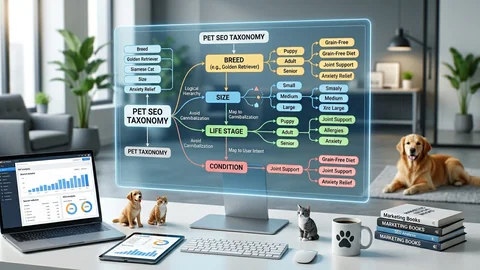
Entity-first extraction: species → breed → life stage → condition
Parse each query into entities: species, breed, life stage, and condition. Treat entities as the backbone for pet keyword clustering. Add secondary attributes like size, coat type, activity level, and environment.
Modifier library: diet, training, grooming, vet, size, sensitivity
Build a controlled modifier library. Core groups include diet, training, grooming, veterinary, size/fit, and sensitivities. Capture lexical variants and regional spellings to avoid fragmentation across near-duplicate intents.
Scoring: search volume, difficulty, commercial match, freshness
Score candidates across four axes: demand, difficulty, commercial match, and freshness. Favor topics with clear product alignment, obtainable SERPs, and steady or rising seasonality. Apply cautious thresholds, not absolutes.
Clustering: tight intent groups with on-page outlines
Group queries by shared entities and modifiers. Use compact clusters that answer a single core need. Draft outlines reflecting intent, not generic structures. Link to your research and prioritization framework to finalize sequencing.

Quick decision guide: if X happens, do Y
If breed + problem is present, publish condition-first guides
Lead with the condition, then adapt recommendations to the named breed. Provide size, coat, conformation, and behavior considerations without diagnosing or prescribing treatments.
If life stage is explicit, prioritize developmental needs content
Center nutrition, training, preventative care, and screening schedules for that age. Include safe ranges, watchpoints, and escalation cues to professional care.
If condition implies product fit, map to product-led templates
Use product-led how-tos when intent suggests gear or dietary solutions. Align recommendations with category filters like size, material, active ingredient, or formulation.
If query is seasonal, schedule 6-8 weeks before peak
Pre-position content before demand spikes. Refresh annually with recent recalls, weather shifts, or awareness campaigns to sustain relevance during trend cycles.
If SERP has medical dominance, add vet-reviewed elements
Include expert review, citations, and MedicalEntity schema. Maintain cautious language, and direct readers to seek veterinary evaluation for urgent or persistent symptoms.
If modifiers show brand terms, produce comparison-safe content
Offer transparent comparisons and use standardized pros/cons. Capture common alternatives, sizes, and use cases to resolve buyer hesitation without overt promotion.
Workflow: from scrape to brief in 60 minutes
Collect: seed intents and expand with patterns
Start with seeds: breed, life stage, and condition. Expand via autocomplete patterns, PAA harvesting, and merchant feeds. Semi-automated pipelines help scale collection while revealing temporal skew.[1] For speed, consider using Petbase AI during expansion.
Normalize: canonicalize breeds and synonyms
Map synonyms to canonical breeds and conditions. Taxonomy plus synonym expansion may improve match rates and reduce duplication across clusters and templates.[2]
Cluster: cosine + rules for intent purity
Use embeddings for semantic proximity, then enforce rules by entity and modifier. Automated taxonomic assignment benefits from guardrails and manual checks where ambiguity persists.[4]
Outline: H2/H3s, FAQs, internal link targets
Outline to answer one dominant intent. Add FAQs covering adjacent modifiers. Plan internal links to hubs, product categories, and related how-tos to progress readers through discovery.
Schema: Product, FAQ, MedicalEntity when appropriate
Use Product for recommendations, FAQ for common clarifications, and MedicalEntity for vetted condition pages. Validate with testing tools, and avoid unsupported medical claims or dosing advice.
Practical safety boundaries
Avoid diagnosing; use cautious language and disclaimers
Describe signs and options without diagnosing. Emphasize variability by breed and individual condition. Encourage timely veterinary consultation for acute, persistent, or worsening issues.
Use authoritative sources for medical definitions
Cite peer-reviewed references or recognized veterinary bodies for definitions and prevalence notes. Language and framing in pet topics may carry bias; review critically before publication.[3]
Do not overgeneralize across breeds without notes
Clarify when guidance is general versus breed-specific. Note conformation, coat, and size factors that may alter care approaches, equipment fit, or dietary tolerance.
Respect YMYL standards: author creds and citations
List author expertise, veterinary review where applicable, and citations. Automated taxonomies and synonym systems may introduce errors, so apply editorial oversight before publication.[4]
Monitoring: what to observe at 7-14 days and 4-8 weeks
7-14 days: indexing status, impressions by cluster, CTR deltas
Confirm indexing in Search Console. Track impressions by cluster and modifiers. Review titles and meta descriptions to lift CTR without inflating claims or misrepresenting outcomes.
4-8 weeks: ranking by modifier type, assisted conversions, cannibalization checks
Segment rankings by breed modifiers, life stage keywords, and condition intents. Attribute assisted conversions where content supports discovery. Audit cannibalization and consolidate overlapping assets.
Iterate: expand winning modifiers, prune weak overlaps
Scale patterns showing durable rankings and conversions. Prune or redirect thin overlaps. Link new wins to related support pieces to consolidate authority, using playbooks like automating internal links to product pages.

Evidence status and where claims need caution
Breed-condition correlations: veterinary literature suggests patterns, not certainties
Breed predispositions may exist, but individual variation is substantial. Automated classification and entity mapping require validation to prevent overstatements in sensitive topics.[4]
Life-stage nutrient needs: standards may vary by region and body condition
Nutrient recommendations differ across standards and individual health. Cite credible sources and present ranges, not absolutes, to reflect uncertainty and practical feeding variability.
Search intent volatility: seasonality and trend cycles affect volumes
Web data may reflect temporal and taxonomic biases. Monitor seasonality and refresh schedules, especially for conditions and events that spike unpredictably.[1][3]
Output examples: brief templates per cluster
Breed × Condition: ‘Bulldog skin allergies’ guide structure
Search intent: Condition management with breed-specific context and product fit.
Outline: Causes and triggers; grooming and bathing cadence; hypoallergenic diet considerations; when to see a vet; gear and topicals formatted by size and sensitivity.
Internal link targets: Bulldog breed hub; Allergy shampoo category; related strategy in programmatic SEO for pet catalogs.
Life Stage × Diet: ‘Senior dog joint support diet’ outline
Search intent: Age-appropriate nutrition for mobility and comfort, including supplements and feeding schedules.
Outline: Signs of joint stiffness; nutrient roles; food forms and palatability; safe supplement use; weight management targets; vet check triggers.
Internal link targets: Senior dog hub; Joint-support food category; calendar setup via building a 30-day automated pet blog.
Species × Grooming: ‘Long-hair cat mat prevention’ checklist
Search intent: Practical grooming cadence, tools, and coat-health prevention with product guidance.
Outline: Brushing frequency; dematting tool comparison; shampoo types; environmental humidity; hairball mitigation; when to seek groomer help.
Internal link targets: Long-hair cat hub; Grooming tools category; seasonal angles in holiday and weather-driven content.
Map clusters to calendar and internal linking
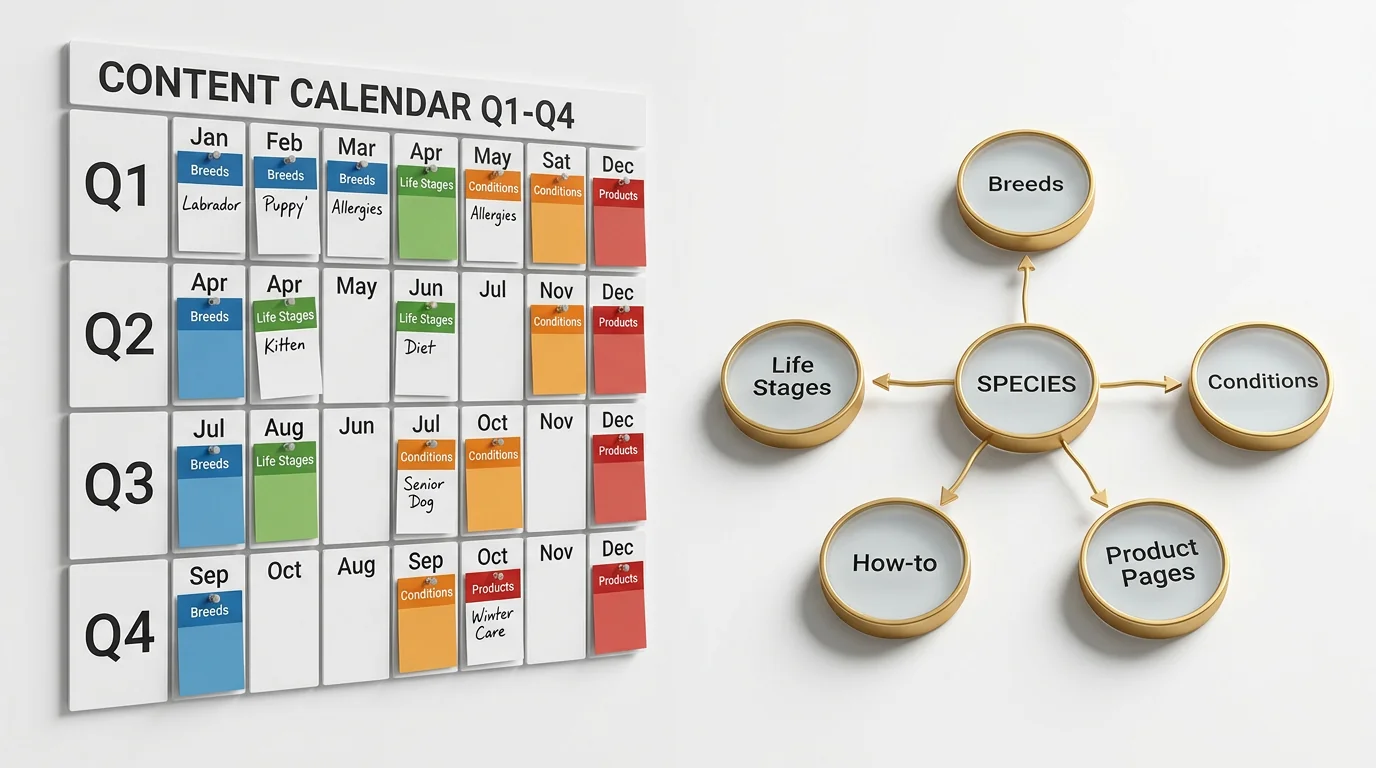
Quarterly themes: allergy, shedding, senior health, training
Batch briefs into quarterly themes that reflect demand cycles. Coordinate product launches and promotions. This alignment supports programmatic pet SEO while simplifying stakeholder planning.
Link architecture: hub → breed/life-stage → product/how-to
Use hub pages for species, breeds, and life stages. Downstream, connect to product-led and how-to assets. Consistent anchors transfer context and reduce discovery friction across clusters.
Anchor hygiene and overlap prevention
Standardize anchors by entity and modifier. Avoid duplicate anchors pointing to different pages. Consolidate near-duplicates, and reserve comparison anchors for brand-term SERPs to limit cannibalization.
Frequently Asked Questions
How do I prioritize breed versus life-stage keywords?
Evidence suggests starting with condition-led queries that include a breed or life stage, then expanding laterally. Compare SERP intent and potential product or service fit to decide sequencing.
What clustering method works best for pet topics?
A hybrid of vector similarity and rule-based grouping around entities (species, breed, life stage, condition) may keep intent clean. Validate clusters with SERP sampling before outlining.
Can I automate medical-related pet content safely?
You may automate drafts with guardrails: cite authoritative sources, add expert review, avoid diagnostic claims, and use cautious wording. Include clear guidance to seek veterinary care.
Which modifiers signal higher commercial intent?
Modifiers like best, vs, cost, near me, diet, food, supplement, harness, shampoo, and insurance often indicate purchase or service consideration. Verify by checking live SERPs and ads density.
How long until clusters show traction?
Impressions may rise within 2 weeks if indexing is smooth, while stable rankings often require 4-8 weeks. Seasonality and site authority can shift timelines.
Note: For medical review process guidance and schema tips, see veterinary blog automation with E-E-A-T.
Conclusion
Automated pet keyword research works best when entities drive structure and modifiers align with care and commerce. Extract species, breed, life stage, and condition. Score, cluster, and brief with safety guardrails. Monitor early signals and iterate. Precision in clustering, careful language, and disciplined internal linking may compound authority and revenue while respecting readers’ needs and veterinary standards.
References
- A Toomes et al. (2023). A snapshot of online wildlife trade: Australian e-commerce trade of native and non-native pets. Biological …. View article
- A Boteanu et al. (2018). Synonym expansion for large shopping taxonomies. Automated Knowledge Base …. View article
- J Bielby et al. (2025). Exploring media representation of the exotic pet trade, with a focus on welfare: taxonomic, framing and language biases in peer-reviewed publications and …. Royal Society Open …. View article
- DA Coil et al. (2019). Genomes from bacteria associated with the canine oral cavity: A test case for automated genome-based taxonomic assignment. PLoS …. View article