From Blog to Basket: Automating Internal Links to Pet Product Pages


Table of Contents +
- Scenario: Auto-linking product pages from breed- and problem-specific blog posts
- Data-driven mapping: Blog topics → product/category targets
- Placement rules that respect UX and SEO
- Anchor text playbook for pet products
- Instrumentation: Tracking what matters
- Quick Decision Guide (Schnell-Entscheidungsleitfaden)
- Monitoring guidance
- Practical safety boundaries
- Evidence status and limits
- Implementation blueprint (pseudo-logic and schema)
- Hand-off checklist for engineering and content ops
- Frequently Asked Questions
- Conclusion
- References
Blueprints to auto-insert relevant pet product links from blogs with smart anchors, safe placement rules, and tracking that may improve conversions.
Scenario: Auto-linking product pages from breed- and problem-specific blog posts
Introduction
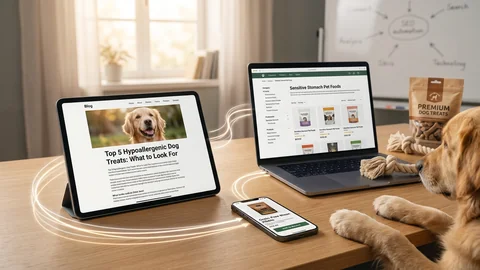
Your pet blog attracts searchers with specific needs. The next step is guiding them to the right products, without distracting from helpful advice.
Automating internal links can connect problems to solutions at scale. It matters because manual linking rarely keeps up with publishing velocity or inventory changes. In this guide, you will learn rule-based placement, anchor text optimization, product linking strategy, and conversion tracking for blogs.
Scope and constraints for pet blogs and product catalogs
This blueprint targets editorial articles tied to breed, size, life stage, or problem-solution topics. It assumes a structured product catalog with categories and SKUs. It excludes promotional landing pages or pages with strong transactional intent.
Petbase automates SEO content for pet stores - publishing 10 optimized articles monthly so you can focus on running your shop - start your free trial.
Data-driven mapping: Blog topics → product/category targets
Keyword-to-SKU taxonomy (breed, size, life stage, condition)
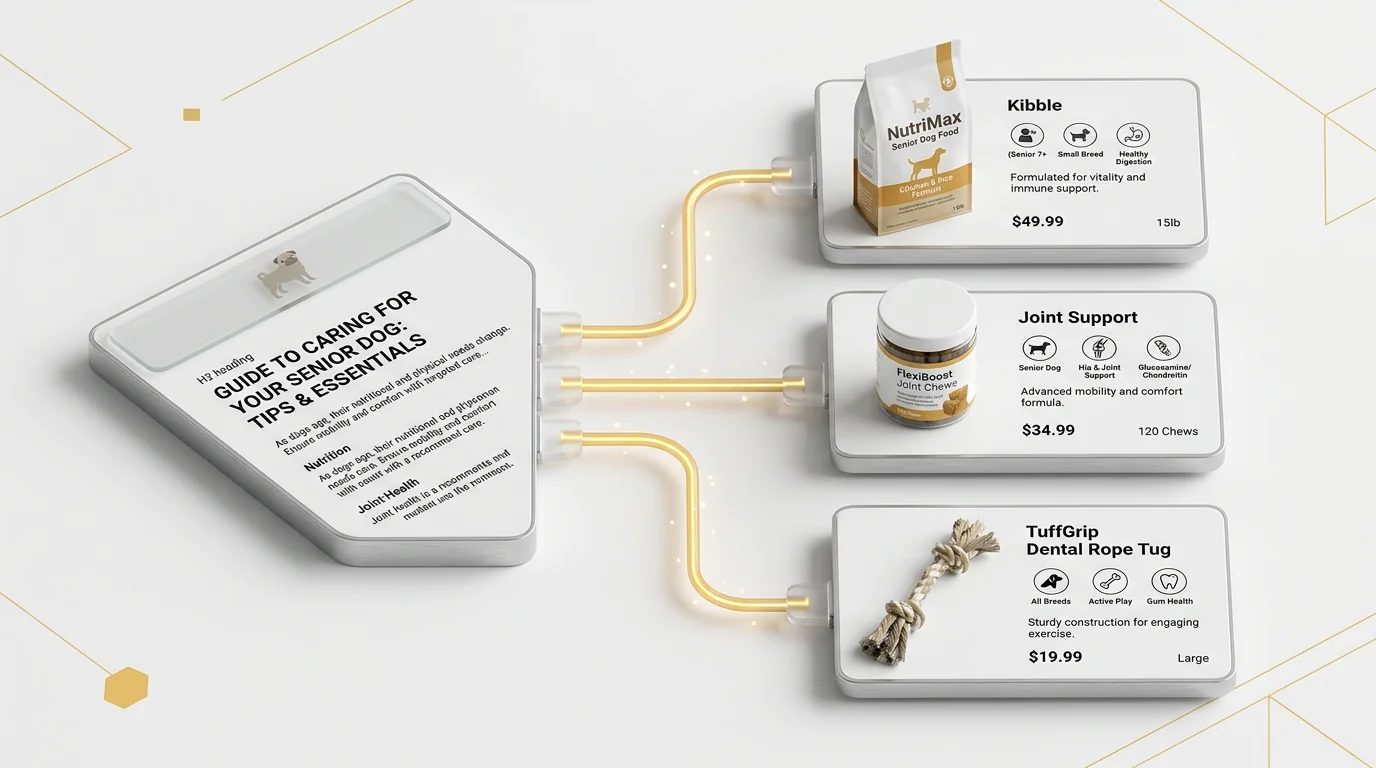
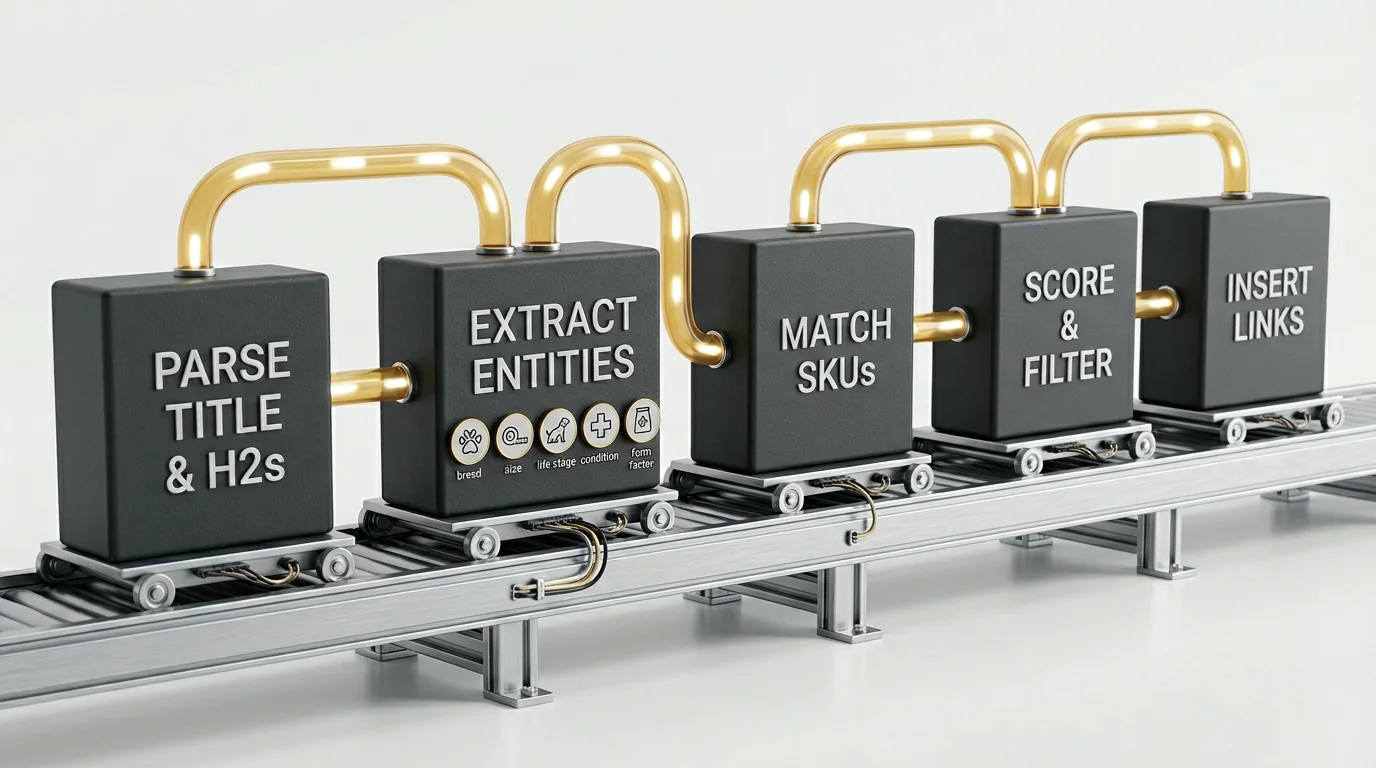
Build a taxonomy that maps blog entities to product facets: breed, size class, life stage, primary condition, dietary need, and form factor. Derive entities using NLP from titles, H2s, and summaries, then match to categories and SKUs programmatically[1].
Relevancy thresholds and tie-breakers
Use a composite score: 60% entity overlap, 20% historical CTR, 10% margin proxy, 10% inventory depth. Set a minimum relevancy score of 0.65. Resolve ties by stock depth, then margin, then seasonality alignment.
Fallback rules when no perfect match exists
If the top SKU score is below 0.65, link to the nearest category filtered by size, life stage, or condition. If categories are too broad, defer linking or surface a buying guide instead to protect UX.
Placement rules that respect UX and SEO
Above-the-fold teaser vs. in-body “helpful moment” links
For problem-solution content, prioritize the first contextual link after the first actionable paragraph. Above-the-fold teasers may help when intent is urgent, but test cautiously to avoid overwhelming readers and harming engagement[2].
Frequency caps per 250-300 words
Apply frequency caps to maintain readability: one link every 250-300 words, up to four per article. Consolidate adjacent links by elevating the strongest target and removing weak or redundant candidates.
Avoiding cannibalization with canonical targets
Define a single canonical internal target per intent cluster. If multiple SKUs satisfy the same intent, link to one primary SKU or a filtered category. Avoid repeating links to similar pages within the same article.
Anchor text playbook for pet products
Descriptive anchors with modifiers (breed, size, benefit)
Compose anchors that communicate fit and value: “grain-free salmon formula for medium breeds,” “senior joint support chews,” or “durable tug toy for heavy chewers.” These descriptors improve clarity and may increase click propensity.
Diversity rules to prevent over-optimization
Rotate three to five anchor variants per target across the site. Mix exact descriptors with partial matches and benefit-led phrases. Maintain a 30-40% ceiling for the most specific variant to reduce repetition risk.
Accessibility and clarity standards
Keep anchors concise (4-9 words), avoid vague terms like “here,” and ensure color contrast meets WCAG guidelines. Add title attributes only when necessary, prioritizing clear link text over tooltip dependence.
Instrumentation: Tracking what matters
UTM structures for blog→product attribution
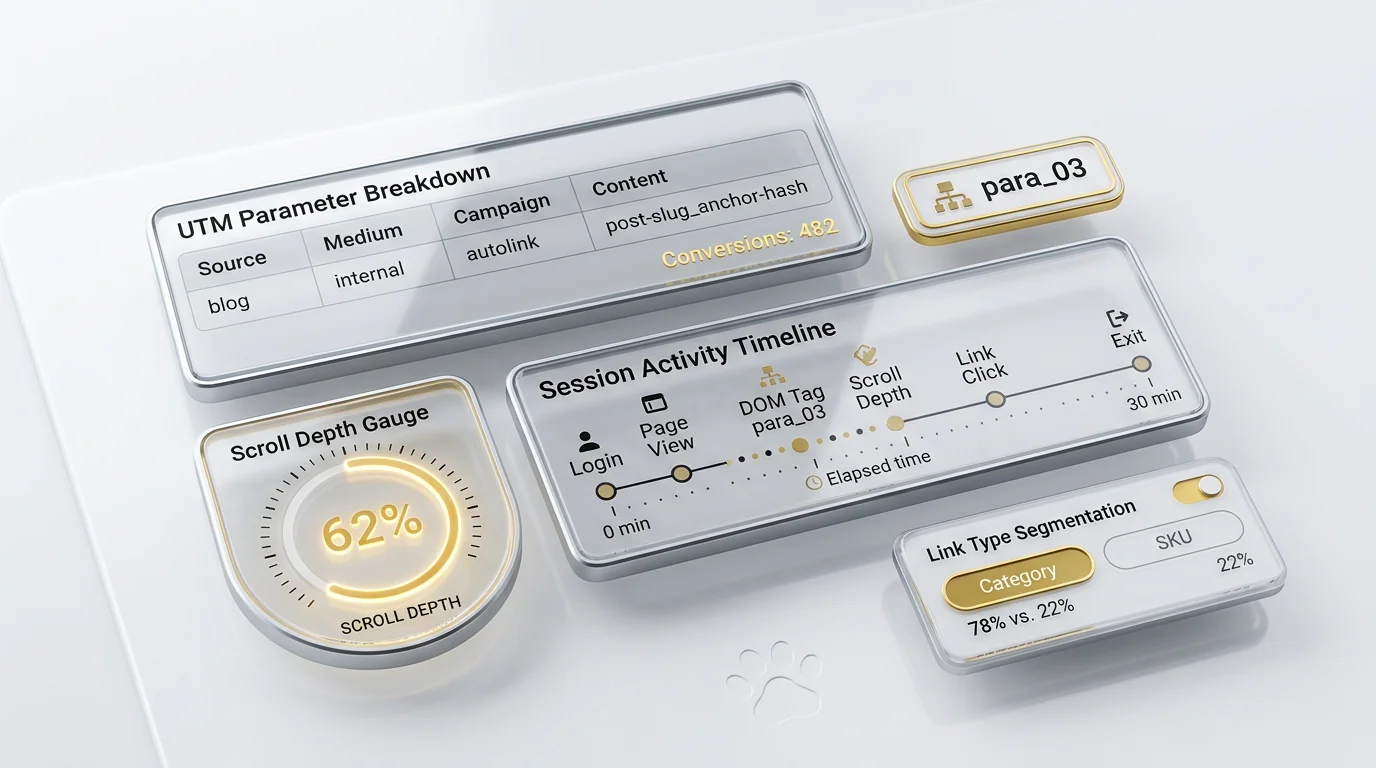
Standardize UTMs to separate automation effects from other traffic: utm_source=blog, utm_medium=internal, utm_campaign=autolink, utm_content=[post-slug]_[anchor-key]_[position]. Consistent tagging supports revenue attribution and experimentation clarity[4].
Click position, anchor, and context logging
Log DOM position (e.g., para_03), anchor text hash, surrounding entities, and link type (SKU vs. category). Store scroll depth at first link and session intent signals to isolate context-driven performance.
Add-to-cart and assisted conversion tagging
Tag add-to-cart events with the originating blog post and link metadata. Attribute assisted conversions across 7-28 days to reflect research behaviors. This window may better capture multi-touch journeys in pet retail[3].
Quick Decision Guide (Schnell-Entscheidungsleitfaden)
- If article intent is informational with a clear problem, then insert 1 contextual link after first solution paragraph.
- If article is listicle/top picks, then use a comparison table with 1-2 links per section and cap total to 5.
- If product inventory is low or price volatile, then link to category with filters instead of SKU.
- If blog traffic is >3k/mo but CTR <0.8%, then test moving first link higher and tightening anchor to benefit-driven phrasing.
- If two products are equally relevant, then link the higher-margin or better-stocked item and add secondary link to category.
- If medical claim context appears, then prefer educational category pages and add veterinary disclaimer anchors.
Monitoring guidance
After 7-14 days: link CTR, scroll depth at first link, bounce vs. engaged sessions
Review link CTR by anchor variant, average scroll depth before the first link, and engaged sessions. Combine with heatmaps to detect friction. Compare against internal linking benchmarks for pet retailers for directional sanity checks.
After 4-8 weeks: assisted conversions, AOV impact, SKU/category revenue share
Evaluate add-to-cart rate, assisted conversions, and AOV movement. Observe shifts in SKU versus category revenue share to confirm whether linking rules favor the right depth of page for your audience.
Cohort comparisons: linked vs. non-linked articles
Construct cohorts of comparable traffic and intent. Measure deltas in CTR, time on page, and revenue attribution. Evidence suggests thoughtful internal linking may support discoverability and conversions in aggregate[2].
Practical safety boundaries
- Max frequency: 1 link per 250-300 words; cap four per article to preserve readability.
- Placement: No links inside H1/H2 or within the first 50 words of the introduction.
- Language: Avoid anchors implying medical outcomes; use cautious, benefit-led framing.
- Intent conflicts: Skip auto-linking on pages with competing transactional intent to avoid dilution; reinforce governance with editorial standards for pet content.
Evidence status and limits
What industry data suggests about internal links and conversions
Research aligns internal linking with improved crawl paths and user navigation, both prerequisites for search visibility and downstream purchase intent when content relevance is strong[4][2].
Where evidence is mixed (positioning above-the-fold, exact-match anchors)
Findings are mixed on aggressive above-the-fold insertion and heavy exact-match anchors. Gains may depend on intent strength and page layout. Conservative frequency and varied phrasing reduce risk while preserving clarity[3].
How to design lightweight A/B tests to gather directional signals
Split test position (paragraph 2 vs. 4), anchor style (benefit vs. descriptor), and target depth (SKU vs. category). Track CTR, add-to-cart, and assisted revenue. NLP-driven mapping may streamline consistent variants[1].
Implementation blueprint (pseudo-logic and schema)
Content parsing and entity extraction
Parse title, summary, and H2s. Extract entities: breed, size, life stage, condition, form factor. Weigh by prominence and frequency. For upstream research discipline, see automated pet keyword research workflows used in pet SEO automation.
Matching logic and priority scoring
For each post, match entities to SKUs using facet overlap and language similarity. Score candidates, then apply inventory and margin multipliers. When scaling catalogs, align with programmatic SEO templates for pet catalogs to reduce mapping drift.
Schema alignment: Product and BreadcrumbList considerations
Ensure Product schema accuracy for linked SKUs and BreadcrumbList alignment on category pages. Structured data that mirrors internal linking rules may support clarity for crawlers and shoppers alike[2].
Hand-off checklist for engineering and content ops
Data inputs required
Provide the product feed with stock and price, content API access, taxonomy mappings, historical CTR and revenue per SKU, and a rules file capturing internal linking rules and exceptions per editorial policy.
QA workflow and rollback plan
Stage links in preview, validate anchors and destinations, and run accessibility checks. Monitor early CTR anomalies. Maintain a rollback script to remove or revert links by post, rule, or date range within minutes.
Governance and change log
Document rule changes, inventory overrides, and anchor rotations. Review monthly with SEO and merchandising. Note impacts in a shared log and link to the Pet Blog Automation orientation hub for governance context.
Frequently Asked Questions
How many internal product links should a pet blog post include?
A conservative range is 1 link per 250-300 words, with a maximum of four per article. This frequency may balance visibility with reader experience.
Should I link to specific SKUs or to categories?
Link to SKUs when inventory, price, and fit are stable. If stock is uncertain or the match is broad (e.g., 'large dog chews'), a category link may serve users better.
What anchor text works best for pet product links?
Descriptive anchors with modifiers like breed, size, and benefit (e.g., 'durable chew for large breeds') may clarify relevance and improve clicks without over-optimization.
How do I measure the impact of internal links on revenue?
Use UTMs for blog→product clicks, capture click position and anchor, and track add-to-cart plus assisted conversions over 4-8 weeks to assess directional impact.
Will auto-inserted links hurt SEO?
When links are relevant, limited in frequency, and clearly labeled, risk appears low. Evidence suggests careful internal linking may support discoverability and UX.
Conclusion
Automating internal links from pet blogs to product pages works best with disciplined mapping, careful placement, and clear attribution. Start with conservative frequency caps and descriptive anchors. Log every click and outcome. Iterate based on CTR, assisted conversions, and inventory dynamics. Teams lacking engineering capacity may consider operational platforms like Petbase AI to manage mappings, anchors, and tracking at scale. Maintain governance, document exceptions, and keep the shopper’s problem at the center of every rule you deploy.
References
- T Suresh (2025). Natural language processing for internal link optimisation: Automating content relationships for better search engine optimisation. Journal of Digital & Social Media Marketing.
- S Das (2021). Search engine optimization and marketing: A recipe for success in digital marketing. 2021 - api.taylorfrancis.com. View article
- D Mladenović et al. (2023). Search engine optimization (SEO) for digital marketers: exploring determinants of online search visibility for blood bank service. Online information …. View article
- A Anand et al. (2023). Clicks to Carts: Digital Marketing's Influence on Purchase Intentions. … , Automation and …. View article