Seasonal Automation for Pet Content: Holidays, Awareness Months, and Weather-Driven Triggers


Table of Contents +
- What this guide solves: one seasonal automation workflow for pet brands
- Build the seasonal backbone: events, triggers, and content slots
- Automation blueprint: rules, data sources, and scheduling logic
- Quick decision guide
- Monitoring after launch: 7-14 days and 4-8 weeks
- Practical safety boundaries for seasonal automation
- Evidence status: what research and benchmarks suggest
- Implementation checklist in your stack
- Where this fits in your editorial calendar strategy
- Frequently Asked Questions
- What this guide solves: operational notes and additional guidance
- Internal linking patterns for seasonal automation
- Operational templates you can adapt today
- Conclusion
- References
Operational guide to automate pet content for holidays, awareness months, and weather triggers. Build calendars, map triggers, and schedule posts with guardrail
Seasonal moments drive intent, but they also create execution chaos. Missed dates, slow approvals, and ad hoc posts cost visibility and revenue.
This guide streamlines seasonal automation for pet content. You will learn a practical, rule-based workflow to auto-generate, schedule, and monitor posts around holidays, awareness months, weather alerts, and gifting periods without losing control.
What this guide solves: one seasonal automation workflow for pet brands
Scope: automate timely posts for holidays, awareness months, and weather alerts
This playbook focuses on “set-it-once” logic for recurring events and real-time triggers. It covers a holiday pet content calendar, awareness month pet marketing, and weather-driven content automation. It standardizes briefing, timing, and formats across markets and channels.
Outcome: a repeatable system that reduces manual effort and misses
Expect fewer last-minute scrambles and more consistent pet blog scheduling. You will standardize lead times, templates, and approval checkpoints. The result is a reliable cadence that scales, supports pet SEO automation, and localizes content responsibly.
Petbase handles this entire content workflow automatically - 10 SEO articles published to your blog every month - start your free trial.
Build the seasonal backbone: events, triggers, and content slots
Holidays and awareness months: canonical list and content tiers
Maintain a canonical list of fixed events: National Pet Day, National Adopt a Shelter Pet Month, and peak gifting windows. Tier each event by business impact and audience fit. Tier A gets full guides, checklists, and social cutdowns. Tiers B and C receive concise refreshes or curated roundups.
Weather triggers: heat, cold, storms, pollen, and parasite risk windows
Define thresholds for heat waves, cold snaps, storms, air quality alerts, pollen spikes, and parasite indices. Map each trigger to preventive tips, product use guidance, and service availability blocks. Localize by ZIP, city, or regional code, and prioritize higher-risk geographies.
Content slots: evergreen, pre-event, day-of, and post-event recaps
Use four slots per event: evergreen hubs, pre-event primers, day-of guides, and post-event recaps. Evergreen hosts canonical advice. Pre-event primes interest and products. Day-of provides live updates. Recaps consolidate learnings and link to relevant long-term care resources.
Automation blueprint: rules, data sources, and scheduling logic
Rule templates: if trigger, then content type, format, and locale
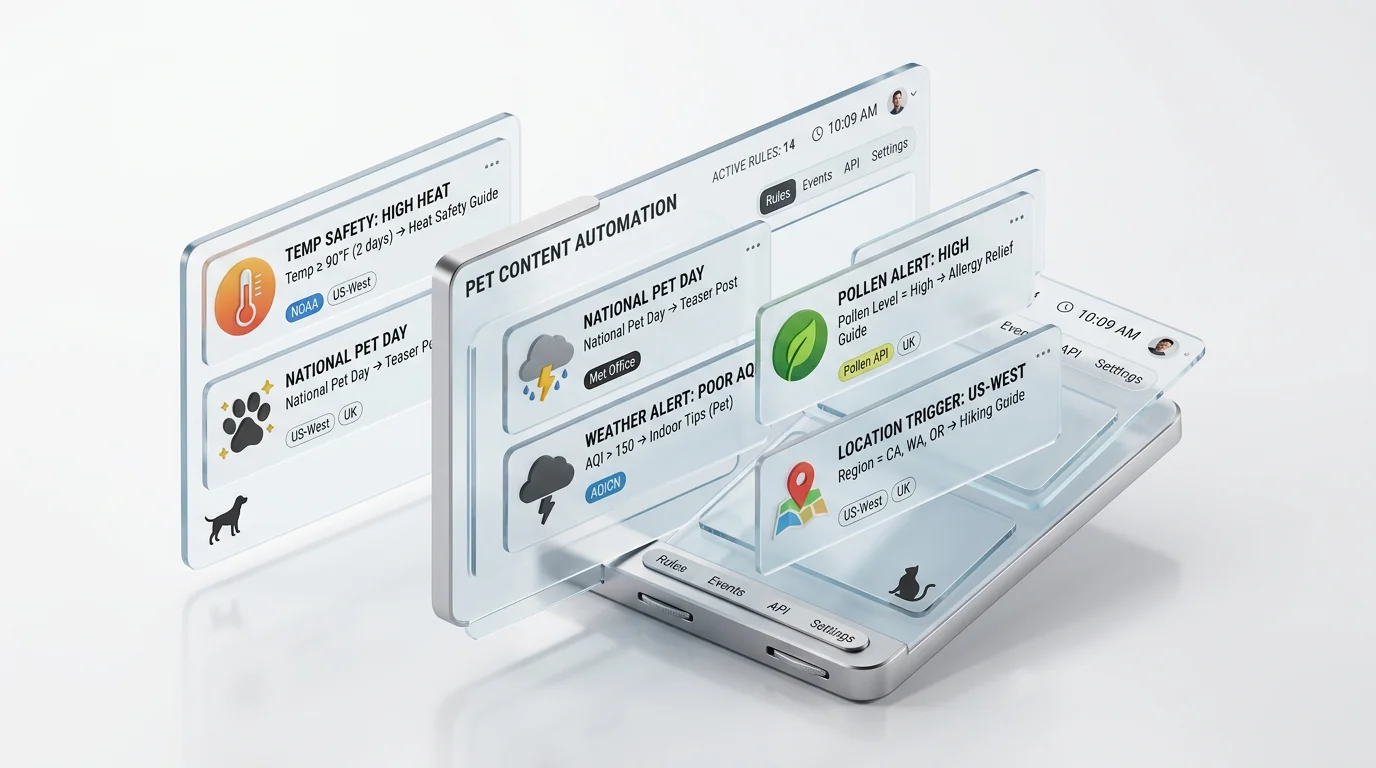
Codify rules such as: If temperature ≥ 90°F sustained 2 days, publish regional heat safety guide with hydration checklist and cooling product recommendations. If parasite index rises, post prevention schedules and regional vet guidance. Include locale, format, and snippet length.
Data feeds: calendars, NOAA/Met Office weather, parasite indices
Use a UTC-normalized holiday calendar and awareness dates. Pull weather alerts from NOAA or Met Office APIs and regional pollen or AQI feeds. Where available, integrate parasite risk dashboards. Teams adopting localized creative automation have reported faster rollouts at scale[1].
Publishing logic: lead times, cadence, and decay
Set pre-event lead times of 14-21 days for Tier A, 7-10 days for Tier B, and same-week for Tier C. For weather triggers, publish within 2-6 hours, then update every 24 hours until conditions normalize. Decay content by converting alerts to evergreen notes when risks drop.
Quick decision guide
If X situation, then Y action (5-7 practical routes)
- If National Pet Day is 14 days out, schedule a pre-event guide with gift ideas and adoption resources. Add internal links to product pages.
- If heat index exceeds threshold regionally, auto-publish a localized safety post. Link to cooling accessories and hydration advice, and set 24-hour updates.
- If flea season begins per regional index, refresh prevention schedules. Surface SKU availability notices and a vet Q&A snippet.
- If severe storms are forecast, push a safety checklist with microchip reminders and emergency kit essentials. Add a service-hours block.
- If air quality worsens, publish an indoor enrichment guide and mask fit tips for outdoor walks. Include a health disclaimer.
- If gifting periods start, publish a curated list with shipping cutoff dates. Update daily if inventory changes significantly.
Monitoring after launch: 7-14 days and 4-8 weeks
Short window: freshness impact, crawl signals, and CTR shifts
Within 7-14 days, check indexing time, impressions, and average position for related queries. Watch CTR lift on SERP features after timestamp refreshes. Industry guidance suggests trend-aware timing may support discovery boosts during narrow windows[2]. Compare to prior seasonal baselines where available.
Longer window: seasonality uplift, assisted conversions, and cannibalization
Across 4-8 weeks, attribute lift in seasonal clusters, returning visitor share, and assisted conversions. Evaluate internal link-assisted revenue, and monitor cannibalization between evergreen hubs and event posts. For ROI frameworks, see measuring automation impact on rankings, traffic, and revenue.
Practical safety boundaries for seasonal automation
Medical caution, temperature thresholds, and localization rules
Use conservative medical phrasing and avoid diagnosing. Enforce regional thresholds for temperature, pollen, AQI, and parasites. Add disclaimers and source markers. Localized, responsible guidance may improve trust and retention in pet commerce contexts[3].
Inventory and service capacity checks before auto-publishing
Gate auto-publishing on stock and service availability. If supply is constrained, switch to educational alternatives or comparable products. Surface shipping cutoffs and wait times. Build rules that pause promotions when inventory dips below a set threshold or capacity is limited.
Evidence status: what research and benchmarks suggest
Freshness and event-aligned search interest
Seasonal and localized creatives have been deployed faster using generative systems, improving creative agility for time-sensitive rollouts[1]. Industry playbooks also emphasize forecasting seasonal patterns to meet intent before peak windows[2].
Weather-linked pet health searches and timing
Machine-learning applications in pet categories highlight seasonal demand, product suitability, and timely guidance patterns[4]. Evidence from pet e-commerce suggests that personalized, automated communications may support loyalty during critical seasonal needs[3].
Implementation checklist in your stack
Taxonomy, tagging, and schema to support automation
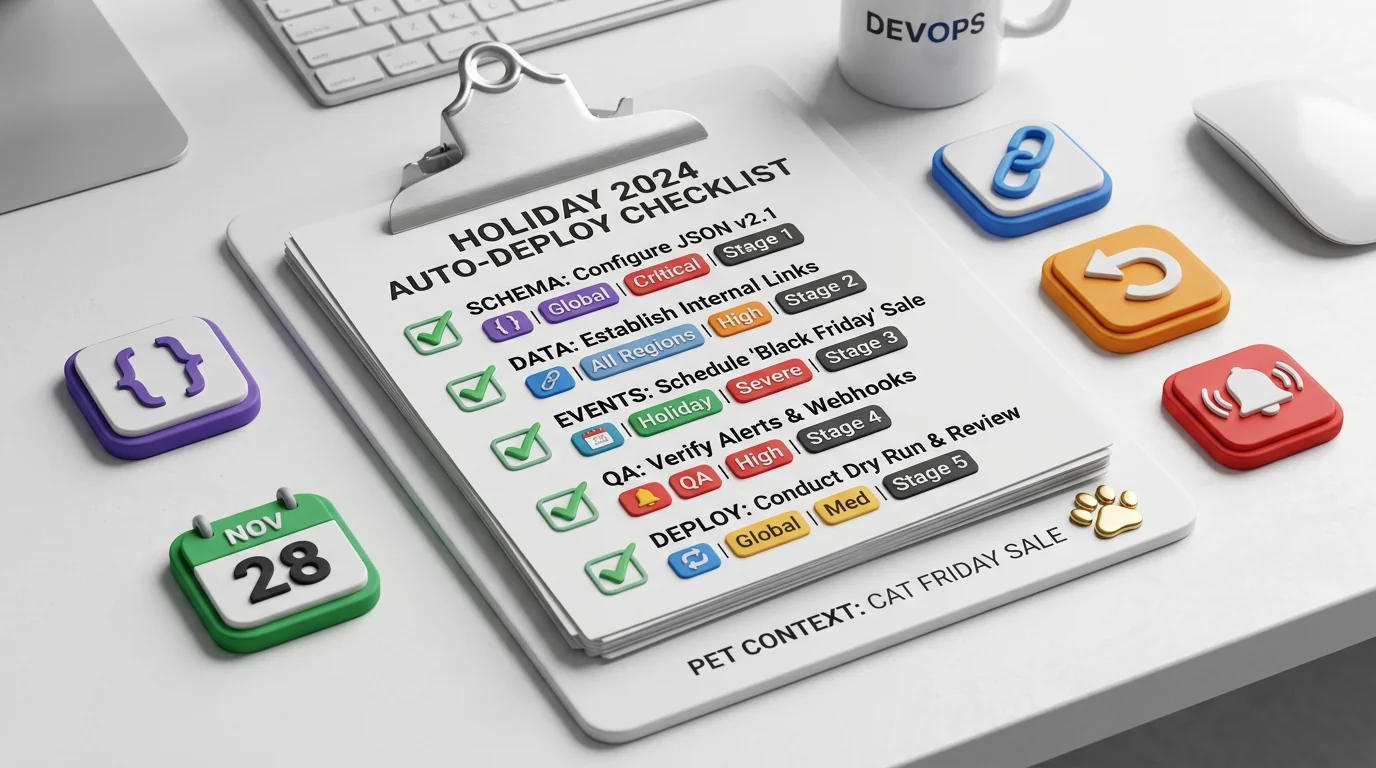
Create tags for event type, region, severity, and lifecycle stage (pre, day-of, recap). Add Event, FAQ, and HowTo schema where appropriate. Use consistent anchors to product and service pages. For keyword scaffolding, see automated pet keyword research by breeds and conditions.
Versioning, QA, and rollback procedures
Version year-agnostic URLs with change logs. Stage updates with visual diffs and automated link checks. Maintain rollback buttons for threshold misfires. For internal link hygiene to product pages, review automating internal links to pet product pages before go-live.
Where this fits in your editorial calendar strategy
Connecting seasonal bursts to evergreen hubs and product pages
Seasonal spikes should reinforce evergreen hubs and key product categories. Link pre-event teasers to day-of guides, then to recaps and evergreen resources. Build a seasonal tag archive and breadcrumbs for crawl paths. To structure your monthly plan, explore building a 30-day automated pet blog calendar.
Frequently Asked Questions
How far in advance should pet holiday content be scheduled?
Evidence suggests publishing preview content 14-21 days before an event may support discovery and internal linking. Day-of updates can refresh timestamps and improve relevance.
Which weather triggers matter most for pet content?
High heat, extreme cold, storms, air quality, pollen, and parasite risk indices often correlate with pet-owner concerns. Align posts to these signals by region to stay useful.
How do I avoid duplicate seasonal posts each year?
Version evergreen templates with year-agnostic URLs and update the body and metadata. Use canonical tags and a changelog rather than creating new URLs annually.
Can seasonal automation work for local pet services?
Yes. Localize triggers and availability blocks, and add structured data for services. Evidence indicates localized tips and hours may improve engagement and calls.
What metrics indicate seasonal content is performing?
Monitor impressions, CTR, position for seasonal terms, returning visitor share, assisted conversions, and inventory-linked clicks. Compare to prior seasons for context.
What this guide solves: operational notes and additional guidance
Workflow orchestration and team alignment
Assign owners for rule tuning, QA checkpoints, and last-mile localization. Maintain a shared dashboard for events, trigger status, and queued assets. Where appropriate, teams may pilot Petbase AI to research pet-specific keywords and automate timely article drafts.
Governance and auditability
Use a central register of triggers, thresholds, and exceptions. Log each publish with the data point that fired the rule. Review quarterly for false positives and lagging metrics, adjusting thresholds and templates.
Internal linking patterns for seasonal automation
Hubs, products, and local services
From pre-event teasers, link to day-of playbooks and post-event recaps. From weather alerts, link to localized products and service pages with descriptive anchors. For governance on medical claims and citations, see veterinary blog automation with E-E-A-T.
Cluster architecture and crawl efficiency
Implement breadcrumb schema and a seasonal tag archive to unify holiday and awareness-month content. Use consistent anchor text toward evergreen hubs. Crosslink related guides to consolidate topical authority and reduce orphaned posts within the seasonal cluster.
Operational templates you can adapt today
Holiday and awareness month templates
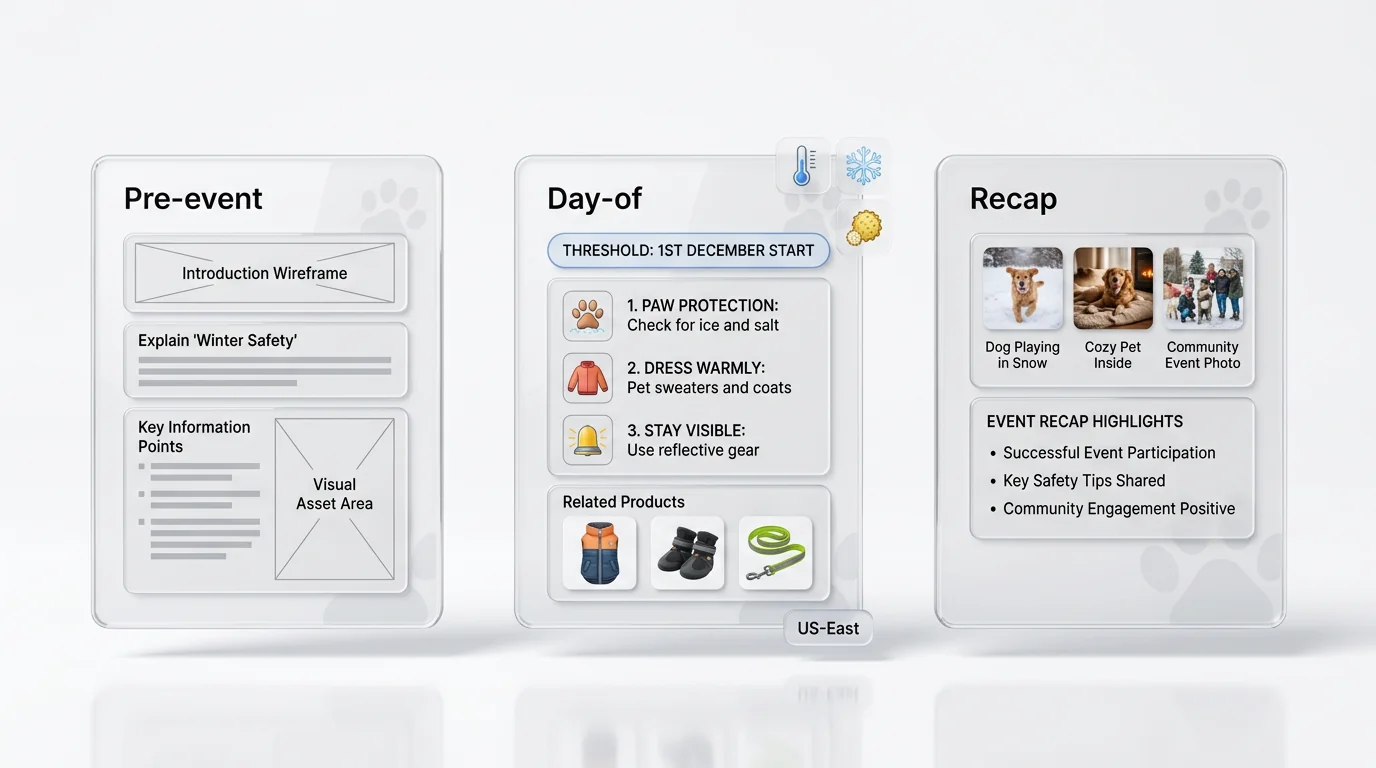
Adopt a three-part framework: pre-event explainer, day-of checklist, and recap with curated community highlights. Localize terminology and add region-specific service notes. Include in-post CTAs that match intent without overshadowing educational guidance.
Weather-triggered alert templates
Structure alerts with a clear headline, threshold note, three safety actions, related product or service links, and a timestamped update log. Archive the alert into evergreen sections once conditions stabilize to preserve long-tail value.
Conclusion
Seasonal automation succeeds when rules are explicit, data sources are reliable, and safeguards are enforced. Start with a canonical calendar, define weather thresholds, and map each trigger to templates and links. Monitor early signals, adjust thresholds, and protect medical and inventory boundaries to preserve trust and impact. To place this workflow in your broader planning, revisit your editorial calendar strategy and set quarterly reviews to refine templates and timing.
References
- R James et al. (2026). Using Gen AI for Content Personalization and Creative Speed in Campaign Development to Build Creative Agility in India's Quick Commerce Market. AI in Consumer Analytics ….
- DS Team (2025). Zero2Launch AI: Ultimate Dropshipping Automation Guide 2024. Dropship Spy Blog. View article
- YH Lee et al. (2025). Primary Determinants and Strategic Implications for Customer Loyalty in Pet-Related Vertical E-Commerce: A Machine Learning Approach. Systems. View article
- R Kumar et al. (2025). Machine learning in pet food: a comprehensive review of applications, challenges, and future directions. ВЕСТНИК АЛМАТИНСКОГО …. View article