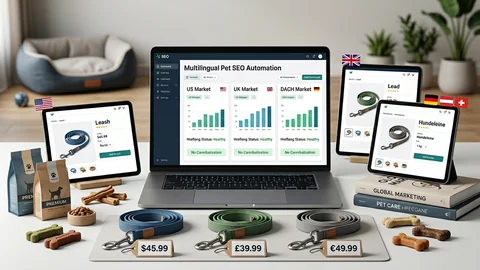
Multilingual Pet Blog Automation: US, UK, and DACH Localization

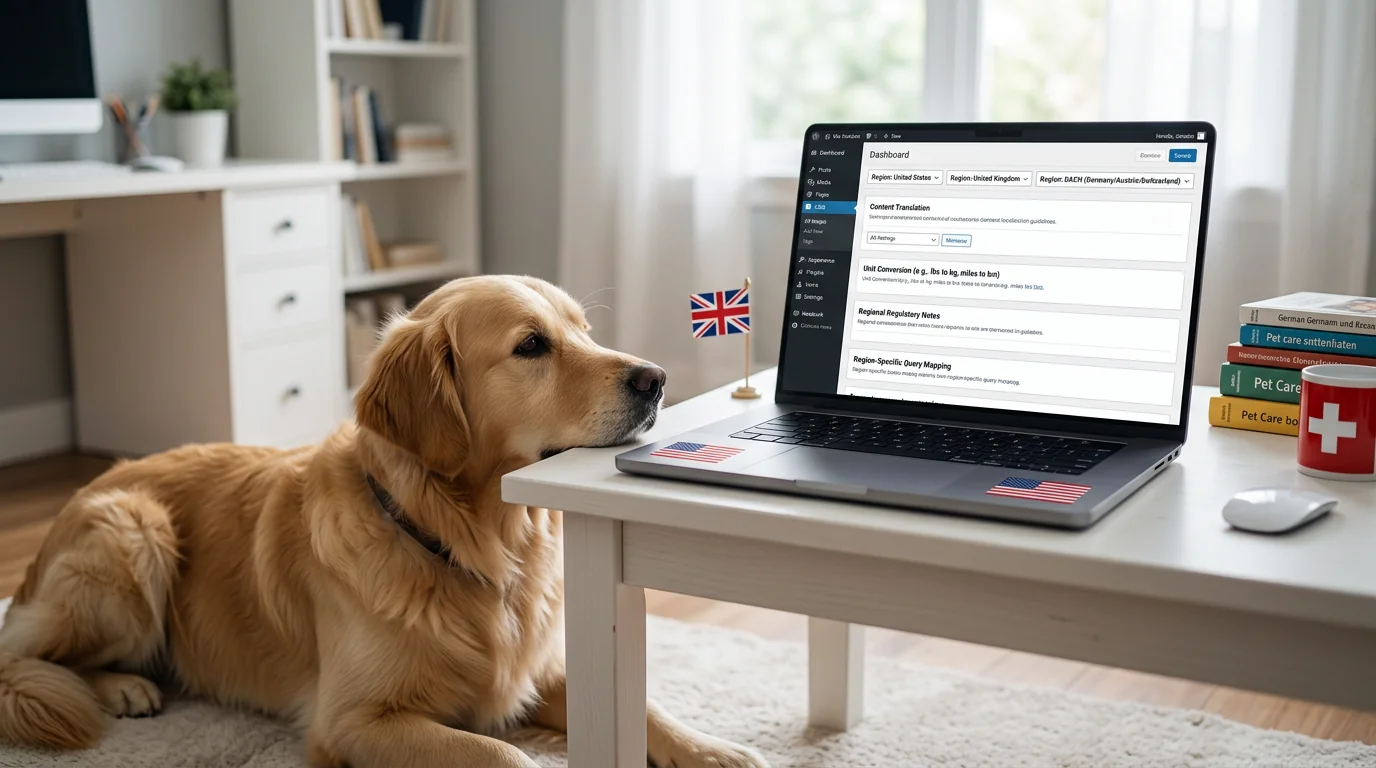
Table of Contents +
- The decision: one global URL with locale variants or region-specific slugs?
- Quick decision guide
- Localization blueprint: language, units, and regulatory notes
- Technical implementation without duplicate pages
- Monitoring: 7-14 days vs 4-8 weeks
- Practical safety boundaries
- Evidence status and what remains uncertain
- Appendix: examples for US, UK, and DACH queries
- Frequently Asked Questions
- Conclusion
- References
Localize automated pet content for US, UK, and DACH. Align spelling, units, regs, and queries without duplicate pages using structured localization.
Localizing automated pet content sounds simple until units, spelling, and regulations collide. Duplicate pages multiply risk and dilute rankings. You can localize precisely without fragmenting your site architecture.
This article explains practical rules for language, measurements, disclaimers, and region-specific queries. You will learn when to use one URL with variants and when to localize slugs. You will also learn implementation, monitoring, and safety boundaries.
The decision: one global URL with locale variants or region-specific slugs?
Scenario overview: content automation constraints and regional needs
Multilingual pet blog automation succeeds when localization decisions are encoded into templates, not left to ad hoc edits. Pet content automation must account for regional search intent pets and measurement conversions pets without duplicating near-identical articles.
Teams typically face two pressures: maintain a manageable publishing pipeline and satisfy local expectations. Misalignment causes cannibalization or thin variants. A structured choice model prevents both.
Selection criteria: language, units, compliance, and SERP intent
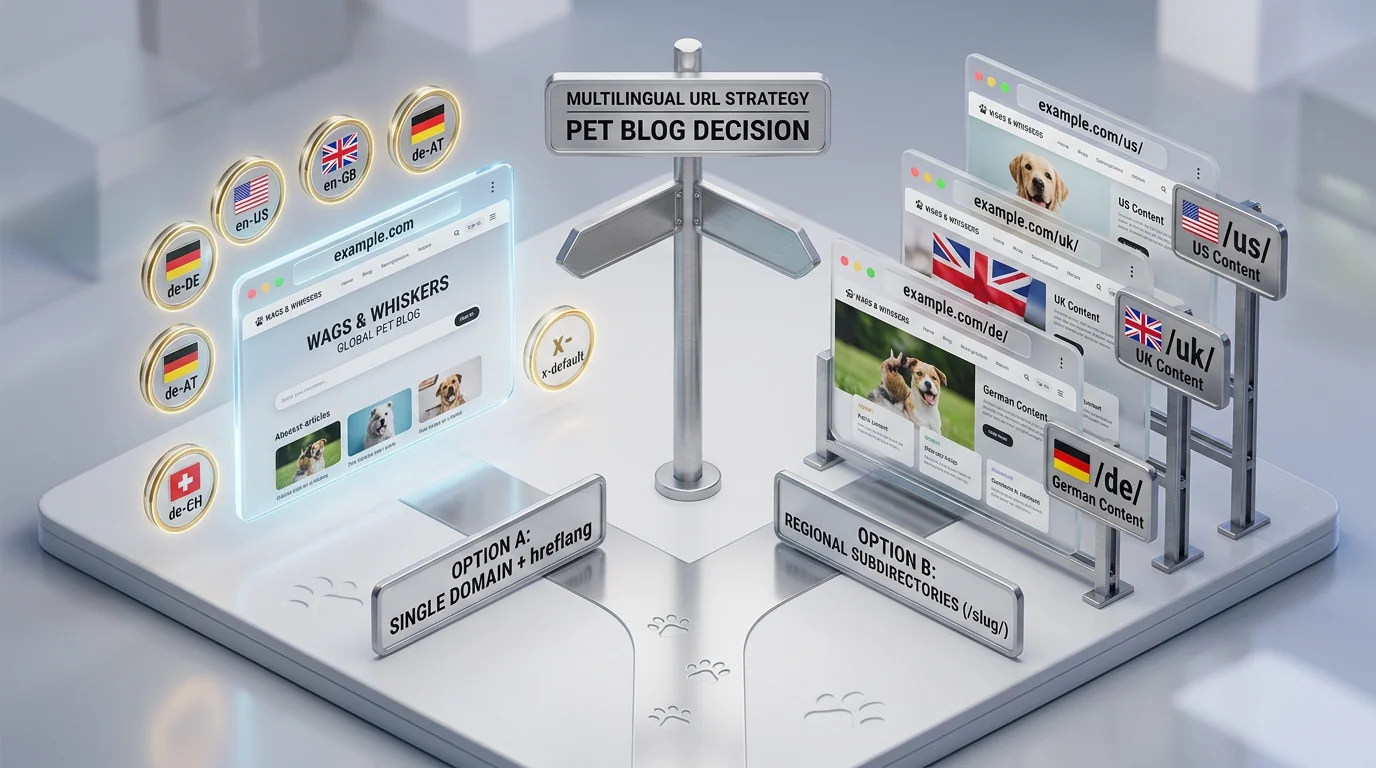
Prefer one global URL with locale variants when language is similar, units are swappable via components, and legal text is harmonized. Diverge to region-specific slugs when search intent, compliance, or commercial offers differ materially.
Localization research emphasizes that effective adaptation goes beyond translation, adjusting conventions, tone, and microcopy to audience expectations, which may justify distinct variants in some cases[2]. Unified content platforms may streamline multilingual orchestration, allowing consistent governance across locales[1].
Petbase handles this entire content workflow automatically - 10 SEO articles published to your blog every month - start your free trial.
Quick decision guide
If X, then Y rules for US, UK, and DACH localization
- If the article only differs by spelling (color/colour) and units, keep one URL. Render locale variants with hreflang and on-page components.
- If UK and US user intent diverges (e.g., brand availability or legal status), create /us/ and /uk/ slugs with dedicated FAQs and merchant proof points.
- If DACH queries require DE headings and UI labels, publish DE-DE primary with hreflang DE-AT and DE-CH when tone and terms remain aligned.
- If veterinary disclaimers or labeling requirements differ by market, publish region-specific variants to reflect compliant language.
- If rich snippets depend on local priceCurrency or merchant availability, use region-specific Product data while preserving a shared canonical article.
- If SERPs show distinct query modifiers by market (near me, NHS-equivalent, Versand), split pages or inject robust regional sections to satisfy intent.
- If translations introduce meaning shifts that change recommendations, separate slugs and route editorial review for each locale.
Localization blueprint: language, units, and regulatory notes
Language and spelling rules (US vs UK English; DACH DE-DE primary)
Use en-US spelling and idioms for US. Use en-GB for UK headlines, body text, and microcopy. Render DE-DE as the DACH baseline, with minor lexicon adjustments for AT and CH only when evidence suggests necessity.
Localization scholarship notes that user trust relies on systemic alignment of conventions, not isolated word swaps-covering punctuation, capitalization, and cultural markers as part of pet SEO localization[2].
Measurements, feeding amounts, and size charts
Render units with locale-aware components:
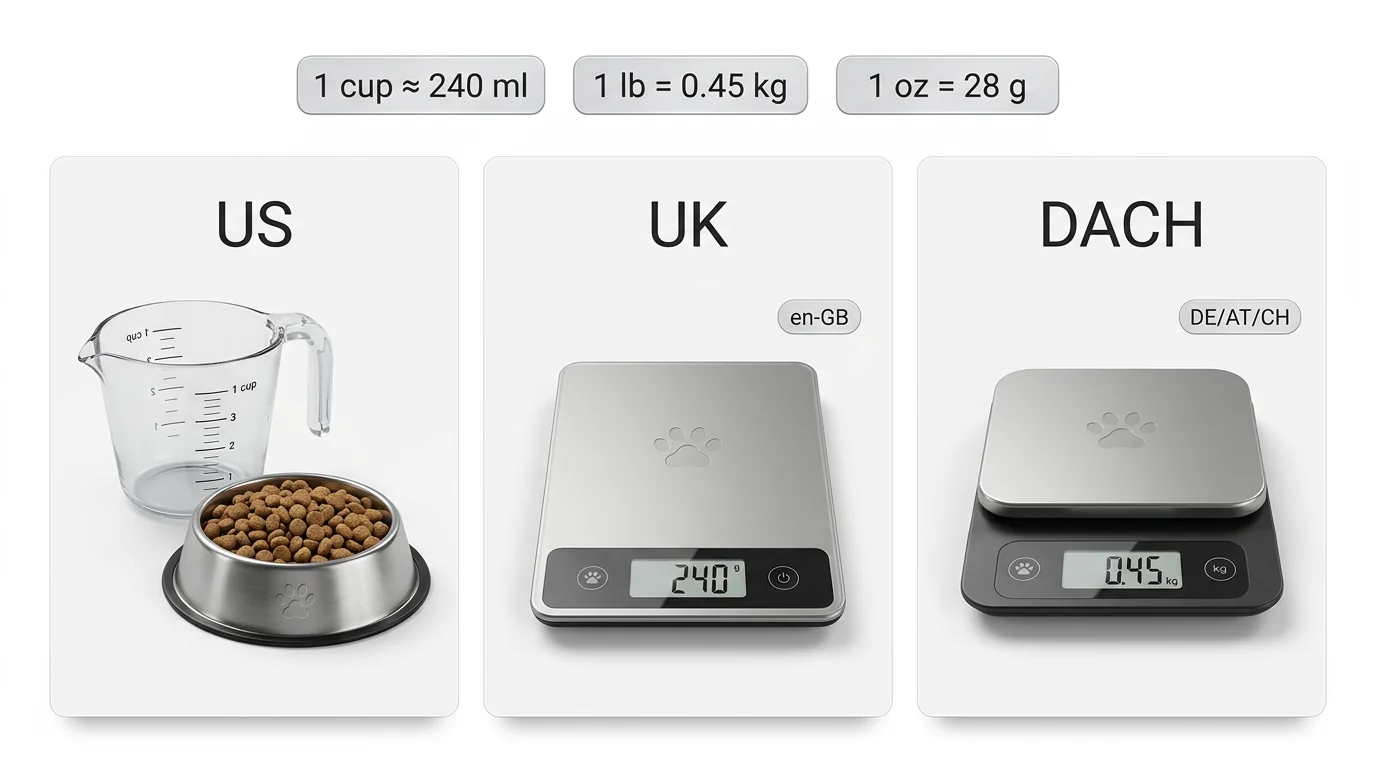
- US: cups, oz, lbs; temperature in °F; volume in fl oz.
- UK: grams, kilograms; temperature in °C; millilitres where relevant.
- DACH: Gramm, Kilogramm; Celsius; ml. Use German labels.
Provide conversions algorithmically but show only one unit set by default. Add conversion notes sparingly to avoid duplication. For measurement conversions pets, round to sensible precision: grams ±5 g, ounces ±0.1 oz, cups to 1/8.
Regulatory disclaimers and veterinary wording
Localize disclaimers with market-appropriate phrasing. US: “This content is for informational purposes and not a substitute for professional advice.” UK: “This information is not medical advice. Consult a qualified professional.”
DACH: include “Hinweise” with clarity that content does not provide a diagnosis, and reference competent authorities where relevant. The interplay between localization and distribution norms suggests these micro-level cues may affect engagement and compliance outcomes[4].
Technical implementation without duplicate pages
Hreflang, canonical, and locale-aware components
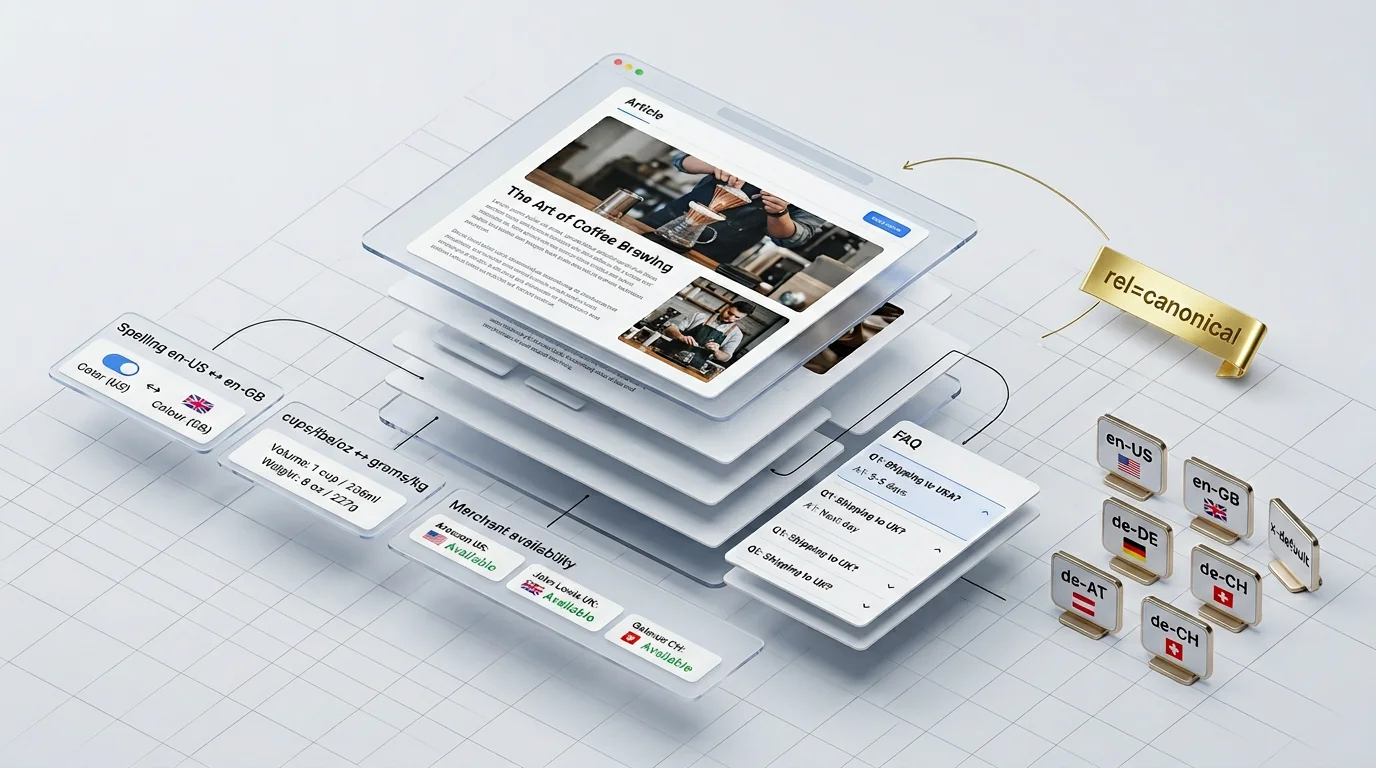
Use one canonical for shared articles. Emit hreflang for en-US, en-GB, de-DE, de-AT, and de-CH as appropriate. Add x-default to the global or selector page. Implement US UK DACH hreflang consistently across all paginated or faceted states.
Implement locale-aware components for spelling, units, merchant availability, and FAQs. Avoid server-side duplication by toggling these components via headers, subfolder context, or user preference. When deciding structure, see our multilingual expansion section for navigation principles.
For operational control, consider template-level flags for locale injection. Many teams benefit from a centralized rules engine; platforms that orchestrate multi-language production across a single interface may support this operating model[1]. When helpful, consider using Petbase AI to automate locale-specific rendering within approved boundaries.
Structured data: Product, Article, and Organization
Localize structured data fields without duplicating content. For Article, set inLanguage to en-US, en-GB, or de-DE as emitted. Keep the same mainEntityOfPage canonical across variants to consolidate signals.
For Product, localize name, description, availability, and priceCurrency (USD, GBP, EUR). If regional pricing differs, attach offer elements per locale page while maintaining canonical logic. For retailers, see programmatic approaches in Programmatic SEO for Pet Catalogs: Safe Templates for Breeds, Sizes, and Life Stages.
Ensure Organization or LocalBusiness markup reflects registered addresses where legally required. Industry reviews note that localization decisions interact with content production and distribution layers, reinforcing the need for coherent metadata[4].
Monitoring: 7-14 days vs 4-8 weeks
Short-term checks: indexing, cannibalization, and CTR deltas
Within 7-14 days, inspect Search Console coverage for each hreflang variant. Confirm indexing parity and absence of soft-404s. Spot cannibalization by comparing impressions and positions for shared head terms across locales.
Monitor CTR deltas by country. A small CTR lift (0.3-1.2 percentage points) may indicate correct spelling and unit alignment. Centralized dashboards can streamline multi-locale monitoring for pet SEO localization operations[1].
Mid-term checks: query shifts, conversions, and engagement
Across 4-8 weeks, track query shifts toward local modifiers, synonyms, and branded variants. Build a region-level “query mapping” framework to compare SERP intent clusters; a practical starting point is in Automated Pet Keyword Research: Breeds, Life Stages, and Conditions.
Evaluate assisted conversions, scroll depth, and time on page by locale. Attribute improvements cautiously, triangulating against seasonality and campaign effects. For ROI tie-outs across locales, see Measuring ROI of Pet Blog Automation: Rankings, Traffic, and Assisted Revenue.
Practical safety boundaries
Guardrails for medical, dosing, and legal content
Do not auto-generate dosing, contraindications, or therapeutic claims without licensed review. If numeric guidance is essential, require human approval and double-key verification. Cap automated unit conversions to benign contexts and show clear advisory language.
Set redlines: no automated emergency instructions, no off-label recommendations, and no claims implying certification. Maintain a changelog for regulatory copy updates and enforce locale-specific templates for disclaimers.
Automation controls, fallbacks, and rollbacks
Use feature flags to deploy localization changes by region. Start with 10-25% traffic exposure. If absolute CTR drops by more than 2-5% or bounce rises over 7-10%, roll back.
Define fallbacks when locale detection fails: default to English with a selector banner. Store previous revisions for instant restore. Log per-locale diffs for audits and incident response.
Evidence status and what remains uncertain
What industry evidence suggests
Studies indicate that centralized multilingual operations may improve governance and consistency across locales, reducing operational overhead for large content portfolios[1]. Localization theory emphasizes adapting broader conventions, not merely lexicon, to meet audience expectations[2].
Emerging modular editing methods suggest scalable, layered localization could reduce dependence on retraining models, potentially supporting fine-grained edits for components like units and disclaimers[3].
Open questions to validate with your data
Which UK vs US microcopy changes yield the highest CTR lift at scale? How often do DE-AT and DE-CH require unique sections versus shared DE-DE?
Does one canonical with localized components consolidate link equity more effectively than fully separate slugs for your niche? How sensitive are conversions to unit precision and rounding choices?
Appendix: examples for US, UK, and DACH queries
Query mapping examples and unit translations
| Locale | Query Pattern | Notes | Units Default |
|---|---|---|---|
| US (en-US) | “best food for puppies in winter” | Emphasize “vet-approved” wording; use “calorie” spelling. | cups, oz, lbs, °F |
| UK (en-GB) | “best food for puppies in winter uk” | Use “vet-approved” with UK spelling. Reference local merchants where relevant. | g, kg, °C |
| DACH (de-DE) | “bestes futter für welpen winter” | Include “Hinweise” and shipping norms like “Versand”. | g, kg, °C |
Unit translation tips: 1 cup ≈ 236.6 ml (round to 240 ml). 1 lb = 0.4536 kg (round to 0.45 kg). 1 oz = 28.35 g (round to 28 g). Apply rounding rules per locale component.
When aligning content with seasonal intent and regional demand spikes, consider structured planning guidance in Seasonal Automation: Holidays, Awareness Months, and Weather-Driven Pet Content.
Frequently Asked Questions
Should I create separate URLs for US and UK pet blogs?
Evidence suggests a single English URL with hreflang variants may work when intent is identical and only spelling or units differ. Use separate slugs if user intent or legal requirements diverge.
How do I handle measurements for pet feeding guides?
Use locale-aware components: US shows cups/lbs/oz, UK shows grams/kg with UK spellings, and DACH shows grams/kg with DE labels. Add conversion notes only if helpful and non-duplicative.
Do I need different content for Germany, Austria, and Switzerland?
Often DE-DE can serve DACH with hreflang for DE-AT and DE-CH if tone and regulations align. Create region-specific variants when queries or legal notes differ.
What regulatory notes should localized pet content include?
Add market-appropriate disclaimers on veterinary advice and labeling. For DACH, include Hinweise that content is not a medical diagnosis and reference local authorities where relevant.
How can I avoid duplicate content issues with automation?
Use canonical to the primary URL, precise hreflang, and inject genuine locale variations: spelling, examples, merchant availability, and region-specific FAQs. Monitor for cannibalization in GSC.
Conclusion
Localizing automated pet content need not fragment your site. Align language, units, and disclaimers with clear rules. Deploy hreflang and structured data carefully. Monitor intent shifts and engagement by locale. Maintain strict safety boundaries for medical and legal content. With a repeatable blueprint, you may capture regional demand while protecting authority and avoiding duplication risks.
References
- I Okonkwo et al. (2023). Localization and global marketing: Adapting digital strategies for diverse audiences. Journal of Digital …. View article
- MA Jiménez-Crespo (2024). Localization in translation. 2024 - taylorfrancis.com. View article
- Z Yu et al. (2025). Cotextor: Training-free modular multilingual text editing via layered disentanglement and depth-aware fusion. The Thirty-ninth Annual …. View article
- Y Jin (2025). Localization in translation. Miguel A. Jiménez-Crespo. 2025 - academic.oup.com. View article