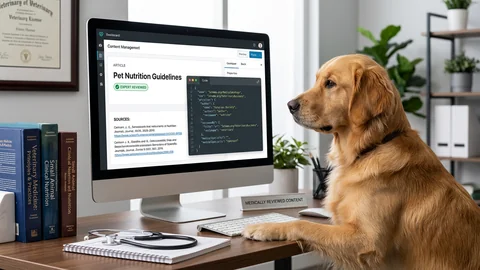
Veterinary Blog Automation With E-E-A-T: Schema, Citations, and Review Flow


Table of Contents +
- Problem to Solve: Safe Automation for Vet-Authored Posts
- Workflow Overview: From Draft to Published With E-E-A-T
- Medical Schema Essentials for Veterinary Pages
- Citations and Evidence: Building Trust Without Overclaiming
- Review and Approval Checkpoints
- Quick Decision Guide
- Monitoring and QA After Go-Live
- Practical Safety Boundaries
- Evidence Status: Where Claims Can Be Strong vs. Cautious
- Frequently Asked Questions
- Appendix: Example JSON-LD Templates
- References
A safety-first workflow to automate vet-authored posts with medical schema, expert review, citations, and patient education pages for stronger E-E-A-T.
Automating veterinary blogs can boost reach, but safety must lead. Medical topics demand accuracy, traceability, and clinical oversight. Automation should never outrun responsibility.
This matters because readers may act on your guidance. A safe system preserves trust and protects patients. In this guide, you will learn a practical, reviewable workflow that embeds E-E-A-T, medical schema markup, rigorous vet citations and sourcing, and clear patient education pages.
Problem to Solve: Safe Automation for Vet-Authored Posts
Risks of naive automation in medical topics
Unreviewed drafts can misstate red flags, underplay risks, or imply diagnosis. Tools may fabricate citations or blur species differences. The result can be credibility loss, legal exposure, and potential harm.
Scope: one repeatable workflow for clinic blogs
We focus on a single, repeatable workflow. It standardizes prompts, sourcing, expert content review workflow, and schema. It fits short patient education pages and longer condition explainers for clinics.
Petbase automates SEO content for veterinary clinics - so you can focus on patients, not blog posts - start your free trial.
Workflow Overview: From Draft to Published With E-E-A-T
Content drafting: prompts, disclaimers, and scoping
Define audience, intent, and clinical boundaries before drafting. Include a top disclaimer stating educational purpose and emergency instructions. Constrain scope to one condition or question. Draft in sections with bullet red flags.
Source handling: citations, URLs, and archive links
Require at least two primary sources per claim cluster. Capture canonical URLs and access dates. Archive public pages for stability. NLP assists concept extraction and term normalization to reduce omissions[3].
Expert review: roles, checklists, and sign-off
Assign a DVM or credentialed reviewer to validate accuracy, dosing ranges, and red flags. Human-in-the-loop review remains essential for safety and context in clinical information workflows[2].
Publication: schema, versioning, and bylines
Generate JSON-LD with author, reviewer, and disclaimer. Store a version ID and change log. Display a byline with credentials and last medical review date. This may support E-E-A-T for veterinary content.

Medical Schema Essentials for Veterinary Pages
Required types and properties for vet topics
Start with Article or BlogPosting for posts. Add MedicalWebPage when content is health-focused. Include about, mentions, citation, datePublished, dateModified, and specialty. Use condition codes where available for clarity.
Author, reviewer, and medical disclaimer markup
Mark the veterinarian under author with credentials. Add reviewedBy for medical review. Represent disclaimers via hasPart WebPageElement or text, and ensure visibility on page. These elements aid machine understanding.
How to mark patient education vs. professional content
Use MedicalAudience for “Patient” versus “MedicalSpecialty” emphasis for professional notes. Tag red flags as ItemList. For topic discovery alignment, see automated pet keyword research workflows that map conditions and synonyms.
Citations and Evidence: Building Trust Without Overclaiming
Preferred sources (peer-reviewed, associations, guidelines)
Prioritize peer-reviewed journals, veterinary associations, teaching hospitals, and government guidance. Evidence suggests AI assists triage of relevant literature, but selection remains a clinical responsibility[1].
Link formatting, anchor text, and access dates
Use descriptive anchors, stable URLs, and include “Accessed: YYYY-MM-DD.” Prefer DOI links when possible. For governance and hygiene patterns, align with a governance and link hygiene checklist.
When to summarize vs. quote and how to indicate uncertainty
Summarize non-controversial facts. Quote dosing language or high-risk passages. Use cautious terms like “may support” when evidence is early. Flag disagreements among sources and explain clinical context.
Review and Approval Checkpoints
Triage review (medical accuracy and scope fit)
Verify audience fit, remove implied diagnosis, and confirm scope. Ensure all claims map to sources. Reject drafts that exceed boundaries or lack red flag guidance.
Clinical review (diagnosis, dosing, red flags)
A DVM checks pathophysiology statements, diagnostic criteria framing, and any medication mentions. Replace absolutes with ranges. Ensure urgent signs are prominent and action-oriented.
Legal/compliance review (disclaimers and claims language)
Validate disclaimers, promotional neutrality, and jurisdictional considerations. Confirm no off-label recommendations. Ensure accessibility and non-alarmist tone.
Final publication review (schema validation and links)
Run schema validation, test internal anchors, and re-check citations. Confirm bylines, dates, and version ID are visible. Publish with a monitored checklist.
For a wider operational framework, refer to our professional services guidance to align clinic workflows and content operations.

Quick Decision Guide
If X situation, then Y action (5-7 scenarios)
- If a draft mentions medication dosages, then route to clinical review or remove specifics.
- If evidence conflicts, then present both positions and mark uncertainty.
- If a source lacks authorship, then replace it with peer-reviewed or association guidance.
- If red flags are absent, then add a bulleted urgent signs list at the top.
- If a claim lacks a citation, then flag it for revision or delete it.
- If schema fails validation, then hold publication until errors resolve.
- If the topic implies diagnosis, then reframe as education and recommend clinical evaluation.
Monitoring and QA After Go-Live
What to check at 7-14 days
Validate indexed status, schema coverage, and rich result eligibility. Monitor comments and support tickets for confusion signals. Track bounce on patient education pages that mention urgent care to detect misinterpretation.
What to check at 4-8 weeks
Assess rankings, engagement, and time on page. Review search queries for risky intent matches. Digital transformation research suggests process KPIs improve when teams iterate using these checkpoints[4]. See post-launch metric patterns for veterinary content for benchmarking ideas.
Practical Safety Boundaries
Topics and actions the system should avoid
Avoid step-by-step treatment protocols, dosage calculators, differential diagnosis trees, or sedation guidance. Do not provide emergency triage beyond “seek immediate care.” Refrain from region-specific regulatory advice without legal review.
Escalation rules and emergency language
Include clear, consistent emergency instructions. Use standardized wording such as “If your animal shows [red flags], seek immediate veterinary care.” Escalate any poisoning, respiratory distress, seizures, or uncontrolled bleeding topics to clinicians.
Evidence Status: Where Claims Can Be Strong vs. Cautious
Well-established areas
General preventive care education, vaccination schedules from recognized bodies, basic nutrition principles, and post-operative home care precautions are well documented. These areas usually allow confident, sourced statements within defined bounds.
Areas with mixed or emerging evidence
Novel therapeutics, microbiome modulation, AI-assisted triage, and certain alternative modalities require caution. Some tools create value, while others remain immature, warranting balanced framing and clear sourcing[1].
How to phrase uncertainty responsibly
Prefer “current evidence suggests,” “early findings indicate,” or “clinicians may consider.” Cite multiple sources when perspectives differ. Summarize consensus and practical implications, and invite consultation for individualized decisions.

Frequently Asked Questions
What schema should a veterinary blog use for medical topics?
Evidence suggests combining Article or BlogPosting with MedicalWebPage can help machines understand medical context. Include author, reviewer, about/mentions, citation, and medical disclaimer properties where applicable.
Do automated vet posts need a human reviewer?
Yes, a qualified veterinary professional should review for medical accuracy, dosage safety, and red-flag guidance. A documented review and visible reviewer credentials may support E-E-A-T signals.
Which sources are acceptable for veterinary citations?
Prefer peer-reviewed journals, veterinary associations, veterinary teaching hospitals, and government resources. Include stable URLs, access dates, and avoid tertiary summaries when primary guidance is available.
How should disclaimers be handled on vet blogs?
Use clear, non-alarmist language that the article is educational and not a substitute for clinical care. Surface disclaimers near the top and in schema where possible, and include emergency instructions for urgent symptoms.
Can automated content cover medication dosages?
Medication details may require cautious handling. Many clinics limit automation to general education and route any dosage or protocol content through strict clinical review with clear risk language.
Appendix: Example JSON-LD Templates
Article with vet author and medical reviewer
{
  "@context": "https://schema.org",
  "@type": "Article",
  "headline": "Understanding Kennel Cough: Symptoms, Care, and Red Flags",
  "datePublished": "2026-03-01",
  "dateModified": "2026-03-01",
  "author": {
    "@type": "Person",
    "name": "Alex Morgan, DVM",
    "affiliation": "City Veterinary Clinic",
    "credentialCategory": "DVM"
  },
  "reviewedBy": {
    "@type": "Person",
    "name": "Jordan Lee, DVM, DACVIM",
    "medicalSpecialty": "InternalMedicine"
  },
  "about": [{"@type": "MedicalCondition", "name": "Infectious tracheobronchitis"}],
  "mentions": ["coughing", "isolation", "vaccine"],
  "citation": [
    "https://association.example.org/guidelines/kennel-cough",
    "https://doi.org/10.0000/example"
  ],
  "hasPart": {
    "@type": "WebPageElement",
    "name": "Medical Disclaimer",
    "text": "Educational only. Not a substitute for clinical care. If urgent symptoms occur, seek immediate veterinary attention."
  }
}
MedicalWebPage with condition and guideline citations
{
  "@context": "https://schema.org",
  "@type": "MedicalWebPage",
  "name": "Allergies in Dogs: Signs and When to See a Veterinarian",
  "datePublished": "2026-03-01",
  "dateModified": "2026-03-01",
  "medicalSpecialty": "Dermatology",
  "about": {"@type": "MedicalCondition", "name": "Atopic dermatitis"},
  "mainEntity": {
    "@type": "MedicalCondition",
    "name": "Canine Atopic Dermatitis",
    "signOrSymptom": ["pruritus", "erythema", "otitis externa"]
  },
  "citation": [
    "https://doi.org/10.0000/derm-guideline",
    "https://universityvet.example.edu/derm/owner-guide"
  ],
  "audience": {"@type": "MedicalAudience", "audienceType": "Patient"},
  "isPartOf": {"@type": "WebSite", "name": "Clinic Blog"}
}
AI can assist coordination across this workflow, from topic research to schema generation. For best results, consider using Petbase AI which is designed for this purpose.
Finally, remember that automation supports clinical expertise but does not replace it. Evidence indicates AI can structure medical text and aid surveillance, yet human judgment remains crucial for safe veterinary communication[2][3].
References
- L Albergante et al. (2025). Artificial intelligence is beginning to create value for selected small animal veterinary applications while remaining immature for others. … of the American Veterinary …. View article
- YG Jin et al. (2025). AI Veterinary Assistance: Enhancing Clinical Decision-making in Animal Healthcare. IEEE …. View article
- M Arguello-Casteleiro et al. (2019). Exploring the automatisation of animal health surveillance through natural language processing. … and Applications of …. View article
- K Beyer et al. (2025). DIGITAL TRANSFORMATION AND BUSINESS PROCESS IMPROVEMENT IN VETERINARY CLINICS. … and Opportunities, Vol …. View article