Programmatic SEO for Pet Catalogs: Safe Templates for Breeds, Sizes, and Life Stages


Table of Contents +
- The scenario: scaling pet-topic pages without thin content
- Decision guide: choose the right template pattern
- Safe data model: fields that drive uniqueness and variability
- Template structure: content blocks that scale and stay safe
- Practical safety boundaries for pet content
- Quality assurance at scale
- Monitoring: what to watch at 7-14 days and 4-8 weeks
- Evidence status: what current research and benchmarks suggest
- Programmatic vs. editorial: where each fits
- Appendix: sample field spec and variability rules
- Frequently Asked Questions
- References
Design safe, scalable templates for pet breeds, sizes, and life stages. Learn data sources, uniqueness rules, QA at scale, and monitoring to avoid thin content.
Scaling pet-topic pages is tempting because demand spans breeds, sizes, and life stages. It is also risky because repetition invites thin content penalties and trust gaps. You need reliable patterns.
This deep dive shows how to design scalable templates without duplication traps. You will learn a safe data model, sources for factual uniqueness, variation rules, and a QA system that holds at scale.
The scenario: scaling pet-topic pages without thin content
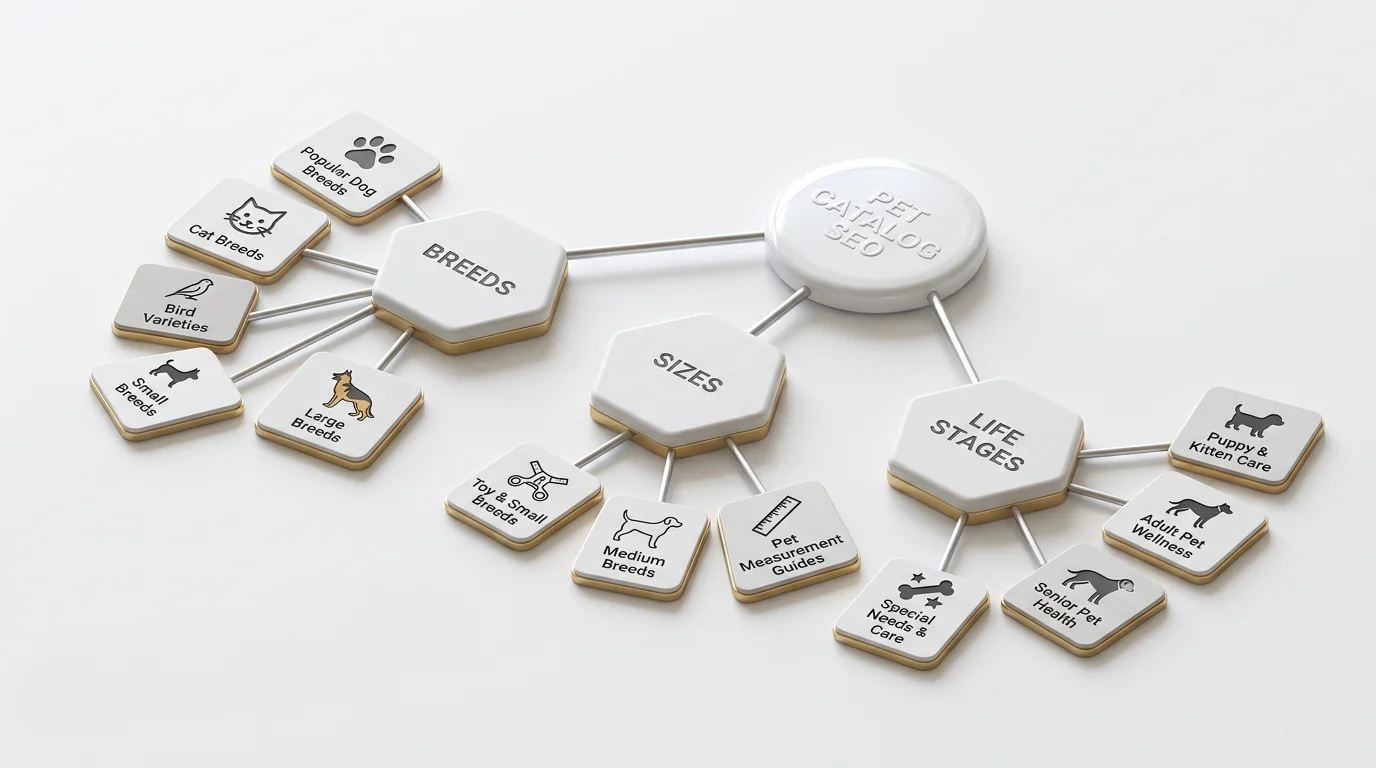
Why breeds, sizes, and life stages are high-variance templates
Search intent splinters across breed attributes, pet size keywords, and life stage content. Users expect concrete differences in fit, care, and product applicability. Templates must encode variability by entity, not just reword paragraphs. That is the core of breed template SEO at scale.
Risk profile: duplication, medical claims, and affiliate bias
Programmatic pages can drift into sameness when fields collapse to generic text. Health and nutrition sections risk overreach or implied diagnosis. Affiliate-driven modules may bias recommendations. Mitigate with explicit variability rules, neutral claim language, and careful merchandising logic.
Petbase automates SEO content for pet stores - publishing 10 optimized articles monthly so you can focus on running your shop - start your free trial.
Decision guide: choose the right template pattern
Quick decision guide (if X, then Y)
- If intent is informational-first, then prioritize breed or life stage templates with neutral care guidance.
- If intent is fit-first, then prioritize size templates with sizing, fit, and usage context.
- If intent is mixed (info plus product), then use condition × product modules with clear disclaimers.
- If you lack verified facts, then delay publication until sources are confirmed.
- If SERPs show shopping carousels, then lean into product-led SEO for pets with comparison blocks.
- If SERPs show encyclopedic results, then emphasize structured facts, references, and schema.
Template archetypes: breed, size, life stage, condition × product
Use breed templates for traits, care considerations, and fit guidance. Use size templates for equipment sizing and exercise needs. Use life stage templates for nutrition, enrichment, and safety. Combine condition × product for cautious, solution-oriented modules. Evidence suggests staged rollouts improve monitoring and reduce duplication risk in programmatic SEO deployments[2].
Safe data model: fields that drive uniqueness and variability
Entity stack and modifiers (breed × size × life stage)
Model entities as a stack: primary entity (breed or size or life stage), modifiers (activity level, coat type, urban vs. rural), and situational contexts (climate, housing constraints). Use controlled fields to drive sentence templates and tables. Reserve narrative blocks for human-reviewed variability.
Sourcing: canonical taxonomies, specs, and expert review
Map breed and size fields to canonical registries and veterinary associations. Gather product specifications from first-party catalogs to align sizing and materials. Structured fields enable consistent schema generation, which may assist automated extraction and SERP interpretation[1]. Add expert review for sensitive facts and annual refresh cycles.
Template structure: content blocks that scale and stay safe
Required blocks and variability rules
Recommended blocks: introduction, fast facts, size-and-fit guidance, temperament/activity context, grooming or maintenance, nutrition overview, training and enrichment, health disclaimers, and product-usage scenarios. Impose variability targets: 30-50% block-level variation per page, and 20-40% token-level variation within repeatable sentences. Enforce entity-dependent tables to keep differences substantive, not stylistic.
Examples of token-level and block-level variation
Example A, size-and-fit: “Harness fit guidance for medium sizes” vs. “Fit notes for compact chests with midline adjusters.” Include a contextual nudge to compare options and maintain pathways using automated internal links to product pages (how internal links move readers from blog to basket).
Example B, life stage enrichment: “Short, frequent enrichment sessions suit early life stages” vs. “Lower-impact puzzles help senior stages maintain engagement.” For medically adjacent points, reinforce expert pathways via veterinary blog automation with E-E-A-T to maintain trust.

Practical safety boundaries for pet content
Medical and nutrition guardrails
Keep guidance non-diagnostic. Avoid dosing, contraindications, or treatment plans. Use phrasing like “may support” and “consider discussing with a professional.” Route condition-specific advice to expert-reviewed pages. Maintain clear boundaries between informational content and product suggestions.
Compliance, sourcing, and claims language
Attribute material facts to recognized organizations and brand specifications. Use neutral, non-comparative claims unless evidence is cited. In automated environments, governance frameworks for content and metadata may support consistency and reduce compliance risk in commerce contexts[4].
Quality assurance at scale
Pre-publish checks (linting, dedupe, hallucination screens)
Run linters for reading level, passive voice, and sentence variety. De-duplicate by shingling and cosine similarity across catalogs. Validate schema and check for unsupported claims. Teams scaling pet SEO automation often centralize these checks; some use tools like Petbase AI to systematize research-to-publish flows.
Post-publish audits (SERP fit and user signals)
Assess SERP alignment: featured snippets, shopping features, and People Also Ask proximity. Monitor click-through, scroll depth, and outbound clicks to product pages. Automated internal linking, guided by NLP entity relationships, may improve crawl pathing and topical reinforcement[3].
Monitoring: what to watch at 7-14 days and 4-8 weeks
Early signals (discovery and duplication)
Within 7-14 days, check index coverage, canonicalization, and sitelinks for template clusters. Investigate duplicate clusters via Search Console and log-based crawler data. If duplication emerges, pause expansion and increase field-level variation or consolidate near-duplicates[2].
Mid-term signals (ranking stability and UX)
Across 4-8 weeks, evaluate ranking volatility, intent match, and behavioral metrics. Look for steady impressions, growing product-click ratios, and improved filter navigation. Rising pogo-sticking indicates intent mismatch or over-templating. Adjust block priority and update field inventories accordingly.

Evidence status: what current research and benchmarks suggest
What seems to work across catalogs
Structured data aligned to controlled fields may aid machine interpretation and snippets[1]. Programmatic SEO shows strongest results when rollouts are staged and localized intent is respected[2]. AI-assisted optimization in commerce contexts may help anticipate intent and scale routine operations[4].
Areas with limited or mixed evidence
Optimal variability percentages vary by niche and authority. Automated internal linking is promising but context sensitivity matters across large catalogs[3]. Heavy templating without robust fields may depress engagement despite technical compliance. Measure, refine, and avoid universal assumptions.
Programmatic vs. editorial: where each fits
Programmatic coverage wins breadth and navigability across recurring pet topics. Editorial depth builds authority for complex issues, nuanced care, and original research. Use both, with clear roles and a shared governance model.
Balancing scale with depth for pet audiences
Use programmatic templates for discoverability, then route readers to deep guides and product experiences. For an orientation to governance, roles, and roadmap, see our scale and templating overview. Blend product-led SEO for pets with high-trust editorial hubs and expert review.
Appendix: sample field spec and variability rules
Field inventory and token ranges
| Field | Type | Token/Value Range | Notes |
|---|---|---|---|
| Primary Entity (breed/size/life stage) | Controlled | 1 value | Canonical taxonomy ID |
| Activity Level | Enum | 3-5 options | Drives enrichment text |
| Coat/Material Considerations | Enum | 3-6 options | Impacts grooming/fit notes |
| Size and Fit Specs | Numeric + Text | 2-6 values | Map to product specs |
| Care Tips | Snippet Set | 4-8 snippets | Rotate 30-50% per page |
| Health Disclaimers | Snippet Set | 2-3 variants | Non-diagnostic language |
Frequently Asked Questions
How do I avoid thin content when templating breed pages?
Use a data-rich field model that mixes static facts with variable blocks (care tips, size-specific fit, common issues). Evidence suggests 30-50% page-level variation helps differentiation.
What data sources are safest for pet breed and life stage info?
Leverage canonical breed standards (e.g., kennel clubs), veterinary associations, peer-reviewed summaries, and brand-first product specifications. Cite sources where material facts are used.
Should medical advice be included in programmatic pet pages?
Keep medical guidance high level and non-diagnostic. Use cautious wording and link to authoritative sources. Reserve specific recommendations for expert-reviewed pages.
How many templates should I launch at once?
Evidence suggests staged rollouts (e.g., 25-100 URLs) allow safer monitoring for duplication, crawl budget, and UX. Scale after stable indexing and engagement metrics are observed.
What schema helps programmatic pet catalogs?
Consider Product, ItemList, and FAQPage where appropriate. For breed informational sections, use About and KnowledgeGraph-friendly entity markup to reinforce context.
Designing safe, scalable templates for programmatic SEO for pet catalogs requires discipline. Build from a trustworthy data model, enforce variability rules, and keep medical guidance guarded. Monitor early and mid-term signals, then iterate deliberately. Pair automation with thoughtful editorial investment, and your catalog may gain breadth without sacrificing trust. To plan topics and mapping, explore automated pet keyword research for breeds and life stages, then connect templates to commerce using internal linking automation that moves readers to product pages. Finally, attribute facts, refresh fields, and maintain a clear review cadence.
References
- BUD Abbasi et al. (2022). Autonomous schema markups based on intelligent computing for search engine optimization. PeerJ Computer ….
- T Kerkola (2025). Programmatic Search Engine Optimization in Localized Web Applications: A Case Study on a. 2025 - utupub.fi. View article
- T Suresh (2025). Natural language processing for internal link optimisation: Automating content relationships for better search engine optimisation. Journal of Digital & Social Media Marketing.
- R Hasan (2025). Enhancing Market Competitiveness Through AI-Powered SEO And Digital Marketing Strategies In E-Commerce. ASRC Procedia: Global Perspectives in …. View article