Local SEO for Pet Stores: Google Business Profile, NAP, and Service Pages

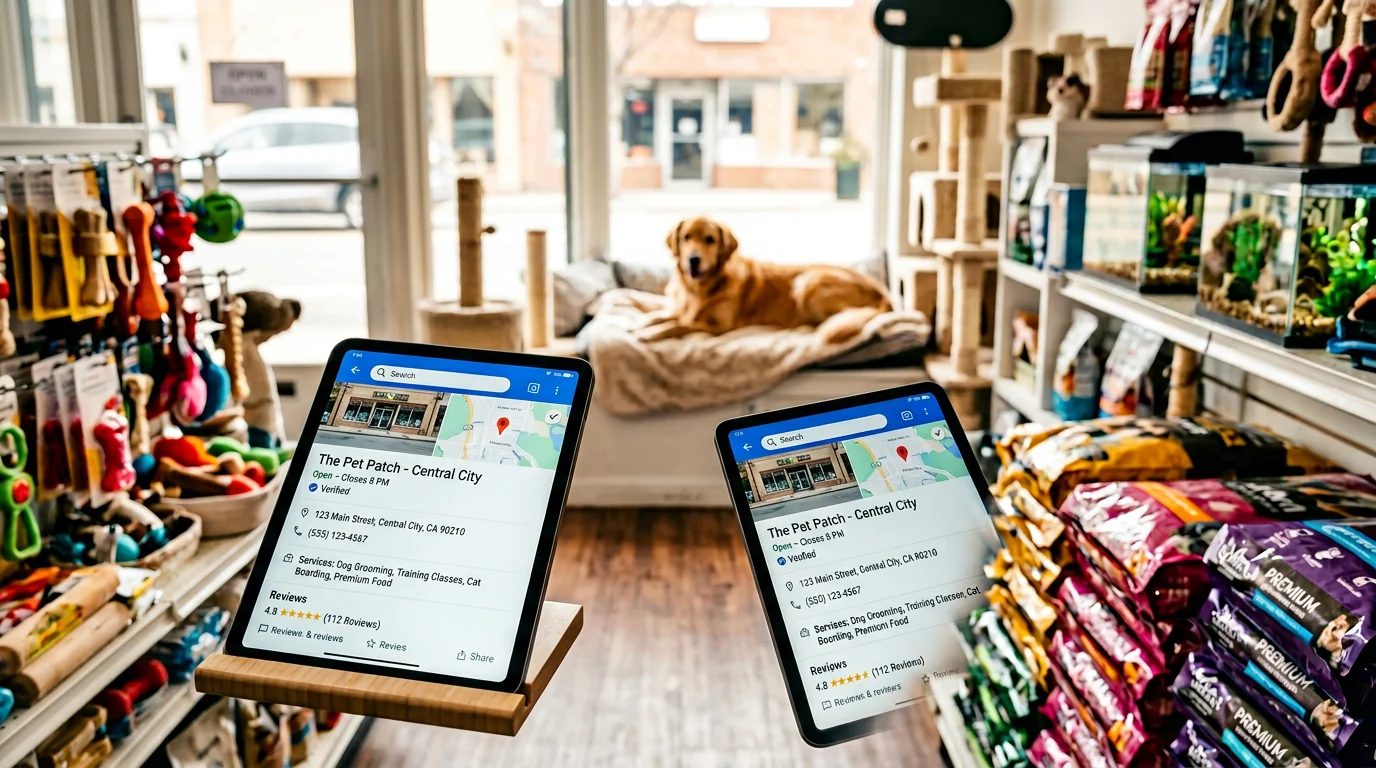
Table of Contents +
- Scenario: One location dropping from the Map Pack after a move or hours change
- Quick decision guide
- Google Business Profile: categories, services, and attributes that may move the needle
- NAP consistency across citations
- Service pages that support local intent
- Monitoring guidance
- Practical safety boundaries
- Evidence status and what the data suggests
- Frequently Asked Questions
- Next steps and internal navigation
- References
Improve pet store local rankings with Google Business Profile setup, accurate NAP, and targeted service pages. Practical steps, checks, and monitoring.
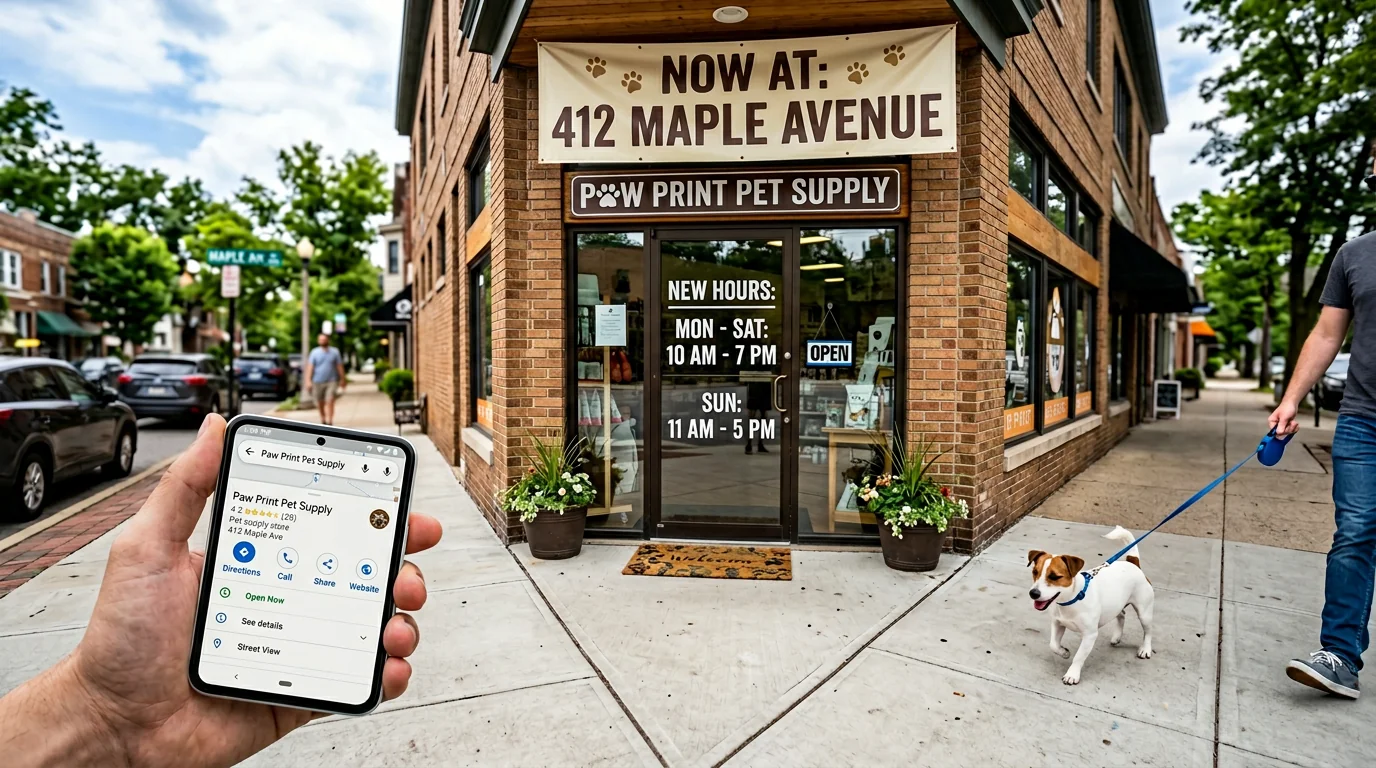
Dropping from local packs hurts foot traffic quickly. It often happens after a move, hours change, or a listing edit. Recovering fast requires disciplined execution and proof of local relevance.
This guide focuses on practical recovery for pet retailer local SEO. You will learn the precise actions that may restore local pack rankings. We cover Google Business Profile fixes, NAP alignment, and pet store service pages. For broader context, see our pet store SEO orientation hub.
Scenario: One location dropping from the Map Pack after a move or hours change
Define the problem and scope in 10 minutes
Confirm which location fell, when it fell, and what changed near that date. Check Google Business Profile (GBP) for edits, suspensions, or pending verification. Note any address, hours, or category changes. Review call logs, directions, and discovery searches in Insights for sudden shifts.
Prioritize fixes: GBP > NAP > service pages
For rapid impact, correct the GBP first, because it directly feeds local maps visibility. Next, enforce NAP consistency for retailers across high-trust directories. Then support relevance with on-site, location-specific service pages that align to your selected categories and real offerings.
Rebuild local relevance with categories, services, and reviews
Choose the most specific primary category and accurate secondaries. Add services that match in-store offerings, with prices if used. Prompt customers for fresh, city-mentioned reviews. Include new storefront and interior photos to validate the move and business continuity.
Petbase automates SEO content for pet stores - publishing 10 optimized articles monthly so you can focus on running your shop - start your free trial.
Quick decision guide
If X, then Y actions for common pet retail situations (5-7 items)
- If you moved within the same city, update GBP address, re-pin the map marker, add exterior photos, and post a “We’ve moved” update.
- If hours changed significantly, update hours, enable “More hours” (e.g., holiday), and add a post clarifying peak times and appointment policies.
- If the listing shows “Temporarily closed,” switch to “Open,” publish a reopening post, and upload same-week storefront photos.
- If calls dropped but impressions held, test a fresh cover photo, refine services, and confirm your primary category.
- If competitors outrank you near them, add proximity-relevant service pages and solicit reviews mentioning nearby neighborhoods.
- If you added grooming, add “Pet Groomer” as a secondary category, list grooming services with prices, and publish grooming FAQs.
- If multi-location cannibalization happens, separate categories and services by location, and differentiate on-page details.
Incremental, hypothesis-driven adjustments often outperform broad overhauls, a pattern consistent with local search optimization research in complex systems[4].
Google Business Profile: categories, services, and attributes that may move the needle
Primary vs. secondary categories for pet retailers
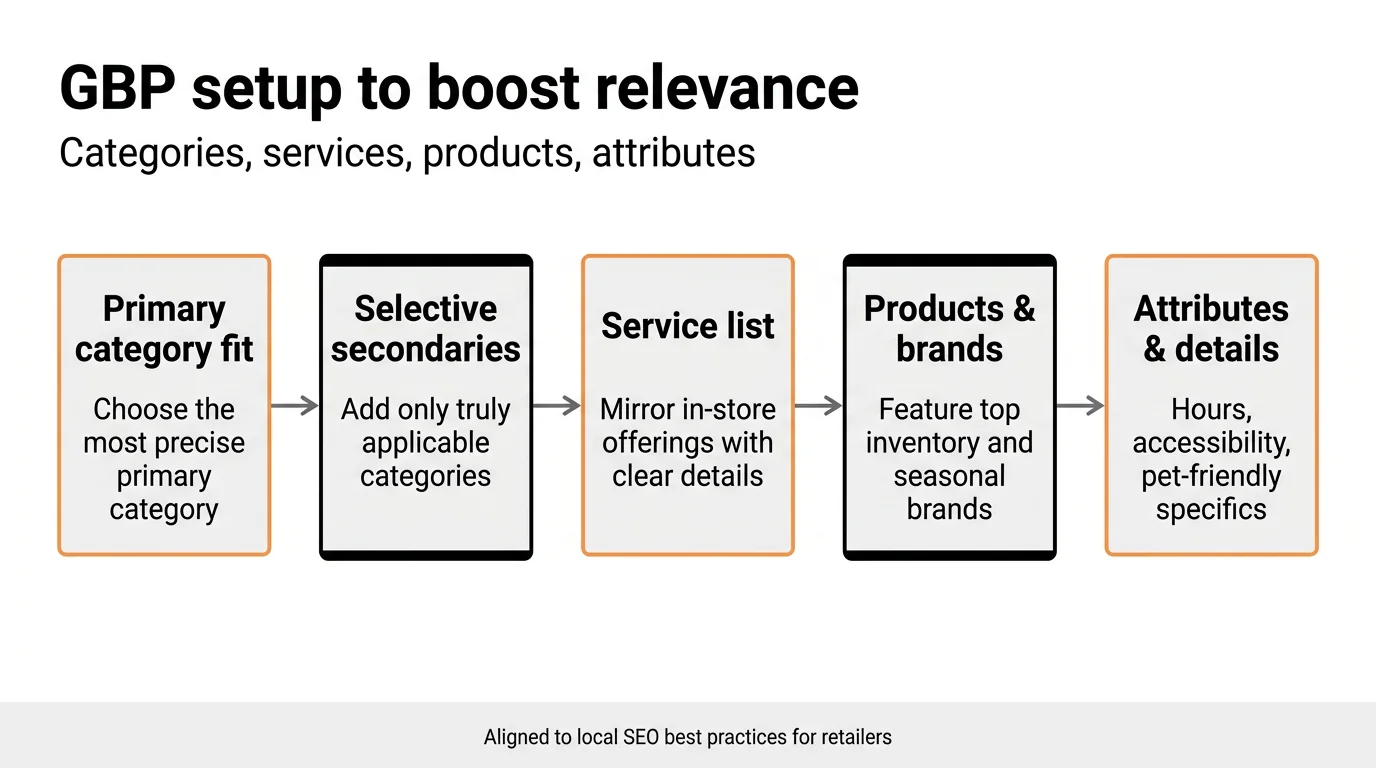
Select the most precise primary category that reflects your main offer, such as “Pet Store.” Add secondary categories sparingly, only for real services delivered in-store. Research suggests focused “feature selection” can improve signal quality and reduce noise[2]. Validate with search results and competitor audits.
Services, products, and attributes setup
Populate services that mirror in-person offerings with simple descriptions and optional pricing. Add top inventory brands in “Products,” especially evergreen staples. Enable relevant attributes, including accessibility, payment types, and on-site services. Align these with your on-page content to reinforce intent matching and trust.
Photos, posts, and hours hygiene
Upload recent storefront, interior, staff, and service photos monthly. Keep hours, holiday hours, and “More hours” current. Post updates about new services, events, or promotions. This ongoing activity signals reliability and may sustain visibility in local pack rankings during changes.
NAP consistency across citations
Audit and normalize Name, Address, Phone
Document your canonical Name, Address, and Phone (NAP). Normalize abbreviations and suite formatting. Ensure the same top-level NAP appears on your website footer and contact page. Use a single authoritative page per location to avoid conflicts.
Fixes on core aggregators and high-trust directories
Prioritize fixes on high-trust directories and major data aggregators that feed maps ecosystems. Aim for clean, duplicate-free citations with identical NAP. Track completion dates and screenshots. Consistent citations may support trust and stabilize rankings over time.
Handling suite numbers, call tracking, and multi-location
Use “Ste” or “Suite” consistently across all listings. For call tracking, set the tracking number as primary in GBP and list the local number as additional to preserve NAP signals. Separate listings per location with unique NAP to prevent merging.
Service pages that support local intent
One page per service and per location
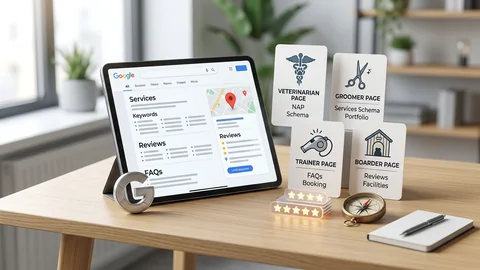
Create a distinct URL for each service at each location, such as /city/service/. Include maps, parking details, and staff bios. This structure may increase topical clarity and reduce cannibalization across locations and offerings for pet store service pages. Consider automation via Petbase AI for scalable consistency.
On-page elements: headings, FAQs, and local details
Use H1 with the service and city, H2s for benefits, process, pricing, and FAQs. Add city landmarks, neighborhoods served, and appointment instructions. Embed a GBP map and pull in recent reviews. This alignment supports intent and conversion.
Structured data and internal links
Implement LocalBusiness and Service schema with accurate NAP, geo, and service details. Add FAQ markup for common questions. Link laterally between related services and to your location page. For schema specifics, see schema for pet stores.
Monitoring guidance
What to observe after 7-14 days
Watch for reinstatement, profile update approvals, and early movement in discovery searches. Track calls, direction requests, and photo views. When feedback cycles are fast, iterative optimization can accelerate convergence toward improvements[3]. Use a geo-grid or zip-level rank tracker for nuance.
What to assess after 4-8 weeks
Evaluate category changes, service additions, NAP cleanup, and new reviews against directional trends. Compare radius of visibility, engagement metrics, and conversion proxies. Formal dashboards help quantify lift; see SEO analytics and ROI tracking for pet retailers for reporting approaches.
Practical safety boundaries
What to avoid in GBP and citations
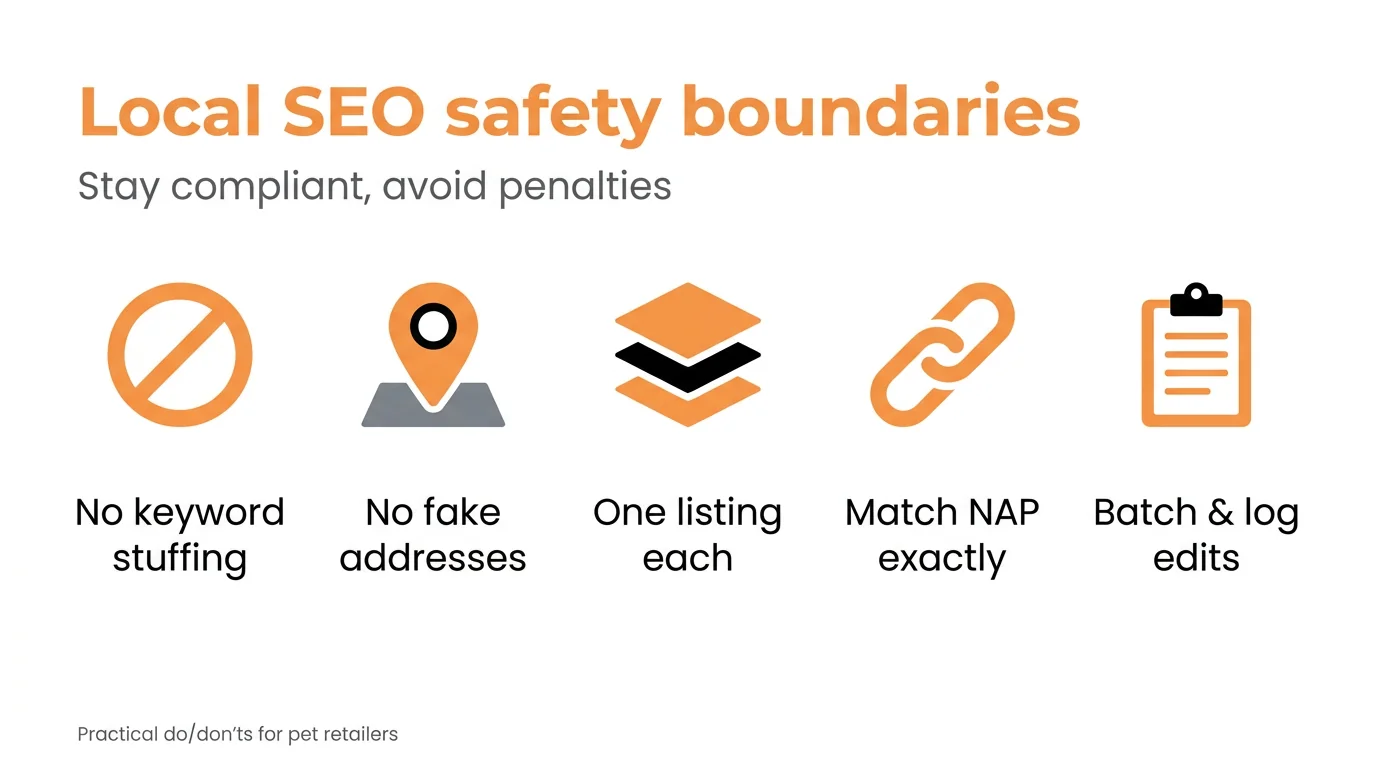
Avoid category stuffing, keyword insertion into business names, or fake addresses. Do not create multiple listings for a single location. Avoid mismatched NAP across profiles. Resist deleting aged listings unless they are confirmed duplicates.
Change management and rollback
Batch related edits and record timestamps, screenshots, and fields changed. Allow changes to propagate before layering more edits. If performance declines persistently, revert categories or services to the last known stable configuration and reassess hypotheses.
Evidence status and what the data suggests
Signals with stronger support
Clarity and consistency across key signals-category selection, accurate NAP, and aligned on-page content-tend to correlate with better visibility. Iterative local search approaches emphasize targeted, constraint-aware improvements over sweeping changes[4].
Areas with mixed or limited evidence
Minor attributes, frequent post cadence, and marginal photo updates may influence engagement more than rankings. Guided local search research suggests penalizing over-weighted signals can prevent getting stuck in suboptimal states, but translation to SEO remains indirect[1]. Balance experimentation with consistency.
Frequently Asked Questions
What is the best primary category for a pet store on Google Business Profile?
Evidence suggests choosing the most specific primary category that matches your core offer, such as “Pet Store”. Use secondary categories like “Pet Groomer” or “Pet Supply Store” if they reflect real services.
How many service pages should a pet retailer create?
A practical approach is one page per distinct service and per location. This may help capture local intent and clarify relevance without diluting content.
Does NAP inconsistency really affect rankings?
Inconsistency may reduce trust signals and lead to duplicate or conflicting listings. Normalizing NAP across key directories can support local visibility and user confidence.
How long until GBP changes impact rankings?
Minor updates may be reflected within days, while category or service changes may take several weeks. Monitoring 7-14 day and 4-8 week intervals is reasonable.
Should I use call tracking numbers for local SEO?
You can use call tracking if you set the tracking number as primary and show the local number as an additional number. This approach may preserve NAP consistency while measuring calls.
Next steps and internal navigation
Where this fits in the pet store SEO orientation hub
This playbook addresses recovery for Google Business Profile for pet stores, NAP consistency for retailers, and service-page alignment after disruptive changes. For broader strategy, revisit our pet store SEO orientation hub and the internal overview at Pet Store SEO: The Complete Orientation Hub. Expand technical depth with schema implementation guidance.
What to document for future updates
Record every GBP edit, category change, and NAP update with timestamps and screenshots. Keep a changelog of pet retailer local SEO tests, outcomes, and metrics. Align on-page improvements with categories and keywords tracked in dashboards for ongoing iteration.
References
- C Voudouris et al. (2025). Guided local search. Handbook of Heuristics. View article
- M Tubishat et al. (2020). Improved Salp Swarm Algorithm based on opposition based learning and novel local search algorithm for feature selection. Expert Systems with …. View article
- D Santos-Martins et al. (2021). Accelerating AutoDock4 with GPUs and Gradient-Based Local Search. Journal of chemical …. View article
- E Aarts et al. (2018). Local search in combinatorial optimization. 2018 - books.google.com. View article