Build a Category Taxonomy for Pet SEO: Breeds, Sizes, Life Stages, and Conditions

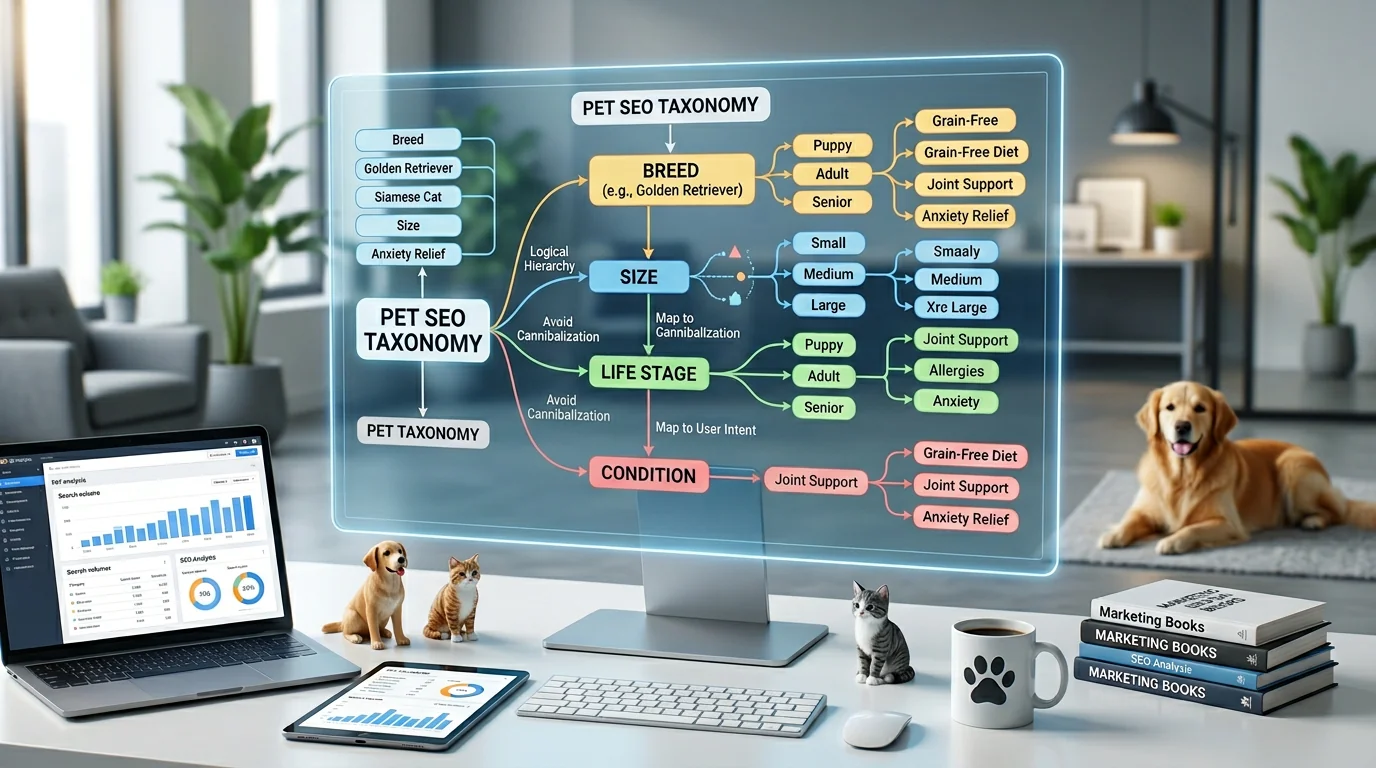
Table of Contents +
- The scenario: one taxonomy to serve search and shopping
- Decision framework: one primary dimension plus safe facets
- Quick decision guide
- Information architecture blueprint
- Content and merchandising rules that reduce cannibalization
- Monitoring guidance
- Practical safety boundaries
- Evidence status and assumptions
- Frequently Asked Questions
- Conclusion: align taxonomy with your broader roadmap
- References
Design a pet SEO taxonomy that maps to breed, size, life stage, and conditions. Reduce cannibalization, avoid thin pages, and scale category UX for search.
Shoppers search by breed, size, age, and specific needs. Your category tree must match those mental models. It also must avoid duplicates and thin collections that dilute authority.
This guide shows a practical framework for pet SEO taxonomy. You will learn how to choose a primary dimension, apply safe facets, set indexation rules, and monitor for cannibalization. Expect implementable thresholds and patterns you can test quickly.
The scenario: one taxonomy to serve search and shopping
User intent clusters: how pet parents actually browse
Pet parents think in concrete contexts. They refine by breed traits, physical size, and life stage. They also shop by dietary sensitivities, behavior goals, and vet-advised conditions.
These intents appear in natural-language signals and social data. Public studies demonstrate that owner conversations about symptoms and needs can be modeled into ontologies and categories, enhancing discovery relevance[4]. Reviews also provide cues that support automated product typing.
For pet store SEO, the challenge is harmonizing these intents into a single, navigable structure. It must serve both queries and merchandising without creating redundant pages.
Constraints: cannibalization, thin pages, crawl budget, and PDP mapping
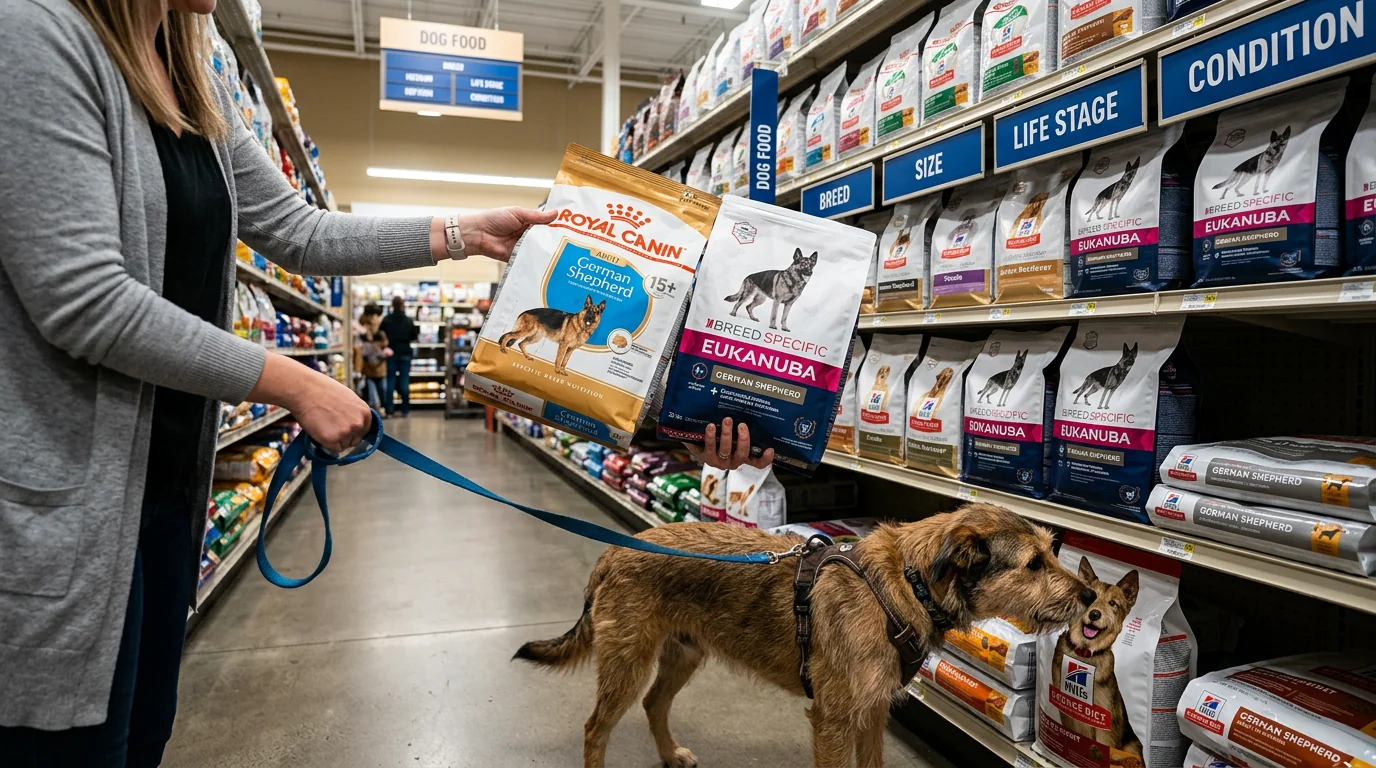
Taxonomies compete with themselves when multiple pages target the same query. Overlapping “breed-size” collections can split impressions and weaken rankings.
Thin pages arise when filters produce low-SKU states or insufficient content. Evidence from retail taxonomy research favors shallower, stronger trees that emphasize demand-aligned categories[2].
Crawl waste occurs when every facet creates an indexable URL. Product detail pages need clear parents. Each SKU should roll up to a single primary category to consolidate signals.
Petbase builds this SEO foundation automatically for pet businesses - 10 optimized articles published every month - start your free trial.
Decision framework: one primary dimension plus safe facets
Choose the primary anchor by demand share (breed vs size vs life stage)
Start with demand-weighted analysis. Compare the share of search volume across breed, size, and life-stage terms. Consider your inventory depth and margin by dimension.
When breed intent dominates and you carry breed-suitable inventory, breed becomes the primary anchor. Breed ontologies and controlled vocabularies can stabilize naming and reduce ambiguity across species groups[1].
Where demand concentrates on size or life stage, elevate that dimension. A two-level core tree, reinforced by carefully governed facets, often supports simpler ecommerce taxonomy and stronger category architecture[2].
Map secondary facets that may be indexable or noindexed
Assign size, life stage, and condition as secondary facets. Consider indexing only the combinations with proven demand, SKU depth, and distinct intent. Others should remain crawlable but noindexed.
Apply controlled vocabularies to facet values. Governance practices from information architecture literature emphasize consistency, synonym control, and lifecycle reviews to prevent taxonomy drift[3].
Add safeguards for faceted navigation SEO. Favor static, canonical parent pages. Promote a subset of high-value facet states when they accrue unique queries and revenue.
Quick decision guide
If X situation, then Y action (5-7 common patterns)
- If breed terms hold the largest demand share, make breed the primary category. Use size and life stage as facets, index only high-demand combinations.
- If inventory is concentrated in sizes, anchor the tree by size. Offer breed as a non-indexed filter unless a breed grouping has depth and demand.
- If life stage drives conversion, elevate it to parent. Attach size and condition as facets, cautiously indexing only top demand clusters.
- If condition-based shopping is common, maintain condition hubs. Canonicalize overlapping breed-condition states to the strongest intent page.
- If PDPs fit multiple categories, assign one primary parent for SEO. Add a single secondary life-stage link for navigation, not indexing.
- If search terms are ambiguous, default to the broader category. Provide on-page guidance to route users to precise sub-states.
- If SKU counts vary seasonally, toggle indexation based on inventory stability and revenue signals.
Information architecture blueprint
Tiered categories: parent, child, facet states
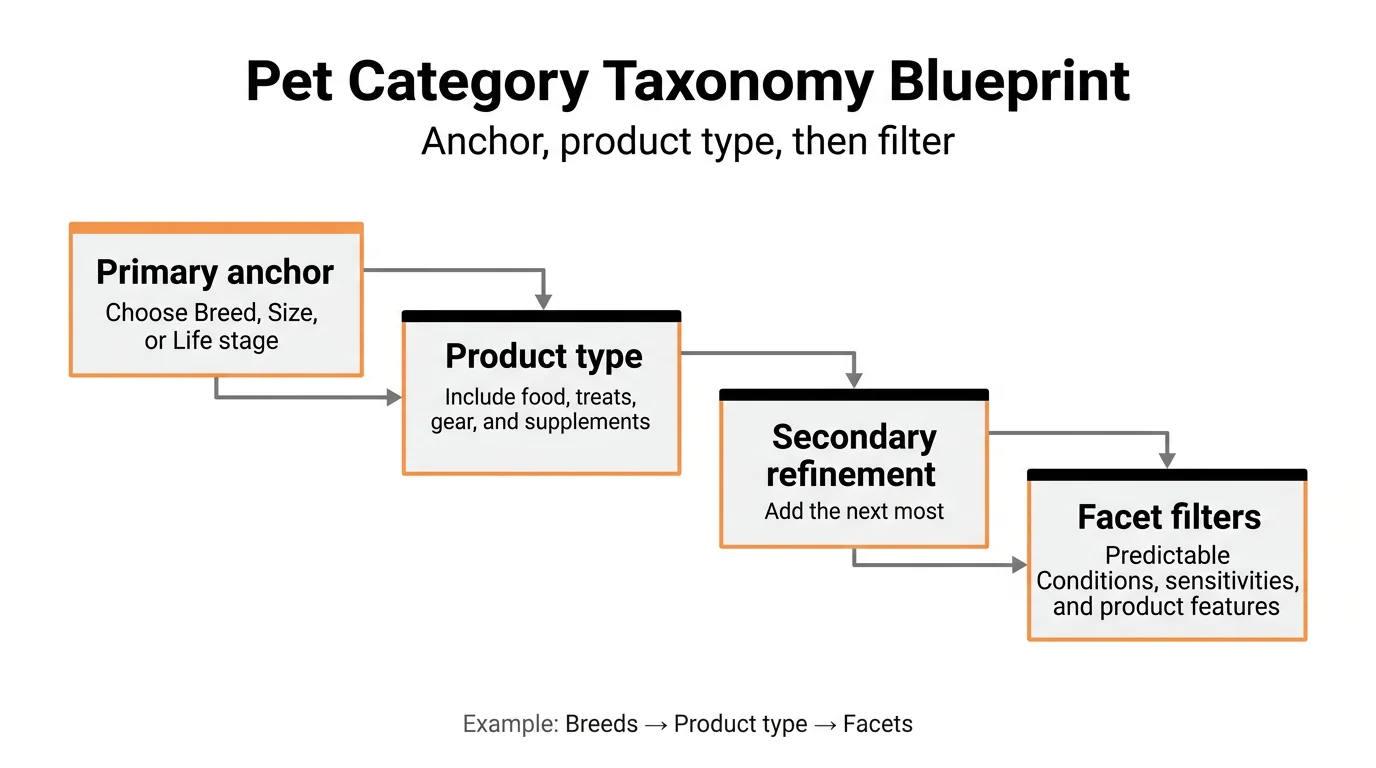
Adopt a three-part hierarchy. Parent represents the primary anchor. Child captures the next-most predictable refinement. Facet states provide filters or selective indexable combinations.
Example models include: Breeds → Product type → Facets; or Size → Product type → Life stage. Keep the core tree shallow, with fewer than six children per parent when possible.
Document rules for which product types appear under each parent. This improves navigability and supports breed-specific SEO without overproliferation.
URL rules, canonical logic, and schema hints
Prefer short, readable paths: /dogs/breeds/labrador/ or /dogs/size/large/. For multi-facet states, render parameters or subfolders, but canonicalize to the most specific indexable page.
Use rel=canonical for overlapping filters. Apply noindex,follow to exploratory combinations. Strengthen Product and collection pages with appropriate schema to improve eligibility and clarity.
For implementation details, see guidance on markup and structured data in Schema for Pet Stores. It may support better crawl interpretation and product visibility.
Content and merchandising rules that reduce cannibalization
Unique intents per page and on-page differentiation
Assign a single dominant query intent to each indexable category. Differentiate on-page copy, FAQs, ingredient calls, and fit notes by audience and need.
Use 120-200 words of unique intro copy per category. Add targeted FAQs and comparison modules. Include breed- or size-relevant imagery and merchandising to signal relevance.
Consolidate near-duplicates. If two pages compete on the same head term, merge content and 301 to the best performer. Reinforce with internal links.
Internal linking patterns from blog and PDPs
Link from informational posts to the single most relevant category. Maintain consistent anchor phrases to concentrate signals and improve category authority.
From PDPs, link to exactly one primary category and one secondary life-stage page. Avoid linking to parallel categories with similar intents to prevent dilution.
For blueprints and examples, review From Blog to Basket: Internal Linking Blueprints for Pet Retailers. It outlines scalable patterns that align content with commercial pages.
Monitoring guidance
7-14 days: crawl, indexation, and duplication checks
After launch, verify crawl paths, canonical targets, and indexation status. Review server logs or crawl tools for excessive parameter exploration. Confirm canonical chains resolve cleanly and facet pages carry correct directives.
Run duplication checks on titles, H1s, meta descriptions, and intro blocks. Investigate pages with identical templates but minimal copy variance. Validate PDP parent assignments for consistency and avoid orphaned SKUs.
Teams automating content and product pages may use Petbase AI to maintain taxonomy-aligned publishing and reduce manual variance across templates.
4-8 weeks: query consolidation, CTR, and revenue signals
Assess which categories capture the dominant queries. Look for consolidation around target head terms. Monitor CTR for improved specificity and snippet relevance.
Review revenue per session and add-to-cart rates by category. De-index or canonicalize combinations that fail to accrue distinct search queries. Expand content only where incremental demand appears.
Evidence from information architecture practice suggests iterative governance and pruning may sustain clarity and performance in complex catalogs[3].
Practical safety boundaries
Facet indexation thresholds and thinness guards
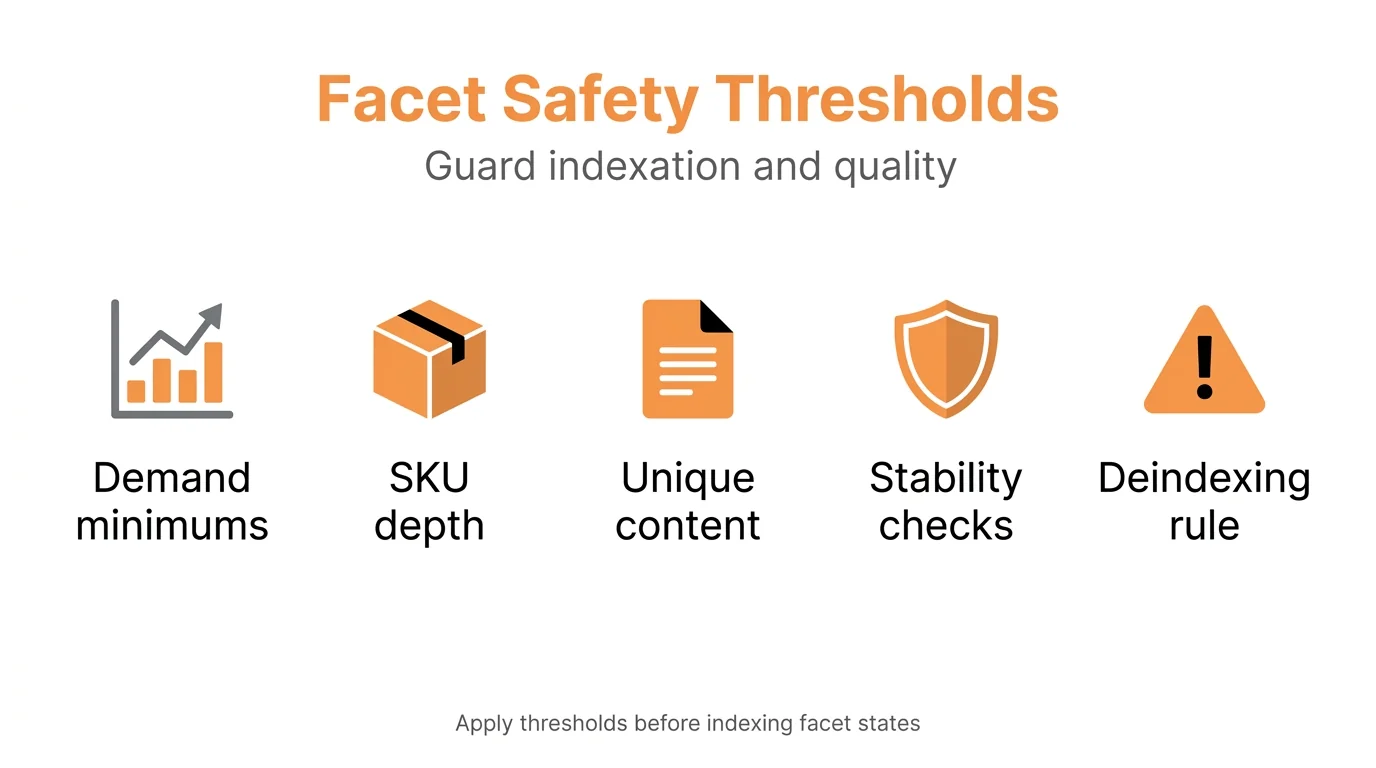
Set minimum thresholds before indexing a facet state. Consider ranges such as 100-300 monthly searches and 12-30 active SKUs with stable availability.
Require unique on-page blocks: 120+ words of targeted copy, two tailored FAQs, and curated products. If thresholds lapse for two consecutive cycles, switch to noindex and keep links followable.
This cautious approach mirrors findings that concise, governed taxonomies reduce noise and help both crawlers and users navigate meaningfully[2].
When to 410, merge, or canonicalize
410 content when the intent is obsolete and has no successor. Merge when two categories compete for the same head term and inventory.
Canonicalize when a facet serves browsing utility but lacks unique search demand. Maintain internal links to the canonical target to pass relevance and assist users.
Re-audit quarterly to catch drift. Controlled vocabularies and breed standards support consistent naming, easing future merges and deprecations[1].
Evidence status and assumptions
What current evidence suggests for pet taxonomy SEO
Evidence suggests that aligning categories to real user language improves discovery. Semantic sensing and social signals can inform condition and symptom facets relevant to pet owners’ needs[4].
Research also favors shallower core trees with deliberate facet governance, rather than deep, unconstrained hierarchies that fragment authority[2]. Using standardized breed vocabularies may reduce ambiguity and improve consistency across catalogs[1].
Governance practices remain a cornerstone for sustainable category architecture in retail environments[3].
Where tests are still needed
Further testing is needed on indexation thresholds for multi-facet combinations. The balance between demand, SKU count, and content uniqueness varies by assortment and seasonality.
Experiments on automated semantic typing from customer content may improve mapping and reduce manual tagging overhead in pet ecommerce[2].
Additional studies should explore how breed ontologies interact with cross-species product types and whether consolidation strategies differ by retailer size[1].
Frequently Asked Questions
Should breed pages or size pages be the primary category?
Evidence suggests choosing the primary dimension by search demand and SKU depth. If breed queries hold the highest share and you stock enough breed-suitable inventory, make breed primary and use size and life stage as controlled facets.
How do I avoid thin or duplicate category pages?
Set minimum SKU and demand thresholds before indexing a facet. Use canonical tags for overlapping filters, consolidate near-duplicate categories, and differentiate on-page content with unique intro copy, FAQs, and internal links.
Can I index multiple facet combinations like breed + condition?
You may index selected high-demand combinations supported by inventory and distinct intent. Apply strict rules: stable inventory, unique content blocks, internal links, and monitoring for query overlap after 4-8 weeks.
What URL structure works best for pet taxonomies?
Short, stable, readable paths tend to perform well, such as /dogs/breeds/labrador/ or /dogs/size/large/. Avoid encoding multiple facet parameters in indexable URLs unless the combination meets demand and uniqueness criteria.
How do blog posts support taxonomy without cannibalization?
Use blog posts to target informational intents and link to the most relevant category. Differentiate titles and intros, add breed- or condition-specific FAQs, and use consistent anchor text to reinforce category relevance.
Conclusion: align taxonomy with your broader roadmap
How this supports scalable publishing and product discovery
A disciplined pet SEO taxonomy aligns shopping with search while guarding against duplication. Choose a single primary dimension, index high-value facets selectively, and govern content to signal distinct intents.
This framework supports scalable publishing, cleaner PDP mapping, and stronger merchant curation. Reinforce it with analytics, content governance, and structured data that clarifies meaning to crawlers and customers.
For strategic context, see the Pet Store SEO overview. For deeper orientation and cross-functional planning, review our orientation hub for pet store SEO and connect taxonomy decisions to analytics and operations.
References
- KR Mullen et al. (2025). The Vertebrate Breed Ontology: Toward Effective Breed Data Standardization. Journal of Veterinary …. View article
- X Liu et al. (2023). Automatic Semantic Typing of Pet E-commerce Products Using Crowdsourced Reviews: An Experimental Study. … Knowledge Graphs and …. View article
- H Lippell (2022). Taxonomies: Practical Approaches to Developing and Managing Vocabularies for Digital Information. 2022 - torrossa.com. View article
- G Cherry et al. (2023). Semantic sensing for data innovation. IET Conference …. View article