Keyword Research for Pet Stores: From Generic Terms to Intent-Rich Queries

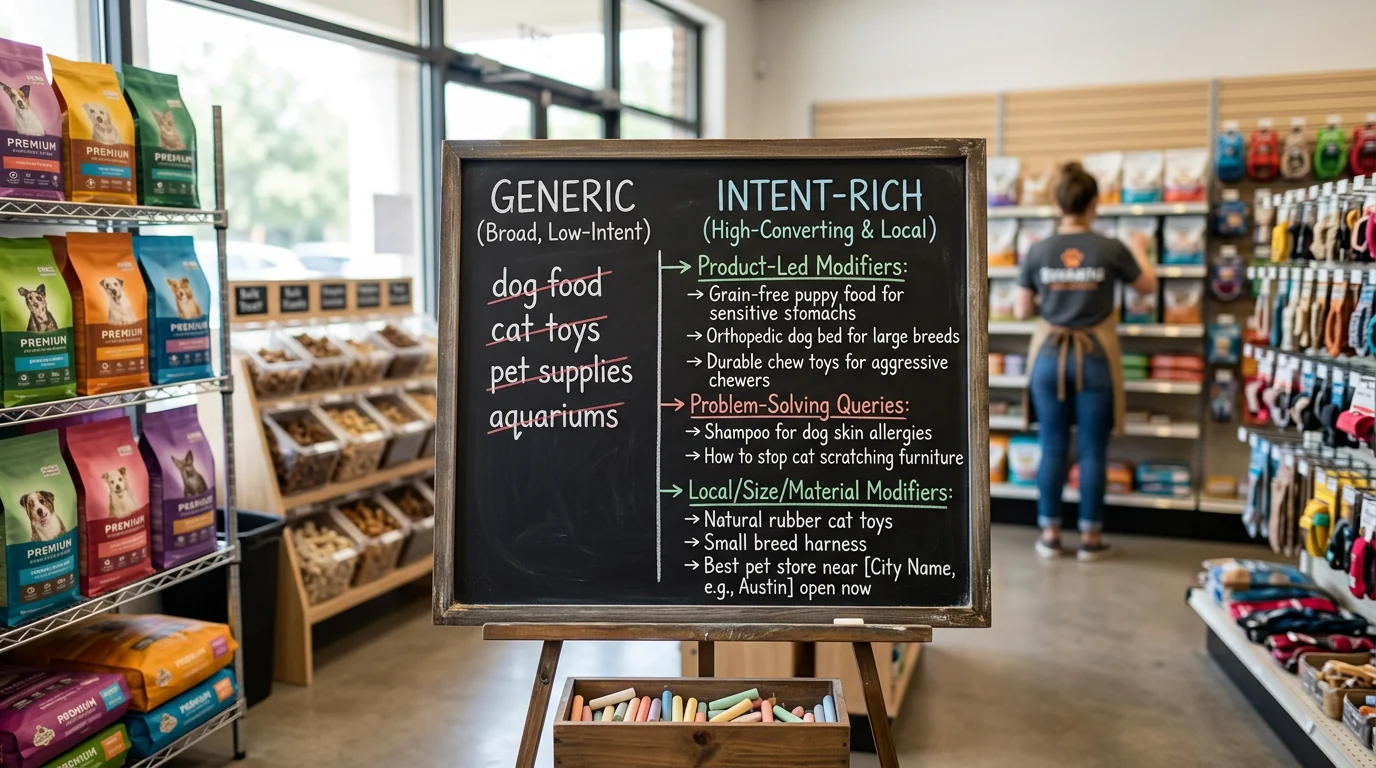
Table of Contents +
- Why generic pet keywords stall and how intent-rich queries unlock buyers
- The focused scenario: turning “dog toys” into SKU-level demand
- Workflow: build an intent stack in 45 minutes
- Quick decision guide (if X, then Y)
- On-page patterns for intent-rich pet queries
- Monitoring and iteration
- Practical safety boundaries
- Evidence status
- Templates and examples you can copy
- Where this fits in your wider pet store SEO plan
- Frequently Asked Questions
- References
Move beyond generic pet terms. Find intent-rich, product-led, and local keywords using breed, size, material, and problem modifiers to capture buyers.
Generic keywords create noise. Intent-rich modifiers create sales. Pet retailers need precision to match real buying decisions, not pageviews.
This matters because search engines reward relevance and users reward specificity. You will learn how to transform vague head terms into product-led, local, and problem-aware queries that convert. Expect clear steps, safety limits, and monitoring guidance.
Why generic pet keywords stall and how intent-rich queries unlock buyers
Signal tiers: informational vs. commercial vs. local-transactional
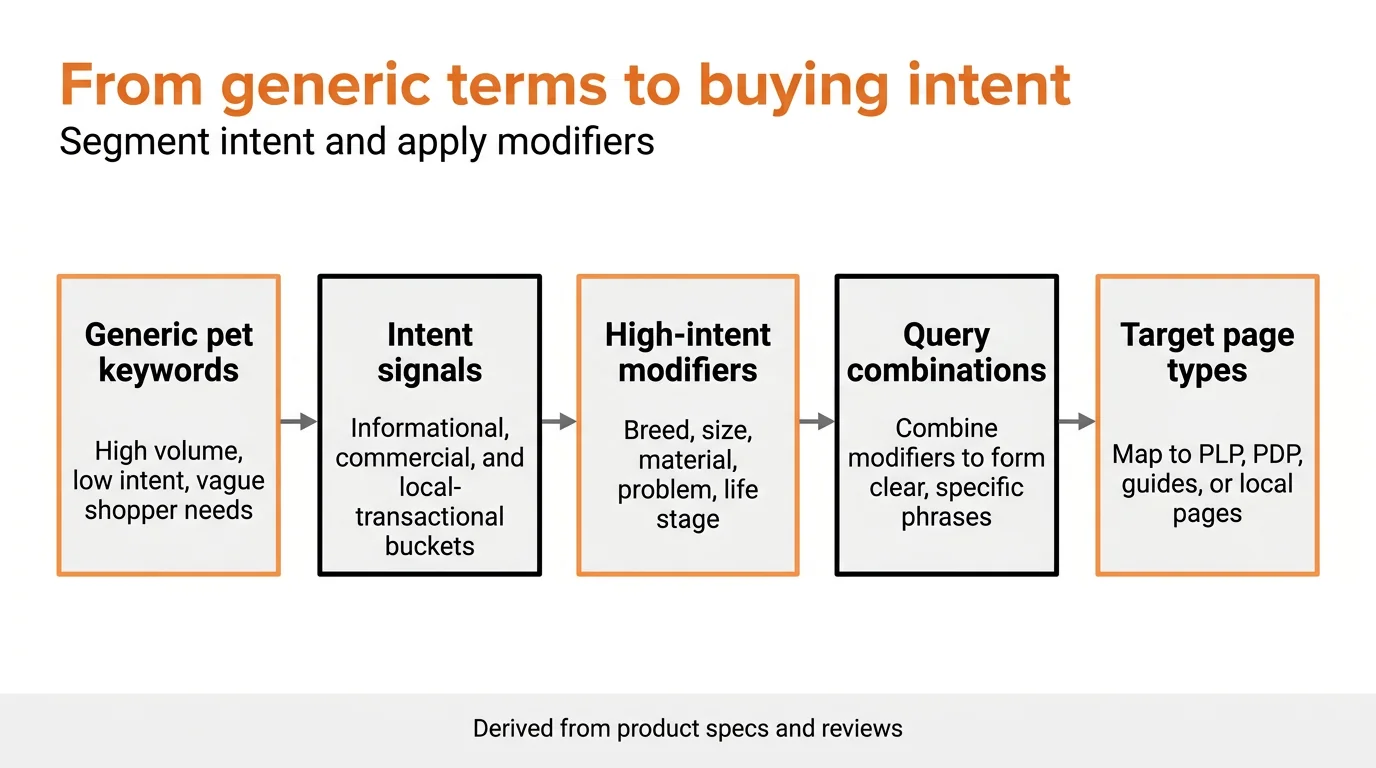
Segment queries by intent signals. Informational terms seek answers, commercial terms compare options, and local-transactional terms suggest buying nearby. Aligning content formats to SERP patterns generally improves relevance and visibility, according to established SEO frameworks.[2]
Modifier patterns that map to products: breed, size, material, problem, life stage
Use modifiers that mirror product specs and decisions. Breed, size, material, problem, and life stage consistently signal high intent. They also form navigable filters that support pet store SEO and long-tail pet keywords at scale.
Petbase automates SEO content for pet stores - publishing 10 optimized articles monthly so you can focus on running your shop - start your free trial.
The focused scenario: turning “dog toys” into SKU-level demand
“Dog toys” attracts browsers. “Durable rubber chew toy for heavy chewers, medium size” attracts buyers. Narrowing with tangible modifiers creates SKU-level demand and fewer irrelevant clicks. This approach underpins product-led SEO for pet retailers and complements local SEO for pet stores.
From head term to query families: examples across breed, durability, and behavior
Create query families, not single terms: “chew toy for strong chewers,” “rubber tug toy medium,” “toy for anxious dogs,” “toy for fetch training,” “chew toy for bulldogs,” “durable ring toy,” “squeaker-free fetch ball.”
Workflow: build an intent stack in 45 minutes
Step 1: seed terms and pain points from catalog and reviews
Extract seed terms from SKUs, attributes, and reviews. Pull breed mentions, material notes, size references, and complaints. Reviews often expose problems and edge cases that map cleanly into intent-rich modifiers.
Step 2: expand with modifier matrices (breed × size × problem × material)
Draft a 4× matrix. Columns: breed or size. Rows: problem and material. Combine into phrases, then prune nonsensical overlaps. This structured expansion reduces guesswork and surfaces high-intent long-tail pet keywords.
Step 3: qualify with SERP features, patterns, and seasonality
Check SERPs for shopping carousels, local packs, and editorial dominance. Note seasonality for shedding, allergies, or holiday gifting. Favor queries with matching SERPs and recurring patterns visible across competitor placements.[2]
Step 4: map each query to a page type (PLP, PDP, blog, local)
Commercial clusters map to PLPs. Specific SKUs map to PDPs. How-to comparisons map to blogs. “Near me” and city modifiers map to local pages. Keep one primary destination per intent to avoid cannibalization.
Step 5: write concise briefs with on-page elements tied to modifiers
Each brief lists title, H1, filters, FAQs, schema, and internal links. Include breed/size/material/problem in copy and metadata. For execution at scale, consider Petbase AI to automate pet-focused briefs and publishing workflows.[3]
Quick decision guide (if X, then Y)
Inventory-led choices
- If stock depth is high, create a PLP with filters.
- If one hero SKU dominates, prioritize a PDP.
- If range is exploratory, launch a buying guide.
Local intent cues
- If queries include city names, build a local page.
- If “near me” appears, optimize Google Business Profile.
- If service signals exist, add appointment CTAs.
Content vs. commerce splits
- If SERP shows product grids, ship PLP/PDP first.
- If guides lead, publish an editorial piece.
- If blended, deploy both with distinct intents.
Handling low volume but high intent
- If CPCs are high, prioritize despite low volume.
- If reviews echo the problem, proceed.
- If margins are strong, create targeted PDP content.
When to consolidate vs. create a new page
- If SERPs match, consolidate variants under one page.
- If SERPs differ, create separate destinations.
- If filters suffice, avoid separate URLs.
Seasonal and breed-trend surges
- If seasonality spikes, pre-launch landing pages.
- If breed trends rise, expand new modifiers.
- If interest fades, merge into evergreen hubs.
On-page patterns for intent-rich pet queries
Title, H1, and facets: include breed/size/material/problem
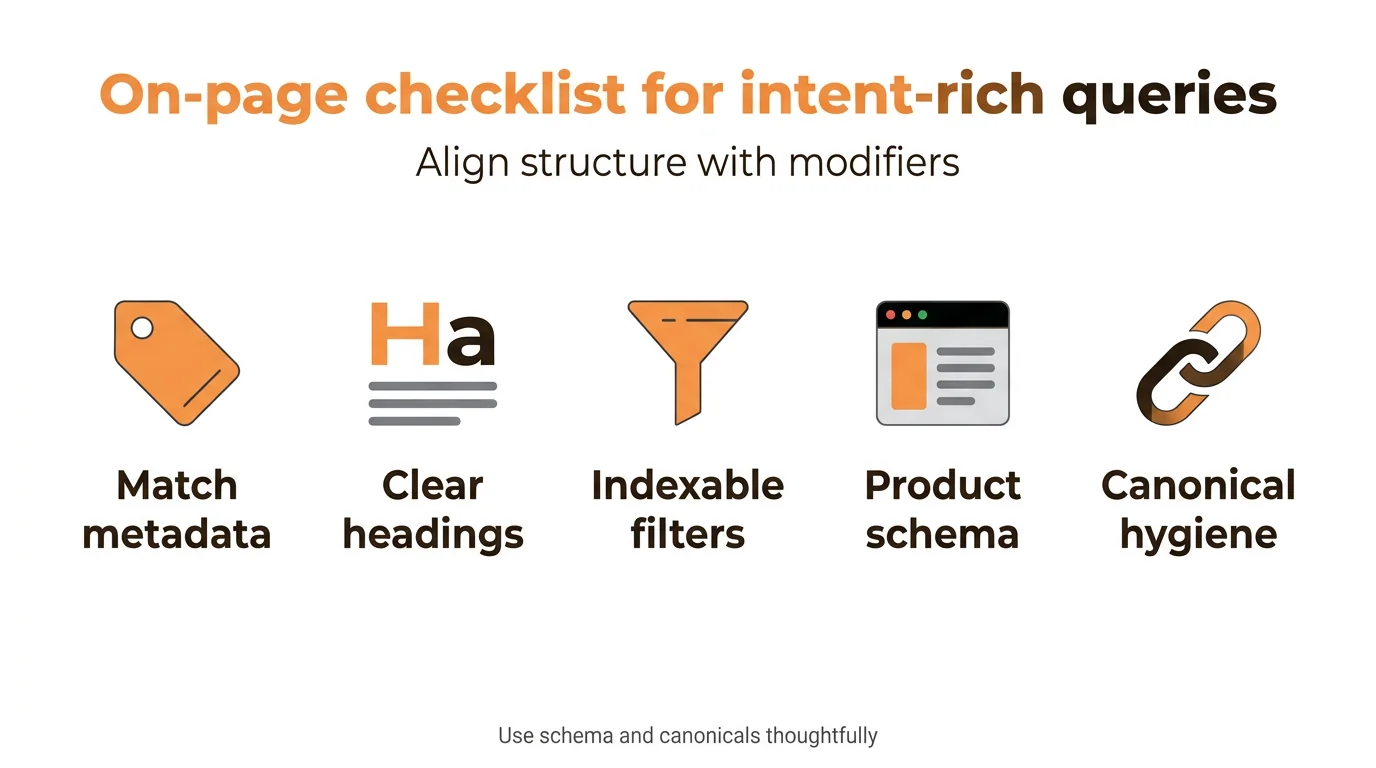
Mirror modifiers in metadata and visible headings. Example: “Medium Durable Rubber Chew Toy for Heavy Chewers.” Reinforce with facets that expose size, material, and problem filters for clarity and crawlable relevance.
Structured data and filters that mirror modifiers
Use Product, AggregateRating, and FAQ schema to clarify offers. Ensure filters generate indexable, canonicalized states only where unique intent exists. Such clarity typically supports ranking stability and comprehension.[2]
Evidence hints: testing durability, allergy notes, care guidance
Add concise evidence: material lab notes, chew-test summaries, care instructions, and dietary cautions. For stronger merchandising, see Shopify product page SEO for pet retailers and locality considerations in Local SEO for pet stores.
Monitoring and iteration
7-14 days: indexation and SERP intent alignment checks
Track indexing, canonical correctness, and early impressions. Compare your page type against active SERP features. Adjust headings or internal links if the intent appears mismatched to prevailing results.[1]
4-8 weeks: query mix, CTR shifts, and assisted revenue
Evaluate emerging query families, CTR by modifier, and assisted conversions. Attribute revenue across discovery and product pages to understand lift from intent-rich targets, not just last-click outcomes.
Refinement: expand winners, retire cannibalizations
Promote winners with stronger crosslinks and expanded variants. Merge overlapping pages when queries and SERPs converge. For context on scaling beyond single pages, consult our Pet store SEO strategy hub.
Practical safety boundaries
Avoid over-claiming health outcomes
Use cautious language for dietary or behavioral benefits. Prefer “may help,” “is formulated for,” or “designed to support,” and cite product specifications rather than asserting medical outcomes.
Do not promise indestructibility
Durability claims should be measured and conditional. Indicate testing protocols, recommended sizes, and supervision notes. Offer warranties or guarantees with clear, fair limitations where appropriate.
Use cautious wording for dietary/allergy guidance
Avoid absolute allergen-free promises. State ingredient sources, manufacturing notes, and cross-contamination policies. Encourage consultation with veterinarians for individual sensitivities and complex dietary needs.
Evidence status
What industry data suggests about long-tail conversion
Industry guidance indicates that specific, commercial long-tails frequently convert better than head terms due to clearer intent and reduced ambiguity. Aggregated performance across many terms may surpass one generic keyword’s yield.[2]
Where evidence is mixed (AI rewrites vs. net-new pages)
Automated rewrites can improve consistency, yet gains may plateau without net-new, intent-mapped pages. Content automation is valuable, but strategic targeting still drives outcomes most reliably.[4]
What to test before scaling (localized modifiers)
Pilot localized modifiers across a few cities, then monitor ranking stability and conversions. Results may vary by competitiveness, brand authority, and listing quality. Expand only where signals remain positive over time.
Templates and examples you can copy
Modifier matrix template (copyable structure)
Columns: breed or size. Rows: problem and material. Cells: combined phrases with intent labels and target page types. Add seasonal tags and evidence notes for PDPs. Prune duplicates aggressively to reduce cannibalization.
Sample brief for “indestructible chew toy for pit bulls”
Title/H1: “Durable Rubber Chew Toy for Powerful Chewers.” Include breed and size guidance, supervised-use notice, lab test summary, and warranty details. Filters: durability, material, size. Internal links: related chew toys and care guides.
Sample brief for “grain-free salmon cat food for allergies”
Title/H1: “Grain-Free Salmon Recipe for Sensitive Cats.” Include ingredient sourcing, manufacturing notes, transition schedule, and vet disclaimer. Filters: life stage, protein, dietary need. Crosslink to breed-specific keywords taxonomy guidance.

Where this fits in your wider pet store SEO plan
Feeding product pages from research outputs
Route qualified commercial groups to PLPs and PDPs. Maintain a master mapping of modifiers to pages. This discipline supports scalable pet store SEO without fragmenting authority across redundant URLs.
Rolling wins into category navigation and internal links
When a modifier wins, promote it into category nav and breadcrumbs. Reinforce with contextual crosslinks from blogs and guides, following product-led SEO for pet retailers principles across the catalog.
Frequently Asked Questions
Are low-volume, long-tail pet keywords worth targeting?
They may drive higher intent and better conversion, especially when tied to breed, size, or problems. Evidence suggests aggregate traffic from many long-tails can outperform one head term.
How do I choose between a blog post and a product page for a keyword?
Check the current SERP. If it shows product listings and category pages, favor a PLP/PDP. If guides and comparisons dominate, a blog or buying guide may fit better.
What modifiers work best for pet stores?
Breed, size, life stage, material, problem/behavior, dietary needs, and local intent such as “near me” or city names commonly align with purchase decisions.
How soon can I see results from intent-rich optimization?
Early signals like impressions may appear within 1-3 weeks. More stable ranking and revenue attribution often need 4-8 weeks, depending on site authority and crawl frequency.
How do I prevent keyword cannibalization with many modifiers?
Define a canonical page per intent and use internal links and filters for close variants. Consolidate pages when queries share the same SERP and user goal.
Conclusion: Moving beyond generic keywords to intent-rich modifiers may transform browsers into buyers. Use breed, size, material, problem, and local signals to align with real decisions. Iterate responsibly, watch evidence, and scale wins through disciplined mapping and careful on-page execution.
References
- T Suresh (2025). Natural language processing for internal link optimisation: Automating content relationships for better search engine optimisation. Journal of Digital & Social Media Marketing.
- S Das (2021). Search engine optimization and marketing: A recipe for success in digital marketing. 2021 - api.taylorfrancis.com. View article
- A Dysin et al. (2018). SEO Automation Tool. 2018 - elib.psu.by. View article
- M Bala et al. (2018). A critical review of digital marketing. M. Bala, D. Verma (2018). A Critical Review of …. View article