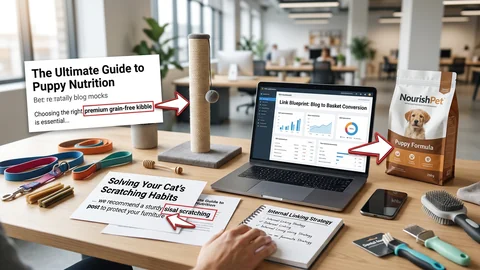
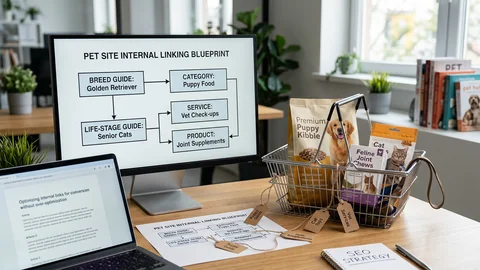
From Blog to Basket: Internal Linking Blueprints for Pet Retailers

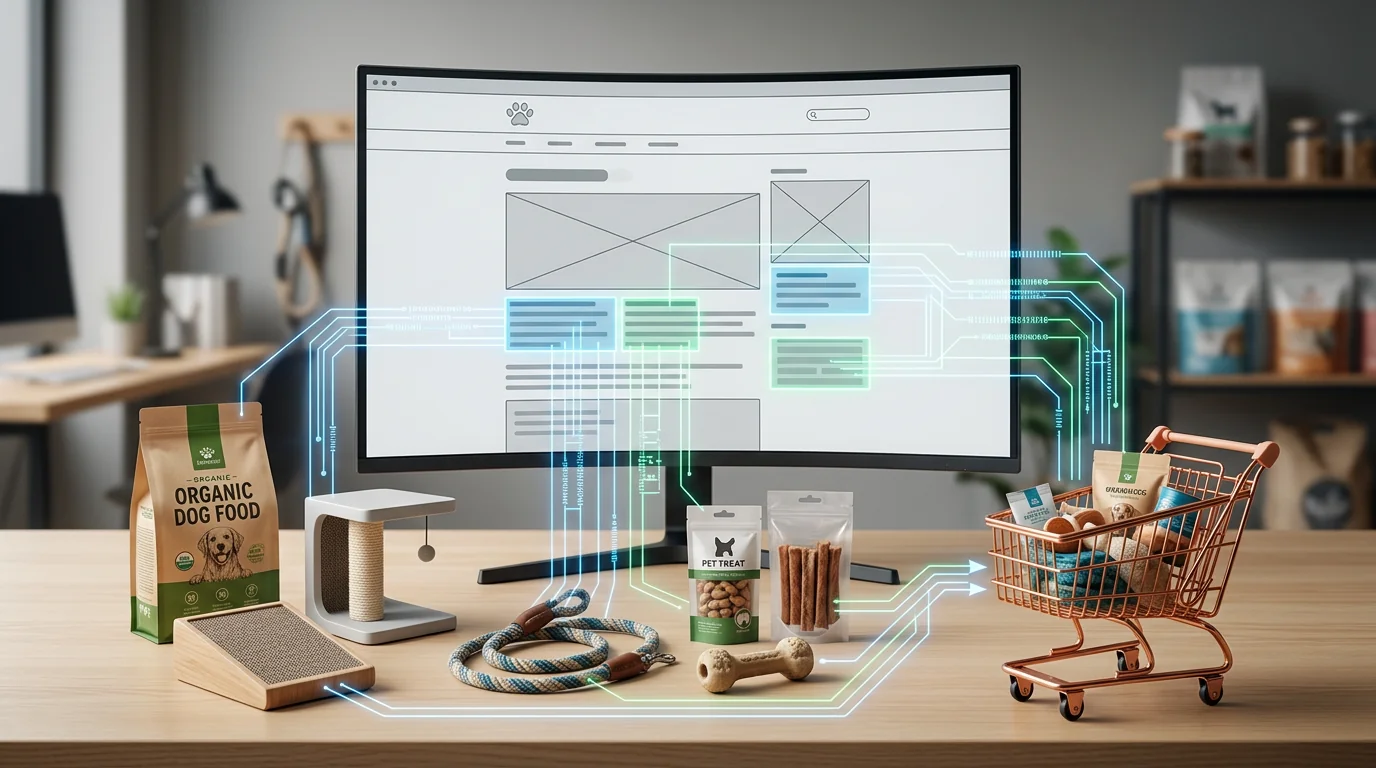
Table of Contents +
- Why internal linking may unlock revenue from pet SEO content
- Blueprint 1: Anchor text rules for pet retail scenarios
- Blueprint 2: Related blocks that steer readers to the right shelf
- Blueprint 3: Merchandising paths from blog to basket
- Quick decision guide: if X, then link Y
- Implementation checklist for Shopify/WooCommerce
- Monitoring: what to observe at 7-14 days and 4-8 weeks
- Practical safety boundaries for internal links
- Evidence status and limits
- Frequently Asked Questions
- Appendix: Sample snippets and anchor map
- References
Turn pet SEO blogs into revenue. Learn internal linking anchors, related blocks, and merchandising paths that may lift clicks from content to product pages.
Educational content attracts engaged readers, yet many leave without buying. The gap is not intent. The gap is pathing that connects care advice to the right shelf.
Internal linking can quietly guide readers from learning to selecting. This matters because pet store SEO traffic only compounds if discovery meets merchandising. You will learn anchor text rules, related blocks, and merchandising patterns that translate product-led content into revenue.
Why internal linking may unlock revenue from pet SEO content
The specific problem: educational posts without paths to purchase
Guides explain care, nutrition, and training, but they rarely route readers to size, life stage, or condition-filtered shelves. Without structured ecommerce internal links, category relevance weakens and session value stalls. Well-planned internal architecture improves crawl efficiency, topical authority, and conversion paths within established SEO frameworks.[2]
For broader context across site architecture, see the Pet Store SEO main guide. It provides a strategic orientation that pairs well with the tactical linking blueprints below.
Key concept: intent-matched links from care guides to category and product pages
Map informational tasks to navigational and commercial destinations. Match early-stage needs to category pages; match purchase-ready cues to product pages. Evidence from NLP-driven linking research suggests algorithmic mapping of entities and intents can scale these connections responsibly.[1]
Petbase automates SEO content for pet stores - publishing 10 optimized articles monthly so you can focus on running your shop - start your free trial.
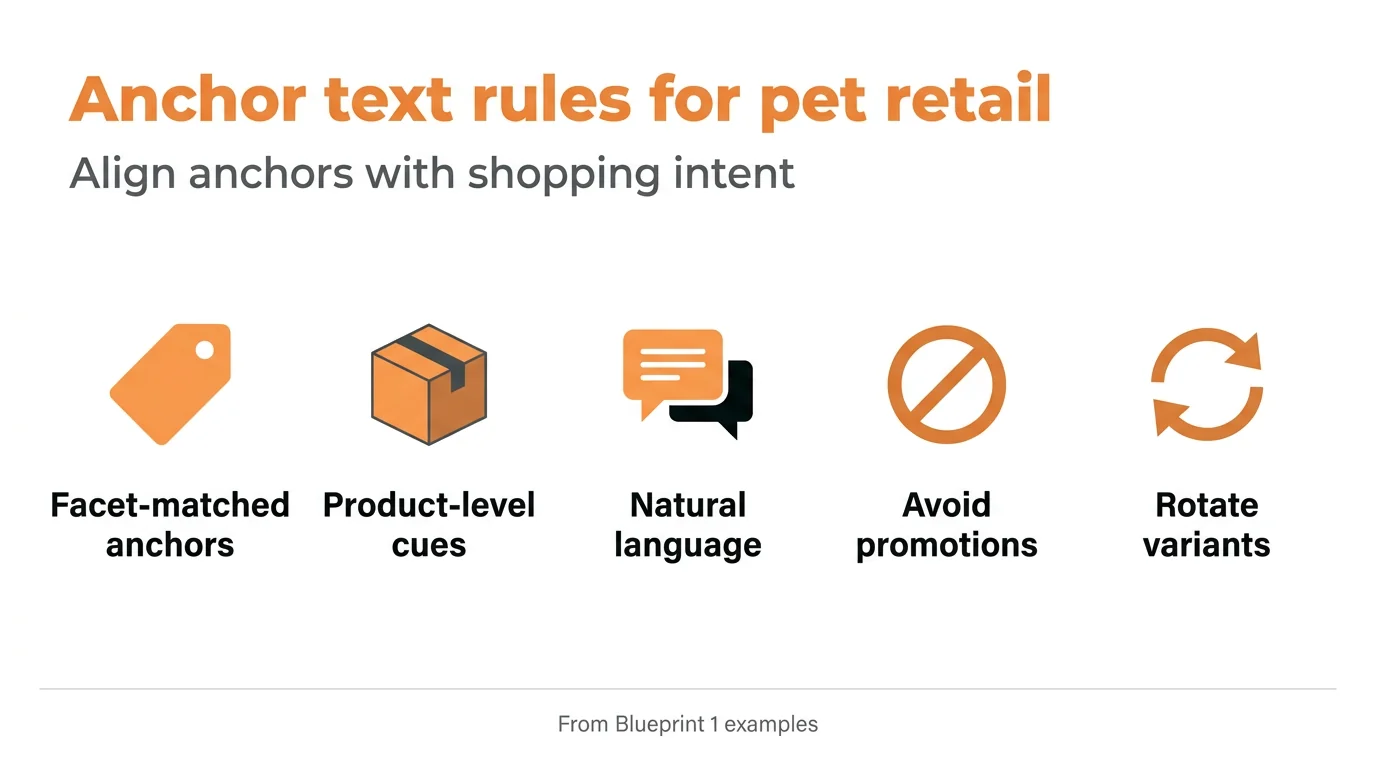
Blueprint 1: Anchor text rules for pet retail scenarios
Navigational anchors to categories (breed, size, life stage)
Use descriptive, non-promotional anchors that reflect taxonomy facets. Examples include “large-breed harnesses,” “senior dog joint care,” or “grain-free food for sensitive stomachs.” Point them to category or filtered category URLs. Keep anchors short, specific, and user-intent aligned to strengthen pet store SEO signals.
Commercial anchors to products (SKU clusters and variants)
When content mentions a concrete solution, link with product-level cues: “salmon-based limited-ingredient kibble 12 lb,” or “no-pull harness, size large.” Favor hero SKU clusters and popular variants. Rotate partial matches to avoid repetition while sustaining relevance and conversion momentum.
Contextual anchors to complementary care content
Support decision-making with lateral content links: “transitioning food safely,” “measuring chest girth,” or “allergy elimination trials.” Keep these contextual anchors subordinate to category and product anchors. They reduce pogo-sticking and nurture confidence without distracting from purchase paths.
Blueprint 2: Related blocks that steer readers to the right shelf
‘Shop the recommendation’ cards inside how-to sections
After each actionable tip, insert a compact card with two hero SKUs and a concise benefit. Example: “Hypoallergenic kibble, adult large,” and “Limited-ingredient salmon topper, adult.” Add one short link to a comparison guide to reinforce trust while enabling a fast click.
Dynamic ‘Breed/Life Stage Fit’ modules
Display an in-content module that toggles by breed size or life stage. Link to size-filtered category URLs, such as “harnesses, size large,” or “puppy training treats.” Keep visual consistency across posts to normalize navigation behaviors and merchandising patterns.
Price-point trios (good/better/best) without hard sell
Offer three options by price band and highlight clear differences: ingredients, durability, or fit. Keep copy neutral and utility-focused. This framing may support informed choice and reduce friction, especially when paired with honest pros and cons.
Blueprint 3: Merchandising paths from blog to basket
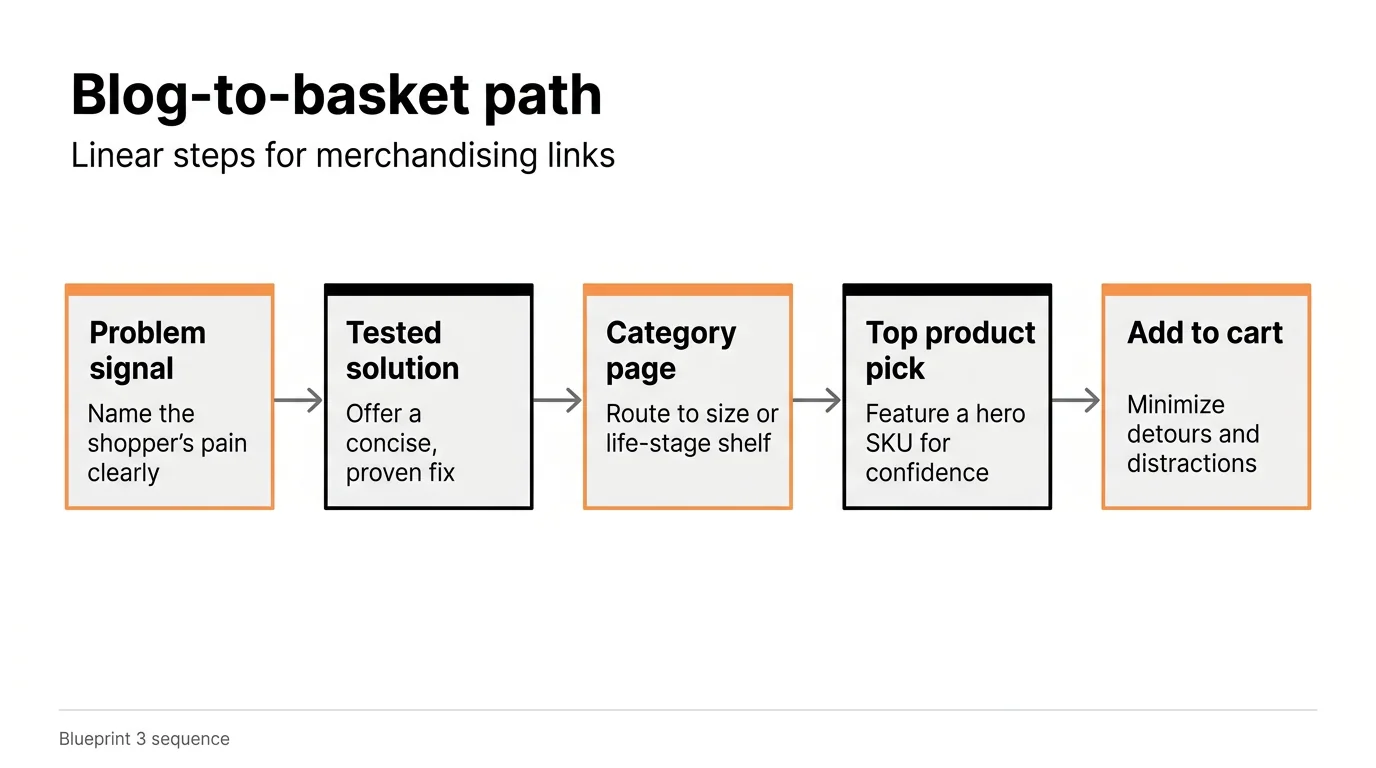
Problem → Solution → Category → Product pathing
Lead with a recognizable problem, propose a tested solution, then route to a relevant category and a top product. Keep steps linear. Limit competing links in the same paragraph to prevent choice overload and diluted click-through.
Seasonal and condition-based paths (allergies, shedding, travel)
Time links to seasonal needs and recurring conditions. Example path: “spring allergies” → “grain-free food for sensitive stomachs” → “limited-ingredient salmon 12 lb.” Pair urgency with helpfulness. Reinforce relevance through consistent anchor text strategy spanning seasons.
Cross-sell paths (food → toppers; harness → reflective leash)
Place complementary links near usage tips. For nutrition, consider “plaque-reducing dental chews” with feeding guides. For walking gear, add “reflective leash for low-light safety.” Space cross-sells after the main link to respect primary intent and clarity.
Quick decision guide: if X, then link Y
- If the reader signals early research, link to a size or life-stage category.
- If the reader requests a specific ingredient or feature, link to the filtered category.
- If the post names a precise variant, link to the corresponding hero SKU.
- If the tip requires a tool or accessory, link to the relevant product with variant preselected.
- If uncertainty remains, link to a concise comparison guide before products.
- If the season drives urgency, link to the seasonal category first, then the hero SKU.
- If care expands to maintenance, add a complementary category cross-sell after the main link.
Implementation checklist for Shopify/WooCommerce
Templates, snippet placement, and URL hygiene
Use content templates that reserve in-article slots for “Shop the recommendation,” “Breed/Life Stage Fit,” and price-point trios. Serve clean, canonical URLs. Avoid parameters in anchors. On Shopify, define card components in section or snippet files and reuse across posts to ensure consistency and scale. For product details and variants, align with Shopify product page SEO templates for variants and reviews.
Automating anchor generation and placement may improve coverage and reduce human error. NLP-based systems help surface entity-intent relationships for reliable link targets at scale.[1] Many teams find Petbase AI helpful when standardizing patterns across large catalogs.
Anchor density and placement by word count
Evidence suggests 3-7 contextual links per 1,000 words can be effective, plus 1-2 navigational category links and 1-3 commercial product links. Front-load the first relevant link above the fold or after the first solution paragraph. Space subsequent links every 150-300 words to limit clustering and improve scannability.
Monitoring: what to observe at 7-14 days and 4-8 weeks
Behavioral metrics that may indicate uplift
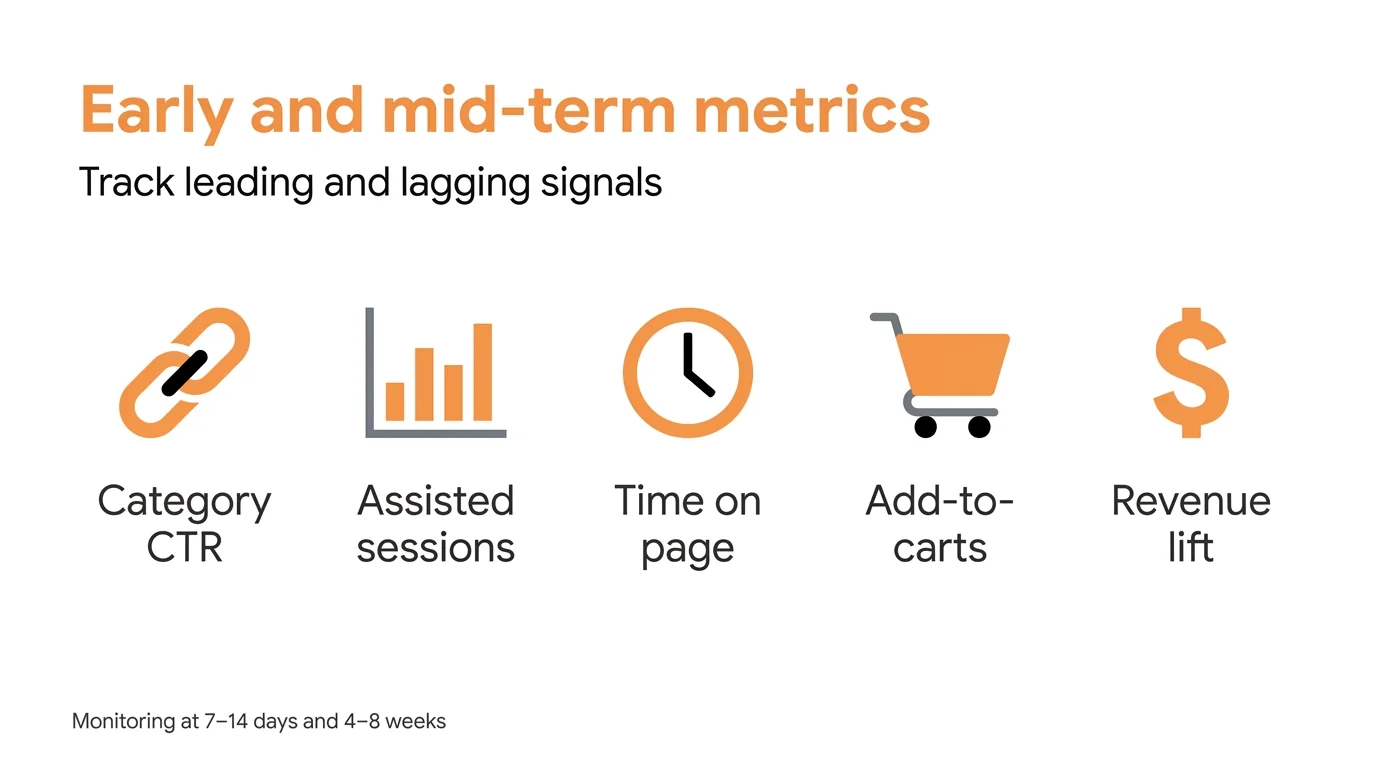
At 7-14 days, review blog-to-category/product click-through rate, assisted sessions to product pages, and time on page. At 4-8 weeks, examine product page sessions from content and add-to-cart rate shifts. Tie link placements to measurable micro-conversions in your dashboards.[2]
For practical instrumentation and revenue attribution, consult SEO analytics and ROI tracking for pet retailers. It may guide dashboard structures suited to internal link testing.
Merchandising diagnostics for underperforming links
If a link underperforms, assess mismatch between intent and destination, weak anchor copy, variant confusion, and price gaps. Test alternative anchors, move the placement earlier, or route to a filtered category. Iterate with small, controlled changes before broader rollouts.
Practical safety boundaries for internal links
Anchor variation, nofollow usage, and cannibalization checks
Rotate partial-match anchors to avoid repetitive phrasing. Reserve nofollow for untrusted or non-SEO destinations, not for internal merchandising. Prevent cannibalization by routing broad intent to categories and specific intent to products. Audit keyword targets to confirm distinct query ownership across pages.
Accessibility and mobile tap-target spacing
Maintain sufficient contrast and underline styles for anchors. On mobile, keep tap targets at least 44×44 px and avoid placing multiple links inside a single short sentence. Screen-reader labels should match intent and destination expectations.
Evidence status and limits
What industry data suggests vs. what depends on your catalog
Industry literature supports structured internal linking and marketing automation as levers for visibility and performance.[3][4] However, specific gains depend on assortment breadth, price competitiveness, and onsite UX. Content-category alignment and inventory depth can moderate outcomes, even with strong link patterns.
Confounding factors to consider in attribution
Seasonality, promotions, ad spend shifts, and algorithm updates may confound results. Control for these with annotated timelines and segmented reporting. Where possible, use holdout posts or staggered deployments to isolate internal link effects.[2]
Frequently Asked Questions
How many internal links should a pet blog post include?
Evidence suggests 3-7 contextual links per 1,000 words can be effective, with 1-2 navigational links to key categories and 1-3 commercial links to relevant products. Monitor click-through and adjust.
Should I use exact-match anchors for product links?
Use descriptive, intent-matched anchors that read naturally. Rotate partial-match and semantic variants to reduce repetition and potential over-optimization.
Where should product links be placed in educational posts?
Place the first relevant link above the fold or after the first solution paragraph, then add in-section ‘Shop the recommendation’ cards near practical tips. Include a concise path at the end.
How do I avoid cannibalization between category and product pages?
Route broad intents to category pages and specific, ready-to-buy intents to product pages. Use consistent anchors and ensure each page targets a distinct query set.
What metrics indicate my internal links are working?
Rising content→category/product click-through rates, improved product page sessions from blog, higher assisted revenue, and stabilized rankings for linked categories may indicate progress.
Appendix: Sample snippets and anchor map
Reusable patterns for ‘allergies’, ‘chewers’, ‘senior dogs’
Allergies: Place a “Problem → Solution” paragraph followed by a card with “limited-ingredient salmon kibble” and “single-protein treats.” Add a soft cross-sell to “plaque-reducing dental chews.” Keep copy empathetic and benefits clear.
Chewers: Insert a durability scale (soft, firm, power) with anchors to matching categories. Offer a “better” long-lasting chew and a “best” extra-durable toy. Link a brief care guide to safe chew sizing.
Senior dogs: Lead with mobility support tips. Link to “senior joint supplements” and “orthopedic beds” in a price trio. Provide a small “Fit” module for weight and size considerations to reduce returns.
Anchor map template for categories and hero SKUs
| Intent Cue | Primary Anchor | Destination Type | Backup Anchor |
|---|---|---|---|
| Sensitive stomach | grain-free food for sensitive stomachs | Category | limited-ingredient salmon kibble |
| Pulling on leash | no-pull harness, size large | Product | front-clip harness for strong pullers |
| Seasonal shedding | de-shedding brushes by coat length | Category | high-visibility grooming glove |
| Night walks | reflective leash for low-light safety | Product | LED visibility collar |
To align anchors with taxonomy, review and refine your categories. See guidance to build a category taxonomy for breeds, sizes, and life stages that supports clean routing and consistent anchor logic.
For seasonal planning that coordinates content and links, also consider your calendar. Align launch dates to category demand windows and merchandising readiness to reduce attribution noise. Deep-dive taxonomies amplify consistency across posts and SKUs.
For organization-wide alignment and technical standards, refer back to the Pet Store SEO main guide. It helps position these blueprints within broader strategy, schema, and on-page optimization. When publishing at scale, ensure schema and product metadata match your internal link destinations to maintain clarity and confidence.
Internal linking for pet retailers works best when it feels invisible. Provide clear, intent-matched paths from educational insight to the exact shelf and SKU. Structure anchors, related blocks, and merchandising paths with discipline, then measure and iterate through modest tests. As patterns stabilize, expand coverage methodically and keep your taxonomy, templates, and analytics aligned for durable gains.
References
- T Suresh (2025). Natural language processing for internal link optimisation: Automating content relationships for better search engine optimisation. Journal of Digital & Social Media Marketing.
- S Das (2021). Search engine optimization and marketing: A recipe for success in digital marketing. 2021 - api.taylorfrancis.com. View article
- V Desai et al. (2019). Digital marketing: A review. International Journal of Trend …. View article
- M Bala et al. (2018). A critical review of digital marketing. M. Bala, D. Verma (2018). A Critical Review of …. View article